
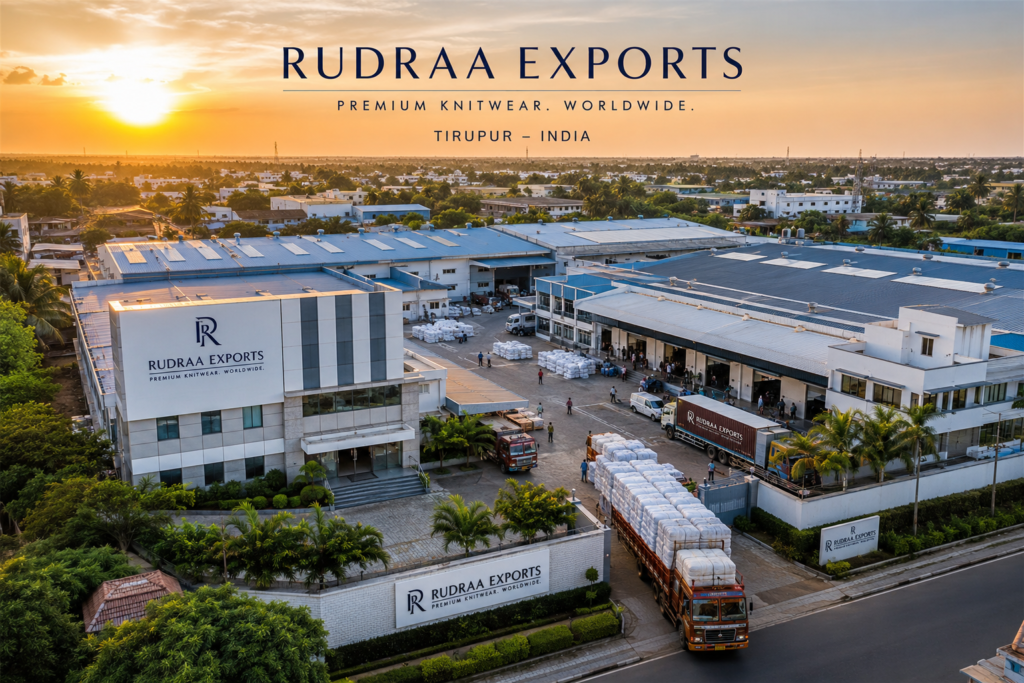
For global apparel buyers, choosing the “best sourcing location” is no longer a single-variable decision driven by CM (cut-and-make) price alone. The winning hubs in 2026 compress lead times, reduce coordination cost, keep compliance risk low, and offer credible sustainability and traceability — while remaining cost-competitive at scale.
Tirupur, in Tamil Nadu, India, is one of the few clusters in the world that delivers on all of these levers at once. That’s why it has earned its global reputation as India’s Knitwear Capital — and why international brands executing China-plus-one diversification strategies increasingly route their cotton knit programs through this single dense, export-oriented cluster.
This guide breaks down exactly why Tirupur works for global buyers, what advantages you can quantify, and how a direct-factory partner like Rudraa Exports helps you capture the cluster’s benefits with clearer accountability and cost transparency.
Quick Answer: Why Is Tirupur Called India’s Knitwear Capital?
Tirupur is called India’s Knitwear Capital because the cluster handles approximately 55–70% of India’s knitted garment exports, recording ₹34,350 crore in FY2022-23 and rebounding to approximately ₹40,000 crore (US$4.69 billion) in FY2024-25. The cluster contains around 20,000 production units including over 10,000 knitting units and approximately 729 dyeing units operating under Zero Liquid Discharge (ZLD) standards, employs roughly 600,000 workers, and has invested in about 2,000 MW of renewable energy capacity. The US accounts for ~30% of Tirupur’s exports, with Europe (especially Italy and Spain) increasing sourcing under China-plus-one diversification strategies.
The Tirupur Export Story: Numbers That Prove Capability
Tirupur’s reputation isn’t built on anecdotes — it’s built on sustained export numbers across cycles:
| Fiscal Year | Knitwear Exports | Key Driver |
|---|---|---|
| FY2022-23 | ₹34,350 crore (55.60% of India’s knit exports, +20% YoY) | Post-pandemic demand recovery |
| FY2023-24 | ₹30,690 crore | Global instability, tariff headwinds |
| FY2024-25 | ~₹40,000 crore (~US$4.69 billion) | China-plus-one shift, sustainability demand |
The dip-and-rebound pattern is the most important signal here. A cluster that contracts under global shocks and then rebounds without rebuilding from scratch is an operationally mature ecosystem — exactly what international buyers should look for when committing multi-season programs.
Geographic distribution of Tirupur’s exports:
- United States: ~30% of exports (forces high compliance documentation discipline)
- European Union: Growing share, especially Italy and Spain
- United Kingdom, Middle East, Australia: Established secondary markets
Major global brands publicly associated with sourcing from the Tirupur cluster include Nike, Zara, H&M, and dozens of mid-market private labels across regulated retail markets.
9 Manufacturing Advantages That Make Tirupur a Smart Sourcing Bet
1. Export Scale Plus Proven Resilience
Tirupur’s first manufacturing advantage is simply proof of export capability at scale. The cluster represented 55.60% of India’s knitted garment exports in FY2022-23 — concentration that signals predictable capacity, consistent workmanship, and factories that understand brand SOPs and audit realities.
Why resilience matters more than peak output: The FY2023-24 contraction to ₹30,690 crore followed by the FY2024-25 rebound to ₹40,000 crore demonstrates the cluster’s ability to recalibrate yarn sourcing, optimize production allocation, and recover momentum quickly. For buyers, this means lower risk during macro shocks like the 2024 tariff turbulence.
How buyers use this advantage:
- Screen Tirupur vendors using export track record — ask for style-level export history across at least two seasons
- Build volume ramp plans assuming cyclicality (lock core programs early, keep surge capacity flexible)
- Confirm whether your partner can reallocate capacity within the local network during demand spikes
2. Full-Stack Knit Ecosystem in One Geography
Tirupur’s biggest operational advantage is end-to-end knit specialization packed into one cluster. The complete production chain — spinning, knitting, dyeing, printing, trims, testing, and logistics — operates within a short radius.
Tirupur’s ecosystem composition:
- Extensive spinning capacity supported by mill networks
- Over 10,000 knitting units running varied gauge specifications
- ~729 dyeing units with ZLD-compliant infrastructure
- Dense garmenting base across 20,000 total units
- Multiple printing technologies (screen, digital, sublimation)
- Trims and accessories suppliers within the cluster
- Testing labs (SITRA presence) and technical institutions
- Specialized apparel logistics intermediaries
Why this matters for buyers: For a single T-shirt program, you can keep yarn sourcing, knitting, dyeing, and garmenting within a small radius — dramatically reducing material transit time and shade-lot mismatch risks compared to dispersed sourcing across multiple cities or countries.
How to leverage this:
- Ask prospective partners to map your product flow in Tirupur (fabric source → dye house → printer → garment unit → testing lab)
- Consolidate fabric formation and wet processing close to garmenting to cut lead time and reduce shade variability
- Use multi-tech printing (traditional plus digital) to support both bulk core volumes and fast fashion capsule drops
3. Cluster Economics: Lower Total Cost (Not Just FOB)
A common sourcing mistake is comparing only quoted FOB prices across hubs. Tirupur’s strongest cost advantage shows up in total cost to serve — fewer delays, lower coordination overhead, reduced rework — driven by agglomeration economics.
Why agglomeration matters in knitwear:
Specialization: One unit becomes excellent at fabric compaction, another at enzyme wash control, another at high-speed garmenting, another at multi-color printing. This specialization improves outcomes and reduces defect rates over time.
Shared services: Common Effluent Treatment Plants (CETPs), shared testing labs, and logistics intermediaries spread compliance and operational costs across the cluster — enabling capabilities that small factories elsewhere cannot afford alone.
Faster problem-solving loops: When fabric and garment teams are within driving distance, shrinkage, shade, and hand-feel issues get resolved in hours or days instead of weeks.
How to leverage cluster economics:
- Evaluate hubs on “coordination cost” — number of handoffs, physical moves, and vendors needed per style
- Use Tirupur’s network structure to create dual-sourcing within the same hub (two approved garment units sharing a fabric platform) for resilience without cross-country complexity
4. Skilled Labor and Knit Category Know-How
Tirupur is not a generic garment hub — it is a specialized knitwear talent market. The cluster provides direct employment to approximately 600,000 workers, with deep accumulated expertise in stretch fabric handling, seam performance, and finishing standards.
Why labor depth reduces buyer risk:
- Deep labor pool means lower ramp-up risk when moving from pilot orders to full programs
- Long export history to demanding US/EU markets means production teams understand AQL discipline and inline quality gates
- Fast sampling cycles are supported by experienced shop-floor teams
- Compliance expectations from regulated buyers have shaped baseline operating standards
The SME advantage: Tirupur’s structure of ~20,000 mostly-SME units distributes workforce skills across many firms — reducing your dependency on a small set of mega-factories and giving you genuine choice in vendor selection.
How to evaluate labor capability:
- During supplier qualification, interview line leaders and QA supervisors — not just merchandisers
- Test factory capability with a 2–3 style pilot using a brand-specific SOP pack
- Look for accumulated knit category know-how, not just polished front-office presentations
5. Sustainability as Infrastructure: ZLD and Renewable Energy
Sustainability is now a gatekeeper for vendor approval — especially for knit dyeing where wastewater risks can derail entire programs. Tirupur’s most defensible ESG advantage is that sustainability has become industrial infrastructure, not just a marketing claim.
Zero Liquid Discharge (ZLD) leadership:
- Hundreds of dyeing units operating under ZLD standards
- Approximately 120 MLD (million liters per day) of water recycled through ZLD systems
- Common Effluent Treatment Plants (CETPs) and Individual Effluent Treatment Plants (IETPs) backbone the ZLD model
- Tirupur is widely cited as the world’s first 100% ZLD textile cluster at this scale
Renewable energy infrastructure:
- Approximately 2,000 MW of renewable energy capacity referenced for the region
- Major wind and solar investments support lower-carbon sourcing strategies
- Individual factory energy mixes vary, but renewable availability enables credible decarbonization roadmaps
Why this matters to buyers:
- Lower regulatory shutdown risk compared to non-compliant wet-processing regions
- Stronger confidence in wastewater traceability and documentation
- Easier alignment with brand restricted substance lists (RSL) and environmental requirements
- Defensible sustainability claims backed by infrastructure, not marketing
How to operationalize sustainability:
- Require a wastewater compliance packet during vendor onboarding (ZLD proof, CETP/IETP pathway, recent compliance documentation)
- Ask for an energy and emissions baseline even if approximate initially
- Build renewable procurement into your supplier scorecard and claim substantiation files
6. Infrastructure and Logistics Connectivity
Speed-to-market combines production efficiency and logistics reliability. Tirupur benefits from strategic positioning within the Coimbatore region with established connectivity to air and seaports through road and rail corridors.
Logistics advantages for international buyers:
- Proximity to Coimbatore International Airport for samples and urgent air shipments
- Dependable trucking links to major seaports — Tuticorin (VOC Port), Chennai, and Cochin
- Specialized logistics intermediaries inside the cluster who understand apparel documentation
- Standardized export documentation routines refined through decades of US/EU shipping
Port options serving Tirupur:
- Tuticorin (VOC Port): Closest port, reported strong dwell-time performance
- Chennai Port: Larger vessel capacity for major global routes
- Cochin Port: West Coast US and Middle East flexibility
How to operationalize logistics:
- During costing, separate production lead time from handoff and transit lead time — Tirupur’s biggest win often comes from fewer handoffs within the same geography
- Set up a logistics SOP for repeat programs (incoterms, carton labeling, export documentation checklist)
- Use Tirupur’s export maturity to enforce SOP adherence across multiple shipments
7. Technology Adoption and Quality Systems
Knitwear quality is driven by process control — yarn selection, knitting parameters, GSM consistency, shrinkage control, color management, and sewing precision. Tirupur’s export maturity has pushed steady technology upgrades, especially in knitting and printing, supported by a strong testing and technical capacity layer.
Technology infrastructure in the cluster:
- Advanced knitting machinery across the 10,000+ knitting units
- Multi-color printing systems supporting both traditional screen and digital print
- Coexistence of digital and traditional print ecosystems for product variation
- Testing laboratories supporting fabric performance and color fastness verification
- SITRA (South India Textile Research Association) contributing to capability building
Quality outcomes buyers can expect:
- For midweight jersey programs: better knitting control reduces GSM variation and shrinkage surprises
- For graphic-driven products: split core volume (screen) and capsule drops (digital) without changing countries
- Faster approval cycles because labs and technical knowledge are local
How to use Tirupur’s technology ecosystem:
- Require a documented quality control plan at onboarding (inline checks, shrinkage testing frequency, shade band control, measurement SOPs)
- Insist on pre-production testing gates and maintain results in shared traceability folders per style
8. Policy Environment and Trade Tailwinds
While factory selection is a micro decision, the macro policy environment shapes your landed cost and long-term stability. India’s textile ecosystem benefits from supportive central initiatives and active trade negotiations.
Policy supports:
- Production Linked Incentive (PLI) scheme for textiles — driving scale, MMF diversification, and export competitiveness
- Active Free Trade Agreement (FTA) negotiations with the EU and UK
- Existing FTAs with the UAE, Australia, and EFTA countries providing preferential tariff treatment
- State-level Tamil Nadu textile policies supporting Tirupur’s growth
Tirupur’s growth ambitions: Industry bodies and state engagement consistently frame ambitions to scale Tirupur’s exports toward US$10 billion by 2030. Whether or not this exact target is met, the alignment between industry and policy on capacity building signals stability for buyers planning multi-year commitments.
How buyers should respond:
- Build a duty-and-incentive watchlist into your sourcing calendar with quarterly reviews
- Ask vendors how they manage policy-linked documentation (export incentives, certificates of origin under FTAs)
- Strong exporters treat documentation as a continuous process, not a scramble before shipment
9. The Direct-Factory Advantage: Where Rudraa Exports Fits
Tirupur’s cluster gives buyers options — but options only become advantages when you can control execution. That’s where a direct-factory sourcing model delivers measurable value: it reduces layers, improves cost transparency, and creates clearer accountability from yarn and fabric decisions through finishing and packing.
Why direct factory beats agent or trader models in Tirupur:
Within Tirupur’s ecosystem — the spinning and knitting base, ZLD-enabled dyeing network, printing capability, trims availability, and testing support — a direct-factory partner like Rudraa Exports acts as a single accountable interface that still leverages cluster specialization.
This structure supports:
- Cleaner costing: Fewer intermediaries, clearer separation between fabric cost and make cost
- Repeatable scalability: Ability to ramp core styles and reallocate capacity within a known network
- Traceability: Documented processing routes, especially for wet processing and compliance documentation
Concrete execution examples:
- Running core basics (tees, polos, loungewear, kidswear) on stable fabric platforms while keeping seasonal prints flexible — without relocating the supply base
- Building a compliance-first route for dyed fabrics by selecting ZLD-aligned dye houses and maintaining documentation continuity from processing to shipment
- Reducing sampling cycle time by coordinating knitting, processing, and garmenting locally under a single planning calendar
How to start with a direct-factory partner:
- Pilot with one partner who can manage the full workflow and provide a transparent vendor map
- Use a traceability-first BOM specifying fibers, yarn counts, fabric construction, and processing route upfront
- Expand categories once the process is stable
12-Point Tirupur Knitwear Factory Evaluation Checklist
Use this as a practical tool for vendor shortlisting and onboarding in Tirupur:
✅ 1. Export track record — Last 24 months of knitwear exports by category and market (US/EU/UK)
✅ 2. Capacity realism — Lines, shift structure, peak-season plan, subcontracting policy
✅ 3. Fabric platform — In-house knitting versus partner knitting, machine gauges available
✅ 4. Wet processing route — Named dyeing units, ZLD compliance proof, CETP/IETP pathway
✅ 5. Water and chemical management — Wastewater documentation, RSL management approach
✅ 6. Renewable energy access — Energy mix snapshot, wind and solar procurement options
✅ 7. Printing capability — Screen versus digital, maximum colors, sampling turnaround
✅ 8. Trims and accessories sourcing — Local vendor list, incoming quality control process
✅ 9. Testing readiness — Lab access, routine test frequency, shrinkage and colorfastness gates
✅ 10. Quality system — Inline checks, final inspection process, documented AQL standards
✅ 11. Traceability file structure — Style-level folder with BOM, process route, test reports, shipment docs
✅ 12. Commercial transparency — Willingness to provide open costing (fabric, CMT, processing, overhead)
Tirupur vs Other Major Knitwear Hubs: Quick Comparison
| Factor | Tirupur (India) | Mainstream China | Bangladesh | Vietnam |
|---|---|---|---|---|
| Knit specialization | Very High | High | Medium-High | Medium |
| MOQ flexibility | High (50–500 pieces) | Low (500+ pieces) | Medium | Low |
| ZLD sustainability infrastructure | Very High (cluster-wide) | Mixed | Limited | Limited |
| Cotton raw material access | High (domestic) | Medium (imports) | Medium (imports) | Low (imports) |
| FTA tariff advantages | Expanding (UK, AUS, UAE, EFTA) | Limited | Yes (LDC status) | Yes (CPTPP, EVFTA) |
| English-language communication | Very High | Medium | Medium | Medium |
| Cluster economies of scale | Very High | High | High | Medium |
Frequently Asked Questions
How much does Tirupur contribute to India’s knitwear exports?
Tirupur exported ₹34,350 crore in FY2022-23, representing 55.60% of India’s knitted garment exports. The cluster rebounded to approximately ₹40,000 crore (US$4.69 billion) in FY2024-25 after a dip in FY2023-24.
What caused Tirupur’s export dip in FY2023-24?
Exports fell to ₹30,690 crore in FY2023-24 amid global economic instability, slower consumer demand in key Western markets, and tariff-related pressures on Indian textile exports.
Why do sustainability-focused brands shortlist Tirupur for knit dyeing?
Because a large share of Tirupur’s approximately 729 dyeing units operate Zero Liquid Discharge (ZLD) systems, with around 120 million liters per day of water recycled. The cluster has scaled wastewater treatment and recycling as industrial infrastructure rather than as a marketing claim.
What is Tirupur’s renewable energy advantage?
The region has invested heavily in wind and solar energy, with approximately 2,000 MW of renewable capacity referenced for the cluster. This supports lower-carbon sourcing roadmaps and credible decarbonization commitments for international brands.
How many production units operate in Tirupur?
The cluster contains approximately 20,000 production units across the knitwear value chain, including over 10,000 knitting units and approximately 729 dyeing units. Most are SME-scale, providing both scale and vendor diversity.
How many workers does Tirupur employ?
Tirupur provides direct employment to approximately 600,000 workers across knitting, dyeing, garmenting, printing, finishing, and ancillary services. The workforce includes a significant share of women from surrounding rural areas.
Which countries import most knitwear from Tirupur?
The United States accounts for approximately 30% of Tirupur’s exports. The European Union (especially Italy and Spain) has increased sourcing under China-plus-one strategies. Other major markets include the United Kingdom, Middle East, Australia, and Canada.
What is the China-plus-one sourcing strategy?
China-plus-one is a supply chain diversification strategy where brands reduce concentration risk by sourcing from a second country alongside China. Tirupur has emerged as the leading China-plus-one alternative for cotton knitwear due to manufacturing maturity, FTA coverage, English-language workforce, and democratic governance.
What categories does Tirupur specialize in?
Tirupur specializes in cotton knitwear including T-shirts, polos, loungewear, kidswear, sweatshirts, hoodies, innerwear, lightweight knit jackets, and athleisure. The cluster handles both basic programs and complex value-added knitwear.
Is Tirupur cost-competitive versus Bangladesh and Vietnam?
Tirupur is competitive on cotton T-shirt and knitwear basics. Indian FOB pricing trended toward US$2.32 per T-shirt in 2024 — comparable to Bangladesh on basics and meaningfully below mainstream Chinese pricing. India’s expanding FTA network adds tariff advantages in covered markets.
What certifications should I require from Tirupur knitwear manufacturers?
Standard certifications include ISO 9001 (quality systems), OEKO-TEX Standard 100 (chemical safety), GOTS (organic textiles), WRAP or BSCI (ethical labor), GRS (recycled content), and SA8000 (social accountability). Verify all certificates through each issuing body’s official database.
How do I start sourcing from Tirupur as a first-time buyer?
Start with a clear tech pack, request quotes from 3–5 factory-direct manufacturers (avoid agents and traders for initial qualification), run a structured factory evaluation, pilot with 1–2 hero styles, and scale only after quality and lead time metrics stabilize. Working with an established direct-factory partner like Rudraa Exports simplifies all of these steps.
Why Rudraa Exports for Your Tirupur Sourcing Strategy
If your 2026 sourcing plan prioritizes cost efficiency without sacrificing quality, scalable knit capacity, and credible ESG and traceability, Tirupur is one of the few global hubs that delivers all three in a single ecosystem.
Rudraa Exports helps international buyers capture those advantages through a factory-direct model built for global apparel brands:
- Clearer costing through fewer intermediaries and transparent fabric vs make cost separation
- Controlled production routes including ZLD-aligned wet processing where compliance demands it
- Single accountable team coordinating across Tirupur’s knitting, dyeing, printing, and finishing network
- Documented traceability for every style from yarn to shipment
- Export documentation discipline matured through buyer relationships across US, EU, Australia, and Middle East
- FTA-eligible certification for buyers in India’s expanding free trade agreement markets
- Multi-port shipping flexibility through Tuticorin, Chennai, and Cochin
Recommended start: Pilot with 1–2 core styles and a defined fabric platform, apply the 12-point evaluation checklist above, and scale once quality and lead-time metrics stabilize.
Conclusion: Tirupur Delivers What 2026 Sourcing Demands
Global apparel sourcing in 2026 demands more than the lowest unit price. It demands resilience, sustainability infrastructure, scalable capacity, and traceability — packaged in a hub that can adapt to demand shifts and regulatory changes without disrupting your business.
Tirupur delivers on all four dimensions. The cluster’s ₹40,000 crore export base, ZLD water recycling at industrial scale, 2,000 MW of renewable energy capacity, 600,000-strong skilled workforce, and ~20,000 specialized production units make it one of the most mature knitwear sourcing destinations in the world — and the leading China-plus-one alternative for international brands.
Combined with India’s expanding FTA network providing tariff advantages in UK, Australia, UAE, and EFTA markets, the case for Tirupur becomes even stronger for buyers planning multi-year sourcing strategies through 2030.
Related guides: how to source T-shirts and knitwear from Tirupur, the best garment manufacturers there, and the top 10 garment exporters.
Ready to explore Tirupur with a direct-factory partner? Visit rudraaexports.com to share your tech pack, target MOQ, and destination market — and start a sourcing partnership built specifically for international buyers.