
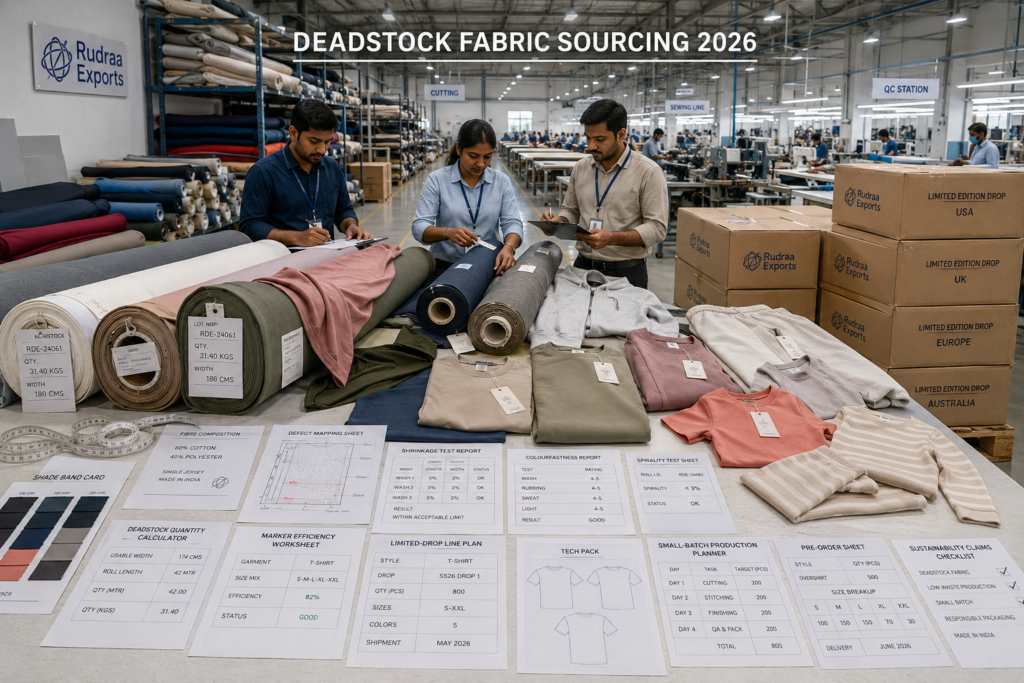
Deadstock fabric can help clothing brands create limited collections with lower waste, stronger storytelling, and lower inventory risk.
But it must be handled carefully.
Deadstock is not magic fabric. It is not automatically organic, recycled, certified, or carbon neutral. It is simply existing unused fabric that is already available in the supply chain.
For new and growing brands, this can be a smart opportunity.
You can use deadstock fabric to launch limited-edition T-shirts, shirts, dresses, kidswear, loungewear, hoodies, overshirts, trousers, uniforms, and small-batch capsules without placing huge fabric orders.
But deadstock fabric also creates challenges:
- Quantity may be limited
- Reorders may not be possible
- Colour can vary between rolls
- Width may differ
- Fabric content may be unclear
- Testing may be missing
- Shrinkage may not be known
- Marketing claims must be careful
At Rudraa Exports, we help clothing brands and global buyers review deadstock and surplus fabric opportunities, check production feasibility, plan limited runs, manage fabric testing, and convert available fabric into export-ready apparel from Tirupur, India.
Quick Answer
Deadstock fabric is unused surplus fabric from mills, factories, cancelled orders, overproduction, or leftover stock. Clothing brands can use it for limited drops, capsule collections, pre-order runs, and sustainable storytelling. Before production, brands should confirm fabric quantity, width, GSM, fibre content, shade consistency, defects, shrinkage, colour fastness, and reorder limitations. Deadstock works best for limited-edition products, not evergreen styles that need repeat fabric supply.
Planning to use deadstock fabric for your next clothing drop? Contact Rudraa Exports to request a fabric feasibility and limited-production review.
What Is Deadstock Fabric?
Deadstock fabric is unused fabric that already exists but has not been converted into finished garments.
It may come from:
- Cancelled orders
- Overproduced fabric
- Mill surplus
- End-of-season stock
- Leftover production rolls
- Sampling excess
- Brand liquidation
- Export surplus
- Fabric stock lots
The uploaded source explains deadstock as unused rolls, overproduced yardage, cancelled-order lots, and end-of-season surplus that can be used for limited collections.
What Deadstock Fabric Is Not
Deadstock fabric is not automatically:
- Organic
- Recycled
- Certified
- Low carbon
- Chemical-free
- Fully traceable
- Repeatable
- Defect-free
A fabric may be deadstock and still need proper testing, documentation, inspection, and careful production planning.
Buyer Rule
Deadstock is a sourcing strategy, not a certification.
Do not make sustainability claims unless you have proof.
Why Clothing Brands Use Deadstock Fabric
Deadstock fabric can be useful for brands that want to launch small, unique, and limited collections.
Benefits of Deadstock Fabric
| Benefit | Why It Helps |
|---|---|
| Uses existing material | Reduces demand for new fabric production |
| Good for limited drops | Quantity scarcity becomes part of the story |
| Lower fabric commitment | Useful for small-batch production |
| Unique fabric access | Helps create distinctive designs |
| Faster sourcing in some cases | Fabric is already available |
| Strong storytelling | “Limited fabric, limited run” positioning |
| Useful for market testing | Lower commitment before scaling |
| Can reduce waste | Keeps usable fabric in circulation |
The uploaded source notes that deadstock fabric can help emerging brands reduce waste while building limited collections with authentic storytelling.
Deadstock Fabric Challenges
Deadstock fabric can create production risk if not handled properly.
Common Challenges
| Challenge | Risk |
|---|---|
| Limited quantity | You may not make all planned sizes |
| No reorder | Bestseller cannot be restocked |
| Shade variation | Garments may not match |
| Width variation | Cutting efficiency changes |
| Unknown fibre content | Label and compliance risk |
| No test reports | Shrinkage or colour issues |
| Defects in rolls | Usable quantity is lower than expected |
| Mixed lots | Colour or handfeel inconsistency |
| Poor documentation | Weak sustainability claims |
A good deadstock program starts with inspection before design is finalised.
Deadstock Sourcing Options
There are three common ways to source deadstock fabric.
1. Indian Fabric Markets
Indian fabric markets can offer strong variety and negotiable prices.
Common sourcing areas include:
- Surat
- Tirupur
- Mumbai
- Delhi
- Ahmedabad
- Bengaluru
Best For
- Designers who can inspect in person
- Small brands looking for unique lots
- Buyers who can negotiate
- Brands that accept non-repeatable fabrics
Risks
- Quality verification is buyer responsibility
- Fibre content may not be documented
- Shade and width can vary
- Reorders are difficult
- Remote buying is risky
2. Online Deadstock Platforms
Online platforms make deadstock sourcing easier for remote buyers.
They may offer searchable inventory, swatches, small quantities, and curated fabric lots.
Best For
- Overseas founders
- Small brands
- Designers needing quick access
- Limited-edition capsules
- Sampling and development
Risks
- Colour may look different in real life
- Handfeel cannot be judged online
- Shipping cost can be high
- Testing still needs to be done
- Reorder may not be possible
3. Direct Mill or Factory Relationships
A direct mill or factory relationship is useful when you want deadstock sourcing to become a system.
The factory can help inspect, test, plan, cut, sew, finish, pack, and export the garments.
Best For
- Brands moving from one-off sourcing to repeat limited drops
- Overseas buyers needing local support
- Knitwear brands sourcing from Tirupur
- Brands needing QC and documentation
- Export-ready production programs
The uploaded source highlights direct mill or factory relationships as the strongest option for brands that need repeatable execution, QA, cutting, sewing, packing, and export support.
Deadstock Sourcing Comparison
| Criteria | Fabric Markets | Online Platforms | Direct Factory Relationship |
|---|---|---|---|
| MOQ | Often flexible | Often low | Depends on lot and product |
| Price | Can be strong | Transparent but may include shipping | Strong if linked to production |
| Quality check | Buyer must inspect | Platform info only | Factory can inspect |
| Traceability | Often weak | Varies | Better documentation possible |
| Colour consistency | Risky | Risky until received | Can segregate lots |
| Lead time | Fast if local | Depends on shipping | Medium but controlled |
| Reorder | Usually impossible | Usually impossible | Alternative lot planning possible |
| Best for | In-person sourcing | Small remote brands | Export-ready production |
How to Check Deadstock Fabric Before Buying
Never buy deadstock only because it looks good.
Check it properly.
Deadstock Fabric Inspection Checklist
| Check | What to Confirm |
|---|---|
| Quantity | Total metres or kg available |
| Usable quantity | Quantity after defects |
| Width | Actual usable width |
| GSM | Fabric weight |
| Fibre content | Cotton, polyester, viscose, blend, etc. |
| Shade | Same lot or multiple lots |
| Defects | Holes, stains, barré, streaks |
| Shrinkage | Wash test required |
| Colour fastness | Wash and rubbing test |
| Spirality | Important for knits |
| Handfeel | Softness and drape |
| Certification | Only if documented |
| Reorder possibility | Usually no |
The uploaded source recommends confirming usable quantity, width, GSM, dye-lot integrity, shrinkage, colourfastness, fibre content, certification records, and pattern consumption before production.
Why Usable Quantity Matters
The full fabric roll quantity is not the same as usable production quantity.
Some fabric may be lost due to:
- Edge defects
- Shade variation
- Holes
- Stains
- Roll-end damage
- Width variation
- Testing cuts
- Cutting wastage
- Marker inefficiency
Example
If you buy 200 metres of deadstock fabric, you may not be able to use all 200 metres.
After defects and cutting wastage, usable quantity may be lower.
This is why quantity should be confirmed before announcing product availability.
Design Rules for Deadstock Fabric
Deadstock works best when the design respects fabric limitations.
Deadstock-Friendly Designs
| Design Choice | Why It Works |
|---|---|
| Boxy T-shirts | Simple cutting and lower wastage |
| Overshirts | Good for limited fabric lots |
| Elastic-waist pants | Easier fit control |
| Kidswear basics | Smaller fabric consumption |
| Contrast panels | Useful for mixed lots |
| Colour-blocking | Helps use shade variation |
| Limited capsules | Matches non-repeatable supply |
| Pre-order drops | Controls quantity risk |
Difficult Designs for Deadstock
| Design Type | Why It Is Risky |
|---|---|
| Evergreen basics | Fabric cannot be reordered |
| Exact uniform colours | Shade mismatch risk |
| Complex tailored pieces | Cutting wastage may be high |
| Wide size range | Fabric may not cover all sizes |
| Large print repeats | Placement may be difficult |
| Strict compliance products | Documentation may be weak |
How to Plan a Deadstock Drop
Deadstock should be planned like a limited edition.
Step 1: Confirm Fabric Lot
Before design finalisation, confirm:
- Quantity
- Width
- GSM
- Fibre content
- Defects
- Shade bands
- Reorder possibility
Step 2: Choose Product Type
Match the fabric to the product.
| Fabric Type | Product Ideas |
|---|---|
| Cotton jersey | T-shirts, kidswear, loungewear |
| French terry | Sweatshirts, joggers, light hoodies |
| Fleece | Hoodies, sweatshirts, joggers |
| Woven cotton | Shirts, dresses, overshirts |
| Viscose | Dresses, tops, resortwear |
| Polyester | Activewear, fashion tops, linings |
| Rib | Tank tops, leggings, cuffs, trims |
Step 3: Calculate Consumption
Ask the factory to calculate how many pieces can be made based on:
- Fabric quantity
- Fabric width
- Marker efficiency
- Size ratio
- Defect allowance
- Product pattern
Step 4: Build the Collection Around Available Quantity
Do not promise more units than the fabric can support.
Example:
| Fabric Available | Product Plan |
|---|---|
| 120 metres cotton jersey | Limited T-shirt drop |
| 80 metres woven cotton | Overshirt capsule |
| 150 kg fleece | Hoodie and jogger set |
| Mixed colour lots | Colour-blocked kidswear |
Step 5: Produce and Market as Limited Edition
Deadstock works well with honest scarcity.
Use language like:
Limited run made from existing surplus fabric. Once this fabric is used, it cannot be restocked in the same material.
How to Price Deadstock Products
Deadstock fabric may be cheaper, but production may not always be cheaper.
Extra Deadstock Costs
| Cost | Why It Happens |
|---|---|
| Inspection | Fabric must be checked |
| Testing | Shrinkage and colourfastness |
| Sorting | Shade and defect separation |
| Cutting | Marker may be less efficient |
| Wastage | Defects reduce usable fabric |
| Documentation | Records need to be kept |
| Small batch | Limited quantity increases unit cost |
Pricing Tip
Add a small buffer for:
- Defects
- Wastage
- Shade sorting
- Testing
- Small-lot inefficiency
Do not price deadstock products only as discounted goods. Limited fabric and strong finishing can support premium pricing.
Marketing Deadstock Without Greenwashing
Deadstock can be part of a sustainability story, but claims must be honest.
Safer Claims
Use claims like:
- Made with deadstock fabric
- Made using existing surplus fabric
- Limited edition due to fabric availability
- Produced in a small batch
- Fabric cannot be reordered
- We used available fabric instead of producing new fabric
Risky Claims
Avoid claims like:
- Zero impact
- Carbon neutral
- Saves X litres of water
- 100% sustainable
- Certified organic, unless documented
- Recycled, unless documented
- Fully traceable, unless documented
The uploaded source warns that brands should avoid claims such as carbon neutral, zero impact, recycled, organic, or quantified emission savings unless they have supporting records or product-specific proof.
Deadstock Documentation Checklist
Keep records for every deadstock lot.
Records to Keep
| Document | Why It Matters |
|---|---|
| Fabric invoice | Proof of purchase |
| Roll photos | Visual lot evidence |
| Lot number | Traceability |
| Fibre content record | Label support |
| GSM record | Product specification |
| Width record | Consumption calculation |
| Test reports | Shrinkage, colourfastness |
| Defect notes | QC planning |
| Cutting records | Quantity validation |
| Finished goods report | Production traceability |
Documentation protects your brand and helps you communicate honestly.
Deadstock Production Workflow
A structured workflow helps avoid chaos.
Workflow
| Step | Action |
|---|---|
| 1 | Source fabric lot |
| 2 | Inspect rolls |
| 3 | Test shrinkage and colourfastness |
| 4 | Confirm usable quantity |
| 5 | Choose product type |
| 6 | Build tech pack |
| 7 | Calculate consumption |
| 8 | Make sample |
| 9 | Approve fit and wash result |
| 10 | Cut production |
| 11 | Segregate shade bands if needed |
| 12 | Stitch and finish |
| 13 | Run QC |
| 14 | Pack and label |
| 15 | Document the lot story |
| 16 | Launch limited drop |
Deadstock Fabric for Small-Batch Production
Deadstock and small-batch production work well together.
Good Fit For
- 50–200 unit drops
- Limited edition collections
- Pre-order capsules
- Instagram launches
- Streetwear drops
- Boutique collections
- Sustainable fashion brands
- Upcycled-inspired ranges
- Founder-led brands
Why It Works
Deadstock fabric is usually limited, and small-batch production is also limited.
Together, they create a practical low-risk launch model.
Direct Factory Support for Deadstock Fabric
A direct factory can reduce deadstock production risk.
Factory Support Can Include
- Fabric inspection
- GSM checking
- Width checking
- Shrinkage testing
- Colourfastness testing
- Shade segregation
- Consumption calculation
- Pattern adjustment
- Marker planning
- Sampling
- Cutting
- Sewing
- QC
- Packing
- Export documentation
For overseas buyers, this is especially useful because deadstock sourcing is difficult to manage remotely.
Why Rudraa Exports
Rudraa Exports supports clothing brands with deadstock, surplus fabric, limited-edition, and small-batch garment production from Tirupur, India.
Product Categories Supported
- T-shirts
- Polo shirts
- Sweatshirts
- Hoodies
- Joggers
- Leggings
- Kidswear
- Babywear
- Shirts
- Overshirts
- Loungewear
- Corporate apparel
- Private-label knitwear
Deadstock Production Support
- Fabric feasibility review
- Deadstock lot inspection guidance
- GSM and width checking
- Shrinkage and colourfastness coordination
- Shade band planning
- Consumption and marker planning
- Limited-run production planning
- Sampling and PP approval
- AQL 2.5 inspection standards
- Export packing and documentation support
Manufacturing Strengths
- Factory-direct Tirupur knitwear manufacturing
- 72,000+ units per month production capacity
- MOQ discussions starting from around 300 pieces for suitable programs
- Sampling support for first-time and growing brands
- Export support for USA, UK, Europe, Australia, Middle East, and global buyers
- Multi-port shipping through Chennai, Tuticorin, and Cochin
Buyer Advantages
- Better control over limited fabric lots
- Fewer middleman handoffs
- Factory-direct pricing without trading-company markups
- Up to 40% cost-saving positioning compared with indirect sourcing models
- Stronger QC before cutting
- Better support for small-batch and limited-edition drops
- Export-ready production workflow
Ready to use deadstock fabric for your next limited drop? Speak with Rudraa Exports to share your fabric details, product idea, target quantity, and destination market.
Deadstock Fabric Checklist for Clothing Brands
| # | Checklist Item |
|---|---|
| 1 | Confirm fabric source |
| 2 | Confirm total quantity |
| 3 | Confirm usable quantity |
| 4 | Check fabric width |
| 5 | Check GSM |
| 6 | Confirm fibre content |
| 7 | Check shade consistency |
| 8 | Check defects |
| 9 | Run shrinkage test |
| 10 | Run colourfastness test |
| 11 | Confirm reorder possibility |
| 12 | Match fabric to product type |
| 13 | Calculate consumption |
| 14 | Plan size ratio |
| 15 | Build tech pack |
| 16 | Make sample |
| 17 | Approve wash result |
| 18 | Plan limited quantity honestly |
| 19 | Keep documentation |
| 20 | Avoid unsupported sustainability claims |
FAQ: Deadstock Fabric for Clothing Brands
1. What is deadstock fabric?
Deadstock fabric is unused surplus fabric from mills, factories, cancelled orders, overproduction, leftover production, or end-of-season stock.
2. Is deadstock fabric sustainable?
Deadstock can support waste reduction because it uses existing material, but it is not automatically sustainable, organic, recycled, or low-impact. Claims should be based on documentation.
3. Can I reorder deadstock fabric?
Usually no. Deadstock is often limited and non-repeatable. Brands should treat it as limited-edition fabric.
4. What products work best with deadstock fabric?
T-shirts, overshirts, dresses, shirts, sweatshirts, joggers, kidswear, loungewear, limited capsules, and small-batch drops can work well depending on fabric type.
5. What should I check before buying deadstock fabric?
Check quantity, usable metres, width, GSM, fibre content, shade consistency, defects, shrinkage, colourfastness, and documentation.
6. Can deadstock fabric be used for export garments?
Yes. Deadstock fabric can be used for export garments if quality, labelling, testing, documentation, and buyer requirements are properly managed.
7. Is deadstock fabric cheaper?
Sometimes, but not always. Fabric cost may be lower, but inspection, testing, sorting, cutting inefficiency, and small-batch production can add cost.
8. How do I avoid greenwashing with deadstock?
Use careful claims such as “made with deadstock fabric” or “made using existing surplus fabric.” Avoid claims like carbon neutral, zero impact, recycled, or organic unless you have proof.
9. Can Rudraa Exports help produce garments using deadstock fabric?
Yes. Rudraa can help review deadstock fabric feasibility, check production suitability, plan consumption, develop samples, manufacture limited runs, inspect quality, pack, and export.
10. Is deadstock good for small clothing brands?
Yes. Deadstock can be useful for small brands because it supports limited drops, smaller quantities, and unique fabric storytelling.
11. What is the biggest risk with deadstock fabric?
The biggest risk is non-repeatability. If the product sells well, you may not be able to restock the same fabric.
12. Should I test deadstock fabric before production?
Yes. Always test shrinkage, colourfastness, handfeel, shade, width, GSM, and defects before cutting production.
Conclusion
Deadstock fabric can be a strong opportunity for clothing brands that want to launch limited collections, reduce waste, and create a more distinctive product story.
But it must be managed with discipline.
The fabric may be limited, inconsistent, undocumented, or impossible to reorder. This means brands must inspect the fabric, test it, calculate consumption, plan the design around the available quantity, and market it honestly.
Deadstock works best when it is treated as a system, not a lucky find.
For brands sourcing from India, Rudraa Exports can help connect deadstock feasibility, sampling, production, QC, packing, and export documentation into one factory-direct workflow.
Visit rudraaexports.com or contact our team directly to share your deadstock fabric details, product category, target quantity, and destination market — and receive a limited-run production review from Rudraa Exports.
Related reading
How to Source Fabric in India for Your Clothing Brand: Mills, MOQs and Quality Guide
How to Launch Your Clothing Brand with Small-Batch Production: 50–200 Unit Guide