
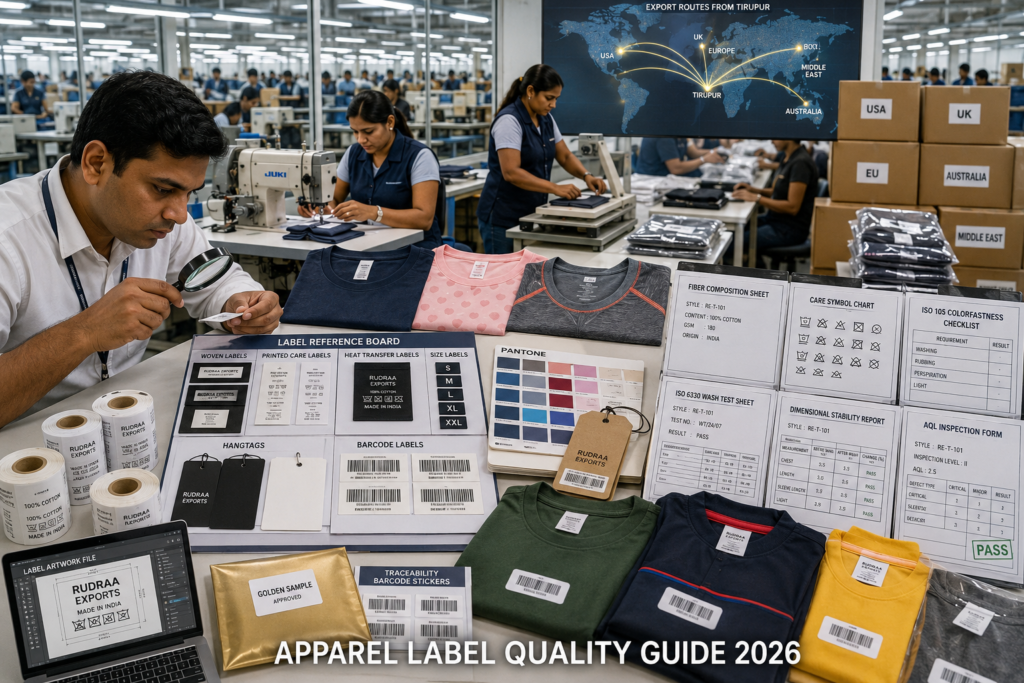
Poor labels do not fail quietly. A care label that fades, bleeds, shrinks, curls, frays, cracks, or detaches can create returns, customer complaints, compliance risk, and expensive rework after the garments are already in the market.
Many apparel brands spend months perfecting fabric, fit, colour, stitching, and packaging — but treat labels as a small trim item. That is a mistake. Labels are touched, read, washed, and inspected repeatedly. They carry brand identity, care instructions, fiber composition, size information, origin details, and sometimes sustainability claims. If they fail, the whole garment feels low quality.
For private-label brands, DTC founders, retailers, corporate apparel buyers, kidswear brands, and export buyers, quality labels for apparel must be specified and tested like any other performance component.
At Rudraa Exports, we help brands manage garment labels as part of a complete apparel quality system — covering material selection, label placement, wash durability, colorfastness, attachment security, compliance, traceability, and production-level quality checks.
Quick Answer
To choose quality labels for apparel, brands should define the label type, material, placement, artwork, wash durability, colorfastness, dimensional stability, attachment method, compliance content, and traceability requirements before production. High-quality labels should remain readable, stable, comfortable, colourfast, and securely attached after repeated washing and wearing. The safest approach is to test labels using garment-relevant wash, rubbing, shrinkage, and attachment checks before bulk production, then control label lots through documented QC and traceability.
Planning a private-label or export garment program? Contact Rudraa Exports to review your label specifications, care label content, trim quality, and production QC plan.
Why Apparel Labels Matter More Than Brands Think
Labels may look small, but they influence quality perception, compliance, returns, and customer trust.
A bad label can cause:
- Care text fading
- Ink bleeding onto fabric
- Label shrinkage
- Neck irritation
- Edge fraying
- Label detachment
- Heat-transfer cracking
- Incorrect care instructions
- Wrong fiber composition
- Wrong size information
- Misleading sustainability claims
- Relabeling costs
- Product returns
The uploaded source highlights that poor labels can lead to avoidable returns, compliance exposure, and expensive rework, especially when labels fade, bleed, shrink, or detach after garments are already in market.
A label is not just branding. It is a product quality and compliance component.
Types of Apparel Labels
Different label types serve different purposes.
Common Label Types
| Label Type | Use Case |
|---|---|
| Main label | Brand identity |
| Size label | Size identification |
| Care label | Washing, drying, ironing, care symbols |
| Fiber content label | Material composition |
| Country of origin label | Origin information |
| Heat-transfer label | Tagless branding or care info |
| Woven label | Premium brand identity |
| Printed label | Cost-effective care and size information |
| Hangtag | Retail communication |
| Barcode / SKU label | Warehouse and retail tracking |
| Compliance label | Children’s wear, regulated markets, buyer-specific rules |
Each label should be chosen based on where it sits, how it touches the skin, how often the garment is washed, and what information it carries.
High-Quality Label Program vs Low-Cost Label Sourcing
A good label program is not about one nice-looking sample. It is about repeatable quality across lots.
| Criteria | High-Quality Label Program | Low-Cost Label Sourcing |
| Material | Chosen for end use and skin contact | Selected mainly by price |
| Wash durability | Tested before bulk | Assumed from sample appearance |
| Colorfastness | Defined and checked | Not controlled clearly |
| Attachment | Matched to fabric and wash profile | Generic sewing or heat press |
| Compliance content | Verified by market requirement | Buyer text printed without checking |
| Traceability | Batch-level tracking | Little or no lot tracking |
| QC gates | Incoming, inline, final checks | Mostly visual check |
| Repeatability | Controlled through specs | Varies by batch |
| Rework risk | Lower | Higher |
| Long-term cost | More predictable | Hidden costs from failures |
A low-cost label can become expensive when it causes returns, relabeling, or compliance corrections.
Label Material Selection
Label material affects comfort, durability, appearance, and compliance.
Material Selection Table
| Material / Label Type | Best For | Risk to Watch |
| Woven polyester label | Brand labels, premium neck labels | Edge stiffness, skin irritation |
| Satin label | Soft care labels | Fraying or print fade |
| Cotton label | Natural brand look | Shrinkage and fading |
| Printed polyester label | Care/content labels | Ink durability |
| Heat-transfer label | Tagless neck, sportswear, inner labels | Cracking or detachment |
| TPU / transfer label | Activewear | Adhesion and stretch compatibility |
| Paper hangtag | Retail branding | Not wash-related but must match claims |
For kidswear, intimates, activewear, and neck labels, comfort is as important as appearance.
Wash Durability: The Most Important Label Test
Labels must survive the garment’s real use.
A care label that fades after three washes damages customer trust. A brand label that shrinks and puckers makes the garment look cheap. A heat-transfer label that cracks or peels creates a quality complaint.
Label Wash Durability Risks
| Failure | What Happens |
| Fading | Care text becomes unreadable |
| Bleeding | Label colour transfers to garment |
| Shrinkage | Label puckers or distorts garment |
| Fraying | Edges become rough or damaged |
| Detachment | Label separates from garment |
| Cracking | Heat-transfer print breaks |
| Curling | Label lifts or irritates skin |
| Hardening | Label becomes uncomfortable |
The uploaded source recommends treating durability as multiple failure modes — no bleed, no fading, no shrinkage, no detachment, and continued readability after laundering.
Colorfastness for Labels
Colorfastness means the label colour or print should not bleed, fade, rub off, or stain the garment.
Common Colorfastness Checks
| Test Area | Why It Matters |
| Wash fastness | Prevents bleeding during washing |
| Rubbing fastness | Prevents ink transfer during wear |
| Perspiration fastness | Important for sportswear and activewear |
| Water fastness | Prevents staining when wet |
| Light fastness | Important for visible outer labels |
| Heat fastness | Important for heat-transfer labels |
A dark care label on a light T-shirt can create staining if colorfastness is poor. This is a small trim issue that becomes a full-garment complaint.
Dimensional Stability: Preventing Label Shrinkage and Puckering
Labels can shrink differently from the garment fabric.
If the garment shrinks 3% but the label shrinks 8%, the label may pucker, twist, or distort the seam. This looks low quality even if the garment itself is correct.
What Buyers Should Specify
- Label shrinkage limit
- Wash method
- Drying method
- Ironing or heat exposure
- Maximum acceptable distortion
- Legibility after wash
- Seam appearance after wash
For knitwear, especially T-shirts, polos, and kidswear, label shrinkage must be checked with the actual garment fabric.
Attachment Security: Sewn Labels vs Heat Transfers
A good label must stay attached.
Sewn Labels
Sewn labels are common for main labels, care labels, and size labels.
Check:
- Stitch density
- Thread quality
- Seam allowance
- Fold type
- Edge fray
- Position consistency
- Skin comfort
- Pull resistance
Heat-Transfer Labels
Heat-transfer labels are common in tagless T-shirts, activewear, inner neck branding, and sportswear.
Check:
- Heat temperature
- Press time
- Pressure
- Adhesive compatibility
- Stretch recovery
- Wash durability
- Crack resistance
- Peel resistance
A heat-transfer label that works on cotton may fail on stretch fabric. Always test on the actual fabric.
Compliance: Labels Are Not Just Design Elements
Labels often carry regulated information.
Depending on the market, garment labels may include:
- Fiber composition
- Care instructions
- Country of origin
- Size
- RN number or importer information
- Safety information
- Tracking details for children’s products
- Sustainability claims
- Certification references
If this information is wrong, the issue becomes more than quality. It becomes compliance risk.
Label Compliance Checklist
| Label Information | Risk if Wrong |
| Fiber composition | Mislabeling and regulatory issue |
| Care instructions | Customer damage claims |
| Country of origin | Customs and market compliance issue |
| Size | Returns and customer complaints |
| Organic/recycled claim | Greenwashing or claim risk |
| Certification reference | Misleading claim if unsupported |
| Children’s tracking info | Safety compliance issue |
| Translation | Wrong care guidance in export markets |
The uploaded source notes that care labels should remain legible and that label accuracy is a known concern in garment compliance.
Label Content Review Before Production
Before printing or weaving labels, brands should review the content carefully.
Content Review Checklist
- Brand name spelling
- Size accuracy
- Fiber content
- Care symbols
- Written care instructions
- Country of origin
- Importer or RN details if needed
- Batch or tracking code if needed
- Certification claim wording
- Sustainability claim wording
- Translation accuracy
- Font size and readability
- Contrast between text and background
Never send label text casually over chat and expect it to be production-ready. Use an approved artwork file.
Label Specification Template
Every apparel tech pack should include a label specification.
10-Point Label Spec Checklist
| # | Specification Item |
| 1 | Label type and placement |
| 2 | Material and construction |
| 3 | Dimensions and tolerance |
| 4 | Artwork file and font minimums |
| 5 | Print, ink, ribbon, or weaving details |
| 6 | Colour target and contrast |
| 7 | Wash and rubbing fastness requirement |
| 8 | Dimensional stability requirement |
| 9 | Attachment method and settings |
| 10 | Lot code or traceability field |
If the label specification is missing, the factory must guess. Guessing creates inconsistency.
Incoming Label Quality Control
Before labels are used in bulk production, they should be inspected.
Incoming QC Checks
| Check | What to Look For |
| Quantity | Correct label count |
| Artwork | Matches approved file |
| Colour | Matches standard |
| Size | Matches specification |
| Cutting | Clean edges |
| Folding | Correct fold type |
| Print clarity | Text readable |
| Material | Correct substrate |
| Lot code | Traceability maintained |
| Defects | Smudging, fray, missing print |
Rejecting bad labels before sewing is far cheaper than relabeling finished garments.
In-Line and Final QC for Labels
Labels should also be checked during and after garment production.
In-Line Label Checks
- Correct label used
- Correct placement
- Correct size label
- Correct care label
- Label not upside down
- No stitching damage
- No puckering
- Heat transfer fully bonded
- No label contamination
- No visible print defects
Final Label Checks
- Label legibility
- Label attachment
- Correct label per size
- Correct label per style
- Care text readable
- No stain or bleeding
- Label comfort
- Carton and barcode label match
- Label documents match production file
Label errors are often simple mistakes, but they become expensive after packing.
Traceability: Why Label Lot Tracking Matters
If a label batch fails, the brand must know which garments are affected.
Traceability helps isolate problems.
Traceability Should Cover
- Label supplier
- Label batch
- Production date
- Artwork version
- Material lot
- Ink or ribbon lot
- Garment style
- Production line
- Packing carton
- Shipment batch
Without lot tracking, one failed label batch can force a much wider inspection or recall.
Common Label Pitfalls
| Pitfall | Result |
| Approving only visual sample | Wash failure later |
| No fiber content review | Compliance issue |
| Wrong care symbols | Customer garment damage |
| Label too stiff | Comfort complaints |
| Poor colorfastness | Bleeding or staining |
| Weak heat transfer | Peeling after wash |
| No lot traceability | Cannot isolate failure |
| Text too small | Unreadable care label |
| Unverified sustainability claim | Greenwashing risk |
| No incoming trim QC | Defective labels enter production |
Avoiding these issues requires process control, not just better-looking labels.
When a Rigorous Label Program Is Worth It
A rigorous label program is especially important for:
- Kidswear
- Babywear
- Intimates
- Sportswear
- Activewear
- Premium basics
- Export garments
- Multi-market distribution
- Organic cotton products
- Recycled-material products
- Corporate uniforms
- School uniforms
- Repeat replenishment programs
These products face frequent washing, skin contact, compliance expectations, or repeat-order consistency demands.
Why Rudraa Exports
Rudraa Exports helps apparel buyers manage labels as part of the complete garment production system.
Label and Trim Control Support
- Label specification review
- Main label, size label, care label, heat-transfer label, hangtag, and barcode label coordination
- Content accuracy review based on buyer-approved files
- Incoming trim inspection
- In-line label placement checks
- Final garment label verification
- Batch-level traceability support
- Label and garment wash-performance coordination
Manufacturing and Quality Support
- Factory-direct Tirupur garment manufacturing
- 72,000+ units per month production capacity
- T-shirts, polos, uniforms, kidswear, activewear, sportswear, corporate apparel, and private-label knitwear
- ISO 9001:2015 certified manufacturing approach
- AQL 2.5 inspection standards
- Support for OEKO-TEX, GOTS, BSCI, SMETA, WRAP, AEO, and buyer-specific requirements where applicable
Buyer Advantages
- Fewer label-related defects
- Better care label accuracy
- Reduced rework risk
- More consistent brand presentation
- Better export documentation alignment
- Traceability across trim lots and garment batches
- Stronger quality perception after wash
Ready to improve your apparel label quality? Speak with Rudraa Exports for a label-quality checklist, spec review, and production QC plan.
12-Point Apparel Label Quality Checklist
| # | Checkpoint | Status |
| 1 | Label type confirmed | |
| 2 | Placement confirmed | |
| 3 | Material approved | |
| 4 | Artwork approved | |
| 5 | Fiber content checked | |
| 6 | Care instructions checked | |
| 7 | Colour and contrast approved | |
| 8 | Wash durability tested | |
| 9 | Colorfastness checked | |
| 10 | Attachment method validated | |
| 11 | Lot traceability recorded | |
| 12 | Final garment label inspection completed |
FAQ: Quality Labels for Apparel
1. Why are labels important in apparel quality?
Labels affect brand perception, care instructions, compliance, comfort, and customer trust. A bad label can make a good garment feel cheap or non-compliant.
2. What are the main types of garment labels?
Common garment labels include main labels, size labels, care labels, fiber content labels, country of origin labels, heat-transfer labels, woven labels, printed labels, hangtags, and barcode labels.
3. What makes a garment label high quality?
A high-quality label is readable, comfortable, durable, colorfast, correctly attached, compliant, and consistent across production batches.
4. Why do care labels fade after washing?
Care labels fade when the print, ink, ribbon, or material is not suitable for repeated laundering or when wash fastness was not tested properly before production.
5. What causes label bleeding?
Label bleeding happens when dyes or inks are not colorfast and transfer to the garment during washing, sweating, or rubbing.
6. Why do heat-transfer labels peel off?
Heat-transfer labels peel when the adhesive is not compatible with the fabric, or when heat, pressure, and time settings are not controlled properly during application.
7. Should labels be tested before bulk production?
Yes. Labels should be checked for wash durability, colorfastness, shrinkage, legibility, and attachment strength before bulk production.
8. What information should be on a care label?
Depending on market requirements, a care label may include washing, drying, ironing, bleaching, dry-cleaning instructions, fiber composition, country of origin, and importer details.
9. Why is traceability important for labels?
Traceability helps identify which garments are affected if a label batch fails, allowing the buyer to isolate the issue instead of inspecting or recalling a larger quantity.
10. Can poor labels cause returns?
Yes. Fading, bleeding, peeling, incorrect care instructions, or uncomfortable labels can create quality complaints and returns.
11. How can brands prevent label mistakes?
Brands should use approved artwork, written label specs, content review, incoming trim inspection, wash testing, in-line checks, and final garment label verification.
12. How does Rudraa Exports help with label quality?
Rudraa supports label specification review, trim inspection, label placement checks, batch traceability, garment wash-performance coordination, and final QC as part of its factory-direct manufacturing process.
Conclusion
Labels are small, but they carry a big responsibility. They affect care guidance, compliance, comfort, brand identity, customer trust, and garment quality perception after wash. Treating labels as a cheap trim item is one of the easiest ways to create avoidable quality problems.
The safest approach is to define label specifications clearly, test wash durability and colorfastness before bulk, verify care and fiber content, control attachment settings, inspect incoming label lots, and maintain traceability throughout production.
Visit rudraaexports.com or contact our team directly to share your label photos, tech pack, target market, and garment category — and receive a factory-direct label quality and garment QC plan from Tirupur.
Related reading
EU Sustainability Compliance for Garments Made in India: Practical Guide for European Apparel Brands
Tirupur Garment Certifications Guide for Buyers in 2026
End-to-End Quality Control in ISO-Certified Tirupur T-Shirt Exporters: Complete 2026 Guide