
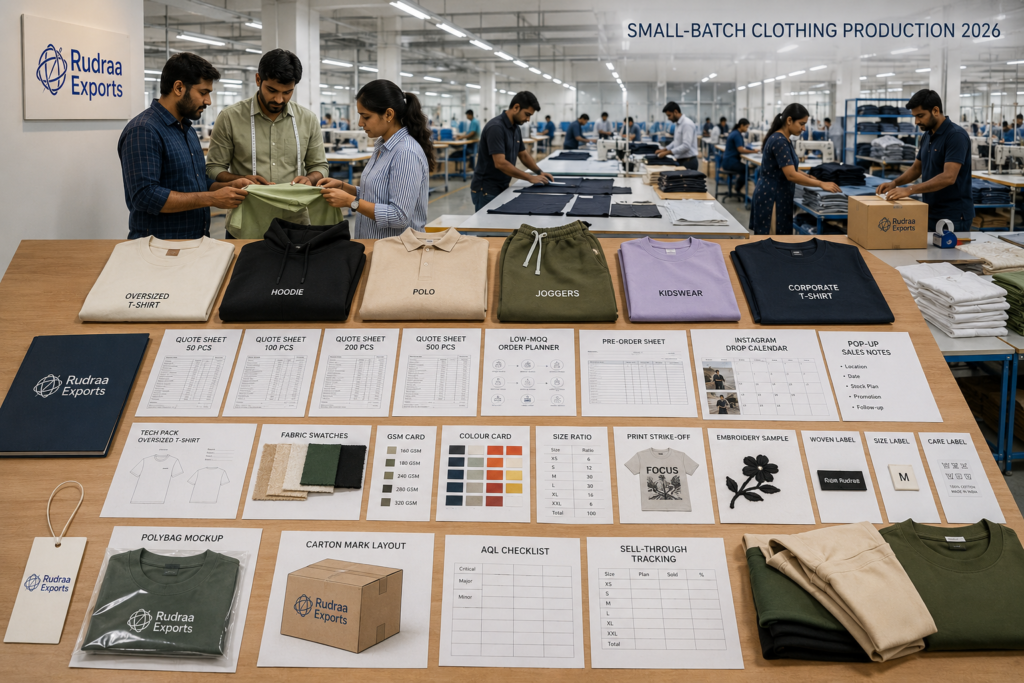
Launching a clothing brand does not mean you need to order thousands of pieces on day one.
For many first-time founders, DTC brands, streetwear labels, Instagram stores, boutique owners, and corporate merch buyers, small-batch production is a safer way to start.
A small batch lets you test your design, price, fit, fabric, colour, size ratio, packaging, and customer demand without locking too much money into unsold inventory.
In this guide, small-batch production means around 300 units per style.
This is enough to look professional, sell properly, collect real feedback, and decide what to scale next.
At Rudraa Exports, we help new and growing brands manufacture small-batch T-shirts, polos, hoodies, sweatshirts, joggers, leggings, kidswear, babywear, uniforms, corporate apparel, and private-label knitwear from Tirupur, India, with factory-direct guidance, sampling support, MOQ planning, production, QC, packing, and export documentation.
Quick Answer
Small-batch clothing production means manufacturing a limited quantity, usually 300 units per style, to test market demand before scaling. It is useful for new clothing brands because it reduces upfront cash risk, avoids dead stock, allows faster design learning, and helps validate fit, pricing, colour, and size demand. Small-batch production has a higher per-unit cost than large MOQ production, but the total financial risk is lower for first launches and early-stage brands.
Planning to launch your clothing brand with a small-batch order? Contact Rudraa Exports to request a low-MOQ production plan for your product, fabric, quantity, and target market.
What Is Small-Batch Clothing Production?
Small-batch clothing production means making a limited quantity of garments before committing to larger production.
For this guide, small batch means:
| Batch Type | Quantity Range |
|---|---|
| Micro batch | 20–50 units |
| Small batch | 50–200 units |
| Pilot batch | 100–300 units |
| Growth batch | 300–500 units |
| Scale batch | 500+ units |
Small-batch production is not only about quantity.
It is a launch strategy.
It helps you test the market before you spend heavily.
Why Small-Batch Production Helps New Clothing Brands
New clothing brands usually do not know which style, colour, size, price, or fit will sell best.
Small-batch production helps reduce risk.
Benefits of Small-Batch Production
| Benefit | Why It Matters |
|---|---|
| Lower upfront cash | You do not need to buy huge inventory |
| Less dead stock | Fewer unsold pieces if demand is weak |
| Faster learning | You learn from real buyers |
| Better design flexibility | You can improve the next drop |
| Easier testing | Test colours, prints, and fits |
| Useful for pre-orders | Produce closer to demand |
| Better cash control | Safer for first-time founders |
| Easier brand launch | Build momentum without overcommitting |
The uploaded source explains that small-batch production helps brands look legitimate, sell through, and learn fast without betting all savings on unvalidated inventory.
Small-Batch vs Large-MOQ Production
Small-batch and large-MOQ production are not the same business model.
They serve different stages of a brand.
Comparison Table
| Criteria | Small-Batch Production | Large-MOQ Production |
|---|---|---|
| Typical quantity | 300 units per style | 500–1,000+ units per style |
| Upfront cash | Lower | Higher |
| Per-unit cost | Higher | Lower |
| Inventory risk | Lower | Higher |
| Flexibility | Higher | Lower |
| Design learning | Faster | Slower |
| Factory availability | Limited | Wider |
| Best for | New brands and drops | Proven repeat sellers |
| Main risk | Higher unit cost | Dead stock |
| Main advantage | Safer validation | Better margin at scale |
The uploaded source compares small-batch production with large-MOQ production across cash outlay, unit cost, inventory risk, flexibility, lead time, factory availability, QC, and scalability.
When Small-Batch Production Is the Right Choice
Small-batch is a strong fit when you are still validating demand.
Choose Small-Batch If You Are
- Launching your first clothing brand
- Testing your first T-shirt or hoodie drop
- Selling through Instagram or Shopify
- Running pre-orders
- Testing pop-ups
- Testing price points
- Unsure about size ratios
- Unsure about colour demand
- Trying a new fabric or GSM
- Building a streetwear capsule
- Testing corporate merch samples
- Launching a private-label basic
Small-Batch Example
A streetwear founder can start with:
| Product | Quantity |
|---|---|
| Oversized T-shirt | 100 pcs |
| Hoodie | 75 pcs |
| Jogger | 50 pcs |
This is safer than ordering 1,000 pieces before knowing which style will sell.
When Small-Batch May Not Be the Best Fit
Small-batch is not always the best option.
Large-MOQ May Be Better If
- You already have proven demand
- You have wholesale orders
- You need the lowest possible unit price
- You sell uniforms or basics repeatedly
- Your product uses custom fabric with high minimums
- Your margin depends on bulk pricing
- You already know your size curve
- You have strong cash flow
Buyer Rule
If you cannot confidently sell most of the order within 30–60 days, start small.
If the product is already proven, scale gradually.
Why Small-Batch Costs More Per Unit
Small-batch production usually has a higher per-unit cost.
This is normal.
The factory still needs to do many of the same steps as a large order.
Cost Drivers
| Cost Driver | Why It Affects Small Batch |
|---|---|
| Pattern making | Same setup cost spread across fewer units |
| Sampling | Needed before bulk |
| Fabric sourcing | Small quantities may cost more |
| Dyeing | Custom colours may have dye-lot minimums |
| Cutting | Less efficient than bulk cutting |
| Printing | Screen setup cost spread across fewer pieces |
| Embroidery | Setup and digitising cost |
| Labels | Custom labels have MOQ |
| Packing | Small runs still need export-ready packing |
A 100-piece order may cost more per unit than a 1,000-piece order, but the total financial risk is lower.
Small-Batch Cost Planning
Do not compare only unit cost.
Compare total risk.
Example: Small Batch vs Large MOQ
| Scenario | Unit Cost | Quantity | Total Inventory Cost |
|---|---|---|---|
| Small batch | Higher | 100 pcs | Lower total risk |
| Large MOQ | Lower | 1,000 pcs | Higher total risk |
A cheaper per-unit price can still be dangerous if you cannot sell the inventory.
Buyer Tip
Your first batch should buy learning.
Your second batch should improve margin.
MOQ Challenges in Small-Batch Production
MOQ means Minimum Order Quantity.
For small-batch clothing, the biggest challenge is not always sewing.
It is fabric, dyeing, trims, labels, printing, and packaging.
MOQ Pressure Points
| Area | MOQ Challenge |
|---|---|
| Fabric | Mills may require minimum fabric quantity |
| Dyeing | Custom colours need dye-lot minimums |
| Rib | Matching rib may need extra quantity |
| Labels | Woven labels have minimums |
| Printing | Setup cost affects small orders |
| Embroidery | Digitising and placement costs |
| Packaging | Custom polybags and cartons need MOQ |
The uploaded source notes that the real gatekeeper in small-batch production is often fabric and trims, not stitching.
How to Make Small-Batch Production Easier
Start with simple choices.
Small-Batch Friendly Decisions
| Instead of… | Choose… |
|---|---|
| 5 colours | 1–2 core colours |
| Custom-dyed fabric | Available fabric colours |
| Many trims | Standard trims |
| Complex packaging | Simple export packing |
| 4 print placements | 1–2 strong placements |
| Too many SKUs | One hero product |
| Special wash | Standard finishing |
| Unclear tech pack | Clear basic tech pack |
For the first launch, simplicity is your friend.
Best Products for Small-Batch Clothing Production
Some products are easier to produce in small batches than others.
Small-Batch Friendly Products
| Product | Why It Works |
|---|---|
| T-shirts | Simple construction and strong demand |
| Polo shirts | Good for corporate and retail basics |
| Sweatshirts | Good for drops and merch |
| Hoodies | Strong streetwear and merch product |
| Joggers | Good paired with hoodies |
| Leggings | Useful for basics and kidswear |
| Kids T-shirts | Good for small brand tests |
| Corporate apparel | Useful for company orders |
| Uniforms | Repeat potential |
| Private-label basics | Easy to scale after validation |
More Complex for Small Batch
| Product | Why It Is Harder |
|---|---|
| Custom denim | Wash and fabric complexity |
| Heavy outerwear | Hardware and construction |
| Highly embellished styles | Labour and QC complexity |
| Custom yarn programs | High material MOQ |
| Many-size kidswear sets | Size ratio complexity |
Step-by-Step: Launch Your Clothing Brand with 50–200 Units
Step 1: Choose One Hero Product
Do not start with a large collection.
Choose one product that represents your brand.
Good first products include:
- Oversized T-shirt
- Regular T-shirt
- Polo shirt
- Hoodie
- Sweatshirt
- Jogger
- Kids T-shirt
- Corporate T-shirt
- Uniform polo
Step 2: Validate Demand Before Production
Before manufacturing, check whether people want the product.
Validation Methods
| Method | What to Measure |
|---|---|
| Pre-order | Paid intent |
| Instagram drop | Saves, DMs, comments, waitlist |
| Pop-up | Try-on feedback and direct sales |
| WhatsApp list | Real buyer interest |
| Email waitlist | Launch demand |
| Sample shoot | Visual response |
| Paid ads test | Click-through and signups |
Buyer Tip
Likes are not sales.
Look for paid orders, deposits, waitlist signups, or clear buyer intent.
Step 3: Build a Simple Tech Pack
Your first tech pack does not need to be complex, but it must be clear.
Basic Tech Pack Should Include
| Section | What to Add |
|---|---|
| Product name | T-shirt, hoodie, polo, etc. |
| Reference image | Style direction |
| Fabric | Composition and GSM |
| Measurements | Size chart and tolerance |
| Colours | Pantone or reference |
| Print / embroidery | Artwork and placement |
| Labels | Neck, size, care labels |
| Packing | Polybag, carton, barcode |
| Quantity | Target order size |
| Notes | Fit and finishing preferences |
A clear tech pack helps the factory quote and sample accurately.
Step 4: Request Samples
Do not skip sampling.
Sampling is where you check fit, fabric, print, labels, and workmanship before production.
Sample Stages
| Sample Type | Purpose |
|---|---|
| Fabric swatch | Checks fabric and GSM |
| Proto sample | First physical version |
| Fit sample | Checks size and body fit |
| Print strike-off | Checks print placement and quality |
| Embroidery sample | Checks logo execution |
| PP sample | Final approval before bulk |
Buyer Tip
For a small-batch launch, one well-approved sample is better than rushing into 200 wrong pieces.
Step 5: Keep the First Batch Focused
The first batch should be simple.
Good First Batch Structure
| Element | Recommendation |
|---|---|
| SKUs | 1–2 styles |
| Colours | 1–2 colours |
| Sizes | Core size range |
| Quantity | 300 units per style |
| Decoration | 1–2 placements |
| Packaging | Simple but branded |
| QC | Strong final check |
Example:
- 100 black oversized T-shirts
- 100 white oversized T-shirts
- One chest print
- One neck label
- One care label
- Standard polybag packing
Step 6: Track Sell-Through and Feedback
After launch, track real data.
Metrics to Track
| Metric | Why It Matters |
|---|---|
| Sell-through | Shows demand |
| Best-selling size | Helps reorder planning |
| Best colour | Guides next drop |
| Return reason | Shows fit or quality issue |
| Customer feedback | Improves next version |
| Repeat buyers | Shows brand strength |
| Restock requests | Signals scale potential |
Scaling Signal
If a product sells through strongly and customers ask for restock, increase quantity in the next run.
Step 7: Scale in Steps
Do not jump from 100 pieces to 5,000 pieces too quickly.
Scale gradually.
Scaling Path
| Stage | Quantity |
|---|---|
| First test | 50–100 pcs |
| First real drop | 100–200 pcs |
| Repeat drop | 200–500 pcs |
| Growth order | 500–1,000 pcs |
| Scale order | 1,000+ pcs |
As you scale, your unit cost usually improves because fabric, trims, cutting, printing, and packing become more efficient.
Small-Batch Pricing Strategy
Because unit cost is higher, pricing must be planned carefully.
Price Planning Questions
| Question | Why It Matters |
|---|---|
| What is your unit cost? | Base pricing |
| What is your packing cost? | Total product cost |
| What is your shipping cost? | Landed cost |
| What is your return rate? | Margin protection |
| What is your ad cost? | Customer acquisition |
| What margin do you need? | Profitability |
| What price will buyers accept? | Market fit |
Do not underprice your first batch only to look cheap.
You need enough margin to fund the next drop.
How to Negotiate Small-Batch Production
Factories may not give bulk pricing for a small run, but you can still negotiate smartly.
Negotiation Tips
| Tip | Why It Works |
|---|---|
| Ask for tiered pricing | Shows cost difference at 50/100/200/500 |
| Standardize fabric | Reduces sourcing complexity |
| Use fewer colours | Reduces dyeing pressure |
| Use same labels across styles | Reduces label MOQ |
| Place repeat order quickly | Builds factory confidence |
| Share forecast | Helps factory plan |
| Avoid last-minute changes | Saves production time |
Good Quote Request
Ask the factory:
“Please quote this product at 50, 100, 200, and 500 pieces, with blank garment pricing and print or embroidery cost shown separately.”
This helps you understand how price changes as you scale.
Why Tirupur Is Strong for Small-Batch Knitwear
Tirupur is a strong sourcing location for small-batch knitwear because of its dense knitwear ecosystem.
Tirupur Strengths
| Strength | Benefit for Small Brands |
|---|---|
| Knitwear specialization | Better for T-shirts, polos, hoodies |
| Fabric availability | Easier to test fabric options |
| Printing support | Useful for drops and streetwear |
| Embroidery support | Good for merch and logos |
| Export experience | Useful for global brands |
| Direct factory options | Fewer middle layers |
| MOQ flexibility | Better for early-stage brands |
| Scale potential | Easy to grow after validation |
The uploaded source explains that Tirupur can support low-MOQ knitwear programs and gives brands a path to start small and scale after demand is proven.
Direct Factory vs Agent for Small-Batch Production
For small batches, hidden margins matter.
A direct factory model can improve transparency.
Comparison
| Area | Direct Factory | Agent / Trader |
|---|---|---|
| Cost | More transparent | Agent margin added |
| MOQ discussion | More practical | May be bundled |
| Sampling feedback | Faster | Slower through layers |
| Fabric choice | Clearer | Depends on supplier network |
| QC | More direct | Depends on agent discipline |
| Production visibility | Better | Lower |
| Scaling | Easier with same factory | May move between suppliers |
| Accountability | One production partner | Responsibility can shift |
For 50–200 unit runs, direct communication helps avoid expensive mistakes.
How Rudraa Exports Supports Small-Batch Brands
Rudraa Exports supports small-batch and scaling garment production from Tirupur.
Small-Batch Support
- Low-MOQ production discussions
- Product feasibility review
- Fabric and GSM guidance
- Simple tech pack review
- Sampling support
- Print and embroidery approval
- Private-label support
- Packaging guidance
- Pilot order planning
- QC inspection
- Export documentation support
- Scale-up planning after sell-through
Product Categories Supported
- T-shirts
- Polo shirts
- Hoodies
- Sweatshirts
- Joggers
- Leggings
- Kidswear
- Babywear
- Corporate apparel
- School uniforms
- Activewear
- Private-label knitwear
Why Rudraa Exports
Rudraa Exports helps new and growing brands manufacture knitwear from Tirupur with factory-direct communication and export-ready production systems.
Manufacturing Strengths
- Factory-direct Tirupur knitwear manufacturing
- 72,000+ units per month production capacity
- MOQ discussions starting from around 300 pieces for suitable programs
- AQL 2.5 inspection standards
- Sampling support for first-time brands
- Export support for USA, UK, Europe, Australia, Middle East, and global buyers
- Multi-port shipping through Chennai, Tuticorin, and Cochin
Buyer Advantages
- Start small before scaling
- Reduce inventory risk
- Avoid unnecessary trading-company markups
- Up to 40% cost-saving positioning compared with indirect sourcing models
- Better fabric and GSM guidance
- Stronger sampling and QC support
- Easier scale path from 50 to 200 to 500 to 1,000+ units
Ready to launch with a small batch? Speak with Rudraa Exports to share your product idea, target quantity, design, fabric, GSM, and destination market.
Small-Batch Clothing Production Checklist
| # | Checklist Item |
|---|---|
| 1 | Choose one hero product |
| 2 | Validate demand before production |
| 3 | Build a simple tech pack |
| 4 | Confirm fabric and GSM |
| 5 | Confirm colour count |
| 6 | Confirm size range |
| 7 | Request tiered pricing |
| 8 | Confirm MOQ by style and colour |
| 9 | Approve fabric swatch |
| 10 | Approve fit sample |
| 11 | Approve print or embroidery |
| 12 | Approve labels |
| 13 | Confirm packaging |
| 14 | Run pilot batch |
| 15 | Inspect quality |
| 16 | Launch and track sell-through |
| 17 | Collect customer feedback |
| 18 | Plan reorder |
| 19 | Increase quantity gradually |
| 20 | Keep improving margin and product quality |
FAQ: Small-Batch Clothing Production
1. What is small-batch clothing production?
Small-batch clothing production means manufacturing a limited quantity, usually around 300 units per style, to test demand before scaling.
2. Is small-batch production good for new clothing brands?
Yes. Small-batch production is a good option for new brands because it reduces upfront cash risk, avoids large dead stock, and helps validate products with real customers.
3. Why does small-batch clothing cost more per unit?
Small-batch production costs more per unit because setup costs, sampling, cutting, printing, trims, and sourcing work are spread across fewer pieces.
4. Can I start a clothing brand with 50 pieces?
Yes, if the product, fabric, colour, and customization are suitable. A 50-piece batch can work well for pre-orders, capsule drops, influencer testing, or local brand launches.
5. What products are best for small-batch production?
T-shirts, polos, sweatshirts, hoodies, joggers, leggings, kidswear, uniforms, and private-label knitwear are good options when the design is kept simple.
6. How do I reduce MOQ pressure?
Use fewer colours, standard fabrics, simple trims, one or two print placements, shared labels, and simple export-ready packaging.
7. Should I take pre-orders before manufacturing?
Pre-orders can help validate demand and reduce inventory risk, but buyers must clearly communicate delivery timelines and production status.
8. How do I know when to scale?
Scale when a product sells through quickly, returns are low, size demand is clear, and customers request restocks.
9. Can Rudraa Exports support small-batch production?
Yes. Rudraa supports small-batch and scaling knitwear production from Tirupur, including T-shirts, polos, hoodies, joggers, kidswear, uniforms, and private-label apparel.
10. What should I send to request a small-batch quote?
Send product type, reference image, tech pack if available, fabric requirement, GSM, quantity, size range, colours, print or embroidery details, labels, packaging, and target market.
11. Is a small batch better than large MOQ?
Small batch is better for testing and early launch. Large MOQ is better when demand is proven and the brand needs lower unit cost.
12. Can small-batch production be exported?
Yes. Small-batch garments can be exported if the order is commercially viable and documentation, packing, and shipping requirements are clear.
Conclusion
Small-batch production is one of the safest ways to launch a clothing brand.
It allows you to test the market, validate fit, confirm pricing, learn size demand, improve designs, and scale only what works.
Yes, the per-unit cost may be higher than bulk production. But the total risk is lower because you avoid committing too much money before demand is proven.
For new brands, the goal is not to manufacture the cheapest possible product. The goal is to manufacture the right first batch, learn quickly, and build a repeatable path to scale.
Tirupur is a strong sourcing hub for small-batch knitwear because it offers fabric, printing, embroidery, sewing, packing, and export support in one ecosystem.
Rudraa Exports helps brands start with small batches and scale into repeat production through factory-direct planning, sampling support, MOQ guidance, QC, and export documentation.
Visit rudraaexports.com or contact our team directly to share your first clothing brand idea, target quantity, fabric, design, and destination market — and receive a small-batch production plan from Rudraa Exports.
Related reading
Low MOQ Clothing Manufacturing for Australian Startup Brands
How to Start a Clothing Brand in Australia: The Correct Order and Realistic Timeline
How to Get Samples from a Garment Manufacturer in India: Step-by-Step Buyer Guide
What Actually Drives Repeat Customers for Early-Stage Clothing Brands