
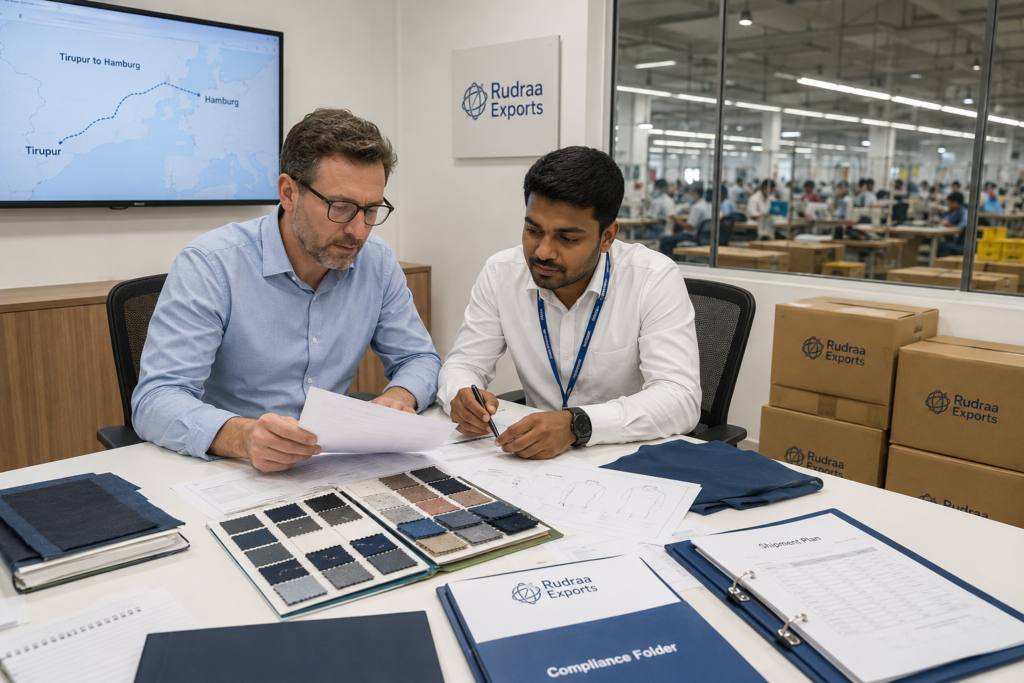
European fashion brands sourcing from India have always had one important cost challenge: import duty.
For many apparel products entering the European Union, brands must pay third-country customs duties on top of product cost, freight, insurance, compliance testing, warehousing, and retail margin pressure. For garments under many HS 61 and HS 62 categories, duty can significantly affect landed cost.
The India–EU Free Trade Agreement 2026 changes the long-term sourcing conversation. If implemented with meaningful tariff reductions for textiles and apparel, the agreement can make India a stronger sourcing destination for European fashion brands, especially for knitwear, cotton basics, T-shirts, polos, sweatshirts, kidswear, uniforms, and private-label apparel.
But the benefit will not be automatic.
European brands will only capture duty savings if their products meet Rules of Origin, documentation requirements, supplier traceability standards, and customs compliance conditions. That means the FTA is not only a tariff opportunity. It is also a supply-chain readiness test.
At Rudraa Exports, we help European buyers build factory-direct garment sourcing programs from Tirupur, India, with structured production records, export documentation, compliance support, and origin-readiness planning.
Quick Answer
The India–EU Free Trade Agreement 2026 is expected to create a pathway for lower or zero import duties on many Indian products entering the EU, including apparel categories over time. For European garment buyers, this can reduce landed cost and improve sourcing competitiveness. However, brands must not assume automatic savings. To qualify for preferential duty, garments must meet Rules of Origin, use compliant documentation, and maintain supplier traceability. European brands should keep 2026 costings conservative under MFN duty, but start preparing FTA-ready SKU plans, origin files, and India-based production structures now.
Planning to source garments from India to Europe? Contact Rudraa Exports to request an FTA-ready sourcing plan and origin documentation checklist.
Why the India–EU FTA Matters for Garment Buyers
Import duty can decide whether a garment program is profitable.
A T-shirt, polo, sweatshirt, or kidswear item may look cost-effective at FOB level, but once duty, freight, VAT handling, customs clearance, testing, and warehousing are added, the landed cost can become much higher.
For years, European brands sourcing from India had to model apparel imports using standard MFN duty assumptions unless a valid preference applied. The India–EU FTA creates a future opportunity to reduce that duty burden.
Why This Matters
| Area | Buyer Impact |
|---|---|
| Landed cost | Lower duty can improve margin |
| Supplier strategy | India becomes more competitive |
| Product planning | Brands can shift more stable SKUs to India |
| Compliance | Rules of Origin become critical |
| Documentation | Origin proof must be managed properly |
| Negotiation | Buyers can plan long-term pricing with suppliers |
| Risk management | India becomes stronger for China-plus-one sourcing |
The FTA can improve India’s sourcing position, but only for brands that prepare early.
What European Brands Should Model Now
The biggest mistake is assuming duty will become zero immediately.
European brands should build three scenarios:
- Current MFN duty scenario
- Partial FTA duty reduction scenario
- Full preferential duty scenario
This helps procurement teams avoid over-promising savings before the agreement is fully implemented and legally usable.
2026 Sourcing Model
| Scenario | What It Means | How Buyers Should Use It |
| MFN duty | Current standard duty applies | Use for near-term 2026 costing |
| Partial reduction | Duty reduces in stages | Use for 2027–2032 planning |
| 0% duty | End-state preference applies | Use only if RoO and documentation qualify |
| Failed RoO | Product does not qualify | Reverts to MFN duty |
| Documentation failure | Preference denied | Duty savings lost |
The safest procurement approach is simple: cost today conservatively, prepare tomorrow aggressively.
MFN vs FTA: How Duty Savings Work
An FTA does not reduce every cost line.
It mainly affects the customs duty line.
Duty Savings Formula
Duty savings = customs value × duty rate removed
If a garment currently attracts 12% duty and the FTA eventually reduces that duty to 0%, then the buyer saves 12% of the customs value, assuming the product qualifies under Rules of Origin.
Example: Cotton T-Shirt
| Item | Example Value |
| Product | Cotton T-shirt |
| Customs value | €5.00 |
| Current duty | 12% |
| Duty amount | €0.60 |
| FTA duty | 0% |
| Potential saving | €0.60 per unit |
For a 250,000-piece program, this can mean:
€0.60 × 250,000 = €150,000 potential duty saving
That is a meaningful margin improvement.
Why the FTA Is Not an Automatic Discount
Many brands think an FTA means cheaper imports immediately.
That is not correct.
A shipment must qualify.
A Garment Must Usually Prove:
- Correct HS code
- Eligible product category
- Compliant origin
- Valid origin documentation
- Supplier declarations
- Manufacturing process evidence
- Direct shipment conditions where required
- Correct customs entry documentation
If any of these fail, the shipment may not receive preferential duty.
What Can Go Wrong
| Problem | Result |
| Imported fabric does not qualify | Preference may be denied |
| No supplier declaration | Customs may reject claim |
| Wrong HS code | Duty calculation issue |
| Missing production records | Origin cannot be proven |
| Incorrect origin statement | Clearance or audit risk |
| Fragmented supplier chain | Documentation gaps |
| Trader-managed sourcing | Weak traceability |
FTA savings are not just negotiated. They are operationally earned.
Rules of Origin: The Most Important FTA Requirement
Rules of Origin decide whether a garment is treated as Indian-origin for preferential duty.
For apparel, origin can depend on where the yarn, fabric formation, dyeing, cutting, sewing, and finishing happen. A product made in India may still fail preference if key inputs or processes do not meet the agreement’s origin rules.
Rules of Origin Questions Buyers Should Ask
| Question | Why It Matters |
| Where is the yarn sourced? | May affect origin eligibility |
| Where is the fabric knitted or woven? | Key apparel transformation step |
| Where is dyeing or processing done? | Supports origin file |
| Where are cutting and sewing done? | Confirms garment manufacture |
| Are trims local or imported? | Can affect non-originating content |
| Are production records available? | Supports audit proof |
| Can supplier provide origin declaration? | Required for preference claim |
| Can the factory trace lot-level records? | Reduces customs audit risk |
European buyers should treat origin planning like product engineering.
Product Categories Most Likely to Benefit
Stable, repeatable garment programs are best positioned to benefit from the India–EU FTA.
Strong FTA-Ready Categories
| Product Category | Why It Fits |
| Cotton T-shirts | High volume and simple BOM |
| Polo shirts | Repeatable fabric and trims |
| Sweatshirts | Stable knitwear programs |
| Hoodies | Good for planned sourcing |
| Kidswear | Repeat styles and seasonal planning |
| Babywear | Strong India/Tirupur category |
| Corporate uniforms | Repeat replenishment |
| School uniforms | Long-term institutional programs |
| Athleisure basics | Strong if fabric origin is controlled |
| Private-label basics | Good for standardization |
The more stable the product, the easier it is to build an origin file.
Product Categories That May Need More Work
Some styles may struggle to qualify if materials are complex or sourced from multiple countries.
Higher-Risk Categories
| Product Type | Risk |
| Multi-fabric garments | More origin complexity |
| Imported performance fabrics | May fail origin rules |
| Bonded or technical apparel | Complex BOM |
| Heavy trim dependency | Non-originating content risk |
| Fast-fashion spot buys | Weak documentation |
| Open-market fabric purchases | Poor traceability |
| Multi-country production | Origin chain becomes unclear |
These products can still benefit, but they need stronger planning.
Why Factory-Direct Sourcing Matters Under an FTA
Under an FTA, documentation becomes as important as production.
When sourcing through multiple agents, traders, or intermediaries, origin evidence can become fragmented. A factory-direct partner improves accountability.
Factory-Direct Advantages
| Area | Advantage |
| Cost | Fewer middlemen and markup layers |
| Communication | Faster clarification |
| Origin records | Easier production traceability |
| Compliance | One accountable partner |
| Documentation | Cleaner shipment files |
| Quality control | Faster corrective action |
| Long-term planning | Easier SKU-level readiness |
At Rudraa Exports, the factory-direct model helps buyers connect product development, production records, quality control, export documentation, and origin-readiness in one workflow.
How FTA Savings and Factory-Direct Savings Can Stack
European brands should think in layers.
First, factory-direct sourcing can reduce cost by removing unnecessary trading-company or agent markups.
Second, future FTA duty reductions can reduce customs duty.
Together, these savings can improve landed cost significantly.
Example Savings Structure
| Savings Layer | How It Helps |
| Factory-direct sourcing | Reduces supplier markup |
| Better MOQ planning | Improves production efficiency |
| Fabric standardization | Reduces material waste |
| FTA duty reduction | Lowers customs duty |
| Better documentation | Prevents preference denial |
| Quality control | Reduces claims and rework |
The biggest advantage comes when cost savings and compliance systems work together.
How European Brands Should Prepare Now
The brands that wait until duty reductions are live may lose time.
The smart approach is to prepare now.
Step 1: Build an FTA SKU Map
Create a list of your imported garment SKUs.
For each SKU, document:
- Product name
- HS code
- Fiber composition
- Current supplier
- Country of manufacture
- Fabric origin
- Trims origin
- Annual volume
- Current duty
- Landed cost
- Origin confidence level
FTA SKU Map Example
| SKU | Product | HS Code | Volume | Origin Confidence |
| TS-101 | Cotton T-shirt | 6109 | 100,000 pcs | High |
| PO-220 | Polo shirt | 6105 / 6106 | 60,000 pcs | Medium |
| HD-450 | Hoodie | 6110 | 40,000 pcs | Medium |
| LG-300 | Leggings | 6104 | 30,000 pcs | Low |
Start with high-volume, high-origin-confidence products.
Step 2: Engineer Origin Into the BOM
Do not wait until shipment to think about origin.
Build the Bill of Materials with origin in mind.
Origin-Ready BOM Checklist
| Component | What to Track |
| Yarn | Supplier and origin |
| Fabric | Knitting/weaving location |
| Dyeing | Processing location |
| Printing | Process and location |
| Embroidery | Process and location |
| Trims | Origin and value |
| Labels | Origin and compliance |
| Packaging | Required documentation |
| Cut and sew | Factory records |
| Shipment | Direct shipment evidence |
The best FTA-ready products are designed to qualify from the beginning.
Step 3: Build the Origin Documentation File
Every FTA-ready shipment should have an origin file.
Origin File Should Include
- Tech pack
- HS classification sheet
- Bill of Materials
- Supplier declarations
- Fabric invoices
- Yarn or fabric origin records
- Dyeing and processing records
- Cutting records
- Sewing records
- Packing list
- Commercial invoice
- Certificate or origin statement where applicable
- Shipment records
- Export documents
This file protects the buyer if customs asks for proof.
Step 4: Rework Supplier Contracts
FTA readiness should be written into supplier agreements.
Contract Clauses to Add
| Clause | Purpose |
| Origin documentation responsibility | Defines who provides proof |
| Supplier declaration requirement | Supports preference claim |
| Record retention period | Protects audit readiness |
| Change-control requirement | Prevents unapproved fabric changes |
| Subcontracting approval | Protects origin chain |
| HS code cooperation | Supports customs broker |
| Compliance document timeline | Prevents shipment delays |
| Rework responsibility | Defines consequences for errors |
If the supplier changes fabric without approval, origin eligibility may fail. That must be controlled.
Step 5: Create a Duty Savings Model
Do not just ask, “Will duty become zero?”
Build a model.
Duty Savings Model
| Year | Duty Scenario | Example Duty on €5 Item | Saving vs 12% Baseline |
| 2026 | 12% MFN | €0.60 | €0.00 |
| 2027 | 9% assumption | €0.45 | €0.15 |
| 2028 | 6% assumption | €0.30 | €0.30 |
| 2029 | 3% assumption | €0.15 | €0.45 |
| Final stage | 0% assumption | €0.00 | €0.60 |
These are modelling assumptions only. Buyers should update them once the final legal schedule is confirmed.
Step 6: Align Quality and Compliance With FTA Readiness
FTA planning should not be separate from quality and compliance.
The same records used for origin can also support buyer compliance, traceability, ESG reporting, and audit readiness.
Combined Readiness System
| Requirement | Shared Evidence |
| Rules of Origin | BOM, supplier declarations, process records |
| Quality control | Inspection reports, production records |
| REACH/RSL | Material and chemical documents |
| GOTS/OEKO-TEX | Certificate scope and transaction evidence |
| ESG reporting | Supplier traceability and process data |
| Customs clearance | Invoice, packing list, origin statement |
One strong data system can serve multiple buyer needs.
Why Rudraa Exports
Rudraa Exports is positioned to support European buyers preparing for the India–EU FTA because we combine factory-direct manufacturing with structured export support.
Manufacturing Capabilities
- Factory-direct Tirupur knitwear manufacturing
- 72,000+ units per month production capacity
- T-shirts, polos, sweatshirts, hoodies, joggers, leggings, kidswear, babywear, uniforms, activewear, corporate apparel, and private-label knitwear
- MOQ discussions starting from around 300 pieces for suitable programs
- Sampling support for European buyers
- Bulk production planning for repeat programs
FTA-Readiness Support
- SKU-level sourcing review
- Fabric and trims origin mapping
- Bill of Materials documentation
- Production record support
- Supplier declaration coordination where applicable
- Commercial invoice and packing list support
- Certificate of origin support where required
- HS code cooperation with buyer/customs broker
- Export documentation workflow
Quality and Compliance Support
- ISO 9001:2015 certified manufacturing approach
- AQL 2.5 inspection standards
- Support for OEKO-TEX, GOTS, GRS, BSCI, SMETA, WRAP, AEO, and related buyer requirements where applicable
- Fabric, GSM, shade, measurement, print, embroidery, trims, label, and packing controls
- Traceability support across fabric lots, dye lots, production batches, inspection records, and shipment files
Buyer Advantages
- Factory-direct pricing without trading-company markups
- Up to 40% cost-saving positioning compared with indirect sourcing models
- English-language communication for European buyers
- Export support for Germany, France, Netherlands, Italy, Spain, Belgium, Denmark, Sweden, and wider EU markets
- Multi-port shipping through Chennai, Tuticorin, and Cochin
- Better preparation for future preferential duty claims
Ready to prepare your garment sourcing for the India–EU FTA? Speak with Rudraa Exports to request an FTA-ready SKU plan, origin checklist, and factory-direct sourcing review.
India–EU FTA Buyer Checklist
| # | Checklist Item |
| 1 | Identify top EU import SKUs |
| 2 | Confirm HS code for each product |
| 3 | Record current MFN duty |
| 4 | Map yarn, fabric, trims, and production origin |
| 5 | Check whether Indian production can meet likely RoO |
| 6 | Build origin file per style |
| 7 | Add supplier declaration requirements |
| 8 | Control subcontracting and fabric changes |
| 9 | Prepare commercial invoice and packing list templates |
| 10 | Align customs broker and supplier documentation |
| 11 | Model duty savings by year |
| 12 | Start with high-volume, simple knitwear SKUs |
FAQ: India–EU Free Trade Agreement and Garment Sourcing
1. What is the India–EU Free Trade Agreement 2026?
The India–EU Free Trade Agreement is a trade agreement intended to reduce or eliminate tariffs on many goods traded between India and the European Union, including potential benefits for textiles and apparel over time.
2. Will the India–EU FTA make Indian garments duty-free immediately?
Not necessarily. Tariff reductions may be phased, and buyers must wait for legal implementation and product-specific schedules before claiming preference.
3. What does the FTA mean for European apparel brands?
It can reduce landed cost for qualifying garments sourced from India, making India more competitive as a sourcing destination for European brands.
4. What are Rules of Origin?
Rules of Origin decide whether a product qualifies as originating from India. For apparel, this may depend on where yarn, fabric, cutting, sewing, and finishing are done.
5. Can a garment made in India fail FTA eligibility?
Yes. If key materials or processes do not meet the origin rule, the garment may not qualify for preferential duty even if final sewing happens in India.
6. What documents are needed to claim FTA preference?
Documents may include supplier declarations, Bill of Materials, origin records, production records, commercial invoice, packing list, and origin statement or certificate where required.
7. Which apparel products may benefit most?
Cotton T-shirts, polos, sweatshirts, hoodies, kidswear, uniforms, and private-label basics may benefit because they are repeatable and easier to document.
8. What should brands do in 2026?
Brands should continue costing conservatively using current MFN duty, while preparing FTA-ready SKU maps, origin files, supplier declarations, and India-based production structures.
9. Why is factory-direct sourcing useful under an FTA?
Factory-direct sourcing reduces documentation gaps, improves communication, supports traceability, and helps buyers build stronger origin evidence.
10. Can FTA savings and factory-direct savings work together?
Yes. Buyers can benefit from both lower supplier markup through factory-direct sourcing and future duty reductions through FTA preference, if products qualify.
11. How does Rudraa Exports help with FTA readiness?
Rudraa helps buyers map SKUs, review BOM origin, maintain production records, prepare export documentation, support compliance files, and coordinate factory-direct sourcing from Tirupur.
12. Should European brands move all sourcing to India because of the FTA?
No. Brands should start with high-volume, simple, repeatable knitwear SKUs that have strong origin confidence, then expand after systems are proven.
Conclusion
The India–EU Free Trade Agreement 2026 can become a major opportunity for European brands sourcing garments from India. But the real winners will not be the brands that wait for tariff reductions. The winners will be the brands that prepare early.
Duty savings depend on HS codes, implementation schedules, Rules of Origin, documentation, and supplier traceability. That means procurement teams should start building FTA-ready SKU maps, origin files, compliant BOMs, supplier declarations, and documentation workflows now.
For European brands sourcing knitwear, Tirupur offers a strong manufacturing base. With the right factory-direct partner, brands can combine cost efficiency, production control, compliance readiness, and future FTA duty savings.
Visit rudraaexports.com or contact our team directly to share your product category, MOQ, HS code, destination market, and current sourcing setup — and receive an FTA-ready garment sourcing plan from Rudraa Exports.
Related reading
How German Fashion Brands Source Garments from India: A Step-by-Step Procurement Guide
Garment Manufacturers India for European Brands: Complete Sourcing Guide 2026
EU Sustainability Compliance for Garments Made in India: Practical Guide for European Apparel Brands