
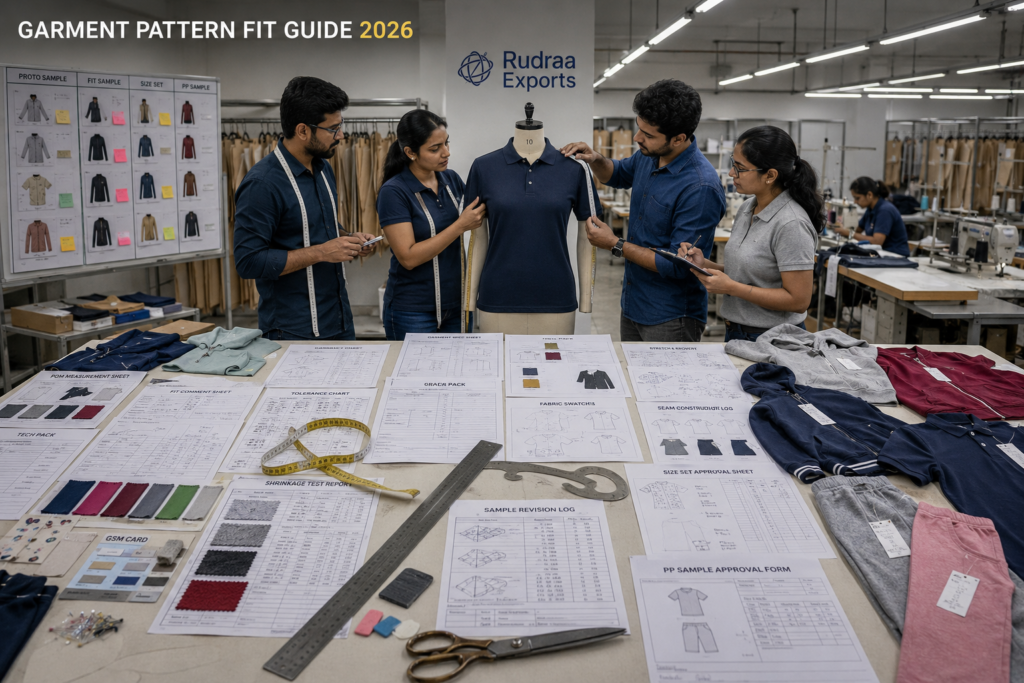
Fit problems usually do not start in sewing.
They start earlier.
A garment can be stitched well and still fit badly if the pattern, fabric, measurements, grading, construction, and sample feedback are not aligned.
This is why garment pattern development is one of the most important steps in apparel manufacturing.
A good pattern helps the garment sit correctly on the body. A weak pattern creates problems such as chest pulling, sleeve twisting, tight armholes, uneven hems, waistband rolling, crotch discomfort, poor shoulder balance, and repeated sample revisions.
For clothing brands, bad fit is expensive.
It increases sampling cost, delays launch dates, creates bulk production risk, and leads to customer returns.
At Rudraa Exports, we help global buyers develop production-ready patterns for T-shirts, polos, hoodies, sweatshirts, joggers, leggings, kidswear, babywear, uniforms, corporate apparel, and private-label knitwear from Tirupur, India.
Quick Answer
To perfect garment patterns, brands must align design intent, fabric behaviour, measurements, tolerances, grading rules, construction details, and fit feedback before bulk production. A production-ready pattern should be tested through fit samples, size sets, shrinkage checks, POM measurements, movement tests, and final PP sample approval. Good pattern development reduces sample rounds, improves bulk consistency, lowers return risk, and helps factories produce garments closer to the approved fit.
Need help improving garment fit before bulk production? Contact Rudraa Exports to request a pattern and sample development review.
Why Garment Patterns Matter
A garment pattern is the blueprint used to cut fabric panels.
It decides:
- Shape
- Fit
- Balance
- Ease
- Length
- Width
- Armhole
- Sleeve shape
- Shoulder slope
- Neckline
- Crotch curve
- Waistband
- Hemline
- Panel placement
If the pattern is wrong, sewing cannot fully fix the garment.
A sewing team can adjust small things, but it cannot correct a badly balanced pattern without changing the master pattern.
The uploaded source explains that fit problems often start when design intent, fabric behaviour, pattern geometry, grading rules, and construction methods are not aligned into one production-ready system.
Common Fit Problems Caused by Weak Patterns
| Fit Problem | Possible Pattern Cause |
|---|---|
| Chest pull lines | Not enough front width or armhole issue |
| Sleeve rides up | Sleeve cap or armhole mismatch |
| Neckline gaping | Neck drop or shoulder balance issue |
| Shoulder seam falls forward | Front/back balance issue |
| Waistband twists | Pattern grain or construction issue |
| Jogger crotch pulls | Crotch curve or rise issue |
| Hoodie hood feels tight | Hood shape or neckline attachment issue |
| Leggings twist after wash | Fabric grain or stretch direction issue |
| Side seam swings | Pattern balance issue |
| Hem is uneven | Front/back length imbalance |
These issues should be corrected in the pattern, not only during sewing.
Why Sample Rounds Increase
Many brands get stuck in repeated sample rounds because feedback is unclear or corrections are made in the wrong place.
Common Reasons for Too Many Samples
| Reason | What Happens |
|---|---|
| No clear POM sheet | Factory guesses measurement method |
| No tolerance | Buyer and factory argue over small variation |
| Wrong base size | Fit comments do not translate well |
| Fabric not final | Pattern changes after fabric changes |
| Shrinkage ignored | Garment changes after wash |
| Grading not checked | Other sizes fit badly |
| Comments are subjective | “Feels tight” is not enough |
| Sewing workaround used | Pattern is not corrected |
| No master pattern update | Same mistake repeats |
The uploaded source notes that 3–5 sample rounds are common, and each cycle can take 2–3 weeks depending on the workflow.
Pattern Development Workflow: Common vs Direct Factory
| Area | Fragmented Workflow | Direct Factory Pattern Workflow |
|---|---|---|
| Pattern making | Separate vendor or freelancer | Aligned with factory team |
| Sampling | Another unit may stitch | Sample room and pattern team coordinate |
| Feedback | Passes through multiple people | Direct correction loop |
| Fabric behaviour | Often considered late | Checked early |
| Grading | May be generic | Based on POM and fit intent |
| QC tolerance | May vary by supplier | Defined before bulk |
| Bulk readiness | Risk of mismatch | Pattern, sample, and QC aligned |
A direct-factory workflow reduces confusion because pattern, sampling, production, and QC work from the same approved information.
The 5 Foundations of a Production-Ready Pattern
1. Design Intent
Before pattern making starts, the factory must understand the intended fit.
For example:
- Slim fit
- Regular fit
- Relaxed fit
- Oversized fit
- Cropped fit
- Boxy fit
- Athletic fit
- Kids regular fit
- Uniform fit
A pattern maker cannot create the right garment if the fit direction is unclear.
2. Fabric Behaviour
Fabric changes fit.
A pattern for 100% cotton jersey will not behave the same as a cotton-elastane jersey, fleece, French terry, rib, woven cotton, or polyester blend.
Fabric Factors to Check
| Fabric Factor | Why It Matters |
|---|---|
| GSM | Affects drape and structure |
| Stretch | Affects ease and body fit |
| Recovery | Affects shape after wearing |
| Shrinkage | Affects post-wash measurement |
| Spirality | Affects twisting in knits |
| Thickness | Affects seams and bulk |
| Drape | Affects silhouette |
The uploaded source highlights that fabric shrinkage, recovery, and knit behaviour must be integrated early to prevent post-wash fit changes.
3. POM Sheet
POM means Point of Measure.
A POM sheet defines where and how each measurement should be taken.
POM Sheet Should Include
| Item | Example |
|---|---|
| POM name | Chest |
| Measurement method | 1 inch below armhole, flat |
| Base size | M |
| Size grading | S to XXL |
| Tolerance | ±1 cm or ±2 cm |
| Diagram | Visual measurement point |
A POM sheet prevents confusion between buyer and factory.
4. Tolerances
No bulk production can match every measurement exactly.
Tolerances define acceptable variation.
Example Tolerance Guide
| Garment Area | Typical Tolerance Logic |
|---|---|
| Chest / body width | Wider tolerance |
| Body length | Medium tolerance |
| Shoulder | Tighter tolerance |
| Collar / neckline | Tighter tolerance |
| Sleeve length | Medium tolerance |
| Waistband | Tighter for fitted garments |
| Leg opening | Depends on product |
The uploaded source gives practical tolerance examples such as wider tolerances for body girths and tighter zones for collars and shoulders.
5. Construction Method
Construction affects final measurement.
A seam type, stitch tension, rib attachment, waistband method, or pocket construction can change how the garment fits.
Construction Details to Confirm
- Seam type
- Stitch type
- Stitch tension
- Rib attachment
- Neck tape
- Shoulder tape
- Waistband method
- Cuff attachment
- Pocket construction
- Zipper placement
- Hem width
- Elastic tension
A pattern should be developed with actual construction in mind.
Pattern Geometry: Why Shape Matters
A pattern is not just measurements.
Two garments can have the same chest measurement but fit differently because the shape is different.
Pattern Geometry Includes
| Area | Why It Matters |
|---|---|
| Shoulder slope | Controls shoulder balance |
| Armhole shape | Controls movement |
| Sleeve cap | Controls sleeve comfort |
| Front/back balance | Controls hang and side seam |
| Neck drop | Controls neckline fit |
| Crotch curve | Controls comfort in pants |
| Waistband shape | Controls twist and pressure |
| Hip curve | Controls lower-body fit |
Good pattern development checks both measurement and shape.
Garment Grading: Making All Sizes Fit
Grading means creating different sizes from the base pattern.
Key takeaway: A graded pattern only holds across the size run when those measurements are captured as a consistent, documented size chart — buyers reject sizes that drift between samples. Turn your graded points of measure into a professional, branded chart with our free size chart builder: choose the garment, switch between cm and inches, and download a ready-to-use size chart PDF for your tech pack and product pages.
A good base-size sample does not guarantee that all sizes will fit well.
Why Grading Matters
| Problem | Cause |
|---|---|
| Size S too tight but M fits | Grade rule issue |
| XXL sleeve too long | Over-grading sleeve length |
| Kids sizes feel inconsistent | Age grading issue |
| Jogger waist fits but hip tight | Poor lower-body grade distribution |
| Hoodie looks good in M but bulky in XL | Grade and proportion issue |
The uploaded source explains that grading is not simply adding centimetres everywhere; it must preserve the style’s shape and design intent across sizes.
Size Set Approval
Before bulk production, brands should approve size set samples.
Size Set Helps Check
- Grading
- Proportion
- Length
- Sleeve fit
- Waistband fit
- Neck opening
- Leg opening
- Kids age fit
- Extended size balance
For export buyers, size set approval is especially important before large production.
Static Fit vs Dynamic Fit
Fit should be checked while standing and while moving.
Static Fit
Static fit checks how the garment looks when the wearer stands normally.
Check:
- Front view
- Side view
- Back view
- Shoulder balance
- Hem level
- Side seam position
- Neckline
Dynamic Fit
Dynamic fit checks movement.
Check:
- Reaching forward
- Raising arms
- Sitting
- Squatting
- Walking
- Bending
- Stretching
The uploaded source recommends distinguishing static fit and dynamic fit because movement issues often involve armholes, sleeve caps, crotch curves, or stretch direction.
Example: Fixing Chest Tightness in a Knit Top
Symptom
The sample shows horizontal drag lines across the chest. The wearer feels tightness when reaching forward.
Weak Feedback
“Chest is tight. Add 2 cm.”
This may not solve the problem.
Better Diagnosis
Check:
- Chest POM
- Armhole depth
- Sleeve cap
- Shoulder slope
- Front body width
- Fabric stretch
- Dynamic movement
Better Correction
The pattern maker may need to:
- Add targeted front chest width
- Adjust armhole curve
- Modify sleeve cap
- Check shoulder balance
- Re-measure against tolerance
- Update master pattern
This is better than randomly adding width at the side seam.
Fit Comment Sheet Template
Use this structure when giving sample feedback.
Sample Details
| Field | Details |
|---|---|
| Style name | |
| Style code | |
| Sample type | Fit sample / PP sample |
| Base size tried | |
| Fit model height | |
| Fit model chest | |
| Fit model waist | |
| Fit model hip | |
| Fabric used | |
| Version number |
POM Review
| POM | Spec | Actual | Difference | Tolerance | Pass / Fail |
|---|---|---|---|---|---|
| Chest | |||||
| Shoulder | |||||
| Body length | |||||
| Sleeve length | |||||
| Waist | |||||
| Hip |
Fit Notes
| Area | Comment |
|---|---|
| Front fit | |
| Side fit | |
| Back fit | |
| Movement | |
| Fabric behaviour | |
| Construction issue | |
| Suggested correction |
Pattern Development Checklist
| # | Checklist Item |
|---|---|
| 1 | Define fit intent |
| 2 | Choose base size |
| 3 | Confirm target customer |
| 4 | Finalise fabric |
| 5 | Confirm GSM |
| 6 | Check stretch and recovery |
| 7 | Check shrinkage |
| 8 | Create POM sheet |
| 9 | Define tolerances |
| 10 | Draft master pattern |
| 11 | Make proto sample |
| 12 | Conduct static fit test |
| 13 | Conduct movement test |
| 14 | Record fit comments |
| 15 | Correct pattern, not only sewing |
| 16 | Make revised sample |
| 17 | Approve fit sample |
| 18 | Create graded size set |
| 19 | Approve PP sample |
| 20 | Lock master pattern for bulk |
How to Reduce Sample Rounds
Sample rounds can be reduced with better preparation.
Reduce Sample Rounds By
| Action | Benefit |
|---|---|
| Sending clear tech pack | Reduces factory questions |
| Providing reference garment | Shows fit intent |
| Finalising fabric early | Avoids pattern rework |
| Defining POM method | Reduces measurement confusion |
| Giving objective feedback | Speeds correction |
| Approving size set | Prevents grading issues |
| Updating revision log | Avoids repeated mistakes |
| Locking master pattern | Protects bulk consistency |
The uploaded source explains that pattern corrections should be captured in the master pattern and revalidated in the next sample so bulk production matches approval.
Product-Specific Fit Checks
T-Shirts
Check:
- Neck rib
- Shoulder slope
- Chest width
- Sleeve opening
- Body length
- Hem balance
- Post-wash shrinkage
Polo Shirts
Check:
- Collar shape
- Placket alignment
- Shoulder balance
- Chest width
- Sleeve length
- Button placement
- Front length
Hoodies
Check:
- Hood size
- Hood symmetry
- Shoulder drop
- Chest width
- Pocket placement
- Rib recovery
- Sleeve length
- Hem rib tension
Joggers
Check:
- Waistband tension
- Rise
- Crotch curve
- Hip width
- Inseam
- Knee movement
- Cuff opening
Leggings
Check:
- Waistband hold
- Stretch recovery
- Squat comfort
- Inseam twisting
- Fabric opacity
- Size grading
Kidswear
Check:
- Neck opening
- Age-fit comfort
- Sleeve length
- Waistband pressure
- Movement comfort
- Safe trims
- Size set across ages
Why Rudraa Exports
Rudraa Exports supports pattern development, sample development, fit correction, and bulk-ready knitwear manufacturing from Tirupur, India.
Pattern and Fit Support
- Product feasibility review
- Tech pack review
- POM sheet review
- Fabric and GSM guidance
- Pattern development support
- Proto sample development
- Fit sample review
- Size set coordination
- Grading review
- Shrinkage consideration
- PP sample approval support
- Bulk production readiness check
Manufacturing Capabilities
- Factory-direct Tirupur knitwear manufacturing
- 72,000+ units per month production capacity
- T-shirts, polos, sweatshirts, hoodies, joggers, leggings, kidswear, babywear, uniforms, activewear, corporate apparel, and private-label knitwear
- MOQ discussions starting from around 300 pieces for suitable programs
- AQL 2.5 inspection standards
- Export support for USA, UK, Europe, Australia, Middle East, and global buyers
- Multi-port shipping through Chennai, Tuticorin, and Cochin
Buyer Advantages
- Fewer communication layers
- Better alignment between pattern, sample, and bulk
- Reduced sample confusion
- Clearer measurement control
- Stronger fit feedback workflow
- Factory-direct pricing without trading-company markups
- Up to 40% cost-saving positioning compared with indirect sourcing models
- Export-ready sampling and production process
Ready to improve fit before bulk production? Speak with Rudraa Exports to share your tech pack, reference sample, fit issue, base size, fabric, and target MOQ.
FAQ: Garment Pattern Development and Fit
1. What is garment pattern development?
Garment pattern development is the process of creating the fabric cutting template that controls the fit, shape, balance, and construction of a garment.
2. Why does my sample not fit like the reference?
The sample may differ because of pattern shape, fabric behaviour, shrinkage, grading, construction, or unclear measurements.
3. Can sewing fix a bad pattern?
Sewing can fix small issues, but major fit problems must be corrected in the pattern. Otherwise, the same problem may repeat in bulk production.
4. What is a POM sheet?
A POM sheet is a Point of Measure sheet. It defines where and how each garment measurement should be taken.
5. What is tolerance in garment fitting?
Tolerance is the acceptable measurement variation in production. For example, a chest measurement may allow ±1 cm or ±2 cm depending on the garment type.
6. What is garment grading?
Grading is the process of creating multiple sizes from a base pattern while preserving fit, proportion, and design intent.
7. Why is size set approval important?
Size set approval checks whether the graded pattern works across all sizes, not only the base sample size.
8. How many sample rounds are normal?
Many products may need a few sample rounds, but too many repeated rounds usually show unclear specs, weak fit feedback, or pattern correction issues.
9. How can I reduce sample rounds?
Send a clear tech pack, finalise fabric early, define POMs and tolerances, give objective fit comments, approve a size set, and ensure corrections are updated in the master pattern.
10. Can Rudraa Exports help with fit correction?
Yes. Rudraa can help review fit issues, POM sheets, fabric behaviour, sample comments, pattern corrections, size set planning, and bulk readiness.
11. Which garments need strong pattern development?
T-shirts, polos, hoodies, joggers, leggings, kidswear, uniforms, activewear, and private-label apparel all benefit from strong pattern development.
12. What should I send for a pattern review?
Send your tech pack, reference sample photos, POM sheet, fit sample photos, fabric details, size range, fit comments, and target market.
Conclusion
A flawless garment fit does not happen by accident.
It comes from a controlled pattern development process.
The buyer, pattern maker, grader, sample team, sewing team, and QC team must work from the same information: fit intent, fabric behaviour, POM sheet, tolerances, construction method, sample feedback, and approved master pattern.
When these parts are aligned, brands reduce sample rounds, save development time, avoid bulk production surprises, and improve customer satisfaction.
For global buyers sourcing knitwear from India, Rudraa Exports provides a direct-factory workflow that connects pattern development, sampling, fit correction, grading, QC, and bulk production readiness in one system.
Visit rudraaexports.com or contact our team directly to share your current fit issue, tech pack, fabric, size range, and target MOQ — and receive a pattern development review from Rudraa Exports.
Related reading
How to Write a Garment Tech Pack: Step-by-Step Guide for Clothing Brands
How to Get Samples from a Garment Manufacturer in India: Step-by-Step Buyer Guide
How to Choose the Right Fabric for Custom T-Shirts: Complete Bulk Buyer Guide 2026