
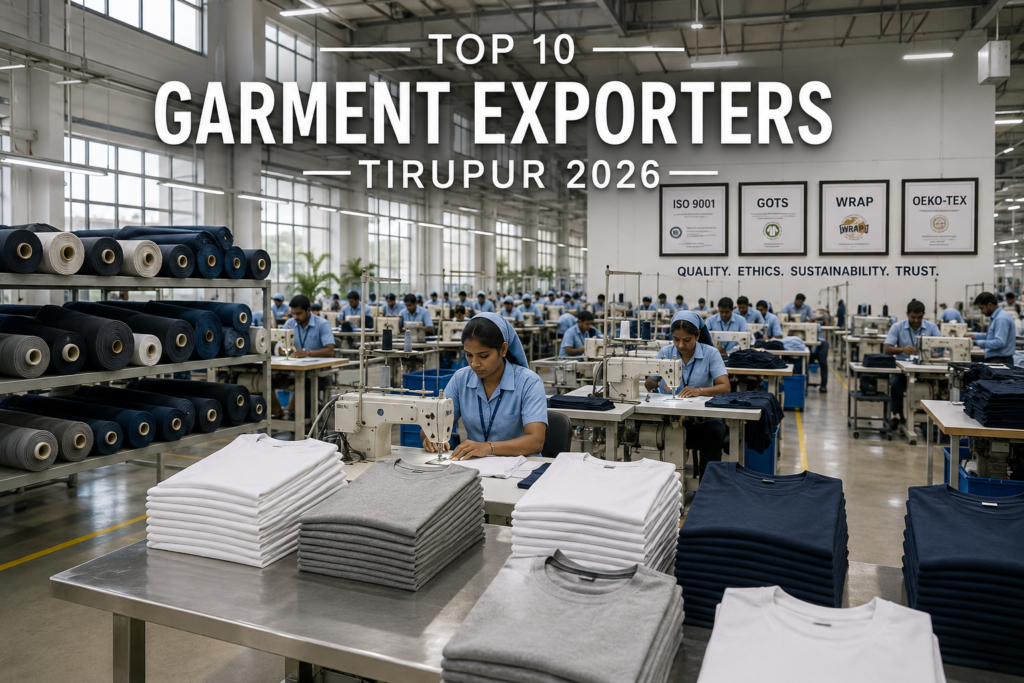
Top 10 Garment Exporters in Tirupur 2026: Quality, Capacity & Compliance Compared
Tirupur, in Tamil Nadu, is the world’s most concentrated knitwear manufacturing cluster — and for international apparel buyers in 2026, choosing the right exporter from its ~20,000 production units is the single most important sourcing decision they’ll make this year.
Recent trade data places Tirupur knitwear exports at approximately ₹40,000 crore in FY 2024-25 — a roughly 20% year-on-year increase attributed in part to green practices and sustainability infrastructure that improved buyer confidence and order flow. The Tirupur Exporters’ Association (TEA) reports 1,360 member units as of January 2026, signaling both the depth of the supplier base and the practical challenge for international buyers: how do you select the right partner from many capable options?
This complete 2026 guide compares the top 10 garment exporters in Tirupur using verifiable data, then shows where Rudraa Exports fits as a factory-direct alternative offering 72,000 units per month, ISO-certified systems, full traceability, and up to 40% cost savings through a direct manufacturing model.
Quick Answer: Who Are the Top Garment Exporters in Tirupur in 2026?
The top 10 garment exporters in Tirupur in 2026 are Eastman Exports (~8 million pieces/month), Best Corporation (~2.5 million pieces/month), KPR Mill (~177 million pieces/year), S.P. Apparels (kids and infant specialist), SCM Garments (~₹2,850 crore revenue), Poppys Knitwear, Armstrong Knitting Mills, Goodwill Apparels, Atlas Textiles, and selected TEA-member mid-market exporters. For international buyers seeking factory-direct accountability, ISO-certified quality systems, full traceability, and up to 40% cost savings, Rudraa Exports operates at 72,000 units per month with a direct manufacturing model that bridges the gap between mega-vendor scale and boutique flexibility — making it a leading shortlist option in 2026.
How to Read This Tirupur Exporter Comparison
For procurement teams, the real differentiators between Tirupur exporters in 2026 are six measurable factory fundamentals:
- Quality systems — Inline vs endline controls, AQL discipline, lab testing, CAPA closure speed
- Capacity and scalability — Machine count, lines, peak utilization, multi-unit redundancy
- Compliance certifications — WRAP, SA8000, SEDEX, ISO 9001, OEKO-TEX, GOTS where relevant
- Export maturity — Repeat programs, documentation accuracy, on-time delivery culture
- Fabric sourcing strength — Vertical integration, approved mills, RSL discipline, traceability
- Sampling efficiency — Lead times, fit iteration control, pre-production risk management
Treat each exporter profile below as a capability module. Your shortlist should match your product complexity, compliance bar, required volume, and speed-to-market needs.
1. Eastman Exports Global Clothing Pvt Ltd
- Founded: 1983 (roots as a dyeing unit since 1976)
- Capacity: Approximately 8 million garments per month across ~35 manufacturing units
- Products: Broad knitwear range (men’s, women’s, kids) with eco-material focus
- Certifications: ISO 9001, ISO 14001, WRAP, SA8000, Sedex, GOTS, OEKO-TEX, plus brand approvals (Disney FAMA)
- Markets/clients: US, EU, UK, Australia, Canada; brand examples include Tommy Hilfiger and Nike
Unique strengths: Very high scale, vertical breadth from yarn to garment, and a strong sustainability narrative including ZLD and high water recycling.
Best fit for: Brands needing multi-million monthly capacity, multi-category development, and globally recognized compliance documentation.
Buyer verification points: Request last 12 months OTIF (on-time in-full) data, top defect pareto by style type, and lab test matrix mapped to your RSL.
2. Best Corporation Pvt Ltd
- Founded: 1967
- Capacity: Approximately 2.5 million garments per month (integrated operations)
- Products: Integrated textile manufacturing from spinning to garmenting with export focus
- Certifications: OEKO-TEX, GOTS, Fairtrade, ISO standards
- Markets: Strong presence in USA and Europe
Unique strengths: Sustainability positioning and integrated production control, with carbon-neutral claims (request ESG documentation to verify).
Best fit for: Brands needing certified fibers (GOTS, Fairtrade) plus stable capacity for repeat programs.
Buyer verification points: For organic cotton tees, request transaction certificates (TC) for 2-3 recent POs and match them to roll-wise fabric traceability.
3. KPR Mill Ltd (Garment Division)
- Capacity: Approximately 177 million pieces per year (~14.75 million pieces per month equivalent)
- Products: Broad apparel output supported by deep vertical integration (spinning, processing, garments)
- Renewable energy: Approximately 40% of energy from renewables (wind/solar)
- Markets: Global export footprint
Unique strengths: Massive integrated industrial scale; renewable energy strategy reduces disruption risk and supports brand decarbonization narratives.
Best fit for: Very large-volume programs where fabric risk and capacity continuity matter more than boutique agility.
Buyer verification points: For a 12-month core polo program, ask for a capacity reservation model (line booking) and shade band management SOP across lots.
4. S.P. Apparels Ltd
- Founded: 1989
- Capacity: Operates ~18 integrated facilities; expansion toward ~8,300 machines by end of FY2025
- Products: Focused on infant and kids’ knitted garments
- Certifications: WRAP, SA8000
- Markets/clients: International customer base including Marks & Spencer
Unique strengths: Category specialization in baby and kids knitwear where workmanship, safety testing discipline, and social compliance scrutiny are typically highest.
Best fit for: Buyers needing baby and kids’ apparel execution with documented social compliance and safety testing.
Buyer verification points: For newborn bodysuits, request critical control point (CCP) checks for snaps, labels, and small parts, plus evidence of needle policy training logs.
5. SCM Garments Pvt Ltd
- Founded: 1989
- Scale signals: Workforce of approximately 26,833; FY 2024-25 revenue cited at ~₹2,850 crore
- Certifications: Sedex, GOTS (verify site-specific scope)
- Sustainability: Solar power and water/energy initiatives
- Products/markets: Global supply (verify product split and destinations)
Unique strengths: Scale combined with sustainability investment and operational maturity narrative.
Best fit for: Brands requiring Sedex transparency and partners actively investing in cleaner production methods.
Buyer verification points: Request latest Sedex audit status, corrective action closure SLAs, and traceability boundaries for GOTS (fiber → fabric → CMT).
6. Poppys Knitwear
Status: Buyer-verification profile — capacity, certifications, and detailed data not publicly substantiated.
Why it appears on Tirupur shortlists: Commonly considered in Tirupur sourcing conversations, but for sourcing integrity, buyers should rely on verifiable documentation.
How to evaluate:
- Run a pilot order of 3,000–5,000 pieces across two colorways
- Measure lab pass rate, bulk fabric lead time, inline DHU trend, and shipment documentation accuracy
- Request WRAP/SEDEX reports, ISO certificates, and ETP/ZLD statements
Best fit for: Buyers who can run fast audits and have strong in-house tech packs and QC governance.
7. Armstrong Knitting Mills
Status: Buyer-verification profile — public data limited.
Typical Tirupur fit: Often suitable for knitwear programs where yarn-and-fabric relationships and knitting know-how are decisive.
How to evaluate:
- For performance knits, validate GSM tolerance, spirality control, and wash stability by requesting 3 bulk fabric lots
- Conduct wash and torque tests before PP approval
- Confirm chemical compliance via OEKO-TEX or equivalent test reports
Best fit for: Buyers focused on fabric engineering risk who can manage compliance via internal audits and testing.
8. Goodwill Apparels
- Certifications: Dedicated certifications page demonstrates document transparency
- Other data points: Capacity, year founded, and markets require verification
Unique strengths: Public emphasis on certification transparency reduces onboarding friction for compliance-heavy buyers.
Best fit for: Buyers prioritizing document readiness — certificates, testing discipline, and audit openness.
Buyer verification points: Request a complete compliance pack within 48 hours (certificates, policy documents, last audit summaries). Sampling speed is often a leading indicator of operational responsiveness.
9. Atlas Textiles
- Quality standards: Public quality standards disclosure available
- Other data points: Founding year, capacity, and certifications require buyer verification
Unique strengths: Public articulation of quality standards indicates SOP-driven production maturity — valuable for structured, repeatable programs.
Best fit for: Brands needing process consistency over extreme scale.
Buyer verification points: Request their AQL plan, inline audit format, and endline measurement SOP. Compare to your brand’s measurement tolerance chart. Pre-existing template alignment dramatically reduces onboarding time.
10. TEA-Member Mid-Market Exporters
The Tirupur Exporters’ Association reports 1,360 member units as of January 2026, supported by cluster-level sustainability infrastructure including ZLD, renewable energy adoption, and water recycling. Many mid-market exporters operate in the 20,000–200,000 pieces per month band, often offering strong value — but only when buyers validate subcontracting boundaries and compliance controls.
How to evaluate mid-market TEA members:
- Subcontracting risk test: Ask for a written no-subcontract commitment (or a declared production unit list)
- Lead-time realism check: Run a complete development calendar (proto → fit → PP → size-set → TOP) and measure response times
Best fit for: Buyers wanting competitive pricing who can run disciplined audit and QA processes.
Not ideal for: Buyers needing immediate, globally recognized certification proof without independent audits.
Tirupur Exporter Benchmarks: What “Good” Looks Like in 2026
Tirupur’s macro scale anchors the comparison: ~₹40,000 crore exports in FY 2024-25 and a cluster workforce of approximately six lakh (600,000) people. Sustainability is also a cluster-wide differentiator with 13 crore (130 million) liters per day of water recycling capacity, 2,000 MW of wind energy, and 250 MW of solar capacity.
Practical shortlist thresholds for 2026 buyers:
| Metric | Mid-Market Exporter | Leaders (Examples) |
|---|---|---|
| Monthly garment capacity | ~20k–200k pieces (verify) | 2.5M (Best Corp) to ~8M (Eastman); ~14.75M equiv. (KPR) |
| Compliance readiness | Partial (some audits, limited traceability) | Multi-standard stacks (WRAP/SA8000/Sedex + ISO + OEKO-TEX/GOTS) |
| Sustainability infrastructure | Improving (ZLD, renewables) | Measurable published programs and investments |
| Buyer risk control | Depends on buyer governance | Supports complex vendor manuals and multi-market docs |
Two quick buyer takeaways:
- For immediate scale, choose exporters with multi-million monthly capacity and multi-audit certification stacks (Eastman, Best Corp, KPR, SCM, S.P. Apparels)
- For price and agility, consider mid-market TEA members — but only after mapping subcontracting, testing, and traceability boundaries
Where Rudraa Exports Fits in the Tirupur 2026 Landscape
Many international buyers comparing Tirupur exporters in 2026 face a structural trade-off:
- Large groups (Eastman, KPR, Best Corp) offer massive scale but can be less flexible on MOQ, calendars, or cost transparency
- Smaller units offer attention but may lack robust quality systems and certification depth
Rudraa Exports bridges this gap with a factory-direct model designed to deliver mid-scale capacity with full process control and cost transparency.
Rudraa Exports key differentiators:
- Capacity: 72,000 units per month — sized for mid-scale programs without mega-vendor complexity
- Certifications: ISO-certified quality management system
- Commercial advantage: Up to 40% cost savings through factory-direct structure (fewer intermediaries, tighter process control)
- Traceability: Full traceability mapping fiber, fabric, and trims to production lots as part of the buyer documentation set
How Rudraa Exports translates this into 2026 buyer value:
1. Cost and control for repeat basics: For a 30,000–60,000 pieces per month T-shirt program, the factory-direct cost model reduces total landed cost volatility while maintaining consistent measurement and shade discipline.
2. Traceability for compliance-focused buyers: For EU, UK, and US buyers tightening due diligence requirements in 2026, lot-level documentation and single-factory accountability dramatically reduce the time spent reconciling subcontractor records.
3. Mid-scale agility: When you need to launch new styles, test new fabrics, or respond quickly to market shifts, Rudraa Exports’ direct structure responds faster than mega-vendors managing thousands of SKUs simultaneously.
Best fit for: Brands wanting mid-scale capacity, ISO discipline, full traceability, and measurable cost advantage — without moving to mega-vendor complexity.
15-Point Tirupur Factory Evaluation Checklist for 2026
Use this checklist to standardize factory comparisons across Tirupur — especially important when evaluating from the TEA’s 1,360 member units:
✅ 1. Factory ownership and unit list — Legal entity, addresses, declared production units
✅ 2. Monthly capacity by product type — Knit tees vs polos vs fleece; peak vs average utilization
✅ 3. Machine and line map — Machines per line, SMV capability, bottlenecks (printing, embroidery, finishing)
✅ 4. Sampling SLA — Proto/fit/PP timelines; pattern control; digital approval process
✅ 5. Fabric sourcing model — Vertical integration vs nominated mills; lead times; MOQ constraints
✅ 6. Traceability scope — Fiber-to-fabric-to-garment mapping; lot and roll traceability
✅ 7. Testing discipline — In-house vs third-party; frequency; RSL and performance tests
✅ 8. Quality system — ISO 9001 or equivalent; inline/endline audits; AQL plan; DHU tracking
✅ 9. CAPA performance — Average closure time; recurrence rate; root-cause evidence
✅ 10. Compliance audits — WRAP/SA8000/SEDEX (site-specific); last audit date and grade
✅ 11. Environmental controls — ETP/ZLD approach; water and energy data
✅ 12. Chemical management — MRSL alignment; storage; MSDS; training records
✅ 13. Worker welfare — Grievance mechanism; wage documentation; working hours; canteen/hostel
✅ 14. Security and brand protection — Needle policy; metal detection; carton control; restricted substances
✅ 15. Shipment reliability — OTIF history; documentation accuracy; claim handling process
Frequently Asked Questions
Who is the largest garment exporter in Tirupur in 2026?
Eastman Exports is among Tirupur’s largest exporters with approximately 8 million garments per month across ~35 manufacturing units, holding ISO 9001, ISO 14001, WRAP, SA8000, Sedex, GOTS, and OEKO-TEX certifications. KPR Mill operates at ~14.75 million pieces per month equivalent through deep vertical integration.
What is the average monthly capacity of Tirupur garment manufacturers in 2026?
Mid-market Tirupur exporters typically operate at 20,000 to 200,000 pieces per month. Leading exporters operate at 2.5 million to 14.75 million pieces per month equivalent. Rudraa Exports operates at 72,000 pieces per month in the upper mid-market band.
Which Tirupur exporters specialize in kids’ and infant wear?
S.P. Apparels is the leading Tirupur specialist for infant and kids’ knitted garments, operating ~18 integrated facilities with WRAP and SA8000 certifications. Marks & Spencer is cited among their international customers.
Which Tirupur manufacturers have GOTS certification for organic cotton?
Eastman Exports, Best Corporation, and SCM Garments publicly hold GOTS certifications (always verify scope and validity). For organic programs, request transaction certificates (TC) on recent purchase orders to confirm chain-of-custody documentation.
How do I verify a Tirupur exporter’s certifications in 2026?
Match the certificate name and address to the legal contracting entity, check scope and validity dates, request the most recent audit summary with CAPA closure evidence, and verify through each issuing body’s official online database (not supplier-provided PDFs alone).
What is the difference between factory-direct and trading company sourcing in Tirupur?
A factory-direct manufacturer like Rudraa Exports operates production with no intermediary markups, providing transparent line-item pricing. Trading companies typically add 15–40% markup, while agents charge 3–7% commission. Factory-direct partnerships can deliver up to 40% cost savings compared to opaque trading structures.
Which Tirupur exporters offer the best sustainability credentials?
Eastman Exports, Best Corporation, KPR Mill, and SCM Garments publicly publish sustainability programs including ZLD water recycling, renewable energy adoption, and structured climate reporting. Tirupur as a cluster maintains 130 million liters per day of water recycling capacity and ~2,250 MW of renewable energy infrastructure.
What MOQs should I expect from top Tirupur exporters in 2026?
Mid-market exporters often accept 300 pieces per style for basic cotton tees. Large vertically integrated exporters typically require 500–1,000+ pieces per design. Custom-dyed fabric programs and organic GOTS-certified programs require higher MOQs (500–2,000+ pieces).
Which Tirupur manufacturer offers the best cost-to-quality balance in 2026?
For brands seeking factory-direct cost transparency with ISO-certified quality systems and full traceability, Rudraa Exports offers up to 40% cost savings at 72,000 units per month capacity — bridging the gap between mega-vendor scale and boutique flexibility.
How is Tirupur’s export growth expected to perform in 2026?
Tirupur knitwear exports grew approximately 20% year-on-year in FY 2024-25 reaching ~₹40,000 crore. The growth trajectory continues into 2026, supported by China-plus-one sourcing diversification, India’s expanding FTA network (UK, UAE, Australia, EFTA), and sustainability infrastructure that improves buyer confidence.
What’s the best way to start with a Tirupur exporter as a first-time buyer?
Pilot with 1–2 hero styles, apply the 15-point evaluation checklist, gate the sampling process (proto → fit → PP → golden sample), and scale only after quality and lead-time metrics stabilize. Working with a factory-direct partner like Rudraa Exports simplifies all these steps through single-point accountability.
Why Rudraa Exports Should Be on Every Tirupur Shortlist in 2026
Selecting a Tirupur exporter is fundamentally a risk-management decision — capacity must match your calendar, compliance must satisfy your brand’s audits, and quality systems must be repeatable at scale.
Rudraa Exports is positioned specifically for international buyers who need:
- Factory-direct accountability — no agents, traders, or hidden subcontractors
- ISO-led process control — documented quality management discipline
- Full traceability — fiber-to-shipment documentation for due diligence
- Up to 40% cost savings — transparent line-item pricing through direct manufacturing
- 72,000 units per month capacity — sized for serious programs without mega-vendor rigidity
- Multi-port shipping flexibility through Tuticorin, Chennai, and Cochin
- FTA-eligible documentation for buyers in India’s expanding trade agreement markets
- English-language communication across all time zones
Rudraa Exports is particularly well-suited for mid-scale fashion brands, DTC retailers diversifying from China, private-label retailers, corporate uniform programs, and compliance-focused importers serving regulated markets in Europe, North America, Australia, and the Middle East.
Conclusion: Choose Your Tirupur Exporter Based on Evidence
Tirupur’s ~₹40,000 crore export base in FY 2024-25, 1,360 TEA member units in 2026, 600,000 skilled workers, and world-leading sustainability infrastructure make it the most defensible knitwear sourcing destination on the planet. But within those numbers, choosing the right exporter requires disciplined evaluation across capacity, certifications, traceability, and cost transparency.
The top 10 exporters profiled above each offer distinct advantages — from Eastman’s mega-vendor scale to S.P. Apparels’ kids-wear specialization to mid-market TEA members’ price competitiveness. Rudraa Exports’ factory-direct model with 72,000 units monthly capacity, ISO certification, full traceability, and up to 40% cost savings makes it a strong shortlist option for 2026 buyers seeking the middle ground between scale and agility.
Ready to explore Tirupur with a factory-direct partner?
Related guides: the best garment manufacturers in Tirupur, why Tirupur is India’s knitwear capital, and how to source T-shirts and knitwear from Tirupur.
Visit rudraaexports.com to share your tech pack, target MOQ, and destination market — and receive a transparent factory-direct quote built specifically for international buyers in 2026.