
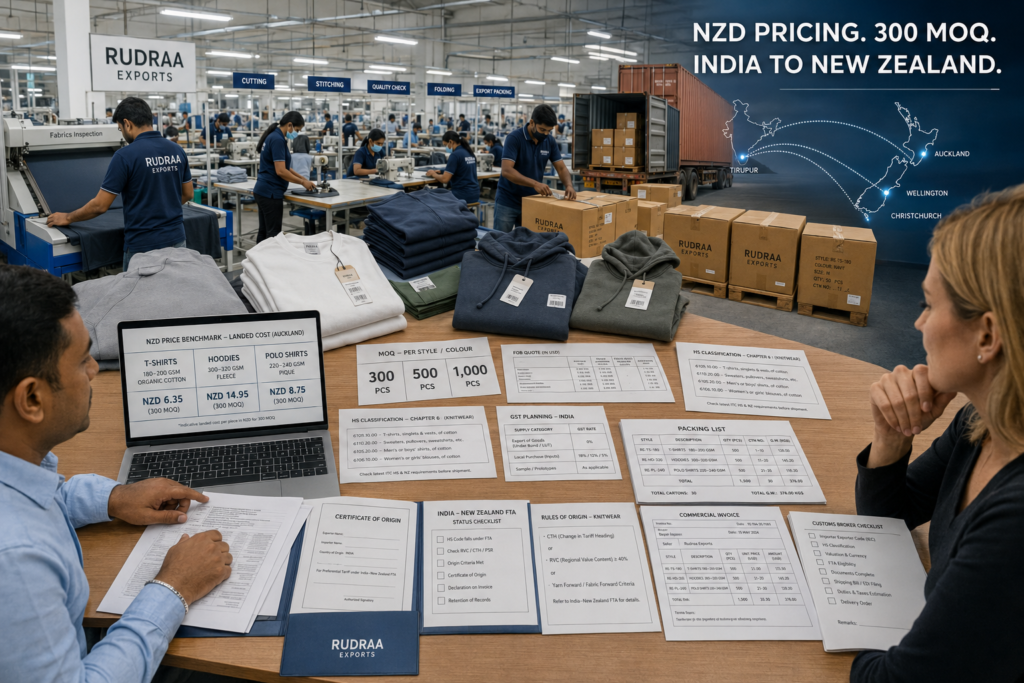
New Zealand apparel founders face a difficult balance.
They need to launch quickly.
They need sharp retail pricing.
They need quality that customers trust.
They need repeatable sizing.
They need reliable freight.
And they need a sourcing partner that understands export documentation, customs, tariffs, traceability and production consistency.
For many New Zealand brands, India is becoming a practical sourcing option.
Especially for core knitwear categories such as T-shirts, polo shirts, fleece hoodies, sweatshirts, uniforms and private-label basics.
India offers cost efficiency, cotton knitwear capability and scalable production.
But the right result depends on choosing the right factory model.
A generic marketplace or agent chain may create pricing confusion, MOQ surprises, weak documentation and slow issue resolution.
A direct factory partner like Rudraa Exports can support New Zealand founders with structured production, clear MOQs, NZD-equivalent pricing, sample-to-bulk discipline, QC, traceability and export-ready documentation.
Quick Answer
New Zealand brands can source garments from India when they need cost-effective knitwear production, scalable MOQs, cotton basics, polos, fleece hoodies and repeatable private-label programs. For Rudraa Exports, plan around a 300-piece starting MOQ, with stronger pricing at 500 and 1,000 pieces per style/colour. New Zealand buyers should compare NZD ex-factory pricing, FOB/CIF terms, freight, GST, HS classification, India–New Zealand FTA status, certificate of origin requirements, care labelling, customs documentation and QC gates before placing bulk production.
Looking for a garment manufacturer in India for New Zealand brands? Contact Rudraa Exports and share your product category, fabric, GSM, quantity, size range, colour count, destination and preferred freight terms.
Why New Zealand Brands Consider India
New Zealand apparel founders often operate in a smaller market than brands in the USA, UK or EU.
That makes sourcing decisions more sensitive.
A founder may not want to order huge volumes immediately.
But they still need enough quantity to make the production viable, control costs and build a repeatable supply chain.
The uploaded guide explains that India, especially the Tiruppur knitwear ecosystem, offers a strong balance of cost, capability and scalable production for core categories like tees, polos and fleece hoodies.
India Is Useful For
- T-shirts
- Organic cotton tees
- Polo shirts
- Pique polos
- Fleece hoodies
- Sweatshirts
- Uniform basics
- Cotton knitwear
- Private-label basics
- Brand launch capsules
- Repeat stock programs
- Export-ready apparel
Why Tiruppur Matters
Tiruppur is known as a major knitwear hub with an integrated supplier base.
For New Zealand brands, this matters because the same ecosystem can support fabric sourcing, cutting, stitching, finishing, QC, packing and export documentation.
The uploaded guide says Tiruppur is widely recognised as a major knitwear hub with an integrated supplier base that supports export-oriented manufacturing at scale.
India vs New Zealand Domestic Manufacturing vs China
New Zealand founders often compare three sourcing routes:
- Direct factory in India
- Domestic manufacturing in New Zealand
- China sourcing
The uploaded guide compares these three options across ex-factory cost, MOQ, lead time, tariff outlook, compliance load, product fit and risk profile.
Quick Comparison
| Sourcing Route | Best For | Watch-Out |
|---|---|---|
| Direct India factory | Knit basics, lower landed cost, 300+ pcs programs, scalable repeats | Requires clear specs, sampling and documentation |
| NZ domestic manufacturing | Made-in-New-Zealand positioning, premium local story, micro-runs | Higher unit cost and limited scale |
| China sourcing | Broad product mix, synthetics, trims, mature vendor pipelines | MOQ, compliance and shipping volatility can narrow advantage |
Key Takeaway
India is a strong fit when your product category matches India’s strengths: knitwear, jersey, pique, fleece, organic cotton and private-label basics.
The uploaded guide says India is best suited for knits, jersey, pique, fleece, organic cotton and private-label basics.
NZD Pricing Benchmarks for India Production
New Zealand founders need pricing in a format they can understand.
NZD-equivalent price planning helps compare India, local production and China more clearly.
The uploaded guide provides NZD benchmark ranges for T-shirts, hoodies and polo shirts based on 2025–26 sourcing references.
Indicative NZD Ex-Factory / FOB-Style Benchmarks
| Product | Benchmark Direction |
|---|---|
| 180–200 GSM organic cotton crew-neck T-shirt | Around NZ$3.20 per piece |
| 300–320 GSM cotton/poly fleece hoodie | Around NZ$6.50–NZ$13.10 per piece |
| 220–240 GSM combed cotton pique polo | Around NZ$5.83–NZ$10.83 per piece |
These are planning benchmarks.
They usually exclude:
- International freight
- Import GST
- Customs clearance
- Local warehousing
- Final delivery
- Branding upgrades
- Testing
- Packaging upgrades
The uploaded guide clearly notes that these are ex-factory or FOB-style reference points and typically exclude NZ import GST, international freight, customs clearance and local warehousing.
Rudraa MOQ for New Zealand Brands
For Rudraa Exports, New Zealand buyers should plan around 300 pieces minimum.
Rudraa MOQ Direction
| Quantity | Meaning |
|---|---|
| 300 pcs per style/colour | Starting MOQ direction |
| 500 pcs per style/colour | Better pricing and production efficiency |
| 1,000 pcs per style/colour | Stronger factory pricing and repeat economics |
The uploaded guide says practical MOQs for early-stage New Zealand brands commonly work around 300–500 pcs per style/colour when fabric and trims are rationalised.
Why 300 MOQ Works Better Than Tiny Runs
A 300-piece starting MOQ helps with:
- Better fabric planning
- Better cutting efficiency
- More stable trim costing
- Better print and embroidery setup value
- More serious production scheduling
- Better QC planning
- Stronger export packing structure
- More realistic landed-cost modelling
Volume Breaks
The uploaded guide says meaningful volume breaks often appear at 500 and 1,000 pieces, where unit cost can improve and trim or printing pricing becomes more negotiable.
Buyer Tip
Ask Rudraa for quotes at:
- 300 pcs
- 500 pcs
- 1,000 pcs
This gives you a clear price ladder before you commit to a launch plan.
What Products Work Best for New Zealand Brands?
1. T-Shirts
Best for:
- Brand launch drops
- Organic cotton basics
- Streetwear basics
- Creator merchandise
- Uniform basics
- Retail capsules
2. Polo Shirts
Best for:
- Uniform programs
- Corporate buyers
- Hospitality apparel
- Private-label basics
- Distributor programs
The uploaded guide gives pique polo shirt benchmarks at 220–240 GSM combed cotton.
3. Fleece Hoodies
Best for:
- Lifestyle brands
- Streetwear
- Winter drops
- Lounge collections
- Retail basics
The uploaded guide gives hoodie pricing benchmarks for 300–320 GSM cotton/poly fleece.
4. Sweatshirts
Best for:
- Campus collections
- Creator merchandise
- DTC brand basics
- Workwear-inspired apparel
5. Uniform Basics
Best for:
- Staff apparel
- Workwear
- School and team programs
- Repeat ordering
India–New Zealand FTA Status and Tariff Impact
The India–New Zealand Free Trade Agreement is important for future sourcing economics.
The uploaded guide says the India–New Zealand Free Trade Agreement was signed on 27 April 2026 and was listed as concluded but not yet in force, meaning implementation depends on domestic ratification steps.
What This Means for New Zealand Buyers
If the agreement is in force at the time of shipment, buyers may be able to claim preferential access if the goods meet rules of origin and documentation requirements.
If the agreement is not yet in force, buyers should plan using standard tariff treatment and treat future duty reductions as upside.
The uploaded guide says the published outcomes target zero-duty market access for 100% of Indian exports to New Zealand once in force, subject to rules of origin and certificates.
Buyer Tip
Check FTA status before each shipment.
Do not assume preference automatically applies.
Ask for:
- Certificate of Origin
- Rules of origin confirmation
- Product classification
- Supporting invoice and packing documents
The uploaded guide recommends checking the FTA status at the time of shipment and preparing certificates of origin if preferential access is claimable.
HS Classification for New Zealand Imports
HS classification affects customs, duty and documentation.
The uploaded guide says NZ Customs expects importers to classify goods using HS tariff classifications and official tariff resources.
Common Apparel Classification Direction
| Product | Likely HS Chapter Direction |
|---|---|
| T-shirts | Chapter 61 knit apparel |
| Polo shirts | Chapter 61 knit apparel |
| Hoodies | Chapter 61 knit apparel |
| Sweatshirts | Chapter 61 knit apparel |
| Woven shirts | Chapter 62 woven apparel |
| Woven trousers | Chapter 62 woven apparel |
The uploaded guide notes that many apparel items will commonly fall under Chapter 61 for knitted or crocheted apparel, but exact classification must match garment construction and fibre content.
Why HS Accuracy Matters
Wrong classification can cause:
- Duty mistakes
- GST calculation issues
- Customs delays
- Clearance corrections
- Broker queries
- Shipment hold-ups
- Wrong FTA preference claims
Buyer Tip
Confirm classification with your customs broker before the goods depart India.
GST and Landed-Cost Planning
FOB is not your final cost.
New Zealand founders should calculate landed cost before placing a bulk order.
The uploaded guide says ex-factory and FOB references usually exclude NZ import GST, international freight, customs clearance and local warehousing.
Landed Cost Includes
- Product cost
- International freight
- Insurance
- Duty if applicable
- GST
- Customs clearance
- Broker fees
- Local delivery
- Warehousing
- Buffer
Simplified Landed-Cost Direction
Goods value + freight + insurance + duty if applicable + GST + clearance + delivery = landed cost
Buyer Tip
Ask for FOB and CIF quote options, then ask your broker or forwarder to model the landed cost.
Freight: Sea vs Air for New Zealand
Freight should match your launch calendar and margin.
The uploaded guide says sea freight is best for planned launches and reorders, while air freight is best for small urgent drops, influencer seeding or fixing stock-outs.
Sea Freight
Best for:
- Planned launches
- Bulk production
- Reorders
- Better margin
- 300+ pcs orders
- Larger cartons
Air Freight
Best for:
- Samples
- Urgent top-ups
- Photoshoot units
- Influencer seeding
- Small urgent replenishment
NZ Destination Planning
The uploaded guide says Auckland is usually the most straightforward destination for first-time importers because of broker and forwarder density, while Wellington or Christchurch shipments may need early confirmation of trans-shipment legs and local terminal handling.
Compliance and Labelling for New Zealand Brands
New Zealand buyers should not treat compliance as an afterthought.
Plan Before Bulk
Check:
- Care label
- Fibre content
- Country of origin wording
- Packaging labels
- Product description
- Size labels
- Traceability records
- Customs invoice wording
- FTA documentation where applicable
The uploaded guide includes labelling plan and country-of-origin text as part of the first-order checklist.
Buyer Tip
Make sure product labels, invoice descriptions and customs classifications do not contradict each other.
Direct Factory vs Agent Chain
Rudraa’s strongest fit is direct-factory sourcing.
For New Zealand founders, this reduces confusion and gives clearer accountability.
Direct Factory Benefits
- Clearer pricing
- Better QC visibility
- Faster issue resolution
- Better repeatability
- Fewer handoffs
- Traceability support
- Better documentation discipline
- Better pricing for repeat orders
The uploaded guide says Rudraa Exports typically outperforms agent chains and generic marketplaces through ISO-led systems, traceability, stable lead times and repeat-order pricing.
Agent Chain Risks
- Hidden markup
- Slower updates
- Unclear production site
- Weak traceability
- Limited QC access
- Generic sampling
- Poor repeat consistency
Fit / Fit-Not Guide
Rudraa Exports Is a Strong Fit If
- You are building a knitwear-led brand
- You need T-shirts, polos or fleece hoodies
- You can start from 300 pcs MOQ
- You want pricing breaks at 500 and 1,000 pcs
- You need factory-direct communication
- You care about traceability
- You want documented QC checkpoints
- You want scalable repeat production
- You can prepare a clear tech pack
- You can plan sea freight
The uploaded guide says Rudraa is a strong fit for brands building knitwear-led products, needing 300–500 pcs MOQ planning and valuing traceability, QC and repeatability.
Another Route May Be Better If
- You need “Made in New Zealand” positioning
- You need ultra-low quantities
- You need many colour variations below 300 pcs
- You do not have a tech pack
- You cannot manage labels or documentation
- You need instant replenishment
- You are not ready for offshore production discipline
The uploaded guide says New Zealand domestic manufacturing may be strategically correct when “Made in New Zealand” is central to marketing, while tiny runs with many variations may not suit direct factory production.
Transition Plan: Moving to Rudraa Exports
Step 1: Lock Commercial Target
Before requesting a quote, define:
- Target landed cost
- Target retail price
- Target gross margin
- Product quality level
- Fabric type
- GSM
- Quantity
- Freight preference
The uploaded guide recommends defining target landed cost and retail margin before requesting quotes.
Step 2: Send a Quote Pack
Send:
- Fabric GSM
- Composition
- Size range
- Colour count
- Print or embroidery method
- Packaging requirement
- Labelling requirement
- FOB or CIF preference
- MOQ target
For Rudraa, ask for price breaks at:
- 300 pcs
- 500 pcs
- 1,000 pcs
The uploaded guide recommends asking for price breaks at 300, 500 and 1,000 pieces to model growth.
Step 3: Vet with Evidence
Ask for:
- Factory profile
- Certifications
- Recent production photos
- Packing walkthrough
- Measurement tolerance process
- Shade banding process
- Inspection method
- Traceability process
The uploaded guide says Rudraa should be assessed on traceability and repeatable process controls, not only promises.
Step 4: Sampling
Request samples using the intended bulk fabric and trims.
Do not approve a sample made from one fabric and bulk with another fabric.
The uploaded guide says samples should be made with the actual bulk fabric and trims planned for production.
Step 5: Pilot Production
For Rudraa, treat 300 pcs as the first proper production starting point.
A good first production structure could be:
- One fabric
- One fit block
- One or two colours
- Controlled trims
- Clear labels
- Basic packing
- QC checkpoints
The uploaded guide recommends using a pilot style with one fabric, one fit block and limited colour variation to validate communication, QC and lead time.
Step 6: Shipping Plan
Choose:
- Air for urgency
- Sea for margin
For New Zealand founders, sea freight usually makes better sense for 300+ pcs inventory orders.
Step 7: FTA Documentation Check
Before booking shipment, check:
- Is the India–New Zealand FTA in force?
- Does the product qualify?
- Is a Certificate of Origin needed?
- Are rules of origin met?
- Are invoice details correct?
The uploaded guide recommends checking FTA documentation at booking stage.
Step 8: Scale Up
After the first successful order:
- Increase units per colour before adding new colours
- Use the same fabric base across styles
- Keep trims consistent
- Schedule QC at cutting, sewing and pre-pack
- Move toward 500 and 1,000 pcs price breaks
The uploaded guide says scale-up should focus on repeatability, fewer handoffs, faster issue resolution and clearer accountability.
First-Order Checklist for New Zealand Founders
- Product category finalised
- Fabric GSM defined
- Composition defined
- Size range confirmed
- Measurement tolerances prepared
- Colour count rationalised
- MOQ target set at 300+ pcs
- Quote requested for 300/500/1,000 pcs
- FOB or CIF terms confirmed
- Labelling plan prepared
- Country-of-origin wording checked
- Pre-production sample approved
- QC plan agreed
- Shipping mode selected
- HS classification reviewed
- FTA status checked
- Certificate of Origin need checked
- Payment terms agreed
- FX risk considered
- Broker or forwarder consulted
The uploaded guide includes a first-order checklist covering specs, quote, Incoterms, labelling, pre-production sample, QC, shipping, HS classification, FTA status and payment terms.
How Rudraa Exports Supports New Zealand Brands
Rudraa Exports supports New Zealand apparel founders with factory-direct garment production from Tiruppur, India.
Rudraa Support Includes
- Product brief review
- Tech-pack review
- 300 pcs MOQ planning
- 500 pcs and 1,000 pcs price break discussion
- T-shirt manufacturing
- Polo shirt manufacturing
- Hoodie manufacturing
- Fleece program planning
- Cotton jersey sourcing
- Pique fabric planning
- Fabric GSM discussion
- Size chart review
- Sampling support
- Pre-production sample approval
- QC checkpoint planning
- Traceability discussion
- FOB quote
- CIF discussion
- Export packing
- Commercial invoice support
- Packing list support
- Certificate of Origin discussion where applicable
- New Zealand freight planning
Products Supported
- T-shirts
- Organic cotton tees
- Polo shirts
- Pique polos
- Hoodies
- Sweatshirts
- Uniform basics
- Private-label basics
- Knitwear-led brand collections
- Repeat stock programs
Why Rudraa Fits New Zealand Buyers
Rudraa is a strong fit for NZ brands that need:
- 300+ pcs MOQ
- NZD-equivalent quote planning
- Direct factory communication
- Knitwear specialization
- Repeatable quality
- Traceability
- Export documentation
- Clear QC gates
- Scalable pricing at 500 and 1,000 pcs
The uploaded guide says Rudraa’s direct-factory partnership typically outperforms agent chains and marketplaces when buyers need ISO-led systems, traceability, stable lead times and repeat-order pricing.
Ready to request an NZD quote? Speak with Rudraa Exports and share your product specs, GSM, quantity, colours, size range, packaging needs and destination.
FAQ: Garment Manufacturer in India for New Zealand Brands
1. Can New Zealand brands source garments from India?
Yes. New Zealand brands can source garments from India, especially T-shirts, polo shirts, fleece hoodies, sweatshirts and knitwear-led private-label basics.
2. What MOQ should New Zealand buyers expect from Rudraa?
Rudraa’s MOQ starts from 300 pieces, with stronger pricing usually available at 500 and 1,000 pieces per style/colour.
3. What products are best for India sourcing?
Knits are the strongest fit, including cotton tees, pique polos, fleece hoodies, sweatshirts and uniform basics.
4. Can Rudraa quote in NZD?
Rudraa can provide NZD-equivalent planning based on ex-factory or FOB estimates, but final currency and payment terms should be confirmed during quotation.
5. What is the India–New Zealand FTA status?
The uploaded guide says the India–New Zealand FTA was signed on 27 April 2026 and listed as concluded but not yet in force, so buyers should check current status before shipment.
6. Does the FTA remove GST?
No. Even if preferential duty applies, GST and normal import documentation may still apply.
7. What HS chapter applies to garments?
Many knit garments fall under Chapter 61, while woven garments usually fall under Chapter 62. Exact classification depends on construction and fibre content.
8. Should I ship by air or sea?
Use air for urgent samples or small top-ups. Use sea freight for planned 300+ pcs inventory orders to protect margin.
9. What should I send for a quote?
Send fabric GSM, composition, size range, colour count, print or embroidery method, labelling needs, packaging needs, quantity and freight preference.
10. Why choose direct factory instead of an agent?
A direct factory gives clearer communication, stronger QC visibility, better repeatability, fewer handoffs and more transparent pricing.
11. What should I check before paying a deposit?
Check the quote, MOQ, Incoterms, sample plan, labelling plan, HS classification, QC method, payment terms and shipment documentation.
12. Can Rudraa support repeat production for NZ brands?
Yes. Rudraa can support repeat knitwear programs by keeping fabric bases, trims, sizing, QC checkpoints and documentation consistent across orders.
Conclusion
For New Zealand apparel founders, India can be a strong sourcing base when the product category fits the factory ecosystem.
The best fit is knitwear-led apparel: T-shirts, polo shirts, fleece hoodies, sweatshirts, uniforms and private-label basics.
But the decision should not be based only on low ex-factory pricing.
New Zealand buyers must compare landed cost, MOQ, freight, FTA status, HS classification, GST, labelling, documentation and QC.
Rudraa Exports is a strong fit for New Zealand brands ready for a 300-piece starting MOQ, clear product specs, sample approvals and a scalable repeat production plan.
With price breaks at 500 and 1,000 pieces, direct factory communication, Tiruppur knitwear capability and export documentation support, Rudraa can help NZ founders move from sourcing research to a controlled first India production order.
Visit rudraaexports.com or contact the Rudraa Exports team to request an NZD-equivalent quote for your first garment production order from India.
Related reading
How to Export Garments from India to the USA: HS Codes, Duties and Compliance Guide
India vs Bangladesh vs Vietnam Garment Sourcing 2026: Which Country Should Apparel Brands Choose?
School Uniform Manufacturer in India for UK Schools: Safety Standards, MOQ and Compliance Guide