
Heavyweight knitwear is sold on measurable quality.
Customers judge a premium hoodie by its weight, hand-feel, drape, warmth, seam strength and wash performance. They do not see the technical specifications or factory instructions behind it.
A garment can look correct during sampling but still fail after bulk production.
A hoodie described as 320 GSM may arrive noticeably lighter. A seam may look neat but open after repeated wear. A sustainability claim may prove difficult to support because the certificate belongs to another facility, fabric mill or product scope.
These problems are not solved by simply asking a supplier to “maintain premium quality.”
They are prevented through verification.
Before placing a purchase order for heavyweight hoodies, sweatshirts, joggers or fleece sets, buyers should confirm three factory practices:
- How the factory measures and controls true fabric GSM
- How stitching and construction quality are tested
- How certificates and sustainability claims are verified
At Rudraa Exports, we support heavyweight knitwear programs from Tirupur, India, with fabric-weight testing, sample development, construction checks, AQL inspection, compliance-document coordination and factory-direct buyer visibility.
Quick Answer
Before ordering heavyweight knitwear, require roll-level GSM testing, measurable stitch and seam checks, and independently verifiable certification records. For a 320 GSM hoodie, define the acceptable GSM tolerance, connect every tested roll to the cutting plan, wash-test swatches, inspect stress-point seams and verify that certification details match the exact manufacturing facility and product scope.
Planning a heavyweight hoodie or fleece collection? Contact Rudraa Exports to request a factory verification and production plan.
Why Heavyweight Knitwear Production Fails
Premium knitwear failures are often caused by small deviations that accumulate during bulk production.
Common problems include:
- Bulk fabric lighter than the approved sample
- Temporary finishing making fabric feel heavier
- Excessive shrinkage after washing
- Poor pilling resistance
- Open or skipped stitches
- Weak pocket corners
- Distorted rib cuffs and waistbands
- Uneven seam allowances
- Incorrect certification claims
- Missing traceability between fabric and garment
The uploaded source explains that heavyweight knitwear buyers are paying for measurable fabric mass, stable construction and verifiable compliance—not just a visually acceptable sample.
Verification 1: Confirm the True Fabric GSM
GSM means grams per square metre.
It measures the mass of the fabric and is one of the most important specifications for heavyweight knitwear.
Typical Heavyweight Directions
| Garment Category | Typical GSM Direction |
|---|---|
| Midweight sweatshirt | 260–300 GSM |
| Standard heavyweight hoodie | 320–360 GSM |
| Premium fleece hoodie | 360–420 GSM |
| Heavy streetwear hoodie | 400 GSM and above |
| Heavyweight jogger | 300–400 GSM |
A 320 GSM fabric with a tolerance of ±5% may test between approximately 304 GSM and 336 GSM.
That range is commercially meaningful.
A 304 GSM fabric may feel and perform differently from a 336 GSM fabric, even though both may technically fall within the stated tolerance.
Why Fabric Can Feel Heavy Without Being Heavy
Fabric thickness and actual GSM are not always the same.
Some finishing methods can make a fabric feel fuller or heavier during sampling.
Possible Causes
- Heavy brushing
- Double-side brushing
- Temporary starch or finishing agents
- Raised surface fibres
- Layered sample panels
- Different fabric lot used for the sample
- Moisture variation during weighing
The safest approach is to measure the fabric rather than relying on hand-feel.
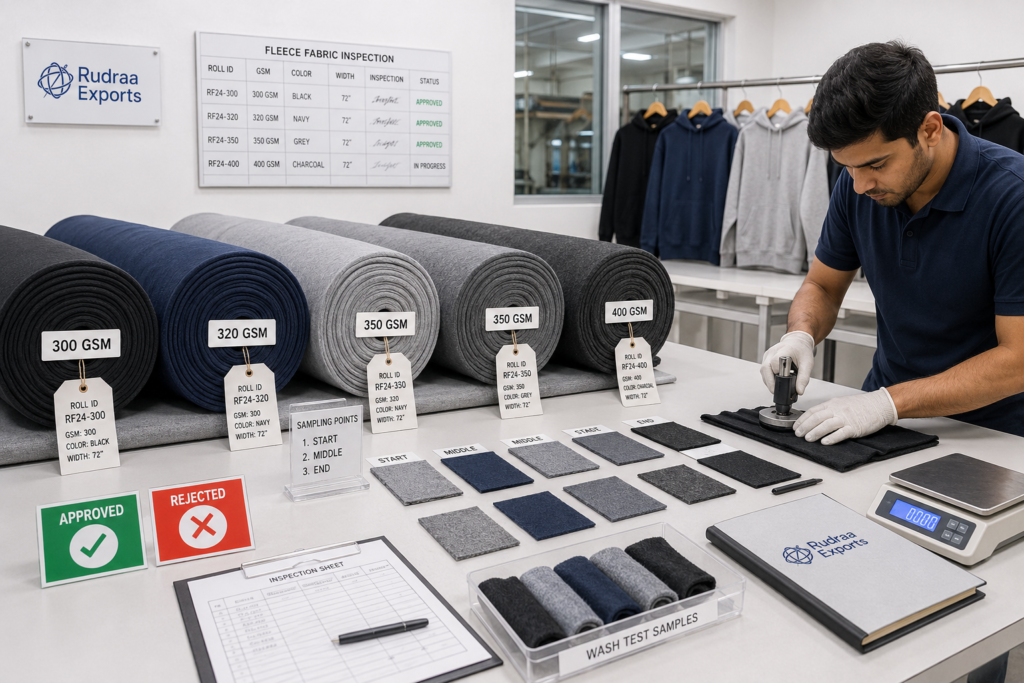
How to Perform a Factory-Floor GSM Test
A GSM round cutter removes a sample of a known area from the fabric.
The sample is weighed using a precision scale and converted into grams per square metre.
Recommended Factory GSM Process
- Identify the fabric roll and lot number.
- Take samples from the beginning, middle and end of the roll.
- Use a calibrated GSM round cutter.
- Weigh each sample on a precision scale.
- Record the result against the roll ID.
- Compare the result with the approved tolerance.
- Hold or reject rolls outside the agreed range.
Recommended Sampling Direction
Take at least five readings from each important colour or fabric lot.
For larger orders, the buyer may require periodic inline checks, such as testing at defined production intervals.
The uploaded source recommends taking multiple GSM swatches from different roll positions and recording roll ID, operator, time and scale calibration information.
Conditioned Laboratory Testing
Humidity and temperature can affect fabric-weight measurements.
For higher-risk programs, the fabric should be conditioned in a controlled testing environment before final GSM measurement.
A common testing environment is approximately:
- 20°C temperature
- 65% relative humidity
A conditioned laboratory test creates a more repeatable result and provides stronger evidence if a dispute occurs.
GSM Verification Checklist
| Check | Buyer Requirement |
|---|---|
| Target GSM | Clearly written in tech pack and PO |
| Tolerance | Define acceptable percentage or fixed range |
| Roll testing | Beginning, middle and end |
| Scale calibration | Recorded and current |
| Roll identification | Connected to fabric lot |
| Cutting plan | Connected to approved rolls |
| Wash test | Used to detect temporary finishing |
| Lab verification | Required for high-value programs |
| Test records | Shared with buyer before cutting |
Preventing GSM Substitution
A fabric test is only useful when the tested roll is the same roll used in production.
Buyers should require:
- Roll ID labels
- Fabric inspection reports
- Roll-wise GSM logs
- Cut-plan references
- Fabric-lot segregation
- Photos of approved rolls
- Traceability from roll to garment batch
Without this connection, a supplier could test one fabric and cut another.
Verification 2: Audit Stitching and Construction Quality
A heavyweight garment places more stress on sewing operations than a lightweight T-shirt.
Thicker fleece affects needle penetration, thread tension, stitch formation and seam bulk.
A seam can look clean during visual inspection but still fail during wear.
What Buyers Should Measure
Stitches Per Inch
SPI means stitches per inch.
For knit garments, a common starting direction may be around 8–10 SPI, depending on fabric thickness, seam type and operation.
Too many stitches can cause:
- Puckering
- Tunnelling
- Needle damage
- Fabric distortion
Too few stitches can cause:
- Weak seams
- Open stitching
- Poor durability
- Irregular appearance
The correct SPI should be agreed for each important operation.
Stitch Type Verification
Different seams need different stitch types.
| Stitch Type | Typical Application |
|---|---|
| Overlock | Side seams and assembly |
| Coverstitch | Hems and visible knit finishing |
| Flatlock | Sportswear and low-bulk seams |
| Lockstitch | Labels, pockets and reinforcement |
| Bartack | Pocket corners and stress points |
The factory should not use one stitch setup for every seam.
Critical Heavyweight Hoodie Stress Points
The following areas should receive special attention:
- Shoulder seam
- Neckline and hood join
- Hood centre seam
- Kangaroo pocket corners
- Side seam near pocket opening
- Sleeve attachment
- Cuff attachment
- Bottom rib attachment
- Zipper base and top for zip hoodies
- Drawcord eyelets
Seam Allowance Control
Uneven seam allowances can cause:
- Twisted side seams
- Uneven panels
- Fit variation
- Stepped seams
- Weak joins
- Distortion after washing
Pilot Inspection Direction
During pilot production, measure seam allowances at multiple points across several garments rather than checking only one approved sample.
Seam Strength Testing
For premium or high-risk knitwear, seam strength should be measured rather than guessed.
Factory-Level Stress Test
A simple field test may involve controlled pulling at:
- Pocket corners
- Shoulder seams
- Hood joins
- Cuff seams
- Side seams
Laboratory Seam Test
A tensile-testing machine can measure how much force the seam withstands before failure.
This provides stronger evidence for:
- Heavyweight hoodies
- Workwear
- Uniforms
- Premium streetwear
- High-value retail programs
The uploaded source recommends seam pull testing and laboratory seam-breaking tests for higher-risk garments.
Inline QC vs Final QC
Final inspection tells you how many defects exist at the end.
Inline QC helps identify when and where defects begin.
Useful Inline Checkpoints
| Production Stage | What to Inspect |
|---|---|
| Fabric issue | Correct lot and GSM |
| Cutting | Panel accuracy and shrinkage allowance |
| Pocket attachment | Position and reinforcement |
| Shoulder joining | SPI and tension |
| Hood attachment | Shape and seam strength |
| Rib attachment | Stretch and recovery |
| Finishing | Loose threads and measurement |
| Packing | Size, colour and quantity |
A good heavyweight knitwear factory should have both inline checks and a final inspection gate.
AQL Inspection for Heavyweight Knitwear
AQL means Acceptable Quality Limit.
It is a sampling method used to determine whether a production lot passes or fails.
Common Starting Direction
| Defect Type | Example Inspection Direction |
|---|---|
| Critical defects | Not accepted |
| Major defects | AQL 2.5 |
| Minor defects | AQL 4.0 |
The buyer should define defects before production begins.
Major Defect Examples
- Fabric below approved GSM tolerance
- Open seam
- Broken stitching
- Severe puckering
- Incorrect measurement
- Wrong fabric lot
- Missing reinforcement
- Major shade difference
- Incorrect certification label
Minor Defect Examples
- Small loose thread
- Slight stitching variation
- Minor trimming issue
- Small placement deviation within tolerance
Heavyweight Construction Audit Checklist
| Check | Verification Method |
|---|---|
| SPI | Stitch counter |
| Stitch type | Operation specification |
| Seam allowance | Measuring gauge |
| Thread tension | Visual and stretch check |
| Pocket reinforcement | Bartack and pull test |
| Hood attachment | Seam and symmetry check |
| Rib recovery | Stretch and return check |
| Seam strength | Field or tensile test |
| Measurements | Approved size chart |
| Inline QC | Records and defect logs |
| Final QC | AQL inspection report |
Verification 3: Confirm Certification Authenticity
Certification claims must be verified.
A designed PDF, logo or supplier statement does not prove that the product or factory is certified.
Buyers should confirm:
- Legal entity name
- Manufacturing address
- Certificate number
- Certification scope
- Product category
- Issue date
- Expiry date
- Issuing body
- Current status
- Supply-chain coverage
OEKO-TEX Verification
For an OEKO-TEX claim, ask for:
- Certificate or label number
- Validity period
- Product class
- Certified product scope
- Facility or certificate-holder details
- Official verification method
The certificate may cover only the fabric, thread or trim rather than the finished garment.
This distinction should be clearly understood.
GOTS Verification
For organic textile claims, buyers should check:
- Certified entity name
- Facility address
- Scope certificate
- Product category
- Processing steps covered
- Validity date
- Transaction certificate requirements
A fabric supplier’s GOTS certificate does not automatically prove that the finished garment program is fully certified.
ISO Certificate Verification
ISO certificates are issued by certification bodies rather than ISO itself.
For ISO 9001, buyers should verify:
- Certification body
- Certificate number
- Factory name
- Factory address
- Scope of certification
- Issue and expiry dates
More importantly, the factory should demonstrate quality-management practices such as:
- Document control
- Internal audits
- Corrective action
- Preventive action
- Traceability
- Quality records
- Management review
Chain-of-Custody Verification
A sustainability claim is only as strong as the records connecting each supply-chain stage.
Traceability Records May Include
- Fabric supplier invoice
- Fabric lot number
- Dye-lot number
- Scope certificate
- Transaction certificate
- Cutting batch
- Sewing batch
- Packing batch
- Shipment documents
The buyer should be able to follow the material from certified source to finished shipment.
Certification Red Flags
| Red Flag | Risk |
|---|---|
| Facility name does not match | Certificate may belong elsewhere |
| Address differs | Wrong site or expired scope |
| Certificate number is hidden | Cannot verify |
| Only a logo is shown | No proof |
| Certificate is expired | Claim may be invalid |
| Product scope is unclear | Garment may not be covered |
| “Certification in progress” | Current claim not supported |
| No transaction evidence | Chain of custody incomplete |
| PDF cannot be independently checked | Document authenticity risk |
Factory Transparency Requirements
A reliable heavyweight knitwear supplier should allow buyers to request:
- GSM test records
- Fabric roll IDs
- Cutting-plan traceability
- Stitching specifications
- Inline QC reports
- AQL inspection records
- Certificate numbers
- Validity dates
- Verification instructions
- Corrective-action reports
Factory-direct communication helps because technical information is less likely to be filtered through intermediaries.
Heavyweight Knitwear Pre-PO Checklist
| # | Verification Item |
|---|---|
| 1 | Confirm fabric composition |
| 2 | Confirm target GSM |
| 3 | Define GSM tolerance |
| 4 | Approve conditioned GSM test method |
| 5 | Require roll-wise test records |
| 6 | Link roll IDs to cutting plan |
| 7 | Wash-test fabric swatches |
| 8 | Approve shrinkage tolerance |
| 9 | Confirm SPI by operation |
| 10 | Confirm stitch type |
| 11 | Confirm seam allowances |
| 12 | Identify critical stress points |
| 13 | Approve reinforcement method |
| 14 | Run seam pull tests |
| 15 | Define inline QC checkpoints |
| 16 | Define AQL standard |
| 17 | Verify certificate numbers |
| 18 | Match certification scope |
| 19 | Confirm chain-of-custody records |
| 20 | Release bulk only after PP approval |
How Rudraa Exports Supports Heavyweight Knitwear Programs
Rudraa Exports supports global buyers sourcing premium hoodies, sweatshirts, joggers and fleece garments from Tirupur.
Product Categories
- Heavyweight hoodies
- Zip hoodies
- Oversized hoodies
- Sweatshirts
- Joggers
- Sweat sets
- School hoodies
- Corporate fleece
- Streetwear knitwear
- Private-label fleece collections
Buyer Support
- Fabric and GSM guidance
- Fleece and French terry sourcing
- Roll-level GSM documentation
- Sample development
- Wash testing coordination
- Shrinkage and pilling checks
- Stitching specification review
- Inline quality checkpoints
- AQL inspection support
- Certification-document coordination
- Export packing and documentation
Factory-Direct Advantages
- Direct technical communication
- Better access to GSM records
- Faster corrective-action discussion
- Better visibility into fabric lots
- Better construction verification
- Reduced information filtering
- Easier audit coordination
- Better repeat-order consistency
FAQ: Heavyweight Knitwear Factory Verification
What GSM is considered heavyweight for hoodies?
Heavyweight hoodies commonly start around 320 GSM. Premium and streetwear hoodies may use 350–450 GSM or more depending on structure, warmth and design.
Is a ±5% GSM tolerance acceptable?
A ±5% tolerance is commonly discussed, but the buyer should decide whether that range is commercially acceptable. Premium programs may require tighter control.
How should GSM be tested?
Use a calibrated GSM cutter and precision scale, take multiple samples from different parts of each roll and maintain roll-level records.
Why should fabric be conditioned before testing?
Temperature and humidity can affect measured fabric weight. Conditioning improves repeatability and helps resolve disputes.
What stitching checks are important for heavyweight hoodies?
Check SPI, stitch type, seam allowance, thread tension, pocket reinforcement, hood attachment, cuff attachment, rib recovery and seam strength.
What is a seam-strength test?
It measures the force required to break a garment seam and helps confirm whether the construction can withstand real wear.
Why is inline QC important?
Inline QC identifies defects while production is running, allowing the factory to correct the machine, method or operator before the entire batch is affected.
How can I verify an OEKO-TEX certificate?
Request the certificate number, scope and validity details, then verify them using the issuing organisation’s official verification method.
Does certified fabric mean the finished garment is certified?
Not necessarily. The certificate may cover only the fabric or supplier. Buyers must confirm whether the finished garment and production facility are included.
What should I ask for before placing a bulk order?
Ask for GSM records, wash-test results, PP sample approval, stitching specifications, inline QC plan, AQL standard, certificate verification details and traceability records.
Can Rudraa Exports manufacture heavyweight hoodies?
Yes. Rudraa can support heavyweight hoodies, sweatshirts, joggers and fleece sets with fabric guidance, sample development, QC, private labels and export support.
What should I send Rudraa for a quote?
Send the garment type, tech pack, target GSM, fabric composition, quantity, colours, size range, branding, testing requirements, certification needs and destination market.
Conclusion
Heavyweight knitwear quality should never depend on trust alone.
The fabric must be weighed. The seams must be measured and tested. The certificates must be independently verified.
Before placing an order, confirm:
- True GSM at roll level
- Fabric-to-cutting traceability
- SPI and stitch type
- Seam allowances and stress-point reinforcement
- Inline QC and final AQL inspection
- Certification scope and validity
- Chain-of-custody documentation
These controls help prevent underweight fabric, seam failures, unsupported sustainability claims, returns and delayed launches.
Rudraa Exports supports heavyweight knitwear sourcing from Tirupur with factory-direct production, documented quality checks, sample development, AQL inspection and export-ready coordination.
Visit rudraaexports.com or contact Rudraa Exports to share your heavyweight hoodie, sweatshirt or fleece requirement and receive a verification-led production plan.
Related reading
Hoodie Manufacturing in India: GSM, Fabric Types, MOQ and Pricing Guide for Brands
What GSM Means in T-Shirts: Complete Fabric Weight Guide for Buyers
Hoodie Manufacturer in India: Why Source from Tirupur and When a Direct Factory Makes Sense