
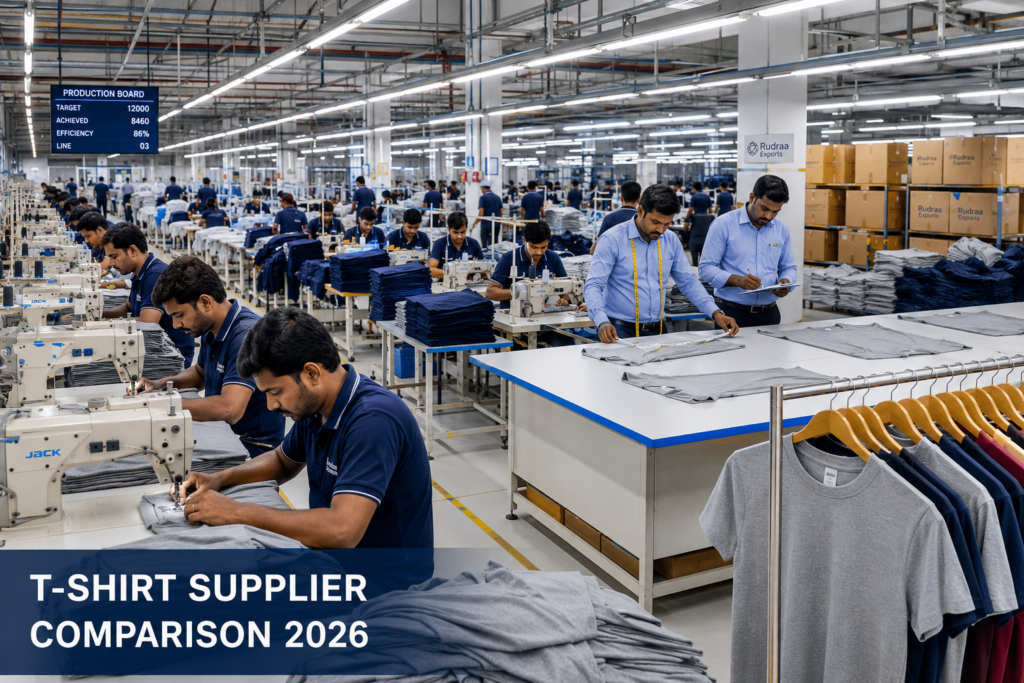
Choosing a T-shirt supplier in 2026 is not just about finding the lowest price. Any supplier can claim “best quality,” “low MOQ,” “fast delivery,” or “export quality.” Most of those claims mean nothing until you compare actual production capacity, certifications, factory ownership, compliance readiness, customization depth, documentation quality, and commercial transparency.
This is where Rudraa Exports needs to be positioned clearly. Rudraa Exports should not be marketed as the biggest T-shirt supplier in Tirupur, because that would be false and easy to challenge. Large suppliers like Eastman Exports clearly operate at a much larger scale, with public information showing over 8 million garments per month and 35 manufacturing units. Rudraa Exports, based on the provided benchmark, publicly shows around 72,000 units per month, a 500+ workforce, ISO 9001:2015 certification, and a factory-direct model with a stated ~40% cost-saving claim. That makes Rudraa a stronger fit for buyers who want direct communication, manageable production attention, compliance visibility, and custom/private-label flexibility instead of being a small account inside a huge factory system.
At Rudraa Exports, the sourcing advantage is not “we are the largest.” The stronger and more believable message is: factory-direct Tirupur T-shirt manufacturing for brands that want transparent pricing, customization support, compliance-ready documentation, and mid-sized production flexibility.
Quick Answer
Rudraa Exports compares better than typical trading suppliers and sourcing agents because it is positioned as a factory-direct Tirupur manufacturer with a publicly stated 72,000 units/month capacity, 500+ workers, ISO 9001:2015 certification, and named compliance credentials such as SEDEX, BSCI, GOTS, OEKO-TEX, and AEO. However, Rudraa is smaller than large exporters like Eastman Exports, which publicly shows far higher scale and stronger vertical integration. Rudraa’s best-fit buyers are small to mid-sized brands, private-label programs, and custom T-shirt buyers who value direct factory access, cost control, and flexible production support.
Need to compare your T-shirt program against factory-direct pricing? Contact Rudraa Exports to share your tech pack, quantity, fabric GSM, print requirement, and destination market.
Rudraa Exports vs Other T-Shirt Suppliers: The Real Comparison
When comparing Rudraa Exports with other T-shirt suppliers, buyers should not use a vague “better or worse” mindset. That is too shallow. A more useful comparison is based on supplier type.
Most T-shirt suppliers fall into four broad categories:
| Supplier Type | Typical Strength | Typical Weakness |
|---|---|---|
| Factory-direct manufacturers | Better control, direct pricing, clearer production communication | May have limited capacity compared to mega exporters |
| Large integrated exporters | Massive scale, vertical integration, stronger backup capacity | Smaller buyers may get less attention |
| Trading companies / agents | Easy sourcing access, multiple factory options | Added markup, weaker production control |
| Online bulk T-shirt vendors | Fast catalog buying | Limited customization and weak export-level compliance |
Rudraa Exports fits into the factory-direct manufacturer category. This gives it a real advantage against traders and agents, but not necessarily against very large exporters on scale.
That distinction matters. A buyer ordering 2,000–20,000 custom T-shirts may care more about flexibility, communication, sampling, and cost transparency. A global retail chain ordering millions of units may care more about multi-factory redundancy, deep vertical integration, and huge capacity. Rudraa should focus on the first buyer type, not pretend to be the second.
Rudraa Exports vs Trading Suppliers
Compared with a typical trading supplier or sourcing agent, Rudraa Exports has a stronger sourcing story.
A trading supplier usually does not own the production floor. They collect buyer requirements, find a factory, add a margin, and manage communication. This can work for buyers who want convenience, but it creates problems when the order becomes technical. If there is a fabric issue, print issue, measurement problem, packing delay, or compliance question, the buyer has to wait while the trader goes back and forth with the actual factory.
A factory-direct manufacturer reduces that communication gap. Rudraa’s factory-direct positioning is one of its strongest commercial advantages because it removes unnecessary middle layers. The benchmark document also states that Rudraa publicly claims around 40% cost saving through its factory-direct model. That claim should be used carefully. It is a strong marketing point, but it must be validated through buyer-specific RFQs because average FOB pricing is not publicly available in the supplied benchmark.
| Comparison Area | Rudraa Exports | Typical Trading Supplier |
|---|---|---|
| Factory ownership | Factory-direct model | Usually no owned factory |
| Pricing | Lower markup potential | Added trading margin |
| Communication | Direct with manufacturing team | Buyer → trader → factory |
| Customization control | Better control over sampling and production | Depends on factory partner |
| Compliance documentation | Publicly lists ISO and compliance credentials | Depends on sourced factory |
| Accountability | Easier to trace | Can become unclear when problems happen |
For buyers, the biggest advantage here is accountability. If a buyer is sourcing custom round-neck T-shirts, polo T-shirts, oversized tees, uniforms, or private-label basics, they need clarity on fabric, GSM, size tolerance, shrinkage, print method, packing, and delivery. A direct factory is usually better positioned to answer those questions quickly.
Rudraa Exports vs Large Exporters Like Eastman
This is where the comparison must be honest. Rudraa Exports does not beat Eastman Exports on scale. The provided benchmark says Eastman has over 8 million garments per month capacity, 35 manufacturing units, and more than 4,100 employees from third-party data. Rudraa’s public capacity is around 72,000 units per month with 500+ workers.
So if a buyer needs millions of pieces per month, multi-unit backup, and very deep vertical integration, Eastman is the stronger option.
But that does not make Rudraa weak. It means Rudraa should compete differently.
Large exporters are excellent for very high-volume retail programs. They usually have deeper process integration, stronger financial reporting visibility, and large production ecosystems. But smaller brands can become low-priority accounts inside very large supplier systems. Sampling may take longer. Communication may feel layered. MOQs may be less flexible. Custom small-batch programs may not get the same attention as major retail customers.
Rudraa’s opportunity is in the middle: serious buyers who need export-quality manufacturing but do not want to be ignored by a mega supplier.
| Dimension | Rudraa Exports | Large Exporter Like Eastman | Buyer Interpretation |
|---|---|---|---|
| Monthly capacity | Around 72,000 units | Over 8 million garments | Eastman wins on scale |
| Workforce | 500+ workers | 4,100+ employees | Eastman wins on manpower |
| Factory model | Factory-direct mid-sized manufacturer | Large integrated exporter | Depends on buyer volume |
| Cost-saving message | Explicit ~40% factory-direct claim | No equivalent public % claim in benchmark | Rudraa has clearer cost-saving positioning |
| ISO visibility | ISO 9001:2015 publicly stated | ISO not verified in supplied benchmark | Rudraa wins on visible ISO claim in this dataset |
| Best fit | Small to mid-sized brands | Large global retail programs | Different buyer segments |
The correct positioning is this: Eastman is stronger for massive scale; Rudraa is stronger for flexible, factory-direct, custom T-shirt sourcing where buyers need attention, cost control, and compliance visibility.
Capacity Comparison: What 72,000 Units per Month Means
Rudraa’s public capacity of around 72,000 units per month should be explained properly. It is not “small” for a custom T-shirt supplier. It is a serious mid-sized production capacity, especially for buyers placing repeat orders, private-label drops, uniform programs, or brand launches.
However, it is not comparable to mega exporters producing millions of garments per month. Trying to position Rudraa as equal to such exporters on scale would be a mistake.
The better buyer-facing explanation is:
Rudraa Exports has enough capacity for serious export programs, but remains mid-sized enough to offer closer production attention.
That is a stronger message because it turns scale into a practical buying advantage.
For example:
- A startup fashion brand may not want to work with a giant exporter.
- A corporate uniform buyer may need 500–10,000 pieces with reliable repeat supply.
- A sportswear brand may need custom T-shirts, polos, and training wear in multiple colorways.
- A private-label buyer may need sampling support and flexible development.
- A D2C brand may need manageable MOQs before scaling.
For these buyers, Rudraa’s size can be an advantage. It is big enough to manufacture seriously, but not so massive that smaller accounts get buried.
Cost Comparison: Where Rudraa’s Factory-Direct Model Helps
The benchmark document clearly states that Rudraa publicly claims ~40% cost saving through a factory-direct model. But it also states that average FOB price, MOQ, and standard lead times are not publicly available in the supplied sources. That means this claim should not be presented as guaranteed savings for every order. It should be framed as a potential advantage that buyers can validate through RFQ comparison.
This is important because T-shirt pricing depends on many variables:
| Cost Factor | Impact on T-Shirt Price |
|---|---|
| Fabric type | Combed cotton, carded cotton, organic cotton, recycled polyester, blends |
| GSM | 160 GSM, 180 GSM, 200 GSM, 240 GSM all price differently |
| Yarn quality | Compact, combed, ring-spun, open-end |
| Dyeing method | Solid dyed, reactive dyed, pigment dyed |
| Print method | Screen print, DTG, DTF, embroidery, heat transfer |
| Quantity | Higher quantities reduce per-piece cost |
| Packing | Plain polybag, barcode, hangtag, custom box |
| Testing | Colorfastness, shrinkage, OEKO-TEX, buyer RSL |
| Shipping terms | FOB, CIF, DDP, air shipment, sea shipment |
A factory-direct model can reduce cost because there is no agent margin. But buyers should still request open costing. A serious RFQ should ask for fabric cost, trim cost, CM cost, print cost, testing cost, packing cost, wastage, and FOB price.
Compliance Comparison: Rudraa’s Stronger Public Signal
One of Rudraa’s strongest advantages in the benchmark is visible compliance signaling. The benchmark says Rudraa publicly lists ISO 9001:2015, SEDEX, BSCI, GOTS, OEKO-TEX, and AEO.
This is useful for buyers because compliance is no longer optional. In 2026, buyers sourcing T-shirts for Europe, the US, Australia, or the Middle East need suppliers who can support documentation, audit expectations, chemical safety requirements, and social compliance checks.
That said, buyers should not blindly trust logo lists. They should verify:
- Certificate number
- Legal entity name
- Factory address
- Expiry date
- Certification body
- Scope of certification
- Product or process coverage
- Latest audit report
- CAP closure evidence
For example, OEKO-TEX matters only if the relevant product components are covered. GOTS matters only if the organic supply chain and transaction certificates are valid. BSCI or SEDEX is useful only when audit reports and corrective action status are available.
So Rudraa’s compliance positioning is strong, but buyers should still follow proper verification. This actually improves trust. Overclaiming creates risk. Transparent verification builds confidence.
Customization and OEM Comparison
For T-shirt buyers, customization depth matters. Many suppliers can make plain round-neck T-shirts. Fewer suppliers can manage fabric selection, GSM matching, pattern development, neck rib quality, shrinkage control, print testing, private-label branding, export packing, and repeat-order consistency.
The benchmark states that Rudraa supports end-to-end services such as fabric sourcing, custom sampling, export documentation, and manufacturing. Eastman, by comparison, has stronger documented vertical integration across knitting, dyeing, finishing, printing, and garmenting.
This means Eastman may have deeper internal process control. But Rudraa’s strength is more suitable for buyers who need practical OEM/private-label support without entering a huge supplier system.
| Buyer Requirement | Rudraa Fit | Large Exporter Fit |
|---|---|---|
| Small custom T-shirt batch | Stronger likely fit | May not prioritize |
| Mid-volume private label | Strong fit | Strong but possibly higher entry barrier |
| Huge retail order | Limited compared to mega exporters | Strong fit |
| Flexible sampling | Strong positioning | Depends on account size |
| Full vertical integration | Moderate | Stronger |
| Direct founder/brand communication | Stronger likely fit | More structured and layered |
MOQ and Lead Time: What Buyers Must Ask
The benchmark clearly states that MOQ and lead time are not publicly stated for Rudraa or Eastman in the supplied sources. That should not be hidden. It should be turned into a buyer action point.
Buyers should ask Rudraa for:
- MOQ per style
- MOQ per color
- MOQ per size ratio
- Sample lead time
- Lab dip lead time
- Print strike-off lead time
- Bulk production lead time
- Packing and inspection timeline
- FOB port options
- Air and sea shipment options
- Reorder lead time
A professional buyer should never rely on a generic answer like “MOQ depends.” That may be true, but the supplier should still be able to give a clear estimate based on fabric, GSM, color, print method, and quantity.
Best-Fit Buyer for Rudraa Exports
Rudraa Exports is best positioned for buyers who want a balance of cost, compliance, flexibility, and direct communication.
The best-fit buyers include:
- D2C fashion brands
- Small to mid-sized apparel brands
- Corporate uniform buyers
- Sports clubs and academies
- Private-label T-shirt brands
- Promotional merchandise companies
- Export buyers testing India sourcing
- Buyers who want factory-direct pricing
- Buyers who need moderate quantities, not millions of pieces
- Buyers who want compliance documentation without working through agents
The wrong fit would be a global retailer needing millions of garments per month from a vertically integrated mega supplier. Rudraa should not chase that positioning unless production scale expands significantly.
Why Rudraa Exports
Rudraa Exports stands out because it gives buyers a more direct route into Tirupur manufacturing. Instead of going through a trader, buyers can work with a factory-direct supplier that publicly communicates its production capacity, workforce, ISO certification, and compliance credentials.
Manufacturing Advantages
- Factory-direct Tirupur T-shirt manufacturing
- Around 72,000 units per month capacity
- 500+ workforce
- Custom T-shirt and knitwear production
- Fabric sourcing and sampling support
- Export documentation support
- Suitable for small to mid-sized private-label and custom programs
Compliance and Quality Advantages
- ISO 9001:2015 publicly stated
- SEDEX, BSCI, GOTS, OEKO-TEX, and AEO listed in the benchmark
- Better compliance visibility than many generic trading suppliers
- Useful for buyers who need documentation before onboarding
- Supports serious sourcing conversations around quality, audits, and export readiness
Commercial Advantages
- Factory-direct pricing model
- Claimed ~40% cost-saving positioning
- Better transparency than agent-led sourcing
- More suitable for brands that need cost control and direct factory communication
- Stronger fit for buyers who want flexibility instead of only massive scale
Ready to compare your current T-shirt supplier with a factory-direct Tirupur manufacturer? Talk to Rudraa Exports for a quote based on your fabric, GSM, quantity, print method, and destination market.
Final Verdict: How Rudraa Should Be Positioned
Rudraa Exports should be positioned as a factory-direct, compliance-visible, mid-sized Tirupur T-shirt manufacturer. That is the strongest and most believable angle.
Do not position Rudraa as larger than major exporters. That is not true. Large players like Eastman clearly outperform Rudraa on production scale, number of units, workforce size, and documented vertical integration. If a buyer needs massive retail production, a giant exporter may be the better choice.
But Rudraa has a strong place in the market. It is better positioned than typical trading suppliers because it offers direct factory access, visible production capacity, public compliance credentials, and a cost-saving factory-direct model. For small to mid-sized brands, private-label buyers, custom T-shirt programs, and export buyers who want practical attention, Rudraa may be a smarter sourcing option than both a trader and an oversized mega supplier.
The honest positioning is simple:
Rudraa Exports is not the biggest T-shirt supplier in Tirupur. It is a factory-direct T-shirt manufacturer built for buyers who want cost control, compliance visibility, customization support, and direct communication without trading-company markups.
Related guides: our roundup of the best garment manufacturers in Tirupur, the T-shirt quality comparison guide, and how to start a supply partnership.
Visit rudraaexports.com or contact the team directly to share your tech pack, target MOQ, fabric GSM, print requirements, and destination market — and receive a factory-direct quote for your 2026 T-shirt sourcing program.
Related reading
Rudraa Exports vs Shahi Exports 2026: Which Manufacturer Fits Your Brand?