
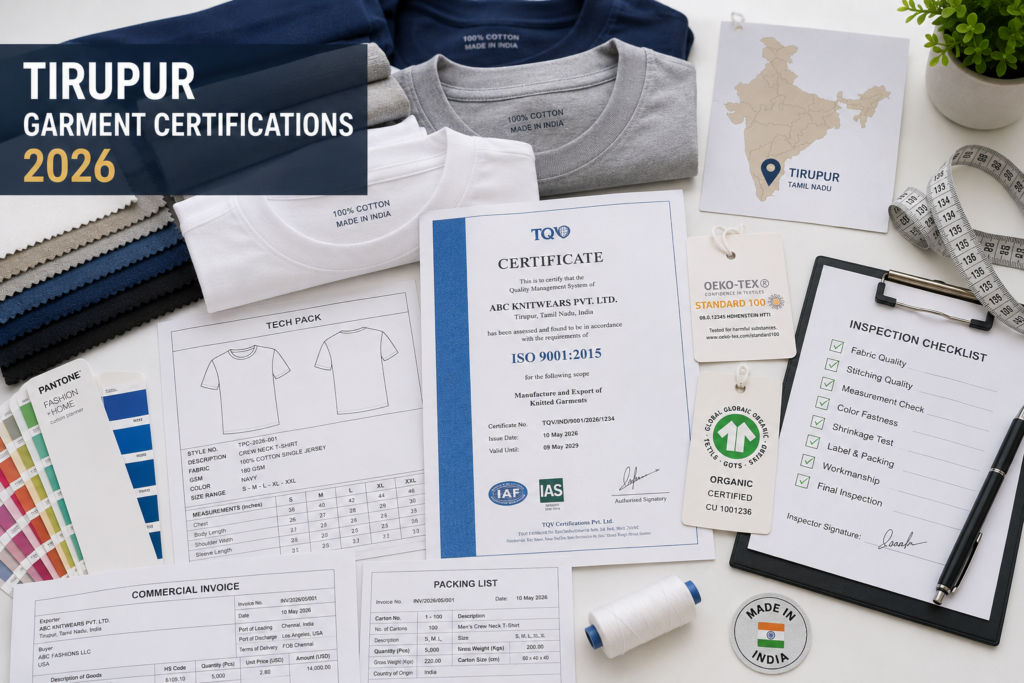
Choosing the right Tirupur garment manufacturer in 2026 is no longer just about price, stitching quality, or production capacity. Serious international buyers now need proof that a factory can deliver consistent quality, chemical safety, ethical labor practices, environmental controls, and export-ready documentation without last-minute surprises.
Tirupur remains one of India’s strongest knitwear and T-shirt manufacturing clusters, but not every certified factory is equally reliable. A certificate on paper does not automatically mean the factory is audit-ready, legally compliant, or suitable for your product category. Buyers need to know what each certification actually proves, what it does not prove, and how to verify the documents before placing bulk orders.
At Rudraa Exports, we work as a factory-direct Tirupur, India T-shirt and knitwear manufacturer for buyers who want transparent sourcing, ISO-aligned quality systems, clear communication, and practical compliance support. This 2026 guide rewrites the key procurement points from the uploaded research document into a buyer-friendly framework for evaluating Tirupur factories, certifications, audits, and quality standards.
Quick Answer
A reliable Tirupur garment manufacturer in 2026 should provide more than a certificate copy. Buyers should verify ISO 9001 for quality systems, ISO 14001 for environmental management, OEKO-TEX STANDARD 100 for product chemical safety, GOTS for organic supply chains, and social compliance standards such as amfori BSCI, WRAP, SMETA, or SA8000. The safest approach is to check certificate scope, expiry date, issuing body, official database validity, audit reports, CAP closure evidence, and product-level test records before bulk production.
Need a custom quote for your specific program? Contact Rudraa Exports to share your tech pack, target MOQ, and destination market.
Why Certifications Matter When Sourcing from Tirupur in 2026
Tirupur is known as India’s knitwear capital because of its dense network of knitting units, dyeing houses, printing facilities, stitching lines, finishing units, packing teams, and export logistics support. The cluster handles a major share of India’s knitted garment exports and supports buyers across the EU, US, Australia, Middle East, and other global markets.
But the buying environment has changed. International sourcing teams now face tougher pressure from compliance teams, ESG reporting, Modern Slavery Acts, EU CSRD expectations, REACH chemical rules, CPSIA requirements for children’s products, and customer demand for traceability. A low FOB price is useless if the shipment fails a chemical test, gets delayed due to documentation gaps, or creates reputational risk.
That is why certification verification has become a sourcing skill. Buyers must separate factories that use certifications as operating systems from factories that use them as sales decoration.
What Do Garment Factory Certifications Actually Prove?
Not all certifications cover the same risk. This is where many buyers make mistakes. ISO 9001 does not prove product chemical safety. OEKO-TEX STANDARD 100 does not automatically prove ethical labor practices. GOTS does not apply unless the product and supply chain meet organic and chain-of-custody rules.
The table below shows how buyers should read the most common certification types.
| Certification / Standard | Main Purpose | What It Proves | What Buyers Must Still Check |
|---|---|---|---|
| ISO 9001:2015 | Quality management | Factory has a documented quality system | Product-level quality, defect history, CAPA evidence |
| ISO 14001:2015 | Environmental management | Factory manages environmental risks and legal obligations | Utility records, permits, subcontractor controls |
| OEKO-TEX STANDARD 100 | Product chemical safety | Textile components tested for harmful substances | Certificate scope, trims, prints, labels, current validity |
| GOTS | Organic textile processing | Organic fiber integrity and chain-of-custody controls | Transaction certificates and approved processing steps |
| GRS | Recycled material verification | Recycled input and chain-of-custody claims | Material percentage, TC documents, supplier scope |
| amfori BSCI | Social compliance audit | Labor, wages, working hours, health and safety checks | Rating, full audit report, CAP closure |
| WRAP | Ethical manufacturing | Legal, labor, safety, and environmental basics | Certification level, facility scope, latest audit result |
| SMETA | Ethical trade audit | Labor, health and safety, environment, business ethics | Buyer acceptance, audit age, nonconformity closure |
| SA8000 | Social accountability | Strong social management system | Certificate verification and worker participation evidence |
ISO 9001: Why Quality Management Matters for Apparel Buyers
ISO 9001:2015 is one of the most common quality standards used by garment manufacturers. It certifies that a factory has a quality management system, not that every garment will automatically be perfect.
For apparel sourcing, this matters because quality failures usually come from weak systems: poor measurement control, inconsistent inline inspection, missing SOPs, poor fabric inspection, untrained operators, or weak corrective action tracking.
A buyer should ask for the ISO 9001 certificate, but that is only step one. The real test is whether the factory can show how quality is controlled from fabric receipt to cutting, stitching, finishing, final inspection, and packing.
ISO 9001 Documents Buyers Should Request
| Document | Why It Matters |
|---|---|
| ISO 9001 certificate with scope | Confirms which site and process are covered |
| Quality manual or process map | Shows how the factory controls production |
| Inline inspection reports | Shows defect monitoring during production |
| Final inspection reports | Confirms shipment-level quality checks |
| Calibration records | Verifies measuring tools, GSM cutters, scales, and testing instruments |
| CAPA register | Shows whether issues are fixed permanently |
| Customer complaint records | Reveals recurring quality problems |
| AQL inspection reports | Confirms acceptance standards such as AQL 2.5 |
A serious buyer should not accept vague statements like “we follow quality standards.” Ask for proof. If the factory cannot show recent inspection records, measurement reports, and corrective action logs, the ISO certificate is a weak signal.
ISO 14001: Environmental Management for Textile Sourcing
ISO 14001:2015 is used to assess whether a factory has a structured environmental management system. In garment manufacturing, this can include energy use, water use, waste handling, chemical storage, hazardous waste disposal, legal permits, and environmental monitoring.
This is especially important in Tirupur because wet processing, dyeing, washing, and finishing may be handled by different units. Even if the stitching factory is clean and certified, your environmental risk may sit with the dyeing or processing subcontractor.
Buyers should ask whether ISO 14001 covers only the garment unit or also upstream processing partners. If dyeing, printing, or washing is outsourced, the factory should provide a named subcontractor list and supporting compliance documents.
OEKO-TEX STANDARD 100: Product Chemical Safety
OEKO-TEX STANDARD 100 is one of the most useful certifications for buyers sourcing T-shirts, babywear, underwear, sportswear, uniforms, and skin-contact garments. It focuses on harmful substance testing across textile products and components.
The key word is “product.” OEKO-TEX STANDARD 100 is not the same as a full factory social audit or environmental certification. It confirms that tested textile components meet chemical safety limits.
For a T-shirt, buyers should check whether the certificate covers:
| Component | Verification Needed |
|---|---|
| Main fabric | Certificate number and material scope |
| Sewing thread | Included or separately certified |
| Neck rib | Included in product scope |
| Prints | Ink or transfer print chemical safety |
| Labels | Woven, printed, or heat-transfer labels |
| Buttons / trims | Required if used in the garment |
| Elastic | Required for shorts, underwear, or activewear |
A common mistake is accepting certified fabric and assuming the final garment is fully OEKO-TEX compliant. If the print, thread, label, or trim is not covered, the claim may not apply to the complete garment.
GOTS: Organic Cotton Claims Need Transaction Certificates
GOTS is important for buyers sourcing organic cotton T-shirts, babywear, sleepwear, and sustainable fashion basics. But this is also an area where weak suppliers misuse language.
A factory saying “we can make organic cotton T-shirts” is not enough. For a valid GOTS supply chain, buyers should verify the facility scope, approved suppliers, processing steps, and transaction certificates.
A GOTS transaction certificate is critical because it connects the organic claim to a specific lot, order, or input. Without it, the claim may be only a marketing statement.
GOTS Buyer Verification Framework
✅ Check the supplier in the GOTS public database
✅ Confirm the certificate validity date covers your production period
✅ Match the legal name and address with the factory you are using
✅ Request transaction certificates for yarn, fabric, or finished goods
✅ Confirm whether printing, dyeing, embroidery, and washing are within approved scope
✅ Add TC submission milestones before shipment
✅ Avoid using “GOTS organic” in product claims unless documentation is complete
Social Compliance: BSCI, WRAP, SMETA, and SA8000
Social compliance has become one of the biggest risk areas in apparel sourcing. Buyers must be able to show that workers are treated legally and ethically, especially when supplying to Europe, the US, Australia, or large retail channels.
The main issues buyers should check are working hours, overtime records, wage payments, fire safety, PPE, grievance systems, worker interviews, contractor labor, migrant labor, and subcontracting.
| Standard / Audit | Best Used For | Buyer Risk Controlled |
|---|---|---|
| amfori BSCI | General social compliance benchmarking | Working hours, wages, safety, labor rights |
| WRAP | Ethical manufacturing certification | Legal compliance, child labor, forced labor, safety |
| SMETA | Retailer and brand ethical trade audits | Labor, safety, environment, business ethics |
| SA8000 | Strong social accountability system | Worker rights, management systems, grievance structures |
The biggest mistake buyers make is accepting a rating without reading the findings. A BSCI C rating with strong corrective action may be manageable. A better-looking report with unresolved critical findings may be risky. The CAP matters as much as the rating.
How to Read Audit Reports and CAPs
A Corrective Action Plan, or CAP, is the factory’s response to audit findings. It should not be a vague document saying “training completed.” A good CAP includes the issue, root cause, corrective action, responsible person, deadline, evidence, and verification method.
For example, if an audit finds blocked emergency exits, a weak CAP says “we instructed workers.” A strong CAP says the factory removed storage from exits, repainted floor markings, updated the daily safety checklist, assigned a safety owner, retrained staff, and attached photo evidence.
CAP Quality Checklist
✅ Is the issue clearly described?
✅ Is the root cause identified?
✅ Is there a responsible person?
✅ Is the closure deadline realistic?
✅ Is objective evidence attached?
✅ Was the fix checked during a follow-up audit?
✅ Does the action prevent recurrence, or only hide the issue temporarily?
If a factory cannot show CAP closure evidence, do not scale volume. That is not being cautious; that is basic procurement discipline.
Product Testing Standards Buyers Should Know in 2026
Garment quality should be tested with recognized standards, not subjective opinions. Buyers should define relevant tests before production starts.
| Test Area | Common Standard | Why It Matters |
|---|---|---|
| Washing shrinkage | ISO 6330 | Checks size stability after washing |
| Colorfastness to washing | AATCC 61 | Measures dye bleeding and fading |
| Pilling resistance | ISO 12945 | Important for knitwear and T-shirts |
| Fabric mass / GSM | ISO 3801 / ASTM D3776 | Confirms fabric weight consistency |
| Final inspection | AQL 2.5 | Sets acceptable defect limits |
| Chemical safety | OEKO-TEX / buyer RSL | Reduces harmful substance risk |
| Children’s safety | CPSIA where applicable | Required for US children’s products |
For T-shirt buyers, GSM, shrinkage, colorfastness, seam strength, print durability, and measurement tolerance should be locked before bulk production. Do not wait until shipment inspection to define quality expectations.
Export Documentation and Compliance for Tirupur Buyers
Certifications are only one part of supplier selection. International buyers also need export-ready documentation. For factory-direct sourcing from Tirupur, this may include commercial invoice, packing list, HS code classification, certificate of origin, bill of lading or airway bill, inspection documents, and FTA-related paperwork where applicable.
For T-shirts and knitwear, buyers commonly deal with HS codes such as 6109 for T-shirts, singlets, and similar knitted garments, and 6110 for sweaters, sweatshirts, and similar knitted products. Exact classification depends on fiber content, construction, and product type.
Tirupur exporters usually ship through major ports such as Tuticorin VOC Port, Chennai Port, and Cochin Port. Buyers sourcing for the UK, UAE, Australia, or EFTA markets should ask early about FTA-eligible documentation, including UAE CEPA, Australia ECTA, UK trade documentation where applicable, and EFTA TEPA readiness.
Certification Verification: The 3-Layer Proof Method
A certificate is useful only if it is authentic, current, and relevant to your order. Buyers should use a simple 3-layer proof method.
Layer 1: Document Check
Check the certificate number, issue date, expiry date, legal entity name, site address, standard name, certification body, and scope. Scope is critical. A certificate for “trading” does not prove manufacturing compliance.
Layer 2: Database Check
Use official verification platforms wherever available. OEKO-TEX, GOTS, and SA8000 have public verification routes. For BSCI, report sharing may happen through the amfori platform. For ISO, buyers should check whether the certification body is credible and properly accredited.
Layer 3: On-Site or Evidence Check
Match documents with real operating evidence. Compare payroll with attendance, inspection reports with production output, chemical inventory with actual storage, and subcontractor lists with shipping or packing documents.
This method prevents one of the biggest sourcing mistakes: believing documents that do not match factory reality.
20-Point Tirupur Factory Vetting Checklist for Buyers
Use this checklist before onboarding a new garment manufacturer.
✅ Confirm legal entity name, address, GST, and export registration details
✅ Match all certificates to the same legal entity or approved production unit
✅ Check whether the factory is manufacturer, trader, or agent
✅ Verify monthly production capacity and line allocation
✅ Ask for ISO 9001 certificate, scope, and latest audit summary
✅ Review inline and final inspection formats
✅ Confirm AQL level, preferably AQL 2.5 for final inspection
✅ Check calibration records for measurement tools and GSM testing
✅ Request OEKO-TEX certificate numbers for fabric and components
✅ Ask for buyer RSL or chemical compliance testing where needed
✅ For organic styles, request GOTS scope and transaction certificates
✅ Review ISO 14001 or environmental control documentation
✅ Confirm dyeing, printing, washing, and finishing subcontractors
✅ Ask for BSCI, WRAP, SMETA, or SA8000 audit reports
✅ Review working-hour and overtime control systems
✅ Check wage records and worker benefits documentation
✅ Review fire safety, PPE, exits, and drill records
✅ Ask for CAP closure evidence from recent audits
✅ Confirm export documentation capability and HS code knowledge
✅ Add compliance requirements directly into the PO or supplier agreement
Red Flags When Choosing a Tirupur Garment Manufacturer
Some warning signs are serious enough to pause onboarding immediately.
| Red Flag | Why It Matters |
|---|---|
| Certificate cannot be verified | Possible fake, expired, or borrowed certificate |
| Scope does not match production | Certification may not cover your order |
| Factory refuses full audit report | Buyer cannot assess real risk |
| No CAP evidence | Problems may repeat in bulk production |
| No subcontractor disclosure | Hidden compliance and quality risk |
| No component-level OEKO-TEX proof | Chemical claim may not cover full garment |
| Organic claim without transaction certificate | GOTS claim may be invalid |
| Identical time records for many workers | Possible cosmetic compliance |
| No calibration records | Measurement and GSM claims may be unreliable |
| Poor communication on documents | Likely shipment-stage delays |
The brutal truth: if a factory becomes defensive when you ask for basic verification, they are not ready for serious international buyers.
Why Rudraa Exports
Rudraa Exports is positioned for buyers who want factory-direct production from Tirupur without agent layers, unclear pricing, or weak documentation practices.
Manufacturing Capabilities
- Factory-direct Tirupur, India T-shirt and knitwear manufacturing
- 72,000+ units per month production capacity
- MOQs starting from around 300 pieces per style
- Support for custom T-shirts, knitwear, uniforms, sportswear, and private label programs
- Multi-port shipping support through Tuticorin VOC, Chennai, and Cochin
Quality and Compliance
- ISO 9001:2015 certified manufacturing approach
- AQL 2.5 inspection standards for consistent shipment quality
- Buyer-aligned documentation support for international sourcing teams
- Capability to support certification-aligned sourcing requirements such as OEKO-TEX, GOTS, GRS, WRAP, SMETA, BSCI, and related buyer standards
- Practical production controls across fabric, cutting, stitching, finishing, inspection, and packing
International Buyer Advantages
- Factory-direct pricing with no trading-company markup
- Up to 40% cost savings compared with trading-company sourcing models
- English-language communication for global buyers
- Export support for EU, US, Australia, and Middle East markets
- FTA-eligible documentation support for markets such as the UAE, Australia, UK, and EFTA where applicable
Ready to discuss your program? Speak with our Tirupur factory team for transparent factory-direct pricing built for international buyers in 2026.
FAQ: Tirupur Garment Certifications and Compliance
1. What certifications should a Tirupur garment manufacturer have in 2026?
A reliable Tirupur garment manufacturer should ideally have ISO 9001 for quality management and strong buyer-ready processes for inspection, documentation, and corrective actions. Depending on the product, buyers may also need OEKO-TEX STANDARD 100, GOTS, GRS, ISO 14001, WRAP, SMETA, BSCI, or SA8000.
2. Is ISO 9001 enough for garment sourcing?
No. ISO 9001 confirms that the factory has a quality management system, but it does not prove chemical safety, organic integrity, social compliance, or product-level performance. Buyers should pair ISO 9001 with inspection records, AQL reports, testing standards, and compliance documents.
3. What is the difference between OEKO-TEX and GOTS?
OEKO-TEX STANDARD 100 focuses on harmful substance testing for textile products and components. GOTS focuses on organic textile integrity, environmental criteria, social criteria, and chain-of-custody documentation. For organic cotton garments, GOTS transaction certificates are critical.
4. How do I verify an OEKO-TEX certificate?
Ask for the OEKO-TEX certificate number or QR code and check it through the official OEKO-TEX verification system. Also confirm whether the certificate covers the full garment, including fabric, thread, print, labels, and trims.
5. Can a factory claim organic cotton without GOTS?
A factory can source organic cotton, but buyers should not accept strong organic product claims without valid chain-of-custody proof. For GOTS-labeled products, buyers should request a valid scope certificate and transaction certificates linked to the order.
6. What is AQL 2.5 in garment inspection?
AQL 2.5 is an inspection acceptance level commonly used for apparel shipments. It defines how many defects are acceptable in a sampled lot before the shipment fails inspection. Buyers use it to keep quality decisions objective instead of subjective.
7. Why do social audits matter in Tirupur sourcing?
Social audits help buyers assess working hours, wages, overtime, health and safety, worker rights, and grievance systems. Standards such as BSCI, WRAP, SMETA, and SA8000 reduce ethical and legal sourcing risks, especially for international buyers.
8. What documents should I request before placing a bulk order?
Buyers should request certificates, audit reports, CAP closure evidence, factory profile, production capacity, inspection formats, test reports, component compliance documents, subcontractor lists, and export documentation samples. For organic or recycled claims, transaction certificates are also important.
9. How do I know if a certification covers my order?
Check the certificate scope. It should match the legal entity, site address, process, product type, and production route used for your order. If printing, washing, dyeing, or embroidery is outsourced, those steps must be separately verified.
10. Are Tirupur garment manufacturers suitable for small MOQs?
Yes, some Tirupur manufacturers support smaller MOQs, especially for custom T-shirts, startup brands, uniforms, and test programs. Rudraa Exports supports MOQs starting from around 300 pieces per style, depending on fabric, customization, and production requirements.
11. Which ports are commonly used for Tirupur garment exports?
Tirupur exporters commonly use Tuticorin VOC Port, Chennai Port, and Cochin Port depending on buyer destination, freight plan, and logistics availability. Export-ready factories should be able to support commercial invoice, packing list, certificate of origin, and HS code documentation.
12. What is the safest way to shortlist a Tirupur garment factory?
Use a scorecard that checks product capability, certification scope, quality systems, social compliance, chemical safety, export documentation, pricing transparency, communication quality, and sample performance. Never shortlist based only on a low FOB price.
Conclusion
The best Tirupur garment manufacturers in 2026 are not just factories that can stitch garments. They are partners that can prove quality, compliance, chemical safety, traceability, and export readiness with documents, systems, and verified production evidence. Certifications such as ISO 9001, ISO 14001, OEKO-TEX, GOTS, GRS, WRAP, SMETA, BSCI, and SA8000 are useful only when buyers verify scope, validity, audit reports, CAP closure, and product-level relevance.
Visit rudraaexports.com or contact our team directly to share your tech pack, target MOQ, and destination market — and receive a transparent factory-direct quote built for serious international buyers in 2026.
Certification requirements are especially strict for children’s and institutional wear — see our guide to school uniform manufacturing standards in India for the fabric, safety, and compliance benchmarks buyers should specify.
Related guides: a practical T-shirt quality comparison and our shortlist of the best garment manufacturers in Tirupur.