
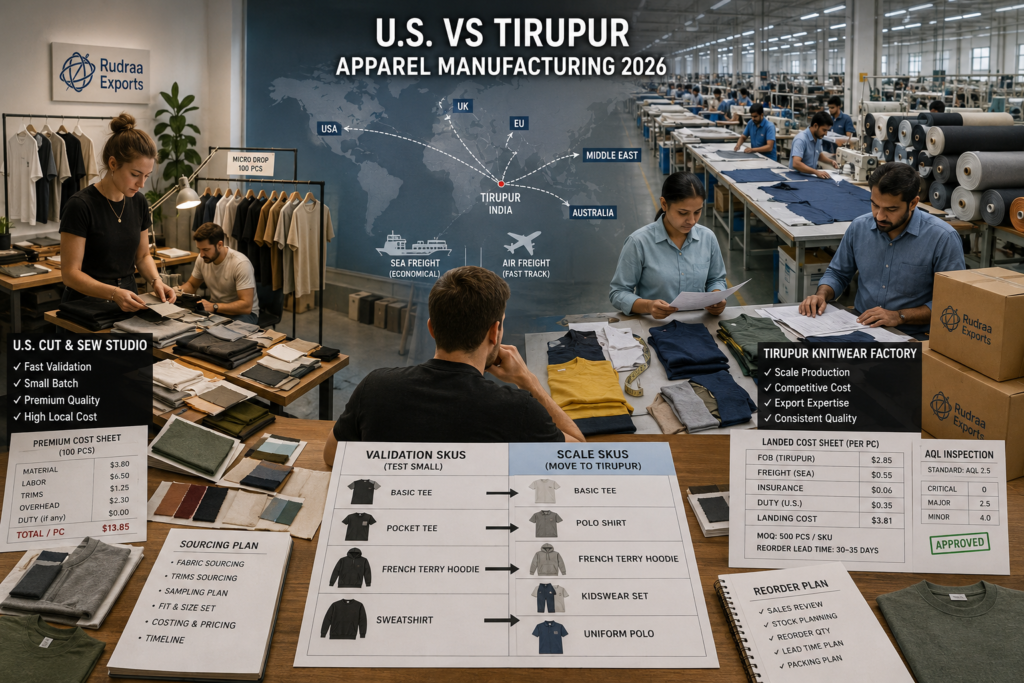
Many early-stage apparel founders ask the same question: should I manufacture locally in the U.S., or should I source from Tirupur, India?
The honest answer is not emotional. It is practical.
U.S. domestic manufacturing can be a smart choice when you are validating a new product, testing fit, building a “Made in USA” brand story, or producing small-batch drops. But once you have proven demand and need repeatable scale, Tirupur often becomes the stronger economic choice — especially for T-shirts, polos, hoodies, sweatshirts, kidswear, uniforms, loungewear, and cotton knitwear basics.
This guide compares U.S. vs Tirupur apparel manufacturing across cost, quality, lead time, MOQ, scalability, tariffs, freight, and buyer fit. The goal is not to say offshore production is always better. The goal is to help Western startup founders make the right decision based on cash flow, margins, speed, and growth stage.
At Rudraa Exports, we support startup brands and growing apparel businesses with factory-direct Tirupur knitwear manufacturing, low-MOQ discussions, sampling, quality control, export documentation, and scale-ready production planning.
Quick Answer
U.S. apparel manufacturing is often better for early product validation, micro-drops, fast local iteration, and brands that can charge a premium for “Made in USA.” Tirupur apparel manufacturing is usually better once a startup has proven demand and needs lower landed cost, repeatable production, better margin headroom, and scale. For simple knitwear like T-shirts, polos, hoodies, and basics, Tirupur can remain cost-competitive even after freight and U.S. import duty, provided the founder plans MOQs, quality control, and shipping timelines properly.
Planning to compare local production vs Tirupur sourcing? Contact Rudraa Exports to request a founder-focused sourcing review and landed-cost worksheet.
Why This Decision Matters for Startup Brands
For a startup apparel brand, manufacturing decisions affect everything:
- Cash flow
- Retail price
- Gross margin
- Paid ads budget
- Inventory risk
- Reorder speed
- Product quality
- Brand positioning
- Customer experience
- Ability to scale
A founder may want to manufacture locally because it feels safer. That can be true in the beginning. But if the unit cost is too high, your margin may collapse before the brand has a chance to grow.
On the other hand, sourcing from India too early can create risk if you do not have stable specs, forecast discipline, or enough volume.
The right answer depends on your stage.
U.S. vs Tirupur: Quick Comparison Table
| Criteria | U.S. Domestic Manufacturing | Tirupur, India Manufacturing | Founder Takeaway |
|---|---|---|---|
| Unit cost | Higher | Lower | Tirupur usually wins on cost |
| Fabric cost | Often higher in small quantities | More competitive for knits | Tirupur has local knitwear ecosystem |
| CMT cost | Higher due to wage structure | Lower due to cluster economics | Biggest savings often come from labour/CMT |
| MOQ | Lower, often easier for testing | Higher, but flexible with right supplier | U.S. better for validation |
| Lead time | Faster for local replenishment | Longer due to production + ocean freight | U.S. better for fast iteration |
| Scalability | Can be limited by capacity and cost | Strong for repeatable knitwear scale | Tirupur better for growth-stage brands |
| Freight | Lower complexity | Needs planning | Offshore requires forecast discipline |
| Duty | No import duty | U.S. duty applies | Duty usually does not erase India’s cost advantage |
| Brand story | “Made in USA” advantage | Value + scale + global sourcing story | Depends on customer positioning |
| Best use | Testing and micro-drops | Proven SKUs and scale | Use both strategically |
Cost Reality: Why Tirupur Often Wins at Scale
The biggest difference between U.S. and Tirupur manufacturing is cost structure.
In U.S. production, sewing wages, local overheads, small-batch fabric sourcing, and factory setup costs can push the ex-factory cost high. In Tirupur, the knitwear ecosystem is built around fabric, dyeing, cutting, sewing, finishing, packing, and export production at scale.
The uploaded source gives an indicative comparison where a basic 180 GSM cotton T-shirt can land much higher in U.S. domestic production, while Tirupur’s ex-factory and landed cost can remain substantially lower even after freight and duty.
Indicative Cost Comparison: 180 GSM Cotton T-Shirt
| Cost Component | U.S. Domestic Range | Tirupur Range |
| Fabric | Higher due to domestic small-batch fabric cost | Lower due to local knit ecosystem |
| CMT | Higher due to wage structure | Lower due to Tirupur cluster economics |
| Trims and packing | Similar, depending on spec | Similar, depending on spec |
| QA/testing | Depends on buyer requirement | Depends on buyer requirement |
| Freight | Lower domestic movement | Higher international freight |
| Duty | Not applicable | U.S. import duty applies |
| Landed cost | Usually higher | Usually lower for scale basics |
The key point: duty and freight matter, but they are not always enough to erase Tirupur’s cost advantage for basic knitwear.
Why Unit Cost Alone Is Not Enough
Founders should not compare only ex-factory price.
You should compare:
Ex-factory cost + freight + duty + testing + packaging + defects + returns + inventory risk
This is the true landed-cost view.
Landed Cost Checklist
| Cost Line | Why It Matters |
| Fabric | Biggest material driver |
| CMT | Cut, make, trim cost |
| Printing / embroidery | Adds setup and quality risk |
| Labels and trims | Can affect MOQ and compliance |
| Packaging | Polybag, carton, barcode, inserts |
| Testing | Shrinkage, colourfastness, RSL, CPSIA where needed |
| Freight | Domestic or ocean/air |
| Duty | Applies to imported goods |
| Customs clearance | Broker and import charges |
| Defects/rework | Hidden margin killer |
| Returns | Affects true profitability |
A low price is not useful if the product creates returns or misses delivery windows.
Quality: Country Does Not Decide Quality — Systems Do
Quality is not automatically better in the U.S. or automatically worse in India.
Quality depends on:
- Tech pack clarity
- Fabric specification
- Approved samples
- Measurement tolerance
- Wash testing
- Colourfastness
- Inline inspection
- Final AQL inspection
- Correct packing
- Supplier accountability
A U.S. factory with weak process can still produce poor garments. A Tirupur factory with strong systems can produce export-grade quality.
Quality Control Comparison
| Area | U.S. Domestic | Tirupur / Rudraa |
| Local rework | Easier | Longer if shipment has moved |
| Sample review | Faster physical feedback | Needs planned approval cycle |
| AQL inspection | Available if specified | Available and recommended |
| Compliance | Depends on factory | Export-focused suppliers support documentation |
| Fit correction | Faster locally | Manageable through structured sampling |
| Bulk repeatability | Depends on system | Strong when specs and QC are locked |
The safest approach is to define quality expectations before production.
AQL: What Startup Founders Should Know
AQL means Acceptance Quality Limit. It is a sampling method used to inspect bulk production.
For DTC apparel basics, founders often use:
- AQL 2.5 for major defects
- AQL 4.0 for minor defects
Common Major Defects
- Wrong measurements
- Open seams
- Holes
- Stains
- Incorrect print placement
- Shade mismatch
- Wrong size label
- Broken stitching
- Twisted garment
Common Minor Defects
- Loose threads
- Slight uneven stitching
- Minor finishing issues
- Small packing imperfections
AQL should be written into the purchase order. Do not rely on “quality will be good.”
Lead Time: U.S. Wins on Speed, Tirupur Wins on Planned Scale
Domestic manufacturing can be faster because there is no international freight, customs, or long shipping route.
For early validation, this matters.
If you are testing fit, checking customer response, and adjusting product quickly, U.S. manufacturing may be worth the higher cost.
Tirupur requires more planning. You need to allow time for:
- Sampling
- Lab dips
- Fabric sourcing
- Cutting
- Stitching
- Printing or embroidery
- Washing or finishing
- Inspection
- Packing
- Freight
- Customs clearance
Lead Time Comparison
| Stage | U.S. Domestic | Tirupur |
| Sampling | Faster due to proximity | Structured but requires shipping time |
| Bulk production | Often shorter for small batches | Longer for export-scale orders |
| Freight | Domestic ground | Ocean or air |
| Reorder speed | Faster | Requires forecast planning |
| Best for | Testing and micro-drops | Planned replenishment and scale |
The founder mistake is using Tirupur like a local factory. Offshore sourcing needs a calendar.
MOQ: Low MOQ Is Useful, But Not Always Profitable
Startup founders love low MOQs because low MOQ feels safe.
That is true during validation.
But low MOQ can also increase cost per unit, reduce production efficiency, and create less negotiating power.
MOQ Comparison
| Stage | Better Manufacturing Choice |
| First product test | U.S. domestic |
| 50–200 unit micro-drop | U.S. domestic |
| 300–500 unit test with stable spec | Tirupur can work |
| 1,000+ unit reorder | Tirupur becomes stronger |
| 10,000+ annual volume | Tirupur usually becomes more attractive |
At Rudraa Exports, MOQ discussions can start from around 300 pieces for suitable programs, depending on fabric, colour, logo method, trims, and customization. But for best Tirupur pricing, founders should concentrate volume into fewer proven styles and colours.
SKU Strategy: Validation SKUs vs Scale SKUs
The smartest founders do not choose only one country. They split products by stage.
Validation SKUs
These are new products you are still testing.
Best manufacturing fit:
- U.S. domestic
- Low MOQ
- Faster rework
- Smaller inventory risk
- Fast feedback loop
Examples:
- New fit
- New silhouette
- Seasonal colour
- Experimental hoodie
- Limited capsule
- Influencer drop
Scale SKUs
These are proven products with repeat demand.
Best manufacturing fit:
- Tirupur
- Better landed cost
- Repeatable bulk production
- Larger inventory runs
- Better margin headroom
Examples:
- Best-selling black T-shirt
- White core tee
- Repeat hoodie
- Corporate polo
- Uniform program
- Always-on basics
Founder Rule
Test locally if needed. Scale in Tirupur when the SKU proves demand.
Scalability: Where Tirupur Becomes Strong
Scaling apparel is not only making more units. It means producing repeat orders consistently.
You need:
- Same fabric handfeel
- Same GSM
- Same shade
- Same fit
- Same measurements
- Same print quality
- Same label placement
- Same packing format
- On-time delivery
Tirupur’s advantage is its knitwear cluster. Fabric, dyeing, printing, stitching, trims, finishing, and packing are available in the same industrial ecosystem.
Tirupur Scale Advantages
| Advantage | Why It Matters |
| Knitwear specialization | Strong for T-shirts, polos, hoodies, basics |
| Fabric ecosystem | Easier repeat fabric sourcing |
| Dyeing support | Better bulk shade management |
| Printing and embroidery | Faster customization |
| Skilled labour | Repeat production capacity |
| Export documentation | Easier international shipments |
| Supplier network | Better scale support |
For a startup that has proven demand, this ecosystem helps convert a small brand into a scalable apparel business.
Tariffs and Duty: Does U.S. Import Duty Remove India’s Advantage?
No, not usually for basic knitwear.
The uploaded source uses a 16.5% U.S. duty planning assumption for Indian cotton T-shirts under a common HTS category. Buyers should confirm final classification and duty with a licensed customs broker.
But duty is usually applied to the customs value, often based on FOB value. If the India FOB cost is much lower than the U.S. ex-factory cost, the duty amount may still be manageable.
Simple Example
| Item | Example |
| India FOB value | $4.00 |
| Duty at 16.5% | $0.66 |
| Freight allocation | $0.50 |
| Estimated landed cost | $5.16 |
If the equivalent U.S. product costs $9–$12 ex-factory, the India option may still have a strong landed-cost advantage.
Freight and Shipping Risk
Offshore manufacturing needs freight discipline.
Risks include:
- Ocean freight spikes
- Vessel delays
- Port congestion
- Customs delays
- Air freight emergencies
- Carton planning inefficiency
- Wrong shipping documents
- Last-minute launch pressure
How to Reduce Freight Risk
- Book freight early
- Use carton optimization
- Consolidate shipments
- Keep packing data accurate
- Maintain a 1–2 week buffer
- Use air only for urgent top-ups
- Track sell-through and reorder earlier
- Use a rolling forecast
A good offshore plan uses ocean freight for bulk and air freight only for emergencies or top-selling restocks.
When U.S. Manufacturing Makes Sense
Choose U.S. domestic manufacturing if:
- You are still testing product-market fit
- You need fast fit corrections
- You want small micro-drops
- You can sell at premium pricing
- “Made in USA” is central to your brand
- You cannot forecast 12 weeks ahead
- You want to avoid customs and freight complexity
- Your order quantity is still very small
Best U.S. Use Case
A founder launches a 150-piece premium streetwear drop and wants to test fit, content, and customer demand. Local manufacturing is worth it because speed and flexibility matter more than unit cost.
When Tirupur Manufacturing Makes Sense
Choose Tirupur manufacturing if:
- You have proven SKUs
- You need lower landed cost
- You can order in larger quantities
- You need better gross margin
- You want to scale paid ads or wholesale
- You can plan 8–12 weeks ahead
- You are producing knitwear basics
- You want factory-direct sourcing
- You need export-ready documentation
Best Tirupur Use Case
A DTC basics brand has proven demand for black and white T-shirts. The founder moves those repeat SKUs to Tirupur to improve margins, while keeping experimental colours local.
Fit / Fit-Not Decision Framework
U.S. Domestic Is a Fit If:
- You need 50–200 pieces
- You are testing fit
- You need fast restocks
- You sell premium local-made products
- You are doing limited drops
- You cannot manage offshore timelines yet
Tirupur Is a Fit If:
- You need 300+ pieces per style/colour
- You have proven demand
- You need better landed cost
- You are producing knitwear
- You can forecast demand
- You want repeatable bulk production
- You need export documentation support
Neither Is a Fit If:
- You have no tech pack
- You keep changing specs
- You cannot approve samples quickly
- You do not know your target margin
- You have no quality standard
- You choose suppliers only by cheapest price
Migration Plan: From U.S. Domestic to Tirupur
A clean migration should be staged.
Do not move everything at once.
Phase 1: Lock the Spec
Before moving production to Tirupur, lock:
- Fabric
- GSM
- Fit
- Measurements
- Shrinkage target
- Print method
- Label placement
- Packing format
- Quality tolerance
- Golden sample
Phase 2: Build the Landed-Cost Model
Include:
- FOB price
- Freight
- Duty
- Customs fees
- Testing
- Packaging
- Inspection
- Rework allowance
- Delivery to warehouse
Phase 3: Sample with Tirupur
Request:
- Fabric swatches
- Lab dips
- Fit sample
- Size set
- Print strike-off
- Pre-production sample
Phase 4: Place Controlled First PO
Start with:
- 1–2 proven styles
- 2–3 core colours
- Simple trims
- Clear size ratio
- AQL inspection
- Pre-shipment document review
Phase 5: Review and Scale
After first delivery, review:
- Actual landed cost
- Defect rate
- Customer returns
- Delivery timeline
- Fit feedback
- Reorder demand
- Freight performance
Then scale additional SKUs.
Why Rudraa Exports
Rudraa Exports supports startup brands and growing apparel buyers who are ready to move from local validation to Tirupur scale.
Manufacturing Capabilities
- Factory-direct Tirupur knitwear manufacturing
- 72,000+ units per month production capacity
- T-shirts, polos, hoodies, sweatshirts, joggers, leggings, babywear, kidswear, activewear, uniforms, corporate apparel, and private-label basics
- MOQ discussions starting from around 300 pieces for suitable programs
- Sampling support for startup brands and growing buyers
- Bulk production planning for repeat and scale SKUs
Quality and Compliance
- ISO 9001:2015 certified manufacturing approach
- AQL 2.5 inspection standards
- Support for SEDEX/SMETA, OEKO-TEX, GOTS, BSCI, WRAP, AEO, and related buyer requirements where applicable
- Fabric, GSM, measurement, shrinkage, shade, print, embroidery, trims, label, and packing controls
- Traceability support across fabric lots, dye lots, production batches, inspection records, and shipment files
Startup Founder Advantages
- Factory-direct pricing without trading-company markups
- Up to 40% cost-saving positioning compared with indirect sourcing models
- Better landed-cost planning for scale SKUs
- Export documentation support for U.S., UK, Europe, Australia, and Middle East markets
- English-language communication for overseas founders
- Support for buyer-nominated freight forwarders
- Multi-port shipping through Chennai, Tuticorin, and Cochin
Ready to compare your U.S. production cost with Tirupur sourcing? Speak with Rudraa Exports for a landed-cost worksheet, first-SKU migration plan, and founder-focused sourcing review.
U.S. vs Tirupur Founder Checklist
| # | Question | Better Fit |
| 1 | Is the product still unproven? | U.S. |
| 2 | Do you need very low MOQ? | U.S. |
| 3 | Is “Made in USA” central to brand story? | U.S. |
| 4 | Do you need fast local iteration? | U.S. |
| 5 | Is the SKU already selling repeatedly? | Tirupur |
| 6 | Do you need lower landed cost? | Tirupur |
| 7 | Can you forecast 8–12 weeks ahead? | Tirupur |
| 8 | Is the product knitwear? | Tirupur |
| 9 | Can you concentrate volume into fewer colours? | Tirupur |
| 10 | Do you need repeatable scale? | Tirupur |
FAQ: U.S. vs Tirupur Apparel Manufacturing
1. Is U.S. apparel manufacturing better than India?
U.S. manufacturing is better for fast local testing, micro-drops, small quantities, and “Made in USA” positioning. India, especially Tirupur, is often better for scale, lower landed cost, and repeatable knitwear production.
2. Is Tirupur good for startup apparel brands?
Yes, if the startup has a stable product or proven SKU. Tirupur is especially strong for T-shirts, polos, hoodies, sweatshirts, kidswear, uniforms, and knitwear basics.
3. When should a startup manufacture in the U.S.?
A startup should consider U.S. manufacturing when it is still validating fit, demand, sizing, and brand positioning, especially for small drops of 50–200 units.
4. When should a startup move production to Tirupur?
A startup should move proven, repeat-selling SKUs to Tirupur when it needs lower landed cost, stronger margins, and scalable production.
5. Does U.S. import duty remove India’s cost advantage?
Usually not for basic knitwear, but buyers must confirm exact duty with a customs broker. Duty should be included as a separate line in the landed-cost model.
6. What products are best for Tirupur manufacturing?
Tirupur is strongest in T-shirts, polos, hoodies, sweatshirts, joggers, leggings, kidswear, babywear, corporate uniforms, school uniforms, and cotton knitwear basics.
7. What MOQ should founders expect in Tirupur?
MOQ depends on fabric, colour, trims, and customization. Rudraa Exports supports MOQ discussions starting from around 300 pieces for suitable programs, but better pricing usually comes with concentrated volume.
8. How can founders reduce risk when moving production offshore?
Start with one proven SKU, lock the tech pack, approve samples, define AQL, use fewer colours, review documents before shipment, and track landed cost after delivery.
9. Should brands keep some production domestic?
Yes. Many brands use domestic production for experimental drops and Tirupur production for proven scale SKUs.
10. Is Tirupur only for large brands?
No. Tirupur can support growing brands, DTC founders, corporate buyers, and private-label programs when the supplier offers suitable MOQ, sampling, and communication support.
11. Why choose Rudraa Exports for startup sourcing?
Rudraa supports startup and growth-stage buyers with factory-direct Tirupur knitwear manufacturing, sampling, MOQ planning, AQL inspection, export documents, landed-cost planning, and scalable production.
12. What is the safest first product to move to Tirupur?
The safest product to move first is a proven repeat-selling knitwear SKU such as a black or white T-shirt, hoodie, polo, or basic sweatshirt with stable fit and predictable demand.
Conclusion
U.S. vs Tirupur apparel manufacturing is not a moral debate. It is a business decision.
U.S. domestic manufacturing is useful when you need speed, small quantities, fast iteration, and a local-made brand story. Tirupur manufacturing becomes stronger when you have proven SKUs, need lower landed cost, want better margin headroom, and can plan production properly.
The smartest founders often use both. They validate locally, then scale proven knitwear products through Tirupur.
Visit rudraaexports.com or contact our team directly to share your product, current cost, MOQ, fabric, and growth plan — and receive a factory-direct U.S. vs Tirupur landed-cost comparison from Rudraa Exports.
Criteria Table (quick reality check for founders)
The table below is the “boardroom summary.” It’s intentionally founder-friendly: what changes your cash needs, retail price flexibility, and ability to restock without losing momentum.
| Criteria | U.S. Domestic Manufacturing (typical) | Tirupur, India (typical) | Founder takeaway |
|---|---|---|---|
| CMT (cut-make-trim) cost | Higher, driven by wage structure. Sewing operator pay averages about $16.14/hour (can exceed $20/hour) PayScale | Lower; local wage frameworks + mature knitwear ecosystem. Tirupur job-work and overhead components often keep per-piece labor/overhead much lower (industry breakdowns cited in findings) ihrcgroup.com | CMT is where offshore typically wins hardest—especially on simple knits like tees. |
| Fabric cost (180 GSM cotton jersey) | U.S. wholesale cotton jersey can be ~$15/yard in small wholesale contexts Vogue Fabrics | Local yarn/fabric ecosystem; yarn price volatility exists (e.g., 30 count combed cotton yarn up in early 2026) Textile Insights | U.S. fabric can crush tee margins unless you’re premium-priced or vertically integrated. |
| Ex-factory tee price range (180 GSM) | Commonly lands in premium range when fabric + labor are included (analysis based on wage + fabric inputs above) | ~$1.50–$4.00/pc depending on fabric, printing, volumes [Research summary sources in findings] | Tirupur’s price band is built for scale; U.S. is built for proximity and smaller runs. |
| Lead time (production) | Often 4–6 weeks (domestic proximity; depends on mill availability) | Often 8–10 weeks production plus ~3 weeks ocean freight (lane-dependent) | If you need fast restocks and you’re not forecasting well, domestic can save you. |
| MOQ (per color/style) | Often 50–200 units | Often 300–500 units [Research findings summary] | U.S. is easier for testing; Tirupur is better when you already know what sells. |
| Scalability / capacity | Smaller number of cut-and-sew facilities; scaling can create bottlenecks | Tirupur is a knitwear cluster with deep subcontracting + export infrastructure (export growth expectations cited) LinkedIn post on Tirupur growth | Cluster manufacturing is designed to scale reorders and multiple styles in parallel. |
| Freight & variability | Lower freight complexity; faster ground shipping | Ocean freight can spike; e.g., Freightos index noted Asia→US West Coast ~ $4,800/FEU in 2026 spikes Freightos update | Offshore requires freight planning (buffers, consolidation, and compliance discipline). |
Next steps:
- Put your next 6 months into two buckets: validation SKUs (low MOQ, speed) vs scale SKUs (high repeat, margin-driven). Source them differently.
- Request a one-page “commercials sheet” from every factory that separates fabric, CMT, printing/embellishment, pack, and testing—so you can compare like-for-like.
Head-to-Head Analysis (cost, quality, lead time, MOQ, scalability, tariffs)
1) Cost: CMT, fabric, labor, and landed unit economics
For founders, “unit cost” is meaningless unless it’s landed cost—ex-factory + freight + duty + packaging + realistic waste/QA. Below is a cost model for a basic 180 GSM, 100% cotton jersey, short-sleeve tee (single color, no complex trims). These are ranges because fabric quality, knit type, yield, and packing specs vary. The goal is a realistic planning band, not a quote.
Cost table: 180 GSM cotton tee (USA vs Tirupur, India) — indicative 2026 ranges
| Cost component (per tee) | U.S. domestic range | Tirupur (India) range | Notes / drivers |
|---|---|---|---|
| Fabric (incl. knit + dye) | $2.10–$3.40 | $1.10–$1.60 | U.S. jersey pricing can be high in wholesale contexts (e.g., $15/yard) Vogue Fabrics. Tirupur sees yarn/dye volatility (dyeing charge hikes 15–20%) YnFx. |
| CMT (cut, sew, finish) | $5.80–$8.50 | $1.70–$2.40 | U.S. sewing wages average ~$16.14/hr PayScale. Tirupur labor + overhead components are structurally lower under local wage frameworks ihrcgroup.com. |
| Trims/pack (labels, polybag, carton) | $0.35–$0.70 | $0.25–$0.55 | Typically closer than founders expect; spec creep matters more than location. |
| QA/testing allowance | $0.10–$0.25 | $0.10–$0.30 | Higher if you add colorfastness, shrinkage, restricted substances testing. |
| Ex-factory subtotal | $8.35–$12.85 | $3.15–$4.85 | Tirupur basic 180 GSM tees are often quoted broadly $1.50–$4.00 depending on specs and volume [Research summary in findings]. |
| Freight to U.S. (allocated) | $0.20–$0.60 | $0.35–$1.10 | Ocean freight volatility: Asia→US West Coast spikes noted around $4,800/FEU Freightos update and related updates Freightos. |
| U.S. import duty (India cotton tee) | $0.00 | 16.5% of customs value (typical planning) | Use the brief’s 2026 duty assumption for Indian cotton tees (e.g., HTS cotton T-shirts). Duty is applied to the dutiable value (usually FOB). |
| Duty amount (typical) | $0.00 | $0.55–$0.80 | 16.5% × ~$3.35–$4.85 FOB ≈ this band. |
| Estimated landed cost | $8.55–$13.45 | $4.05–$6.75 | Even after duty + freight, India often stays ~30–55% lower per unit for a basic tee. |
Why this gap persists in 2026 even with cotton volatility: global cotton prices have been volatile (roughly 82–88 cents/lb in 2026 reports), and yarn values can squeeze spinners Farm Progress. Tirupur also faced yarn price increases (e.g., reports of increases in 2026) New Indian Express and dyeing unit disruptions tied to geopolitical logistics New Indian Express. Yet the structural labor and ecosystem advantages typically dwarf those headwinds for simple knit basics.
Next steps:
- Build your costing sheet with duty and freight as separate lines—then stress-test freight at “normal” and “spike” scenarios using Freightos-style benchmarks Freightos.
- Lock specs early: GSM, yarn count, combed vs carded, bio-wash, and color count—because Tirupur dyeing charges can vary by shade intensity (15–20% hikes reported) YnFx.
2) Quality: certifications, AQL, and “Made in” market perception
Quality isn’t “U.S. vs India.” It’s system + specification + enforcement. U.S. factories often operate with mature QMS expectations. Tirupur exporters selling to international buyers increasingly align to globally recognized compliance norms because they live and die by audits.
In Tirupur, founders should specifically look for factories that can support:
- ISO 9001:2015 quality management systems.
- Social compliance frameworks such as SEDEX (SMETA) and/or WRAP (common in export supply chains; required by brief—treat as a due-diligence checklist when vetting Rudraa or any compliant exporter).
On inspection, founders should understand AQL (Acceptance Quality Limit), a sampling-based standard used in apparel inspections. The two most common founder-level targets:
- AQL 2.5: stricter; appropriate for customer-facing DTC basics where returns are expensive.
- AQL 4.0: looser; sometimes used for promotional goods or non-critical defects.
The practical difference isn’t academic: at AQL 2.5 you’ll reject more lots for stitch/skew/shade issues, so you need a supplier that can rework quickly and maintain shade continuity across dye lots—especially relevant in a market where dyeing units can face disruptions New Indian Express. On the U.S. side, proximity can make rework and rapid replacement easier (ship a carton across states, not oceans).
Finally, there’s brand perception: “Made in USA” can lift conversion for certain customer segments and can support premium pricing—particularly for mission-led brands. “Made in India” is not inherently negative, but you must manage the narrative: transparent compliance, testing, and consistent sizing.
Next steps:
- Put AQL into your purchase order: AQL 2.5 for major / 4.0 for minor is a common baseline for DTC tees (confirm with your QC partner).
- Request compliance proof you can verify: certificate copies + audit scope + expiry dates, and confirm the factory name matches the legal exporter.
3) Lead times: speed, predictability, and the hidden cost of “waiting”
Domestic manufacturing’s biggest advantage is often not speed—it’s predictability with fewer moving parts. If your product is simple and the factory has fabric access, a domestic production cycle can frequently land in a 4–6 week window. That time-to-restock is a growth lever when you’re learning demand and you can’t afford stock-outs (or cash tied up in inventory that doesn’t move).
Tirupur, by comparison, usually has two clocks:
- Production clock: commonly 8–10 weeks for confirmed bulk after approvals.
- Logistics clock: add ~3 weeks ocean freight plus customs drayage variability—and plan more during disruptions. Freight markets have been volatile, with Freightos reporting sharp increases in Asia→US spot rates in 2026 updates Freightos.
But here’s the founder trap: faster doesn’t always mean cheaper. If domestic costs force you to price a tee at $42 instead of $32 (or shrink your paid acquisition budget), you may lose more growth than you gain from speed. Conversely, if offshore forces 12–13 weeks end-to-end and you haven’t built forecasting discipline, you’ll miss peaks and burn cash on air freight.
Two case snippets (founder-realistic scenarios):
- Case A: 2,000-unit Kickstarter streetwear launch stays domestic. The founder values marketing leverage (“Made in USA”), needs small size curves, and must iterate fit after first deliveries. Paying more per unit is justified because the campaign is about credibility and speed, not maximum margin.
- Case B: 20,000-unit DTC basics brand moves to Tirupur to scale. After proving repeat demand for 2–3 colorways, the brand shifts production to Tirupur to cut landed cost materially—even after the 16.5% duty—so it can fund paid acquisition and inventory depth. The brand adds a 90-day planning cadence and locks a QC protocol to manage long pipeline risk.
Next steps:
- If sourcing from India, implement a rolling forecast: place the next PO when you receive the current PO’s shipping confirmation—not when you’re almost out of stock.
- Budget a “variability buffer” of 1–2 weeks in your launch calendar for dyeing/logistics shocks referenced in Tirupur news New Indian Express.
4) MOQs: why “low MOQ” can be the most expensive money you spend
Startups love low MOQs because they feel safer. But low MOQ can be a stealth tax: you pay more per unit, get less negotiating power on fabric, and often receive less process attention because the factory has to prioritize bigger accounts.
Typical planning ranges (as commonly seen by founders):
- U.S. MOQ: 300 units per style/color (domestic factories are often set up for smaller runs).
- Tirupur MOQ: 300 units per style/color for medium exporters [Research findings summary].
In Tirupur, the MOQ isn’t arbitrary; it’s connected to batch efficiency in knitting, dyeing, cutting lays, and finishing lines. The research findings also note dyeing charge increases and color-dependent pricing pressure YnFx. That matters: if you insist on five colors at 150 units each, your “India savings” can evaporate through surcharge pricing, delayed batching, or shade inconsistency.
A founder-friendly way to think about MOQ is to connect it directly to your SKU strategy:
- Validation phase (0–6 months): fewer colors, fewer sizes, more testing. Domestic MOQ flexibility can win.
- Scale phase (6–12 months): double down on proven colors and reorder fast; Tirupur MOQs become an advantage because they force you to focus on what sells.
Next steps:
- If you want Tirupur pricing, design for it: start with 2–3 core colors and concentrate volume.
- Use MOQ to negotiate: offer repeat orders (e.g., “same fabric, same pattern, quarterly”) to unlock better pricing than a one-off PO.
5) Scalability & capacity: where Tirupur’s ecosystem changes the game
Scaling isn’t just “make more.” It’s the ability to:
- run multiple styles concurrently,
- repeat an exact fabric hand-feel and shade,
- maintain consistent measurements,
- and deliver on time as volume increases.
Tirupur’s key advantage is cluster specialization. It’s not one factory doing everything perfectly; it’s a network of knitters, dyeing/processing, printing/embellishment, and sewing units that have grown around export demand. Industry commentary in the findings points to Tirupur’s growth expectations (e.g., projections of ~25% export growth in 2025–26 in shared industry commentary) LinkedIn post. The region also hosts industry trade activity focused on knitwear technology and production capabilities, such as Knit Show 2025 coverage Trade India.
U.S. domestic manufacturing can scale, but founders often encounter two constraints:
- fewer available production lines for cut-and-sew at competitive prices, and
- fabric sourcing constraints if you’re committed to domestic mills at specific specs (fabric cost evidence supports the pressure Vogue Fabrics).
If your brand plan depends on “drop culture” with frequent small batches, domestic can be strategically aligned. If your plan depends on always-in-stock basics, wholesale replenishment, or corporate/bulk programs, Tirupur’s system is built for it.
Next steps:
- Decide your scaling model: drops (domestic-friendly) vs replenishment (Tirupur-friendly). Then source accordingly.
- Ask your India partner how they manage capacity: do they reserve line time for repeat customers, and can they split production across units while keeping one QC standard?
6) Tariff & trade: yes, duty matters—no, it usually doesn’t erase India’s advantage
For U.S.-bound cotton tees, founders must plan for import duty. The brief specifies 16.5% duty (as of 2026) for Indian cotton T-shirts under the commonly used HTS category for cotton tees. You should confirm your exact classification with a customs broker, but as a planning assumption, 16.5% is a reasonable budgeting line per the brief.
Here’s the key: duty is a percentage of the dutiable value (often FOB). So if your India FOB is ~$3.50–$4.85, a 16.5% duty adds roughly $0.58–$0.80 per tee (see table above). If your U.S. ex-factory is $8.35–$12.85, the tariff is not the deciding factor—the underlying cost base is.
The bigger trade-related risks are operational:
- Freight spikes and schedule slips (documented volatility in 2026 Freightos updates) Freightos.
- Processing disruptions (e.g., dyeing unit output dips reported) New Indian Express.
- Input inflation (cotton volatility and yarn price changes) Farm Progress.
Next steps:
- Put duty into your Shopify margin model and rerun pricing at two FX/freight scenarios. If your business only works when freight is “perfect,” it’s fragile.
- Use consolidation and correct carton planning to reduce freight per unit—small packaging changes can offset a meaningful portion of duty.
7) Final verdict: when U.S. makes sense—and when Tirupur is the smarter path
Choose U.S. domestic when:
- You’re pre-product-market-fit and need rapid iteration on fit and construction.
- Your brand story can genuinely monetize “Made in USA” (premium pricing + conversion lift).
- Your order profile is inherently small-batch (50–200 units) and frequent.
- You can’t yet forecast 12–13 weeks ahead without risking stock-outs.
Choose Tirupur, India when:
- You’ve validated 2–5 winning SKUs and now need repeatable scale.
- Your business depends on margin headroom (paid ads, wholesale terms, returns).
- You can meet 300–500 MOQ per color/style and simplify your color palette.
- You can operate a forecasting cadence and enforce quality via AQL + lab tests.
In plain founder economics: once you’re ordering in the thousands, India’s landed cost advantage typically outweighs duty and freight, and the upside compounds with every reorder because your operational system gets tighter.
Next steps:
- Audit your top 2 SKUs: if you’re reordering them repeatedly, treat them as “scale SKUs” and model India.
- Don’t migrate everything—migrate what’s stable first (core tees/hoodies) and keep experimental capsules domestic.
Fit / Fit-Not Guidance (a practical decision framework)
This decision framework avoids ideology and focuses on constraints.
“Fit” for U.S. domestic (best match)
You’re a fit for U.S. production if most of these are true:
- You’re still discovering fit (neck rib, body length, shrink tolerance).
- You run micro-drops and want to react weekly.
- You can sell a tee at a premium price, and the origin story is a conversion lever.
- You want to avoid ocean freight planning complexity for the next 6 months.
Example move: Launch in the U.S. for the first two drops (e.g., 150–300 units total), then lock the spec sheet and move the “always-on” tee to India.
“Fit” for Tirupur, India (best match)
You’re a fit for Tirupur if most of these are true:
- You have at least one proven SKU that can support 1,000–20,000 units/year.
- You need a lower landed cost to fund growth (ads, creators, wholesale margins).
- You can keep designs operationally simple: fewer colors, fewer trims, consistent fabric specs.
- You’re willing to manage approvals (lab dips, size sets, pre-production sample) and accept a longer pipeline.
Example move: Move your best-selling black/white tees first, keep seasonal colors domestic until demand is proven.
“Fit-Not” red flags (either location)
Regardless of country, avoid factories if:
- They won’t provide clear costing lines (fabric vs CMT vs print).
- They avoid AQL language or refuse third-party inspection.
- They can’t show compliance certificates when requested (especially if you sell to EU/UK retailers).
Next steps:
- Write a one-page “sourcing brief” for factories (specs, size range, forecast, AQL target, testing needs).
- Ask every supplier the same 10 questions—then compare answers, not vibes.
Migration Plan: a 6–12 month roadmap from domestic to Tirupur without breaking your brand
A clean migration is staged, not abrupt. Here’s a founder-friendly plan that preserves cash flow and reduces risk.
Phase 1 (Weeks 0–4): Spec lock + costing truth
- Freeze the tech pack for the SKU you’ll migrate first: GSM, yarn type, stitch type, measurement tolerances, shrinkage targets.
- Build a landed-cost model using the table structure above. Include freight variability using 2026 spot-rate context from Freightos updates Freightos.
Deliverable: A “golden sample” and a costing sheet you can defend.
Phase 2 (Weeks 4–8): Sampling + compliance verification
- Request: development sample → size set → pre-production sample.
- Ask for ISO 9001:2015 + SEDEX/WRAP documentation (per the due-diligence expectations in the brief).
- Align on inspection: AQL target (2.5/4.0) and who pays for rework if failures occur.
Deliverable: Approved pre-production sample and signed QC expectations.
Phase 3 (Weeks 8–14): First bulk order (controlled)
- Place an MOQ-respecting PO (e.g., 300–500 per color/style).
- Use fewer colors to reduce dye-lot risk, especially amid dyeing charge and disruption news YnFx; New Indian Express.
- Book freight early and plan receiving with buffer.
Deliverable: First landed shipment plus a defect/returns report.
Phase 4 (Months 4–12): Scale with process, not stress
- Reorder based on sell-through triggers (e.g., reorder at 6–8 weeks of cover).
- Expand to additional SKUs once the first SKU hits stable quality and delivery cadence.
- Negotiate better pricing by offering repeatability (same fabric, consistent volumes).
Next steps:
- Choose one SKU for migration and commit to a calendar—most failures come from “half-migrating.”
- Treat QC as a process: capture defect photos, categorize issues, and feed them back into the next PO.
When you’re ready to scale, use Tirupur like a grown-up supply chain
If you’re a Western founder who has validated demand and now needs lower landed cost, reliable bulk capacity, and export-ready documentation, Tirupur is often the most rational path—even with the 2026 duty environment. Rudraa Exports helps founders translate specs into repeatable production with clear commercials, QC expectations, and a scale-first approach.
If you want a side-by-side landed-cost worksheet for your exact tee/hoodie specs and a pilot plan for your first 300–500 MOQ run, reach out to Rudraa Exports and request a founder-focused sourcing review.
Sources
[1] https://textileinsights.in/cotton-yarn-prices-surge-in-tirupur
[2] https://www.yarnsandfibers.com/news/textile-news/tirupur-textile-dyers-increase-dyeing-charges-with-hike-in-raw-material-costs
[3] https://www.newindianexpress.com/states/tamil-nadu/2026/Mar/24/west-asia-crisis-30-output-dip-in-tiruppur-dyeing-units
[4] https://ihrcgroup.com/mw-tamil-nadu
[5] https://www.reddit.com/r/zim/comments/1u1h2lg/freightos_weekly_update_june_9_2026_excerpts
[6] https://www.voguefabricsstore.com/wholesale-fabrics-buy-the-bolt/Wholesale-Fabrics/Wholesale-Knit-and-Stretch-Woven-Fabrics/wholesale-cotton-jersey-knit-fabric
[7] https://www.globalsources.com/product/cotton-yarn-price-per-kg_1203978840f.htm
[8] https://www.payscale.com/research/US/Job=Sewing_Machine_Operator/Hourly_Rate/d7878019/Sewing
[9] https://citiindia.org/citi-hails-revision-of-gst-rate-on-textile-job-work-3
[10] https://www.farmprogress.com/cotton/yarn-values-keeping-lid-and-floor-on-cotton-prices
[11] https://www.economyinsights.com/p/cotton-price-movements-and-their-impact-on-textile-manufacturing-costs
[12] https://www.tradeindia.com/tradeshows/138397/knit-show-2025.html
[13] https://www.suertetextile.com/news/top-10-jersey-knit-lycra-cotton-fabric-suppliers-for-wholesale-buyers-in-2025
[14] https://textileinsights.in/cotton-yarn-prices-surge-in-tirupur
[15] https://www.textiletoday.com.bd/latest-trends-of-south-indian-cotton-yarn-trading-market
[16] https://hometextileviews.com/mixed-trend-in-cotton-yarn-from-south-india-prices-ease-in-tirupur
[17] https://thesourcingdesk.com/news/cotton-yarn-prices-fall-tirupur-india-sourcing-costs-2026
[18] https://www.instagram.com/p/DYUqbNkHBe0
[19] https://www.fibre2fashion.com/news/textile-news/south-india-cotton-yarn-prices-stable-amid-thin-trade-299849-newsdetails.htm
[20] https://www.tradeindia.com/products/30s-100-oe-grey-cotton-yarn-c8440387.html
[21] https://apparelresources.com/business-news/manufacturing/cotton-yarn-prices-surge-tirupur-amid-global-market-pressures
[22] https://www.smartinfoindia.com/news-details-english/yarn-prices-rise-by-twelve-rupee-kg-tiruppur-exporters-under-pressure
[23] https://www.newindianexpress.com/states/tamil-nadu/2026/May/03/price-of-cotton-yarn-increases-by-rs-7kg
[24] https://cottonworks.com/news/monthly-economic-letter-january-2026
[25] https://www.cottoninc.com/market-data/monthly-economic-newsletter
[26] https://tradingeconomics.com/commodity/cotton
[27] https://www.ams.usda.gov/mnreports/cnwwcmr.pdf
[28] https://www.macrotrends.net/2533/cotton-prices-historical-chart-data
[29] https://naturesfabrics.com/products/off-white-organic-cotton-spandex-jersey-fabric-180-gsm-knit-in-the-usa
[30] https://www.yardblox.com/collections/knit-fabric-by-the-yard
[31] https://fred.stlouisfed.org/series/PCU313240313240
[32] https://www.etsy.com/listing/1747164319/180gsm-knit-hemp-cotton-fabric-by-the
[33] https://nickoftimefabric.com/collections/fabrics-made-in-america
[34] https://datausa.io/profile/soc/sewing-machine-operators
[35] https://www.payscale.com/research/US/Job=Sewing_Machine_Operator/Hourly_Rate/d7878019/Sewing
[36] https://www.bls.gov/oes/2019/may/oes516031.htm
[37] https://www.bls.gov/oes/2022/may/oes516031.htm
[38] https://careerbridge.wa.gov/work/career-groups/manufacturing/sewing-machine-operators
[39] https://www.reddit.com/r/zim/comments/1u1h2lg/freightos_weekly_update_june_9_2026_excerpts
[40] https://www.linkedin.com/posts/mehmet-korkut-a1b59796_here-are-updated-freightos-baltic-index-spot-activity-7430673610899496960-WfTX
[41] https://www.freightos.com/freight-industry-updates/weekly-freight-updates/freight-rates-elevated-but-mostly-level-as-war-stretches-on-april-07-2026-update
[42] https://www.freightos.com/freight-industry-updates/weekly-freight-updates/hormuz-tension-keeps-pressure-on-rates-section-122-invalidated-may-12-2026-update
[43] https://docshipper.com/logistics/2026-freight-rate-forecast-why-shipping-prices-are-dropping-and-how-to-pivot
[44] https://unitedconsultancy.com/wp-content/uploads/2025/03/the-tamil-nadu-minimum-wages-notification-april-2025-1.pdf
[45] https://www.scribd.com/document/839041834/Minimum-Wages-Tailoring-Industry-2024-2025
[46] https://ihrcgroup.com/mw-tamil-nadu
[47] https://www.sgcms.com/regulatory-updates/minimum-rate-of-wages-tamil-nadu-april-2025
[48] https://www.instagram.com/p/C8t-25ZSSnj
[49] https://apparelresources.com/business-news/trade-business-news/tirupur-knitwear-makers-get-relief-yarn-prices-drop
[50] https://www.instagram.com/reel/DWy2HtCD5bV?hl=en
[51] https://www.facebook.com/cnbctv18india/videos/tiruppur-powers-70-of-indias-knitwear-exportsa-5-billion-ecosystem-a-million-job/984565400891584
[52] https://www.instagram.com/reel/DPBs3fuCOs9
[53] https://www.facebook.com/groups/3450692924949100/posts/24482296151362138
[54] https://www.scribd.com/document/877974991/Best-Mills-Price-List-for-June-2025
[55] https://www.yarnsandfibers.com/news/textile-news/tirupur-textile-dyers-increase-dyeing-charges-with-hike-in-raw-material-costs
[56] https://www.instagram.com/p/DO-zyb6FD5t
[57] https://www.etsy.com/listing/477802951/jersey-knit-fabric-by-the-yard-wholesale
[58] https://shop.eaglefabrics.com/listing/477802951/jersey-knit-fabric-by-the-yard-wholesale
[59] https://www.voguefabricsstore.com/wholesale-fabrics-buy-the-bolt/Wholesale-Fabrics/Wholesale-Knit-and-Stretch-Woven-Fabrics/wholesale-cotton-jersey-knit-fabric
[60] https://www.suertetextile.com/news/top-10-jersey-knit-lycra-cotton-fabric-suppliers-for-wholesale-buyers-in-2025
[61] https://bulkhempwarehouse.com/rib-knit-hemp-lycra-fabric-usa-8-5oz-per-yard-1
[62] https://www.alibaba.com/jersey-knitted-promotion.html
[63] https://wisdomofageny.com/collections/knitted-jerseys
[64] https://www.facebook.com/groups/284712216601010/posts/1006162304455994
[65] https://www.etsy.com/market/knit_jersey
[66] https://textilepages.com/yarn/ne-30-1-combed-compact-100-cotton-turkey-knitting
[67] https://www.globalsources.com/product/cotton-yarn-price-per-kg_1203978840f.htm
[68] https://www.linkedin.com/pulse/yarn-market-price-analysis-bangladesh-international-trends-arefin-7xkpc
[69] https://www.alibaba.com/product-detail/Ne-30-1-Ring-Spun-Pure_1601110341531.html
[70] https://www.facebook.com/groups/350574931719444/posts/24041193635564241
[71] https://www.instagram.com/reel/DLDGJA3z9K7
[72] https://www.knittingtradejournal.com/flat-knitting-news/13475-india-s-knitwear-exporters-planning-price-rise
[73] https://www.instagram.com/p/DYi5kT0OVYt
[74] https://www.newindianexpress.com/states/tamil-nadu/2026/Mar/24/west-asia-crisis-30-output-dip-in-tiruppur-dyeing-units
[75] https://apparelresources.com/business-news/sourcing/tirupur-textile-dyers-raise-processing-charges
[76] https://www.indiantextilemagazine.in/rs-200-cr-central-funds-to-end-tirupur-dyeing-industry-crisis
[77] https://www.scribd.com/document/428607133/Report
[78] https://www.tradeindia.com/tradeshows/138397/knit-show-2025.html
[79] https://www.indiantextilemagazine.in/karl-mayer-experiences-record-response-from-indian-textile-industry-at-itma-asia-2025
[80] https://www.fibre2fashion.com/industry-article/64/overview-of-tirupur-knitwear-industry
[81] https://apparelresources.com/business-news/sourcing/indias-growing-knitting-industry-focusing-on-new-technologies-to-cater-to-the-emerging-domestic-market
[82] https://citiindia.org/citi-hails-revision-of-gst-rate-on-textile-job-work-3
[83] https://www.facebook.com/groups/gsttds/posts/1377796726007964
[84] https://d23z1tp9il9etb.cloudfront.net/download/knowledgeShare18-19/Impact-GST-Textiles-Apparels.pdf
[85] https://www.pib.gov.in/PressReleasePage.aspx?PRID=2163905
[86] https://www.gstcouncil.gov.in/gst-council
[87] https://www.farmprogress.com/cotton/yarn-values-keeping-lid-and-floor-on-cotton-prices
[88] https://fred.stlouisfed.org/tags/series?t=cotton%3Bprice
[89] https://cottongins.org/blog/weekly-cotton-market-update-jan-17-2026
[90] https://www.economyinsights.com/p/cotton-price-movements-and-their-impact-on-textile-manufacturing-costs
[91] https://hemptraders.com/products/order-yarn-30s-70-organic-cotton-30-hemp-ring-spun-machine-yarn-30s
[92] https://www.cottoninc.com/quality-products/fabric-technology/fabricast-fabric-inspiration/2025-fabricast-fabric-collection
[93] https://webhost2.co.ocean.nj.us/ocbidportal.nsf/0/589225c81fca6d6385258c3f005557c4/$FILE/FINAL%20-%20WORK%20CLOTHES%20FOR%20VARIOUS%20DEPARTMENTS%20-%202025.pdf
[94] https://www.stevenslee.com/appellate/seeking-equitable-adjustments-in-new-jersey-public-contracts-how-proposed-2025-tariffs-could-trigger-relief
[95] https://www.instagram.com/p/DSeDn16j1CR
[96] https://www.facebook.com/groups/3853142618110367/posts/9445374852220421
[97] https://modaknits.com/how-much-does-it-cost-to-create-t-shirts
[98] https://www.quora.com/How-much-is-the-price-of-wholesale-T-shirts-in-Tirupur
[99] https://www.scribd.com/document/975107950/Tirupur-Hub-Product-Catalog-with-Price
[100] https://www.indiamart.com/proddetail/basic-t-shirt-4011643391.html
[101] https://www.paapicreations.com/plain-t-shirts
[102] https://www.clothmanufacture.com/tirupur/best-low-moq-clothing-manufacturers
[103] https://www.instagram.com/reel/DMEZSLWyZEf
[104] https://yourprintwear.in/wholesale-moq
[105] https://tirupurexportcompany.com
[106] https://www.reddit.com/r/Tiruppur/comments/1ooz3b1/need_low_moq_clothing_manufacturers
[107] https://www.linkedin.com/posts/wazir-advisors_textileindustry-apparelindustry-apparelmanufacturing-activity-7417831997781315584-6IUh
[108] https://textilesouthasia.com/2026/01/29/wazir-advisors-launches-annual
[109] https://easitex.co/lifestyle/1311-wazir-advisors-annual-t-a-industry-report-2026.html
[110] https://www.linkedin.com/posts/textilevaluechain_textileindustry-apparelindustry-industryreport2026-activity-7424719909458206720-d255
[111] https://www.facebook.com/textilevaluechainmedia/posts/wazir-advisors-2026-report-outlines-trends-challenges-and-opportunities-in-india/1360250322784719
[112] https://www.scribd.com/document/792183840/The-State-of-Fashion-2025
[113] https://www.ey.com/content/dam/ey-unified-site/ey-com/en-gl/services/consulting/documents/ey-gl-cpo-survey-2025-outlook-report-02-2025.pdf
[114] https://www.mckinsey.com/industries/retail/our-insights/reimagining-the-apparel-value-chain-amid-volatility
[115] https://www.linkedin.com/posts/proteams_2025-global-chief-procurement-officer-survey-activity-7351173789805703168-jiWH
[116] https://www.mckinsey.com/~/media/mckinsey/industries/retail/our%20insights/fashions%20new%20must%20have%20sustainable%20sourcing%20at%20scale/fashions-new-must-have-sustainable-sourcing-at-scale-vf.pdf
[117] https://www.greythr.com/notifications/draft-tamil-nadu-minimum-wages-notification
[118] https://www.scribd.com/document/858097640/2025-2026-Home-Textiles-Minimum-Wages-With-GO
[119] https://ascent-hr.com/wp-content/uploads/2026/03/Tamil-Nadu-Minimum-Wages-26-27.pdf
[120] https://tea-india.org
[121] https://www.indiantextilemagazine.in/tag/tirupur-exporters-association
[122] https://www.newclothmarketonline.com/knowledge-bank/list-of-exporters-associated-with-tirupur-exporters-association-tea
[123] https://retail.economictimes.indiatimes.com/tag/tirupur+exporters+association
[124] https://www.linkedin.com/pulse/should-you-move-your-clothing-production-from-india-2026-shanmugam-myfuc
[125] https://pineconesandcactus.com/2026/01/21/2025-sewing-stats-what-i-spent-and-what-i-sewed
[126] https://dhaka-apparels.com/how-to-calculate-cmt-garments-industry
[127] https://www.tobimaxtextiles.com/blog/what-is-cmt-in-garment-manufacturing
[128] https://www.facebook.com/groups/290354722125469/posts/1516260826201513
[129] https://textileengineering.net/cmt-calculation-in-garment-industry
[130] https://www.textilesresources.com/trade-fairs-events/knit-show-2025
[131] https://www.instagram.com/p/DHnem07xytZ
[132] https://www.tradeindia.com/tiny/Qx2y6ayO6M
[133] https://tradeshows.tradeindia.com/knitshow
[134] https://www.fibre2fashion.com/trade-fairs/knit-show-2025-64515
[135] https://www.facebook.com/groups/2583541311695954/posts/24328068116816627
[136] https://www.kansai-special.com/knit-show-2025
[137] https://www.instagram.com/reel/DLL0fdDTe4W?hl=en
[138] https://rudraaexports.com/bulk-corporate-tshirts-tirupur-2026
[139] https://www.cottonjobs.in/2025/05/president-clothing-company-tirupur-jobs.html
[140] https://www.instagram.com/p/DU2a0ioDHt_
[141] https://www.youtube.com/watch?v=vpaNAyMT9_8
[142] https://rudraaexports.com/negotiate-tirupur-tshirt-supplier-2026
[143] https://www.tradeindia.com/products/180-gsm-men-cotton-t-shirt-c11024032.html
[144] https://www.dnkexports.in/product/30140228/White-Cotton-Round-Neck-Half-Sleeve-T-shirt-180-gsm-bio-wash
[145] https://dir.indiamart.com/tiruppur/poly-cotton-t-shirts.html
[146] https://www.facebook.com/groups/2407957859449434/posts/4009480925963778
[147] https://www.ijcrt.org/papers/IJCRT2511540.pdf
[148] https://globallivingwage.org/case-studies/garment-industry-in-tiruppur-tamil-nadu-india
[149] https://www.scribd.com/document/888598422/SMV-and-SAM-Measurement-in-Garment-Industry
[150] https://www.youtube.com/watch?v=RXOMrXZzhjI
[151] https://www.epi.org/publication/minimum-wage-15-by-2025
[152] https://www.nteu.org/blog/2024/12/24/payraise
[153] https://www.truckingdive.com/news/employer-pay-raises-for-2025-payscale-softening-labor-market/723524
[154] https://tea.texas.gov/about-tea/newsroom
[155] https://www.textilesresources.com/news/knitted-cotton-yarn-prices-up-rs-61-per-kg-since-january-in-tirupur
[156] https://www.tristarenergy.in/blog/solar-installation-tirupur-areas
[157] https://www.newindianexpress.com/states/tamil-nadu/2026/Apr/02/yarn-price-up-by-rs-12kg-tiruppur-exporters-feel-the-squeeze-as-costs-rise-amid-global-turmoil
[158] https://www.business-standard.com/article/economy-policy/rise-in-yarn-prices-tn-s-tirupur-garment-units-to-go-on-6-day-strike-122050300144_1.html
[159] https://www.thehindu.com/news/national/tamil-nadu/knitwear-sector-ecstatic-over-new-guidelines-for-minimum-lending-rate/article8006837.ece
[160] https://www.linkedin.com/posts/ankit-jaiswal-32455b42_cmt-calculation-in-apparel-manufacturing-activity-7377205306470293505-H0Vu
[161] https://www.portugalclothingfactory.com/blog/clothing-manufacturing-costs-portugal
[162] https://www.quora.com/How-do-I-cost-a-garment-for-CMT-Cut-Make-and-Trim
[163] https://www.tradeindia.com/tirupur/mens-t-shirts-city-228122.html
[164] https://www.youtube.com/watch?v=tOJ3O1xUDjM
[165] https://www.youtube.com/watch?v=ejHUjPEwygE
[166] https://tea.texas.gov
[167] https://www.modernabolition.com/products/tyc-2026-conference-tee
[168] https://www.reddit.com/r/tea/comments/1rxypno/suggestions_for_buying_tea_in_march_2026
[169] https://www.instagram.com/p/DZK6KrWiecN?img_index=2
[170] https://www.linkedin.com/pulse/hot-off-press-mckinsey-digitization-apparel-sourcing-achim-berg
[171] https://www.mckinsey.de/~/media/mckinsey/locations/europe%20and%20middle%20east/deutschland/news/presse/2019/2019-10-17%20mode%20nachhaltigkeit/1910-fashion-new-must-have-sustainability.pdf
[172] https://www.mckinsey.com/~/media/mckinsey/industries/retail/our%20insights/digitization%20the%20next%20stop%20for%20the%20apparel%20sourcing%20caravan/the-next-stop-for-the-apparel-sourcing-caravan-digitization.pdf
[173] https://www.supplychaindive.com/news/apparel-digitization-mckinsey-survey-CPO/505826
[174] https://www.ijsat.org/papers/2025/2/5931.pdf
[175] https://apparelresources.com/business-news/sourcing/industry-stands-by-the-wage-hike-in-tirupur
[176] https://www.facebook.com/groups/168132561945826/posts/1046874717404935
[177] https://www.labourstartcampaigns.net/show_campaign.cgi?c=5505
[178] https://ideas.repec.org/p/iad/glliwa/250439.html
[179] https://www.linkedin.com/posts/mr-pankaj-94a596125_standard-allowed-minutes-sam-is-a-key-metric-activity-7208150412393086976–G9V
[180] https://plaintshirtstirupur.com/plain-t-shirts-in-bulk
[181] https://sk-tshirts.com
[182] https://www.veerayeehr.com/wp-content/uploads/2026/03/Tamil-Nadu-Revised-Dearness-Allowance-2026-27.pdf
[183] https://avantiscdnprodstorage.blob.core.windows.net/legalupdatedocs/42614/Govt-of-Tamil-Nadu-notified-regarding-the-Revision-of-the-Minimum-Rates-of-Wages-for-Employment-in-Hosiery-Manufactory-and-Knitwear-Manufactory-MAY122025.pdf
[184] https://www.citehr.com/search/knitwear-industry-and-hosiery-industry-minimum-wages-in-tamil-nadu-2026-2027
[185] https://www.ceicdata.com/en/india/minimum-daily-wage-rate-minimum-wages-act-1948-tamil-nadu/minimum-daily-wage-rate-tamil-nadu-spinning-knitting-printing-dyeing-finishing-bleaching-of-silk-pina-fibre-silk-industry
[186] https://www.newslaundry.com/2024/02/19/no-wage-hike-for-tn-garment-industry-workers-in-10-years-despite-top-court-order
[187] https://www.facebook.com/tamilanmarketofficial/videos/tirupur-wholesale-market-tirupur-t-shirt-wholesale-market-tirupur-t-shirt-tirupu/24630913253273994
[188] https://www.youtube.com/watch?v=9VBHiUOv_Hk
[189] https://www.linkedin.com/posts/amit-kamboj-070a02152_the-tirupur-knitwear-industry-expects-a-25-activity-7318548124048728065-haxj
[190] https://massindia.in/guide-to-successfully-export-bulk-t-shirts-from-tirupur
[191] https://www.indiamart.com/tirupurknitwearsexports/about-us.html
[192] https://www.thugiltex.com/markets/usa
[193] https://www.youtube.com/watch?v=aOdlkBusYec
[194] https://www.linkedin.com/posts/dharmendra-singh-38b9704_tirupur-garmentexports-textileindustry-activity-7352896186434965504-Y-hR
[195] https://www.youtube.com/watch?v=21MNVWv2ATs
[196] https://www.france24.com/en/live-news/20251008-indian-garment-exporters-reel-under-us-tariffs
[197] https://thefederal.com/category/business/tirupur-us-tariff-trump-knitwear-exports-kumar-duraisamy-231722
Related reading
India vs China T-Shirt Manufacturing in 2026: Which Is Better for Your Brand?
Clothing Manufacturer for Canadian Brands: Source from India Direct With No Agents