
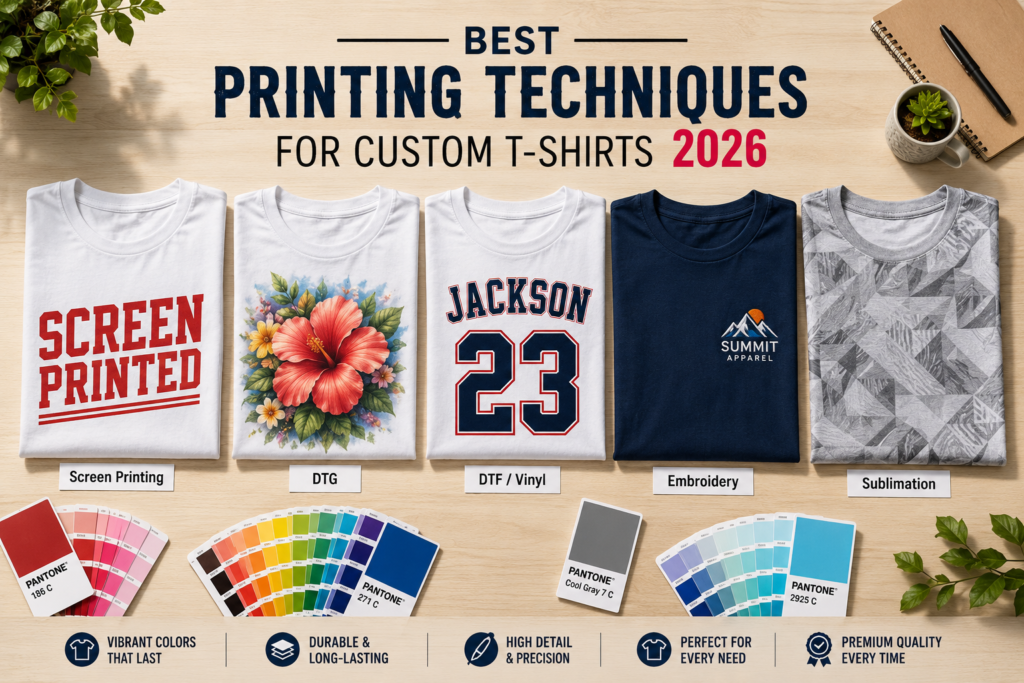
For brand founders, sourcing managers, and private-label retailers, the print method on your custom T-shirts isn’t just a design decision — it’s a unit economics decision that quietly shapes your margin, return rate, customer reviews, and reorder strategy.
The same blank cotton tee can deliver wildly different outcomes depending on print technique. Cracking after three washes destroys DTC brand reputation. Hand-feel complaints kill repeat purchases. Color drift across reorders breaks corporate uniform programs. Choosing the right printing technique for custom T-shirts in 2026 is about aligning manufacturing physics with your business model — whether you’re running drop-based merch, seasonal fashion capsules, corporate uniform programs, or multi-thousand-unit promotional runs.
This complete 2026 guide compares the five dominant T-shirt printing methods — screen printing, DTG (Direct-to-Garment), DTF heat transfer, embroidery, and dye-sublimation — across cost, durability, MOQ, sustainability, and best-use scenarios. At the end, you’ll see how Rudraa Exports integrates these techniques into a factory-direct production model built for international buyers.
Quick Answer: Which Printing Technique Is Best for Custom T-Shirts in 2026?
The best printing technique for custom T-shirts in 2026 depends on your order size, design complexity, and durability needs: screen printing is best for bulk orders (500–10,000+ pieces) with simple 1–4 color designs and offers the lowest unit cost at scale plus 100+ wash durability. DTG (Direct-to-Garment) is best for small batches (1–300 pieces) with full-color photographic designs and supports rapid SKU testing. DTF heat transfer is ideal for mixed designs and personalization (names, numbers) at low MOQs. Embroidery is best for premium uniforms and workwear with logos under 3.5 inches. Dye-sublimation is the durability champion for polyester performance T-shirts with all-over prints. Most successful brands use hybrid strategies — DTG for sampling, screen printing for bulk reorders.
Why Print Method Selection Drives Unit Economics
The core trade-off in T-shirt printing economics is straightforward:
- High setup overhead (screen printing) rewards scale with low per-unit cost
- Low setup overhead (DTG, DTF) rewards flexibility and SKU variety
That trade-off affects MOQ strategy, price breaks, production scheduling, and even how you build your product roadmap — for example, “one hero graphic in three colorways” versus “50 designs in small batches.”
Quality expectations also differ by channel:
- Tour merch needs fast turnaround and strong wash durability
- Corporate tees prioritize consistent color and repeatability across departments
- Fashion startups care about hand-feel, breathability, and the ability to test designs without dead-stock risk
- Performance apparel demands stretch retention and breathability
At-a-Glance Comparison: 5 T-Shirt Printing Methods in 2026
| Method | How It’s Applied | Typical Order Size | Cost Structure | Durability | Best Use Cases |
|---|---|---|---|---|---|
| Screen Printing | Ink pushed through mesh stencil; cured | 50–10,000+ pcs | Setup per color + low unit cost at scale | 100+ washes (plastisol) / 50+ washes (water-based) | Bulk promos, retail basics, tour merch |
| DTG Printing | Inkjet prints directly to garment; pretreat + cure | 1–300 pcs | Low setup; ink scales with coverage | ~50 wash cycles (ISO 6330 validated) | Fashion sampling, POD, full-color art |
| DTF Heat Transfer | Print to film + adhesive; heat-pressed | 1–500 pcs | Low setup; per-transfer consumables | Good (varies by film/press quality) | Names/numbers, mixed designs, fast runs |
| Embroidery | Thread stitched into garment | 24–2,000 pcs | Digitizing fee + cost per stitch | Excellent (often longest life) | Uniforms, workwear, premium logos |
| Dye-Sublimation | Dye vaporizes under heat; bonds with polyester | 25–10,000+ pcs | Setup + paper/ink; scales well | Very high (color becomes the fiber) | Polyester performance tees, all-over prints |
1. Screen Printing: The Scale Champion for Bulk Custom T-Shirts
How Screen Printing Works
Screen printing is a stencil-based process where each ink color requires its own screen (mesh) coated with photo emulsion. Artwork is output to film, the screen is exposed under UV light, and the unexposed emulsion is washed out to create an open stencil. Ink is then pushed through the mesh onto the garment using a squeegee — either on a manual carousel or an automatic press.
Production efficiency benchmarks:
- Manual presses: 40–100 shirts per hour
- Automatic presses: 500–800 shirts per hour
This speed differential is exactly why screen printing dominates high-volume custom T-shirt programs in 2026.
Screen Printing Ink Types
Plastisol Ink:
- Most common for bulk T-shirt printing
- Cure temperature: 250–320°F
- Durability: 100+ washes when properly cured
- Pros: Excellent color opacity, vibrant on dark garments
- Cons: Heavier hand feel, PVC-based (less eco-friendly)
Water-Based Ink:
- Softer hand feel, more breathable
- Cure temperature: ~320°F with proper airflow
- Durability: 50+ washes with correct curing
- Pros: Eco-friendlier, vintage soft finish
- Cons: More technical to cure correctly
Screen Printing Pros and Cons
Pros:
- Lowest cost per unit at scale (1–4 color prints)
- High production speed on automatic presses
- Excellent color opacity and consistency
- Versatile effects: high-density, puff, silicone, discharge
Cons:
- Setup overhead per color and per placement
- Not ideal for frequent artwork changes or micro-batches
- Quality failures usually trace to curing and registration issues
- Higher water/chemical load in traditional workflows
Screen Printing Cost and MOQ in 2026
US/EU benchmark pricing:
- Setup fees: ~$25–$30 per color
- Per-shirt cost at 25 pcs: $8–$12
- Per-shirt cost at 250 pcs: $4–$6 (often including blank)
Tirupur, India benchmark pricing:
- Common screen printing services: ₹150–₹300 per piece (varies by design complexity)
- Factory efficiency appears at 100+ pieces
- Accelerates dramatically at 1,000+ pieces
Best Use Cases for Screen Printing
- Bulk promotional tees and corporate programs
- Tour merch with standardized designs
- Retail basics with repeat seasonal reorders
- Campus events and large-volume distributions
Real-world example: A corporate buyer ordering 5,000 tees for a national campaign with a two-color chest print and one-color back print typically gets the strongest ROI with screen printing. Setup is meaningful, but unit cost becomes extremely competitive at volume.
Pro tip: Ask your Tirupur factory whether they run manual or automatic presses for your volumes and what curing control they use (conveyor dryer specs, time/temperature logging). Speed claims without cure discipline are a red flag.
2. DTG (Direct-to-Garment) Printing: The Flexibility Leader for 2026
How DTG Printing Works
DTG printing uses inkjet technology to print water-based pigment inks directly onto the garment. The 3-stage workflow:
- Pretreatment — Especially for dark garments, a polymer solution improves ink adhesion, vibrancy, and wash durability
- Printing — High-resolution printheads deposit CMYK + white pigment inks
- Curing — Heat press or tunnel dryer bonds ink to fibers
Pretreatment cost benchmark: ~$0.25–$0.35 per shirt for common solutions.
Production speed:
- Desktop/small production: ~50 shirts per hour
- Industrial DTG systems: 125+ shirts per hour
DTG Pros and Cons
Pros:
- Virtually no setup cost per design
- Excellent for photographic and high-color-count artwork
- Enables on-demand workflows reducing dead stock
- Perfect for fashion startups testing prints, placements, colorways
Cons:
- Per-piece cost rises with ink coverage
- Requires disciplined maintenance (clogged nozzles cause downtime)
- Fabric dependency — best on cotton, blends need specific profiles
- Not cost-competitive vs screen printing at 2,000–10,000 pcs of same design
DTG Cost and MOQ in 2026
DTG is the only method genuinely supporting MOQ of 300 piece — which is why print-on-demand (POD) and creator brands adopt it.
Cost drivers:
- Ink (CMYK + white)
- Pretreatment ($0.25–$0.35/shirt)
- Labor handling
- Machine amortization
For ink-heavy, high-coverage designs, some operator estimates suggest $3.50–$4.50 per print just in ink — meaning DTG never gets “cheap” like screen printing at scale.
DTG Durability in 2026
When DTG is done correctly — proper pretreatment, ink laydown, and curing — wash performance is commonly validated through:
- ISO 6330 (domestic laundering standard)
- AATCC 61 (accelerated wash testing)
Reported performance reaches around 50 wash cycles with minimal color change under defined test conditions for quality pigment ink systems.
Critical buyer rule: Always insist on test method specification (ISO 6330 wash recipe, temperature, detergent, drying) — don’t accept “lasts a long time” as durability proof.
Best Use Cases for DTG Printing
- Fashion startups launching capsule drops with many designs
- Creator merch and on-demand programs
- Sampling and pre-production validation
- Small-batch SKU testing before scaling
Hybrid strategy example: A streetwear brand tests 12 graphics across 2 colorways (48–120 tees total) using DTG to avoid screen setup costs, validates customer response, then shifts winning designs to screen printing for 1,000-unit reorders.
Pro tip: If you’re sourcing DTG in Tirupur, ask whether pretreatment is automated or manual spray. Inconsistent pretreatment is the #1 cause of chalky whites, staining, and wash failures.
3. DTF Heat Transfer (Direct-to-Film): The Mixed-SKU Speed Champion
How DTF Heat Transfer Works
DTF (Direct-to-Film) is the fastest-growing T-shirt decoration method in 2026:
- Design is printed onto a special film using pigment inks
- Adhesive powder is applied and cured
- Film is heat-pressed onto the garment
- Carrier film is peeled away
DTF works as a bridge between screen printing and DTG — capable of full-color art without the same pretreatment requirements on many fabrics.
Vinyl Heat Transfer (HTV)
Vinyl heat transfer cuts colored vinyl into shapes using a plotter, weeds excess material, and presses the design onto the garment. Vinyl excels in simple, bold graphics, names, and numbers.
DTF/Vinyl Pros and Cons
Pros:
- Very low setup, fast changeovers
- Excellent for mixed designs in one PO
- Great for personalization (names, individual IDs)
- DTF supports full color and gradients
- Useful overflow tool when screen capacity is constrained
Cons:
- Hand-feel heavier than DTG or water-based screen prints (especially with large coverage)
- Durability depends heavily on consumables and press discipline
- Not ideal for premium fashion where breathability matters
DTF/Vinyl Cost and MOQ
Heat transfer is typically priced per transfer + application labor. It shines when you have many designs across small quantities because there’s no per-color screen setup.
Decision rule: If your supplier offers both screen printing and DTF, ask for a break-even comparison at your specific quantities. Most suppliers use DTF for under-100 mixed art and screen printing for standardized bulk.
Best Use Cases for DTF and Vinyl
- Event merch with 30 designs × 10 units each
- Corporate programs with personalization (employee names)
- Brands wanting full-color front prints in small batches
- Mixed-SKU runs combining standard logos + variable data
Real-world example: A sports club ordering 200 tees with the same chest logo but different player names and numbers typically combines vinyl or DTF for variable data with screen printing for the base logo — the fastest, lowest-risk combination.
Pro tip: Put transfers through the same QC as prints — peel test, stretch test, and defined ISO 6330 wash cycle count before approving bulk production.
4. Embroidery: Premium Branding for Uniforms and Workwear
How Embroidery Works
Embroidery converts artwork into stitch data (digitizing) and then uses multi-head embroidery machines to stitch thread into the garment.
Process steps:
- Digitizing — Defining stitch types (satin, fill), direction, density, underlay, pull compensation
- Hooping — Garment is hooped (or clamped) with stabilizer/backing applied
- Stitching — Multi-head machine stitches using colored threads
- Finishing — Excess backing removed, trimmed, pressed, inspected
Embroidery Pros and Cons
Pros:
- Premium perceived value (signals quality uniforms and workwear)
- Excellent longevity — thread outlasts most surface prints
- Great on heavier garments and structured areas
- Ideal for minimalistic branding
Cons:
- Not suitable for large, full-front artwork
- Fine gradients and photographic art don’t translate
- Adds weight, can reduce stretch in stitched area
- Risk of puckering on lightweight tees without correct backing
Embroidery Cost Structure
Embroidery pricing has two components:
- Digitizing fee — One-time per design
- Per-piece stitch count cost — Based on total stitches in design
For bulk buyers, multi-head machines reduce labor per piece, so unit cost drops as quantities rise.
Best Use Cases for Embroidery
- Corporate uniforms (left chest logos)
- Workwear requiring abrasion resistance
- Premium brand positioning (heritage, craft, elevated basics)
- Sports caps and structured garments
Real-world example: A corporate buyer sourcing 1,000–3,000 tees for field staff often chooses embroidery for a small chest logo to maintain premium look over long wear life — especially when garments are washed frequently.
Pro tip: Keep embroidered logos under ~3.5 inches wide for tees unless you’ve tested fabric puckering. Always request a sewn sample on your exact fabric (combed cotton, CVC blend, etc.) before bulk approval.
5. Dye-Sublimation: The Performance Champion for Polyester T-Shirts
How Dye-Sublimation Works
Dye-sublimation prints designs onto transfer paper using disperse dyes, then uses heat and pressure to turn dye into gas. The gas bonds into polyester fibers, becoming part of the fiber itself rather than sitting on the surface.
Dye-Sublimation Pros and Cons
Pros:
- Exceptional feel — no ink film on top, breathability maintained
- High durability — dye bonds with fiber, resists cracking and peeling
- Ideal for full-coverage patterns and repeat graphics
- Strong sustainability narrative for water reduction vs conventional wet processes
Cons:
- Fabric constraint — primarily polyester (not 100% cotton tees)
- Best results require light bases (dark polyester needs different strategies)
- Color management and heat uniformity are critical
- All-over print cut-and-sew adds complexity and higher MOQ planning
Dye-Sublimation Cost and MOQ
Sublimation becomes cost-effective when you commit to repeatable patterns and can run longer rolls/panels. Real cost drivers:
- Artwork size (all-over vs spot print)
- Cut-and-sew complexity
- Yield/reject tolerance
Best Use Cases for Sublimation
- Polyester performance tees and training tops
- Sports and teamwear with all-over patterns
- Brands needing lightweight, high-breathability prints
- Sportswear with sponsor logos and player names
Real-world example: A performance brand launching polyester training tees with all-over geometric patterns should shortlist sublimation over DTG (cotton-first) or thick transfers — sublimation preserves stretch and breathability while delivering all-over design.
Pro tip: Decide early whether you want all-over print via cut-and-sew panels. That decision changes MOQ planning, yield calculations, and factory line allocation more than the print itself.
Print Method Selection Checklist for 2026
1. Product and Artwork Definition
✅ Garment fiber content (100% cotton / CVC / polyester)
✅ GSM and knit type (single jersey, interlock, compact)
✅ Artwork type (vector logo, halftones, photo, gradients)
✅ Color count and coverage area
✅ Placement count (chest, back, sleeve — each affects costing)
✅ Special effects (water-based soft hand, high-density, puff)
2. Commercial Plan
✅ Order size now vs later (sampling 1–50, launch 100–500, scale 1,000–10,000+)
✅ SKU count (many designs push toward DTG/DTF)
✅ Target landed cost and acceptable setup fees
✅ Reorder behavior and frequency
✅ Lead time expectations
3. Quality and Testing
✅ Wash durability requirement (specify ISO 6330 test method)
✅ Print feel requirement (soft-hand vs bold/raised)
✅ Color tolerance (especially for corporate brand colors)
✅ Sample types required (strike-off, size-set, PP sample)
✅ Cure verification standards
4. Sustainability and Compliance
✅ Ink system eco-certifications (OEKO-TEX, GOTS)
✅ Water and chemical usage comparison
✅ Waste handling protocols
✅ ZDHC alignment for chemical management
5. Supplier Capability (India/Tirupur Sourcing Lens)
✅ Factory-direct vs trading layers
✅ Scalability from sampling to bulk
✅ Capacity planning (e.g., 72,000+ units/month at Rudraa Exports)
✅ ISO 9001 quality system alignment
✅ Tirupur hub advantages (knitting, dyeing, decoration in one ecosystem)
Hybrid Printing Strategies for Smart 2026 Brands
The smartest international brands in 2026 don’t choose one method — they combine techniques strategically:
Strategy 1: Sampling → Bulk Pipeline
- DTG for first 10–50 pieces (test market response)
- Screen printing for 1,000+ piece reorders of winning designs
Strategy 2: Standard + Variable Data
- Screen printing for base logo on 500–2,000 pieces
- Vinyl/DTF for personalization (names, numbers) on each piece
Strategy 3: Multi-Category Brand
- Screen printing for fashion basics
- Embroidery for premium polos and workwear
- Sublimation for performance/athleisure line
Strategy 4: Drop-Based Merch
- DTG for limited capsule drops (12+ designs)
- DTF for collab and personalization releases
Frequently Asked Questions
What’s the most durable printing method for custom T-shirts in 2026?
Properly cured plastisol screen printing is widely cited as extremely durable — often referenced as 100+ washes when curing is correct. Water-based screen prints often deliver 50+ washes. Dye-sublimation on polyester is durable because dye bonds with fiber. Always require ISO 6330 wash testing to validate “durable” claims with measurable definitions.
When is DTG printing cheaper than screen printing?
DTG is cheaper for small runs and high design variety because it avoids per-color screen setup. Screen printing economics improve fast as quantity grows — setup fees (~$25–$30 per color) get amortized across hundreds or thousands of shirts. For 12–100 pieces across many designs, DTG wins. For 500–5,000 pieces of the same design, screen printing wins.
How do I avoid cracking and fading in screen printed T-shirts?
Most cracking complaints trace back to cure problems. Plastisol needs correct curing — under-cure can crack or wash out, over-cure can scorch fabric. Water-based inks need proper curing around 320°F with airflow. Build QC around cure verification and run wash testing using ISO 6330 methods before scaling.
What’s the difference between screen printing and DTG printing?
Screen printing uses stencils with one ink color per screen — economical at scale (500+ pieces of same design), excellent durability, limited color count. DTG (Direct-to-Garment) uses inkjet printing — full-color capable with no setup cost per design, ideal for small batches (1–300 pieces), but doesn’t scale economically like screen printing.
Which printing technique is best for full-color photographic designs?
DTG (Direct-to-Garment) is the best choice for full-color photographic designs on cotton T-shirts. It uses CMYK + white pigment inks to reproduce gradients, halftones, and photographic detail without screen color separation. For polyester, dye-sublimation delivers superior photographic results.
What is DTF heat transfer and how is it different from DTG?
DTF (Direct-to-Film) prints the design onto a special film with adhesive powder, then heat-presses it onto the garment. Unlike DTG which prints directly on fabric and requires pretreatment, DTF works on more fabric types and supports full color with consistent output. DTG offers softer hand feel; DTF offers faster mixed-SKU production.
How much does it cost to print custom T-shirts in Tirupur, India in 2026?
Tirupur screen printing services typically range from ₹150–₹300 per piece depending on design complexity, color count, and vendor positioning. DTG runs higher per piece for low quantities but eliminates setup fees. Always validate with strike-offs and request a detailed cost breakdown showing fabric, CMT, decoration, trims, and packaging separately.
What MOQ do I need for screen printing custom T-shirts?
MOQ for screen printing typically starts around 300 pieces per design at small shops, with factory efficiency appearing at 100+ pieces and accelerating dramatically at 1,000+ pieces. Lower MOQs may be accepted but with higher per-unit setup amortization.
Is heat transfer (DTF/vinyl) lower quality than DTG or screen printing?
Not inherently. Transfers can be excellent for small runs and personalization, but results vary more with consumables and press discipline than buyers expect. Always demand real samples and a defined wash-test method (ISO 6330) before signing off bulk orders.
What questions should I ask a Tirupur factory before placing a bulk custom T-shirt order?
Ask about: (1) decoration line type — manual vs automatic presses — and throughput; (2) sampling approval workflow including strike-offs and size sets; (3) wash-test standards used (ISO 6330); (4) how they handle repeat orders to maintain consistency (ink batch control, documented parameters); and (5) factory-direct vs trader status.
What’s the most sustainable T-shirt printing method in 2026?
Sustainability rankings depend on baseline comparison: water-based screen printing reduces VOCs versus plastisol; DTG with pigment inks uses less water than traditional wet processes; dye-sublimation can save significant water versus conventional dyeing. Always request specific ink certifications (OEKO-TEX) and ZDHC chemical management alignment.
Can one factory in Tirupur handle multiple printing techniques?
Yes. Top Tirupur exporters like Rudraa Exports operate or coordinate access to multiple decoration techniques within the cluster — screen printing, DTG, DTF, embroidery, and sublimation can all be combined under one production plan with integrated quality control.
Why Rudraa Exports for Multi-Technique Custom T-Shirt Manufacturing in 2026
Rudraa Exports operates as a factory-direct Tirupur, India manufacturer with integrated access to all five major T-shirt printing techniques in 2026:
- Screen printing for bulk runs with multi-color capability
- DTG printing for sampling and small-batch full-color designs
- DTF heat transfer for mixed-SKU runs and personalization
- Embroidery for premium uniform and workwear programs
- Dye-sublimation access for polyester performance lines
Key advantages for international buyers:
- ISO 9001:2015 certified quality systems with ISO 6330 wash testing
- Flexible MOQs starting from ~300 pieces per style
- 72,000+ units monthly capacity sized for serious programs
- Factory-direct cost transparency — up to 40% savings vs trading-company sourcing
- Cluster ecosystem access — knitting, dyeing, decoration, finishing in one workflow
- Multi-port shipping flexibility through Tuticorin, Chennai, and Cochin
- Mature export documentation for EU, US, Australia, and Middle East buyers
- FTA-eligible documentation for India’s expanding trade agreements
- English-language communication across all time zones
Rudraa Exports is particularly well-suited for DTC fashion brands, private-label retailers, corporate uniform programs, and importers serving regulated markets needing flexible decoration strategies and multi-technique capabilities.
Conclusion: Choose Print Method as a Business System, Not a Design Decision
The best printing technique for your custom T-shirts in 2026 is the one that aligns manufacturing physics with your business model. Screen printing wins on scale economics. DTG wins on flexibility and SKU testing. DTF wins on mixed-SKU speed. Embroidery wins on premium positioning. Sublimation wins on polyester performance.
Most successful brands in 2026 use hybrid strategies — combining methods to balance cost, durability, and speed across their product lines. The right factory partner makes this possible by offering all five techniques under one integrated quality system with transparent costing.
Ready to choose the right printing technique for your next custom T-shirt program?
Visit rudraaexports.com to share your tech pack, artwork, target MOQ, and destination market — and receive a multi-technique quote built for international buyers in 2026.
Related reading
Corporate T-Shirt Customization Guide for Brand Managers in 2026
Premium Embroidery Manufacturing in India for Australian Apparel Start-Ups