
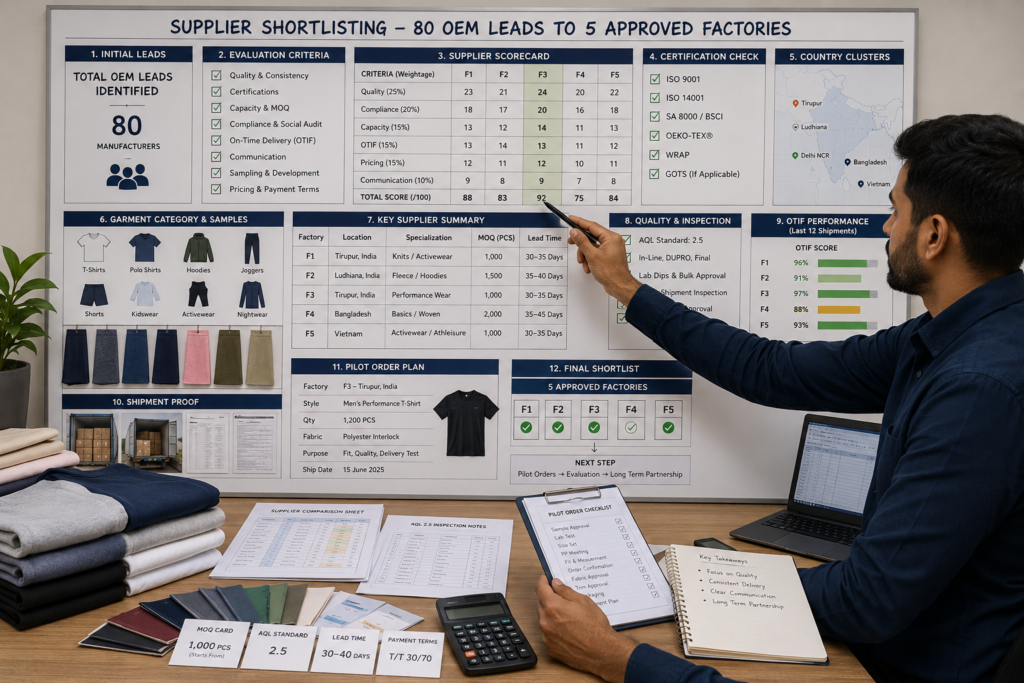
Finding a reliable OEM clothing manufacturer is not about guessing.
It is about proof.
A good factory should not only say it can manufacture your garments. It should be able to prove its capability through samples, compliance documents, quality systems, export history, delivery performance, traceability, and repeat-order discipline.
For buyers in Europe, the USA, Australia, and the Middle East, this matters even more because apparel sourcing involves quality risk, compliance risk, delivery risk, and reputation risk.
The wrong supplier can create late shipments, poor sizing, weak stitching, shade mismatch, compliance gaps, hidden subcontracting, and costly rework.
The right OEM partner can help you scale with consistent product quality, controlled costs, export documentation, and repeatable production.
At Rudraa Exports, we support global buyers with OEM and private-label garment manufacturing from Tirupur, India, including tech pack review, fabric sourcing, sampling, AQL inspection, export packing, compliance documentation support, and repeat-production planning.
Quick Answer
To find a reliable OEM clothing manufacturer, start with a clear manufacturing brief, build a longlist from B2B platforms, industry directories, trade fairs and shipment data, then apply hard filters for legal identity, factory ownership, export experience, certifications, QC systems and compliance documents. Shortlist factories using objective scores such as ISO 9001, WRAP, BSCI, OEKO-TEX scope, OTIF delivery history, AQL inspection, First Pass Yield, traceability and audit readiness. Final approval should come only after sampling and a small pilot order.
Looking for a verified OEM clothing manufacturer in India? Contact Rudraa Exports to request an OEM production and factory capability review.
Why OEM Manufacturer Vetting Matters
OEM apparel sourcing can look simple at the beginning.
Many suppliers say:
- We can make this.
- MOQ is flexible.
- Quality is good.
- We export worldwide.
- We have certifications.
- Delivery is fast.
But serious buyers need proof behind every claim.
The uploaded source explains that sourcing the right OEM apparel partner should be a systematic process built on verifiable proof, clear criteria, and repeatable checks.
What Is an OEM Clothing Manufacturer?
OEM means Original Equipment Manufacturer.
In apparel, an OEM clothing manufacturer produces garments according to the buyer’s design, tech pack, fabric specification, measurements, trims, labels, packaging, and quality requirements.
OEM Is Best For Buyers Who Need
| Requirement | Why OEM Helps |
|---|---|
| Custom design | Buyer controls style and fit |
| Private label | Brand labels and packaging |
| Tech pack execution | Factory follows buyer specs |
| Repeat production | Approved specs can be repeated |
| Quality control | AQL and inspection checkpoints |
| Export documentation | Suitable for global buyers |
OEM vs ODM Clothing Manufacturing
| Criteria | OEM | ODM |
|---|---|---|
| Design ownership | Buyer owns design | Factory offers existing design |
| Tech pack | Buyer-led | Factory-supported |
| Speed | Slower than ODM | Faster start |
| Customisation | Higher | Medium |
| Brand uniqueness | Stronger | Lower |
| Best for | Serious brands and repeat programs | Quick market entry |
Step 1: Define Your Manufacturing Brief
Before contacting factories, prepare a short and clear manufacturing brief.
Your Brief Should Include
| Brief Item | Example |
|---|---|
| Product category | T-shirts, hoodies, leggings, uniforms |
| Fabric | Cotton jersey, fleece, pique, poly-spandex |
| GSM | 180 GSM, 240 GSM, 320 GSM |
| Construction | Knitwear, woven, fleece, activewear |
| Trims | Labels, zippers, drawcords, buttons |
| MOQ target | 50 pcs, 300 pcs, 1,000 pcs |
| Size range | XS–XXL or kids size curve |
| Compliance | ISO, OEKO-TEX, WRAP, BSCI, GOTS |
| QC standard | AQL 2.5, inline and final inspection |
| Packaging | Polybag, carton, barcode, retail pack |
| Delivery | Ex-factory date and destination market |
The uploaded source recommends starting with a 1–2 page manufacturing brief covering product category, construction, fabric weights, trims, compliance needs, MOQ, lead time, labels, packaging and QC standards.
Step 2: Build a Manufacturer Longlist
Do not depend on one platform.
Use multiple sourcing channels so you can compare quality and reduce platform bias.
Where to Find OEM Clothing Manufacturers
| Channel | Use Case |
|---|---|
| B2B platforms | Fast discovery and comparison |
| Industry directories | Better legitimacy checks |
| Trade fair exhibitor lists | Export-focused supplier discovery |
| Shipment databases | Export history validation |
| Referral networks | Practical supplier feedback |
| Factory websites | Product range and capability review |
The uploaded source suggests building an initial longlist of 50–80 candidates using B2B platforms, industry directories, trade fair exhibitor lists and shipment databases.
Step 3: Apply Hard Filters
After building your longlist, remove weak suppliers early.
Hard Filters
| Filter | Why It Matters |
|---|---|
| Legal identity | Confirms real company |
| Factory ownership | Separates factory from trader |
| Export registration | Shows export capability |
| Product fit | Factory must match your category |
| Certification proof | Confirms compliance claims |
| Audit documents | Shows social compliance visibility |
| Export activity | Shows real shipment experience |
| QC process | Confirms quality control system |
| Communication | Shows responsiveness and clarity |
The uploaded source recommends dropping suppliers that cannot provide legal identity, proof of factory ownership, compliance documents, and evidence of export activity.
Step 4: Score Factories Objectively
Do not shortlist only by price.
Create a scorecard.
OEM Factory Scorecard
| Criteria | Score |
|---|---|
| Product capability | /10 |
| Fabric sourcing strength | /10 |
| Sampling quality | /10 |
| MOQ fit | /10 |
| Lead-time realism | /10 |
| ISO 9001 / quality system | /10 |
| OEKO-TEX / chemical safety | /10 |
| WRAP / BSCI / social compliance | /10 |
| AQL inspection process | /10 |
| OTIF delivery history | /10 |
| Traceability | /10 |
| Export documentation | /10 |
| Communication | /10 |
| Cost transparency | /10 |
| Reference proof | /10 |
The uploaded source recommends scoring factories on compliance depth, delivery reliability, quality performance and traceability systems.
Step 5: Verify Certifications and Audit Claims
A certificate logo is not enough.
You must verify the details.
Certification Checks
| Certification | What to Verify |
|---|---|
| ISO 9001:2015 | Scope, legal entity, issuing body and validity |
| OEKO-TEX Standard 100 | Certificate number, product class and validity |
| WRAP | Facility name, address and certificate status |
| BSCI | Audit summary and CAPA status |
| GOTS | Scope, organic claim and transaction process |
| GRS / RCS | Recycled material claim and chain of custody |
| ISO 14064 | Carbon reporting scope if relevant |
The uploaded source highlights ISO 9001, WRAP, BSCI, OEKO-TEX, GOTS, ISO 14064 and other standards as objective reliability criteria for export buyers.
Step 6: Validate Shipment History
A reliable export factory should have evidence of actual shipments.
What to Check
| Shipment Check | Why It Matters |
|---|---|
| Recent shipments | Shows active export business |
| Same legal entity | Avoids trading-company confusion |
| Product category | Confirms experience with similar garments |
| Destination markets | Confirms export readiness |
| Repeat shipments | Indicates buyer trust |
| Stable volume | Shows production consistency |
The uploaded source recommends using shipment databases to confirm repeat shipments, target markets and product categories, and suggests looking for at least three shipments in the last 12 months tied to the same legal entity.
Step 7: Check Quality Systems
Quality must be controlled before final inspection.
Quality Proof to Request
| Quality Area | What to Ask |
|---|---|
| Incoming fabric inspection | How fabric is checked before cutting |
| Inline inspection | How defects are caught during production |
| Final inspection | AQL method and report format |
| Measurement control | Tolerance and size set process |
| Needle policy | Safety and broken-needle control |
| Shade control | Lab dips and bulk shade bands |
| Defect tracking | Rework and rejection records |
| CAPA | Corrective and preventive action process |
The uploaded source recommends using AQL inspections and First Pass Yield to evaluate quality performance and rework levels.
What Is AQL in Garment Inspection?
AQL means Acceptable Quality Limit.
It is used to decide whether a shipment passes or fails based on sampled garments.
Common AQL Planning
| AQL Level | Use Case |
|---|---|
| AQL 1.5 | Premium or stricter quality programs |
| AQL 2.5 | Common general apparel inspection |
| AQL 4.0 | Budget or less strict programs |
Buyer Tip
Ask the factory for a sample final inspection report before you place the first bulk order.
What Is OTIF?
OTIF means On Time In Full.
It measures whether the factory delivered the correct quantity on the agreed date.
Why OTIF Matters
A factory may produce good samples but still fail if it cannot deliver on time.
Track OTIF by:
- Purchase order
- Product category
- Season
- Buyer
- Shipment date
The uploaded source identifies OTIF as an important delivery reliability metric to track by purchase order and season.
What Is First Pass Yield?
First Pass Yield, or FPY, measures how many garments pass without rework the first time.
A higher FPY usually means better process control.
Why FPY Matters
Low FPY can mean:
- More rework
- More delays
- More hidden defects
- Higher inspection failure risk
- Less production discipline
The uploaded source recommends using First Pass Yield to estimate rework levels and quality performance.
Step 8: Check Traceability
Modern apparel buyers increasingly expect traceability.
Traceability Questions
| Question | Why It Matters |
|---|---|
| Where is the fabric sourced? | Supports material traceability |
| Is subcontracting used? | Reduces hidden factory risk |
| Can you map process steps? | Improves audit readiness |
| Do you have facility identity records? | Supports transparency |
| Can you provide lot-level records? | Helps claims and recalls |
| Can you support DPP data fields? | Useful for EU future readiness |
The uploaded source discusses traceability systems such as Open Apparel Registry and Digital Product Passports, especially for buyers preparing for stronger transparency expectations.
Step 9: Run a Factory Visit or Video Audit
A visit or video audit helps verify real capability.
What to Check During Factory Audit
| Area | What to Observe |
|---|---|
| Cutting section | Marker control and fabric handling |
| Sewing lines | Line balancing and machine condition |
| QC points | Inline and final inspection setup |
| Needle policy | Broken needle control |
| Fabric warehouse | Segregation and cleanliness |
| Finished goods area | Packing discipline |
| Chemical storage | Safety and compliance |
| Subcontracting | Confirm what is in-house |
| Sample room | Development capability |
| Documentation | Records and SOPs |
The uploaded source recommends factory visits and audits to validate line balancing, quality checkpoints, needle policy, incoming inspection, lab testing workflow, warehouse segregation, chemical storage and subcontracting controls.
Step 10: Run a Pilot Program
Do not approve a large purchase order based only on samples.
Run a pilot.
Pilot Program KPIs
| KPI | What to Measure |
|---|---|
| Sampling response time | Speed and clarity |
| Sample accuracy | Match to tech pack |
| Defect rate | Quality level |
| OTIF | On-time and full delivery |
| Inspection result | AQL pass or fail |
| Communication | Issue handling |
| CAPA closure | Corrective action discipline |
| Documentation quality | Export readiness |
The uploaded source recommends a sampling plus small pilot order before final approval, using KPIs such as OTIF, defect rate, responsiveness and corrective action closure time.
Red Flags When Vetting OEM Clothing Manufacturers
Be careful if you see these warning signs.
Documentation Red Flags
| Red Flag | Risk |
|---|---|
| Certificate name does not match factory | Misleading compliance claim |
| No certificate number | Cannot verify |
| No audit summary | Social compliance unclear |
| No legal registration | Entity risk |
| No export proof | Weak export experience |
Operational Red Flags
| Red Flag | Risk |
|---|---|
| Unrealistic lead time | Delay likely |
| Very low price without explanation | Quality or hidden-cost risk |
| No inline QC | Defects found too late |
| No AQL process | Shipment acceptance unclear |
| Heavy subcontracting | Traceability risk |
| No sample room | Weak development support |
Commercial Red Flags
| Red Flag | Risk |
|---|---|
| Pressure for 100% upfront payment | Payment risk |
| Constant quote revisions | Poor costing control |
| Unclear Incoterms | Import cost confusion |
| Hidden surcharges | Margin risk |
| Slow communication | Bulk issues likely |
The uploaded source lists red flags such as mismatched certificate scope, reluctance to share certificate numbers, unrealistic lead times, vague AQL, undisclosed subcontractors, poor chemical storage, pressure for 100% upfront payment and hidden surcharges.
OEM Factory Approval Packet
Before approving a supplier, ask for a complete approval packet.
Approval Packet Checklist
| # | Document / Proof |
|---|---|
| 1 | Company registration |
| 2 | Export registration or association proof |
| 3 | Factory address and legal entity |
| 4 | Product capability profile |
| 5 | Machine list |
| 6 | Monthly capacity |
| 7 | Certification copies |
| 8 | Certificate scope statements |
| 9 | Social audit summary |
| 10 | CAPA status |
| 11 | QC SOPs |
| 12 | AQL inspection plan |
| 13 | OTIF delivery evidence |
| 14 | Traceability process |
| 15 | Shipment proof |
| 16 | Customer references |
| 17 | Payment terms |
| 18 | Incoterms |
| 19 | Sample policy |
| 20 | Pilot-order plan |
The uploaded source provides a practical OEM approval checklist including company registration, association membership, certification copies, audit summary, QC SOPs, OTIF history, traceability, shipment evidence and financial screening.
Why Rudraa Exports
Rudraa Exports supports global buyers with OEM and private-label clothing manufacturing from Tirupur, India.
Product Categories Supported
- T-shirts
- Polo shirts
- Hoodies
- Sweatshirts
- Joggers
- Leggings
- Kidswear
- Babywear
- Nightwear
- Uniforms
- Corporate apparel
- Activewear
- Private-label knitwear
Buyer Support
- OEM tech pack review
- Fabric and GSM guidance
- MOQ planning
- Sampling support
- Fit and size set coordination
- Lab dip coordination
- Print and embroidery approval
- Private-label support
- Care label and packaging support
- AQL 2.5 inspection support
- Export packing and documentation
- Repeat-order planning
Manufacturing Strengths
- Tirupur-based factory-direct knitwear manufacturing
- 72,000+ units per month production capacity
- MOQ discussions starting from around 300 pieces for suitable programs
- Export support for Europe, USA, Australia, Middle East and global buyers
- Multi-port shipping through Chennai, Tuticorin and Cochin
- Factory-direct pricing without trading-company markups
Buyer Advantages
- Clearer factory accountability
- Better product specification control
- Better MOQ and repeat-order planning
- Better QC visibility
- Better export documentation support
- Stronger sampling-to-bulk coordination
- Fewer middle layers
- Up to 40% cost-saving positioning compared with indirect sourcing models
Ready to vet a reliable OEM clothing manufacturer in India? Speak with Rudraa Exports to share your product category, tech pack, MOQ, compliance needs and destination market.
OEM Clothing Manufacturer Vetting Checklist
| # | Checklist Item |
|---|---|
| 1 | Prepare manufacturing brief |
| 2 | Confirm product category |
| 3 | Confirm fabric and GSM |
| 4 | Confirm MOQ target |
| 5 | Build longlist from multiple channels |
| 6 | Remove traders if factory-direct is required |
| 7 | Verify legal identity |
| 8 | Verify factory address |
| 9 | Check certification scope |
| 10 | Review audit summary |
| 11 | Ask for AQL inspection process |
| 12 | Ask for OTIF history |
| 13 | Review shipment evidence |
| 14 | Check traceability process |
| 15 | Conduct video audit or visit |
| 16 | Approve samples |
| 17 | Run pilot order |
| 18 | Measure defect rate |
| 19 | Measure responsiveness |
| 20 | Approve only after proof |
FAQ: Reliable OEM Clothing Manufacturers
1. How do I find a reliable OEM clothing manufacturer?
Start with a clear manufacturing brief, build a supplier longlist from multiple channels, apply hard filters, verify documents, score factories objectively, approve samples and run a pilot order before bulk production.
2. What should I check before choosing an OEM clothing manufacturer?
Check legal identity, factory ownership, product capability, MOQ, certifications, QC process, AQL inspection, shipment history, export documentation, traceability and buyer references.
3. What certifications are important for apparel factories?
Common certifications include ISO 9001, OEKO-TEX Standard 100, WRAP, BSCI, GOTS, GRS, RCS and ISO 14064 depending on buyer requirements.
4. Is a B2B platform verified badge enough?
No. Platform badges are useful for discovery, but buyers should still verify certificates, audit summaries, legal identity, shipment history and factory ownership.
5. What is AQL in garment inspection?
AQL means Acceptable Quality Limit. It is a sampling method used to decide whether a bulk shipment passes or fails inspection.
6. What is OTIF in apparel sourcing?
OTIF means On Time In Full. It measures whether a factory ships the correct quantity by the agreed date.
7. What is First Pass Yield?
First Pass Yield measures how many garments pass production or inspection without rework. It helps show process discipline.
8. How can I avoid trading companies?
Ask for factory ownership proof, factory address, machine list, video tour, production flow, legal entity documents and export records tied to the same factory.
9. What are warning signs of an unreliable manufacturer?
Warning signs include mismatched certificates, vague pricing, unrealistic lead times, no AQL system, no audit documents, hidden subcontracting, slow communication and pressure for full upfront payment.
10. Should I run a pilot order?
Yes. A pilot order helps test quality, communication, delivery reliability, documentation and corrective action before placing a larger order.
11. Can Rudraa Exports support OEM manufacturing?
Yes. Rudraa supports OEM and private-label garment manufacturing from Tirupur, including tech pack review, fabric sourcing, sampling, QC, packing and export documentation.
12. What should I send Rudraa for OEM manufacturing?
Send product type, tech pack, fabric composition, GSM, quantity, colour count, size range, print or embroidery details, labels, packaging, compliance needs and destination market.
Conclusion
Finding a reliable OEM clothing manufacturer requires a structured process.
Start with a clear brief. Build a longlist. Apply hard filters. Verify legal identity, certifications, factory ownership, shipment history, quality systems and traceability. Then approve only after sampling and a pilot order.
The best factories are not the ones with the lowest quote.
They are the ones that can prove capability, quality, delivery reliability, compliance, communication and repeatability.
Rudraa Exports helps global buyers source OEM and private-label garments from Tirupur, India, with factory-direct production, MOQ planning, AQL inspection, sampling support, export documentation and repeat-order coordination.
Visit rudraaexports.com or contact our team directly to share your OEM clothing manufacturing requirement — and receive a factory-direct sourcing plan from Rudraa Exports.
Related reading
How to Verify a Brand-New Overseas Garment Manufacturer Before Paying a Deposit
OEM vs ODM Garment Manufacturing: A Decision Framework for Apparel Brands Sourcing from India
OEM vs CMT vs Full-Package Apparel Manufacturing: Which Model Should Buyers Choose?
How to Handle a Failed Garment Shipment: Disputes, Claims and Resolution Guide