
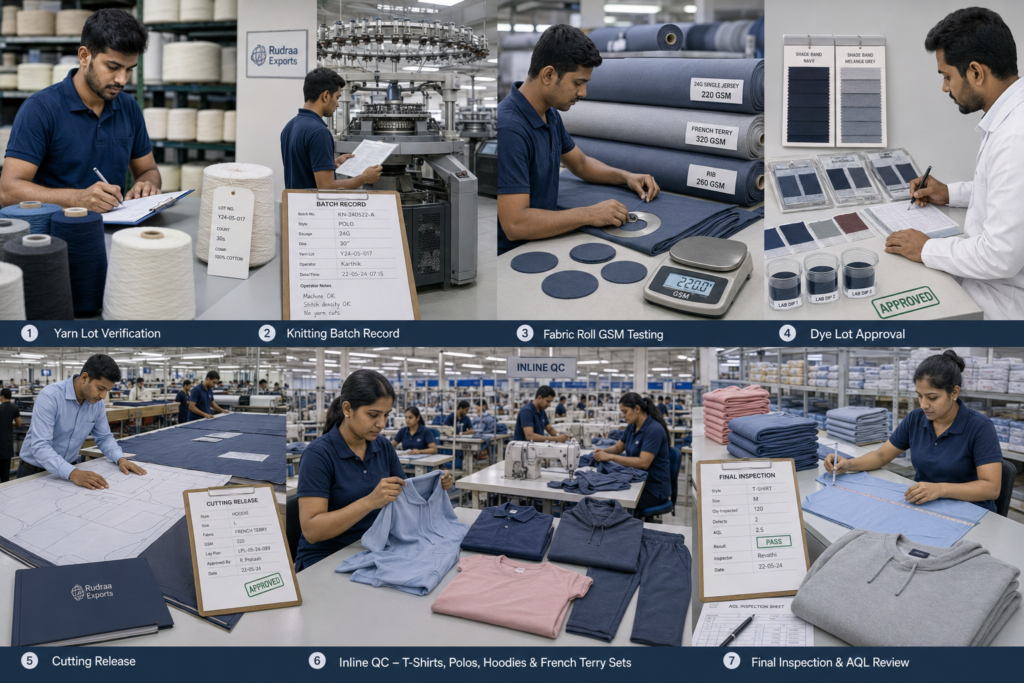
GSM is one of the most important specifications in knitwear manufacturing.
For T-shirts, polos, hoodies, sweatshirts, French terry sets and premium fleece garments, GSM affects:
- Fabric weight
- Drape
- Opacity
- Hand feel
- Durability
- Shrinkage performance
- Customer perception
- Production cost
When a brand orders a 240 GSM T-shirt or a 320 GSM hoodie, that number becomes part of the product promise.
If the actual bulk fabric is lighter than approved, the garment may still look acceptable in photos, but customers will feel the difference immediately.
This is why GSM fraud is a serious risk in garment sourcing.
A supplier may show the correct GSM during sampling but deliver lighter fabric in bulk. The result is a product that feels cheaper, performs worse and damages the brand’s reputation.
At Rudraa Exports, we help buyers control GSM through early fabric specification, roll-level traceability, sample verification, inline quality checks, export-ready documentation and factory-direct production visibility from Tirupur, India.
Quick Answer
To prevent GSM fraud, brands must verify three practices before production: yarn substitution, moisture manipulation and selective cutting. The safest method is to define GSM in the tech pack, use a known-area GSM test, condition samples before weighing, test multiple points from each fabric roll, record roll IDs and link approved fabric to cutting bundles. GSM should be verified before bulk cutting, not only during sample approval.
Concerned about GSM mismatch in your next order? Contact Rudraa Exports to request a GSM-controlled knitwear production discussion.
What Is GSM in Garment Manufacturing?
GSM means grams per square metre.
It measures fabric weight.
A higher GSM usually means a heavier fabric. A lower GSM usually means a lighter fabric.
Common GSM Planning Direction
| Product | Common GSM Direction |
|---|---|
| Lightweight T-shirt | 140–160 GSM |
| Standard T-shirt | 160–180 GSM |
| Premium T-shirt | 200–240 GSM |
| Polo shirt | 200–260 GSM |
| French terry | 240–320 GSM |
| Standard hoodie | 280–360 GSM |
| Heavyweight hoodie | 400+ GSM |
These ranges are planning directions. Final selection depends on product purpose, fabric composition, finish and target market.
The uploaded source explains that GSM directly affects drape, opacity, durability and how premium a garment feels in hand.
Why GSM Fraud Matters
GSM fraud is not a small technical issue.
It affects both product quality and profitability.
How Lower GSM Hurts the Brand
| Area | Impact |
|---|---|
| Product feel | Garment feels thinner or cheaper |
| Opacity | Fabric may become see-through |
| Drape | Fit and structure may change |
| Durability | Fabric may wear faster |
| Shrinkage | Performance may become unstable |
| Customer trust | Product may not match promise |
| Returns | Complaints may increase |
| Margin logic | Retail pricing becomes harder to justify |
How Lower GSM Benefits a Bad Supplier
Fabric is one of the largest cost drivers in garments.
If a supplier quotes 240 GSM but uses 210 GSM in bulk, fabric consumption and cost may fall while the buyer still pays based on the approved specification.
The uploaded source notes that lower-than-promised GSM can reduce fabric consumption for the factory and quietly shift margin away from the brand.
How GSM Fraud Happens
GSM fraud often succeeds because buyers check only the sample.
A supplier can produce one correct sample and still deliver bulk fabric that is lighter, inconsistent or manipulated.
Common Weaknesses in Buyer Verification
- No GSM test method written into the tech pack
- No tolerance defined
- No roll ID recorded
- No sample cut map
- No conditioned testing
- No calibrated weighing scale
- No inline GSM checks
- No third-party testing
- No bulk fabric approval before cutting
The uploaded source warns that if a supplier cannot show how GSM is measured, conditioned and audited across rolls, the buyer is relying on a pleasant first impression rather than certainty.
Typical Factory Practice vs Rudraa Exports Method
| Verification Area | Common Risk | Rudraa-Oriented Control |
|---|---|---|
| GSM declaration | GSM stated on paper only | GSM defined early and checked through measurable steps |
| Sampling | Swatch has no roll ID | Sample linked to fabric and batch records |
| Moisture | Fabric may be humidified before weighing | Measurement discipline with controlled testing |
| Cutting point | Heaviest area selected | Multiple random cuts from roll positions |
| Bulk production | GSM checked only once | GSM checks added before cutting and during QC |
| Traceability | Fabric source unclear | Roll, batch and cutting records maintained |
| Disputes | Subjective argument | Acceptance linked to documented test method |
Practice 1: Yarn Substitution
Yarn substitution happens when the approved sample uses one yarn quality, count or blend, but bulk production uses a different yarn.
How It Works
A supplier may develop the sample using the correct yarn and fabric weight.
After approval, bulk fabric may be knitted using:
- Cheaper yarn
- Different yarn count
- Different blend
- Lower-quality fibre
- Different mill source
- Different knitting tension
The garment may look similar at first, but the feel, GSM, shrinkage and durability may change.
The uploaded source identifies yarn substitution as one of the key GSM manipulation methods buyers should control.
Warning Signs
- Bulk fabric feels different from sample
- Supplier cannot provide yarn lot details
- Roll IDs are missing
- GSM varies widely between rolls
- Fabric becomes thinner after wash
- Hand feel changes between colours
- Supplier says variation is “normal process difference”
How to Prevent Yarn Substitution
Ask for:
- Approved yarn count
- Fibre composition
- Mill or fabric source
- Yarn lot reference
- Knitting batch number
- Roll IDs
- Fabric test report
- No-substitution clause
- Buyer approval before any material change
Purchase Order Clause Example
No yarn, blend, GSM, fabric source, knitting process, dyeing process or finishing change is permitted without written buyer approval. Any unauthorised substitution may result in rejection, rework, replacement or commercial adjustment.
Practice 2: Moisture Manipulation
Moisture manipulation happens when fabric is steamed, sprayed or tested in uncontrolled humidity so it weighs more during GSM measurement.
Why Moisture Matters
Fabric weight can be affected by moisture.
A humidified fabric swatch may temporarily show a higher weight than it would under controlled conditions.
The uploaded source explains that moisture control is important because conditioning affects GSM accuracy and reliability.
How It Works
A supplier may:
- Steam fabric before weighing
- Spray swatches lightly
- Test in a humid environment
- Skip conditioning
- Use a recently processed wet-feeling fabric
- Weigh samples before proper drying or stabilisation
Warning Signs
- GSM passes at factory but fails in third-party lab
- Fabric feels damp or unusually soft during testing
- Weight drops after resting
- Same roll gives different readings at different times
- Supplier resists conditioned testing
How to Prevent Moisture Manipulation
Use a consistent testing process:
- Condition fabric before testing
- Cut a known area sample
- Use a calibrated precision scale
- Record date, time and roll ID
- Test multiple samples
- Compare against tolerance
- Retest suspicious readings
Buyer Instruction
Write this into your tech pack:
GSM must be tested on conditioned fabric using a known-area cutting method and calibrated weighing scale. Test records must include roll ID, sample location, date, operator and measured GSM.
Practice 3: Selective Cutting
Selective cutting happens when the supplier tests only the heaviest part of the roll.
How It Works
Fabric GSM may vary slightly across:
- Roll width
- Roll length
- Beginning of roll
- Middle of roll
- End of roll
- Edge area
- Centre area
A supplier may cut the GSM test swatch from a heavier or tighter-knit area to make the roll appear compliant.
The uploaded source describes selective cutting as the “heaviest spot” tactic where the sample passes but average bulk fabric may be lighter.
Warning Signs
- Only one swatch tested per fabric
- No cut location recorded
- Supplier cuts from roll edge only
- Bulk garments feel inconsistent
- GSM varies between sizes or colour lots
- Fabric roll records are incomplete
How to Prevent Selective Cutting
Require a sample cut map.
Example Roll Testing Rule
For each fabric roll:
- Cut from left, centre and right width positions
- Test beginning, middle and end where practical
- Record roll ID
- Record cut location
- Average the result
- Flag any roll outside tolerance
Suggested Pilot Rule
Minimum GSM testing: 3 cuts across width × 2 positions along roll length per pilot lot.
This helps prevent one “best spot” from representing the whole roll.
GSM Verification Workflow Before Bulk Production
Step 1: Define GSM in the Tech Pack
Do not write:
Premium heavyweight fabric
Write:
320 GSM brushed fleece, acceptable tolerance ±5%, tested using conditioned known-area samples before bulk cutting.
Step 2: Approve Fabric with Records
Your fabric approval should include:
- GSM result
- Fabric composition
- Finish
- Colour
- Roll or batch ID
- Test date
- Test method
- Buyer approval
Step 3: Confirm Bulk Roll IDs
Before cutting, ask for:
- Roll list
- GSM readings
- Colour lot
- Dye lot
- Fabric width
- Total metres
- Roll allocation by size or style
Step 4: Test Before Cutting
Bulk fabric should not be cut until the approved GSM is confirmed.
Step 5: Retest During Production
Recheck GSM at:
- Greige fabric stage if applicable
- Finished fabric stage
- Cutting stage
- Pre-shipment inspection stage
The uploaded source recommends embedding GSM checks into inline and pre-shipment quality gates instead of checking only during sampling.
GSM Testing Checklist
| # | Checkpoint |
|---|---|
| 1 | Target GSM stated in tech pack |
| 2 | Acceptable tolerance defined |
| 3 | Fabric composition confirmed |
| 4 | Yarn or fabric source recorded |
| 5 | Roll ID assigned |
| 6 | Dye lot recorded |
| 7 | Swatches conditioned |
| 8 | GSM cutter used |
| 9 | Scale calibrated |
| 10 | Multiple cut locations tested |
| 11 | Cut map recorded |
| 12 | Average GSM calculated |
| 13 | Outlier readings reviewed |
| 14 | Wash test completed where required |
| 15 | Bulk cutting held until approval |
| 16 | Inline GSM retest planned |
| 17 | Pre-shipment GSM check included |
| 18 | Records shared with buyer |
| 19 | Approved swatch retained |
| 20 | Dispute method agreed before PO |
What GSM Tolerance Should Buyers Use?
Some GSM variation can happen due to knitting, finishing and measurement conditions.
However, variation should be defined before production.
Practical Tolerance Table
| Product Type | Suggested Planning Tolerance |
|---|---|
| Basic promotional garment | Broader tolerance may be acceptable |
| Premium T-shirt | Tighter control preferred |
| Polo shirt | Moderate to tight control |
| French terry set | Tight control recommended |
| Heavyweight hoodie | Tight control recommended |
| Luxury basics | Tightest practical control |
Example
Target: 320 GSM
Tolerance: ±5%
Acceptable range:
- Lower limit: 304 GSM
- Upper limit: 336 GSM
A reading below 304 GSM should trigger retesting, hold, replacement or buyer approval.
The uploaded source notes that buyers may use formal tolerances, such as around ±5% in some knitwear contexts, but acceptance should be clearly written before production.
How GSM Fraud Affects Different Garments
T-Shirts
A 180 GSM T-shirt supplied at 155 GSM may:
- Feel thinner
- Become more transparent
- Lose shape faster
- Reduce premium perception
Polo Shirts
Lower GSM can affect:
- Collar balance
- Placket structure
- Body drape
- Wash durability
Hoodies
A 320 GSM hoodie supplied at 285 GSM may:
- Feel less premium
- Drape differently
- Lose warmth
- Reduce perceived value
French Terry Sets
GSM mismatch can affect:
- Set consistency
- Jogger drape
- Sweatshirt structure
- Shrinkage behaviour
When to Use Third-Party Testing
Third-party testing is useful when:
- Order value is high
- Product is positioned as premium
- Buyer has had GSM issues before
- Fabric claim is important
- Retailer requires documentation
- Multiple colours or lots are used
- Supplier is new
- Dispute risk is high
Third-Party Inspection Scope
Ask the inspector or lab to check:
- Fabric GSM
- Fabric composition
- Shrinkage
- Colourfastness
- Pilling
- Seam strength
- Measurement
- Workmanship
- Packaging
The uploaded source points to third-party testing and inspection as practical controls when GSM risk is high.
How to Move from an Unreliable Supplier to a GSM-Controlled Factory
Switching supplier does not mean moving every style immediately.
Use a staged migration.
Step 1: Select One Pilot Style
Choose one product where GSM matters most, such as:
- Premium T-shirt
- Heavyweight hoodie
- French terry set
- Polo shirt
Step 2: Define the GSM Contractually
Write:
- Target GSM
- Tolerance
- Test method
- Conditioning requirement
- Sample locations
- Retest rule
- Rejection rule
Step 3: Run Verification-First Sampling
Approve:
- Fabric swatch
- GSM test report
- Roll or batch ID
- Wash result
- Fit sample
- PP sample
Step 4: Place a Controlled Pilot Order
Keep the order simple:
- One fabric
- One colour
- One dye lot
- One style
- One GSM target
Step 5: Review Process Records
Before scaling, review:
- Roll list
- GSM results
- Cutting records
- QC reports
- Pre-shipment inspection
- Finished garment result
The uploaded source recommends a staged migration from unreliable suppliers using one pilot style, one fabric, one colour and a clear GSM specification.
How Rudraa Exports Helps Prevent GSM Fraud
Rudraa Exports supports buyers who need better fabric-weight control and traceability for knitwear production.
Rudraa GSM Control Support
- GSM planning before sampling
- Fabric and GSM guidance
- Roll and batch mapping
- Factory-direct communication
- Sample-stage verification
- Bulk fabric approval before cutting
- Inline QC checkpoints
- Pre-shipment inspection support
- Approved swatch retention
- Documentation sharing
- Repeat-order consistency
Products Where GSM Control Matters
- Basic T-shirts
- Premium T-shirts
- Oversized T-shirts
- Polo shirts
- Hoodies
- Sweatshirts
- Joggers
- French terry sets
- Activewear
- Kidswear
- Private-label basics
Why Factory-Direct Matters
A factory-direct model can reduce the information gaps that allow GSM drift.
It gives buyers clearer visibility into:
- Fabric sourcing
- Roll identity
- Batch records
- GSM testing
- Production approval
- Cutting release
- QC checkpoints
- Shipment inspection
The uploaded source positions Rudraa’s factory-direct and traceability-led methodology as a way to reduce ambiguity around GSM acceptance and production records.
GSM Fraud Prevention Checklist
| # | Buyer Action |
|---|---|
| 1 | Do not approve fabric by hand feel alone |
| 2 | Define target GSM in tech pack |
| 3 | Define acceptable tolerance |
| 4 | Require conditioned testing |
| 5 | Use known-area GSM measurement |
| 6 | Ask for scale calibration confirmation |
| 7 | Test multiple points per roll |
| 8 | Record cut location |
| 9 | Record roll ID |
| 10 | Link roll ID to cutting plan |
| 11 | Confirm yarn or fabric source |
| 12 | Add no-substitution clause |
| 13 | Wash-test suspicious swatches |
| 14 | Hold bulk cutting until GSM passes |
| 15 | Include inline GSM checks |
| 16 | Include pre-shipment GSM verification |
| 17 | Retain approved swatch |
| 18 | Use third-party testing for high-risk orders |
| 19 | Compare bulk garment feel to approved sample |
| 20 | Keep all records for repeat orders |
FAQ: GSM Fraud in Indian Garment Factories
1. What is GSM fraud?
GSM fraud happens when the approved fabric weight does not match the actual bulk fabric supplied, often through yarn substitution, moisture manipulation or selective testing.
2. Why does GSM matter in T-shirts and hoodies?
GSM affects fabric weight, opacity, drape, durability, warmth and premium feel.
3. Can a sample have correct GSM but bulk fail?
Yes. A supplier may prepare a correct sample but use different yarn, lighter fabric or selective testing during bulk production.
4. How do I test GSM?
Use a known-area fabric cutter and calibrated weighing scale, then calculate grams per square metre. Testing should be done on properly conditioned fabric.
5. What is moisture manipulation?
It is when fabric is humidified, steamed or sprayed before weighing so that the GSM reading appears higher.
6. What is selective cutting?
Selective cutting means taking the test swatch from the heaviest part of the roll instead of testing random representative points.
7. What is yarn substitution?
Yarn substitution means changing yarn count, fibre quality, blend or source after sample approval.
8. What GSM tolerance is acceptable?
Tolerance depends on product and buyer requirement. A tolerance such as ±5% may be used in some knitwear contexts, but it must be agreed before production.
9. Should I use third-party testing?
Yes, especially for premium garments, high-value orders, new suppliers, export compliance or previous GSM issues.
10. How can Rudraa Exports help control GSM?
Rudraa can support GSM planning, roll-level traceability, sample verification, inline QC, pre-shipment checks and factory-direct documentation.
11. When should GSM be checked?
Check GSM during sampling, before cutting bulk fabric, during inline QC and before shipment when required.
12. What should I send Rudraa for a GSM-controlled quote?
Send your product type, target GSM, fabric composition, quantity, colours, size range, finish, testing needs and destination market.
Conclusion
GSM fraud is difficult to detect when buyers rely only on sample hand feel or supplier declarations.
The solution is a verification system.
Define the target GSM. Set tolerance. Use conditioned known-area testing. Test multiple points per roll. Record roll IDs. Link fabric approval to cutting. Add inline and pre-shipment GSM checks.
The three biggest risks are yarn substitution, moisture manipulation and selective cutting.
Each can be controlled when the buyer and factory agree on measurable standards before production begins.
Rudraa Exports helps brands source knitwear from Tirupur with factory-direct communication, GSM planning, roll-level visibility, sampling discipline, QC checkpoints and export documentation.
Visit rudraaexports.com or contact the Rudraa Exports team to request a GSM-controlled knitwear manufacturing discussion.
Related reading
T-Shirt Quality Comparison Guide for Buyers
How to Choose the Right Fabric for Custom T-Shirts: Complete Bulk Buyer Guide 2026