
Getting a T-shirt FOB quote from India is easy.
Understanding the real landed cost in Australia is where many brands make mistakes.
A factory may quote USD 3 per T-shirt. But by the time you add freight, insurance, duty, GST, brokerage, port charges, inland delivery, sampling, inspection, bank fees and exchange-rate movement, the true unit cost can be very different.
This is why Australian fashion brands should never price products using only “FOB + shipping guess.”
A proper landed-cost model protects your margin, helps you compare suppliers correctly, and prevents surprise costs after the shipment arrives.
At Rudraa Exports, we help Australian buyers source T-shirts and knitwear from Tirupur, India, with factory-direct pricing, ECTA-ready documentation support, clear shipment planning, export packing and line-item cost visibility.
Quick Answer
The landed cost of importing T-shirts from India to Australia includes FOB price, international freight, insurance, duty, GST, customs brokerage, port or terminal charges, inland delivery, sampling, inspection, bank fees and exchange-rate impact. ECTA may reduce customs duty to 0% for eligible Indian-origin goods, but GST still applies. For a 1,200-piece cotton T-shirt order, a realistic landed-cost model may fall around AUD 5.50–7.00 per piece before hidden development and finance add-ons, depending on FOB price, freight mode, GST, local charges and documentation.
Want a line-item T-shirt landed-cost estimate for Australia? Contact Rudraa Exports to request a factory-direct costing plan.
Why Landed Cost Matters
FOB price is only one part of your real cost.
Your landed cost decides:
- Retail price
- Wholesale price
- Gross margin
- Cash flow
- Import budget
- Reorder planning
- Freight mode decision
- Promotional floor price
The uploaded source explains that pricing errors usually do not come from factory price alone, but from missed import line items, GST mechanics and small fees that compound.
What Is Landed Cost?
Landed cost is the total cost of getting goods from the overseas factory to your warehouse or selling point.
Simple Formula
Landed Cost = FOB + Freight + Insurance + Duty + GST + Brokerage + Port Charges + Inland Delivery + Hidden Cost Add-ons
For Australian importers, landed cost should be calculated in AUD per unit.
Landed-Cost Factors for T-Shirts
| Cost Factor | What It Includes |
|---|---|
| FOB unit price | T-shirt production, trims, packing and factory export readiness |
| International freight | Sea freight, air freight, surcharges and fuel charges |
| Insurance | Cargo protection for shipment value |
| Customs duty | Based on HS code and ECTA eligibility |
| GST | Usually 10% on taxable importation value |
| Brokerage | Customs clearance and entry lodgement |
| Port charges | Terminal, destination and handling charges |
| Inland delivery | Port to warehouse transport |
| Sampling | Proto, fit sample, size set, lab dips and courier |
| Inspection | Pre-shipment inspection and reinspection if needed |
| Bank / FX fees | Transfer charges and exchange-rate spread |
The uploaded source provides a landed-cost checklist covering FOB, freight, insurance, duty, GST, brokerage, port charges, inland delivery, sampling, inspection, bank charges and FX fees.
FOB Price Is Not the Final Cost
FOB means the factory price up to the point of export under the agreed Incoterm.
It may include:
- Fabric
- Cutting
- Stitching
- Trims
- Labels
- Basic packing
- Export carton
- Factory overhead
- Export handling at origin depending on agreed terms
But FOB does not usually include:
- International freight
- Australian customs clearance
- GST
- Port charges in Australia
- Local delivery in Australia
- Retail fulfilment cost
- Marketing cost
- Returns cost
ECTA Duty: What It Changes
ECTA means Australia–India Economic Cooperation and Trade Agreement.
For eligible Indian-origin garments, ECTA may reduce duty to 0%.
But ECTA does not remove every cost.
ECTA Can Help With
| Cost Area | ECTA Impact |
|---|---|
| Customs duty | May reduce to 0% if eligible |
| GST | Still applies |
| Freight | Still applies |
| Insurance | Still applies |
| Brokerage | Still applies |
| Port charges | Still apply |
| Local delivery | Still applies |
The uploaded source explains that ECTA can remove duty for eligible goods, but GST, freight, port charges, brokerage and domestic transport still apply.
Buyer Tip
Do not assume every “Made in India” shipment gets 0% duty.
You need proper origin proof, usually through the required ECTA documentation process.
GST on Imported T-Shirts
GST is one of the biggest cost lines Australian buyers must plan.
GST is generally 10% on taxable importation value.
This usually includes more than the goods value.
GST Planning Includes
- Customs value
- Duty if applicable
- Freight
- Insurance
- Other import-related values depending on declaration
The uploaded source explains that many brands wrongly calculate GST only on goods value, while GST applies to taxable importation value.
HS Code for Cotton T-Shirts
Cotton T-shirts commonly fall under HS 6109.10.00, depending on the exact product and classification review.
Classification Depends On
| Classification Factor | Example |
|---|---|
| Product type | T-shirt |
| Fabric | Cotton |
| Construction | Knitted |
| Gender / age | Men’s, women’s, kids |
| Use | Apparel |
| Sleeve / design | Basic or special construction |
Buyer Tip
Always confirm HS code with your customs broker before final landed-cost calculation.
Full Landed-Cost Formula
Use this formula for each shipment.
Formula
Total Landed Cost AUD = FOB AUD + Freight AUD + Insurance AUD + Duty AUD + GST AUD + Brokerage AUD + Port Charges AUD + Inland Delivery AUD + Hidden Cost Add-ons AUD
Per-Unit Formula
Landed Cost Per Unit = Total Landed Cost ÷ Total Pieces
The uploaded source recommends building a costing sheet where every cost line has an owner, source document and allocation method.
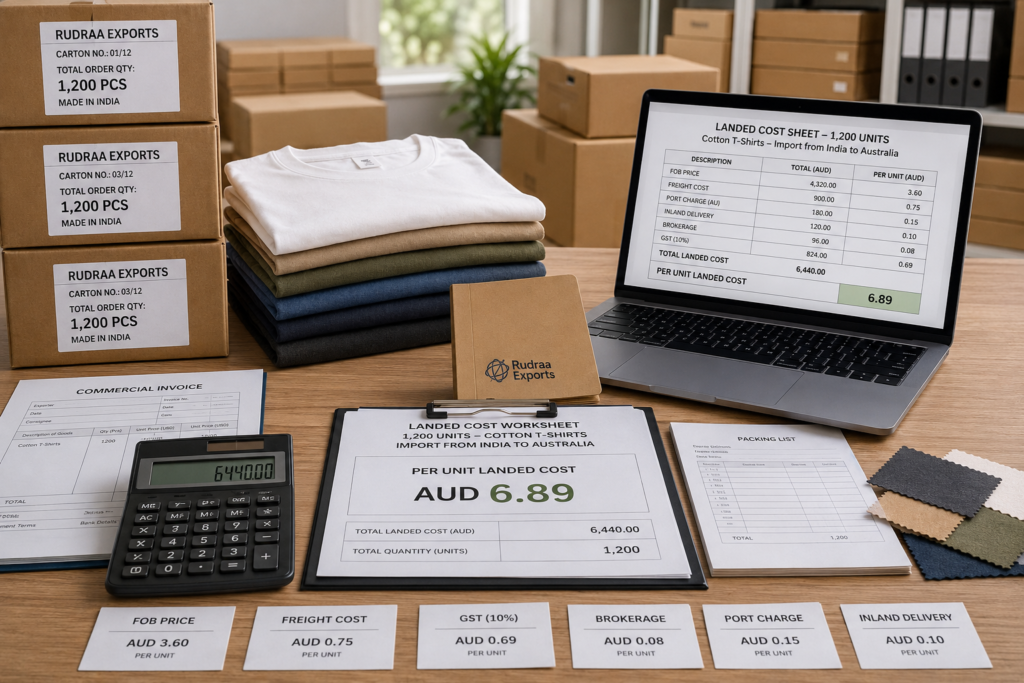
Worked Example: 1,200 Cotton T-Shirts from India to Australia
Assumptions
| Item | Assumption |
|---|---|
| Product | Cotton T-shirts |
| Quantity | 1,200 pieces |
| HS code | 6109.10.00, subject to broker confirmation |
| Freight mode | Sea LCL |
| ECTA duty | 0% if eligible and documented |
| Planning FX | 1 USD = 1.50 AUD |
Landed Cost Table
| Line Item | Shipment Total USD | Shipment Total AUD | AUD Per Unit |
|---|---|---|---|
| FOB factory price | 3,600 | 5,400 | 4.50 |
| International freight | 650 | 975 | 0.81 |
| Insurance | 20 | 30 | 0.03 |
| Duty under ECTA | 0 | 0 | 0.00 |
| GST | — | 640 | 0.53 |
| Brokerage / entry | — | 220 | 0.18 |
| Port / terminal charges | — | 550 | 0.46 |
| Inland delivery | — | 450 | 0.38 |
| Total landed cost | — | 8,265 | 6.89 |
Result
Estimated landed cost = AUD 6.89 per T-shirt
The uploaded source provides this worked 1,200-unit example and shows a landed result of AUD 6.89 per T-shirt before hidden cost add-ons.
Hidden Costs That Change the Real Unit Cost
The basic landed cost may still miss commercial costs.
Hidden Cost Add-Ons
| Hidden Cost | Example |
|---|---|
| Sampling and courier | AUD 900 |
| Pre-shipment inspection | AUD 350 |
| Bank fees / FX spread | AUD 60 |
Amortised Per-Unit Add-On
| Hidden Cost | AUD Per Unit |
|---|---|
| Sampling and courier | 0.75 |
| Inspection | 0.29 |
| Bank / FX fees | 0.05 |
| Total hidden add-on | 1.09 |
True Commercial Cost Example
AUD 6.89 landed cost + AUD 1.09 hidden add-ons = AUD 7.98 true commercial unit cost
The uploaded source explains that sampling, pre-shipment inspection and bank or FX fees should be added or amortised to understand the real commercial unit cost.
Sea Freight vs Air Freight
Freight mode changes unit economics.
Sea is usually cheaper per unit but slower.
Air is faster but more expensive.
Sea Freight
Best for:
- Planned bulk orders
- Replenishment
- Lower freight cost per unit
- Stable launch calendars
- Non-urgent inventory
Air Freight
Best for:
- Urgent launches
- Influencer campaigns
- Stockout prevention
- Small top-up orders
- High-margin products
The uploaded source explains that freight mode is a pricing and cash-flow decision, not only a logistics decision.
Sea vs Air Cost Example
Sea LCL Example
For 1,200 T-shirts, the example sea freight cost is:
AUD 0.81 per unit
Air Freight Example
If packed T-shirt chargeable weight is around 0.25 kg:
| Air Freight Rate | Estimated Freight Per Unit |
|---|---|
| USD 2.50 / kg | Around AUD 0.94 per unit before extra handling |
| USD 6.00 / kg | Around AUD 2.25 per unit before extra handling |
Buyer Tip
Do not average sea and air costs into one price if you use both modes.
Track them separately.
Margin Framework After Landed Cost
Once you know landed cost, you can set your pricing properly.
Example
Inventory landed cost: AUD 6.89
Volatility buffer: AUD 0.40
Pricing landed cost: AUD 7.29
Pricing Examples
| Channel | Margin Target | Example Price |
|---|---|---|
| DTC retail | 70% GM | AUD 24.30 |
| Wholesale | 50% GM | AUD 14.58 |
| Markdown floor | 35% GM | AUD 11.22 |
The uploaded source gives a margin-setting framework where landed cost is used to calculate DTC retail price, wholesale price and markdown floor.
How to Build a Repeatable Landed-Cost Sheet
Step 1: Confirm Product Identity
Create a product folder with:
- Tech pack
- Fabric composition
- Construction details
- Product photos
- HS code notes
- Size range
- Packing method
Step 2: Add Official Cost Lines
Your costing sheet should include:
- FOB
- Freight
- Insurance
- Duty
- GST
- Brokerage
- Port charges
- Inland delivery
Step 3: Add Hidden Cost Lines
Add:
- Sampling
- Lab dips
- Courier
- Inspection
- Bank charges
- FX spread
- Reinspection if needed
Step 4: Track Source Documents
For each cost, keep:
- Supplier invoice
- Freight quote
- Broker invoice
- Port charges invoice
- Local delivery invoice
- Bank statement
- Inspection invoice
Step 5: Reconcile After Shipment
After the shipment clears, compare:
- Estimated cost
- Actual invoice
- Variance
- Reason for variance
- Fix for next shipment
The uploaded source recommends reconciling the first two shipments against real invoices to separate predictable, variable and one-off differences.
Common Landed-Cost Mistakes
| Mistake | Impact |
|---|---|
| Using only FOB price | Underpriced product |
| Forgetting GST | Cash-flow surprise |
| Assuming ECTA always applies | Duty shock |
| Ignoring port charges | Unit cost increases |
| Not adding inspection | Quality risk |
| Not amortising sampling | Margin looks better than reality |
| Averaging sea and air | Wrong pricing by channel |
| Ignoring FX spread | Phantom margin loss |
| No broker review | Classification risk |
| No post-shipment reconciliation | Same mistakes repeat |
Why Rudraa Exports
Rudraa Exports helps Australian brands import T-shirts and knitwear from Tirupur with factory-direct clarity and export support.
Rudraa Support Includes
- T-shirt tech pack review
- Fabric and GSM guidance
- FOB quote clarity
- MOQ planning
- ECTA document support where eligible
- Commercial invoice support
- Packing list support
- Export carton planning
- AQL 2.5 inspection support
- Sea and air shipment planning support
- Australia documentation support
Product Categories Supported
- T-shirts
- Polo shirts
- Hoodies
- Sweatshirts
- Joggers
- Leggings
- Kidswear
- Babywear
- Nightwear
- Uniforms
- Corporate apparel
- Activewear
- Private-label knitwear
Manufacturing Strengths
- Tirupur-based factory-direct knitwear manufacturing
- 72,000+ units per month production capacity
- MOQ discussions starting from around 300 pieces for suitable programs
- Export-ready packing and documentation
- Multi-port shipping through Chennai, Tuticorin and Cochin
- Export support for Australia, USA, UK, Europe, Middle East and global buyers
Buyer Advantages
- Better FOB clarity
- Better landed-cost planning
- ECTA-ready export document support
- GST and freight planning inputs
- Better packing and carton traceability
- Factory-direct pricing without middleman markups
- Up to 40% cost-saving positioning compared with indirect sourcing models
- Repeatable costing support for Australian buyers
Ready to calculate the real landed cost of T-shirts from India to Australia? Speak with Rudraa Exports to share your T-shirt quantity, fabric, GSM, destination, freight preference and target margin.
T-Shirt Landed-Cost Checklist for Australian Buyers
| # | Checklist Item |
|---|---|
| 1 | Confirm T-shirt fabric |
| 2 | Confirm GSM |
| 3 | Confirm HS code with broker |
| 4 | Confirm FOB price |
| 5 | Confirm quantity |
| 6 | Confirm Incoterm |
| 7 | Check ECTA eligibility |
| 8 | Prepare Certificate of Origin if applicable |
| 9 | Get sea freight quote |
| 10 | Get air freight quote if needed |
| 11 | Estimate insurance |
| 12 | Estimate duty |
| 13 | Estimate GST |
| 14 | Add brokerage |
| 15 | Add port charges |
| 16 | Add inland delivery |
| 17 | Add sampling cost |
| 18 | Add inspection cost |
| 19 | Add bank and FX fees |
| 20 | Reconcile actual cost after shipment |
FAQ: Landed Cost of Importing T-Shirts from India to Australia
1. What is the landed cost of importing T-shirts from India to Australia?
Landed cost includes FOB price, freight, insurance, duty, GST, brokerage, port charges, inland delivery and hidden costs such as sampling, inspection and bank fees.
2. Is FOB the final cost?
No. FOB is only the factory-side export price. The real cost in Australia includes import, freight, tax, clearance and delivery charges.
3. Is duty 0% under ECTA?
It can be 0% for eligible Indian-origin goods if rules of origin and documentation are correct. ECTA duty benefit is not automatic for every shipment.
4. Does GST still apply if duty is 0%?
Yes. GST generally still applies even when customs duty is reduced to 0%.
5. What is GST on imported T-shirts in Australia?
GST is generally 10% on taxable importation value. Your customs broker should confirm the exact calculation for your shipment.
6. What HS code applies to cotton T-shirts?
Cotton knitted T-shirts commonly fall under HS 6109.10.00, subject to broker confirmation based on the actual product.
7. What documents are needed to claim ECTA?
Common documents include commercial invoice, packing list, bill of lading or airway bill, and Certificate of Origin or origin evidence where required.
8. Is sea freight better than air freight?
Sea freight is usually cheaper for bulk orders. Air freight is faster but more expensive and should be used for urgent launches, top-ups or high-margin products.
9. How should I price T-shirts after landed cost?
Add operating costs, fulfilment cost, return allowance, payment fees, marketing cost and target margin after calculating landed cost.
10. What hidden costs should I include?
Include sampling, courier, lab dips, pre-shipment inspection, bank transfer fees, FX spread, reinspection and unexpected handling charges.
11. Can Rudraa Exports help estimate landed cost?
Yes. Rudraa can help provide FOB quote inputs, packing details, export documentation and shipment planning support so your broker can prepare a more accurate landed-cost estimate.
12. What should I send Rudraa for a landed-cost estimate?
Send product type, tech pack, fabric, GSM, quantity, destination city, preferred freight mode, label requirements, packaging needs and target retail or wholesale price.
Conclusion
The real landed cost of importing T-shirts from India to Australia is more than FOB plus freight.
Australian buyers must include duty, GST, brokerage, port fees, inland delivery, insurance, sampling, inspection, bank fees and FX movement.
ECTA can improve duty outcomes for eligible Indian-origin T-shirts, but GST still applies and origin documentation must be correct.
A proper line-item costing model helps brands protect margin, compare sea vs air freight, set wholesale and retail prices and avoid surprise costs after shipment.
Rudraa Exports helps Australian buyers source T-shirts and knitwear from India with factory-direct production, export packing, document support and landed-cost planning inputs.
Visit rudraaexports.com or contact our team directly to share your T-shirt import requirement — and receive a factory-direct landed-cost planning quote from Rudraa Exports.
Related reading
How to Forecast Garment Landed Costs from India to Australia
How to Import Garments from India to Australia: Duties, GST and Customs Guide 2026
Where Clothing Brand Founders Waste the Most Money: A Factory-Side Guide