
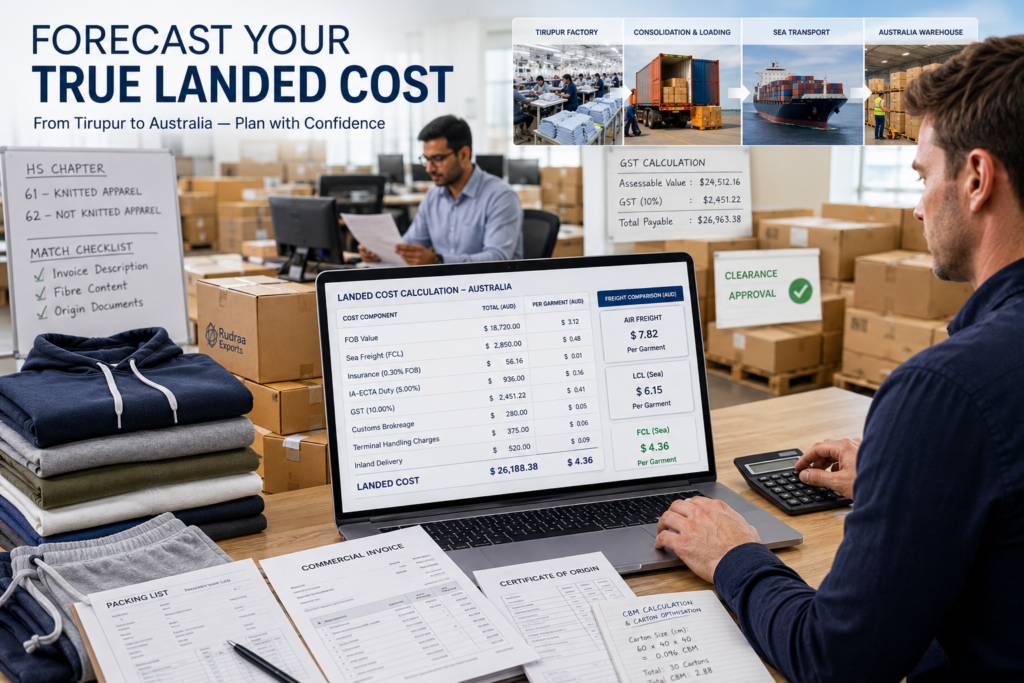
A low factory price does not automatically mean a low final cost.
For Australian apparel brands, the true cost of importing garments from India includes much more than the supplier’s quotation.
A shipment may also include:
- International freight
- Cargo insurance
- Customs duty
- GST
- Customs brokerage
- Port and terminal charges
- Local delivery
- Inspection fees
- Bank charges
- Exchange-rate movement
When these costs are not forecast properly, a shipment can land significantly above budget and reduce the margin available for marketing, wholesale discounts or promotions.
A reliable landed-cost system gives you a clear answer to one important question:
What will each garment actually cost when it reaches my Australian warehouse?
At Rudraa Exports, we help Australian buyers source garments from Tirupur with factory-direct costing, export packing, documentation support, carton planning and shipment coordination.
Quick Answer
To calculate garment landed cost from India to Australia, add the customs value of the goods, international freight, insurance, customs duty, GST, brokerage, terminal fees and Australian delivery charges. Under IA-ECTA, many eligible Indian-origin garments may receive preferential duty treatment when the correct HS classification, rules of origin and documentation are in place. GST generally remains payable and is calculated on the taxable importation value rather than only the supplier invoice.
Need a factory-direct export quote with packing and shipment details? Contact Rudraa Exports and share your product, quantity and Australian delivery destination.
What Is Garment Landed Cost?
Landed cost is the complete cost of moving a garment from the factory to the buyer’s warehouse.
Basic Formula
Total Landed Cost = Goods Value + Freight + Insurance + Duty + GST + Brokerage + Port Charges + Inland Delivery
Per-Unit Formula
Landed Cost Per Garment = Total Landed Cost ÷ Total Units
The uploaded guide explains that accurate landed-cost planning requires duty, GST, freight, insurance, customs charges and local delivery to be calculated separately rather than grouped under one estimated shipping amount.
Why Landed-Cost Forecasts Go Wrong
Import-cost surprises usually come from one or more of these issues:
- Wrong HS code
- Incorrect duty assumption
- Missing IA-ECTA origin documents
- GST calculated on the wrong value
- Incomplete freight quotation
- Unplanned destination charges
- Poor carton utilisation
- Currency movement
- Design or pattern costs not reviewed for customs valuation
- Supplier and broker documents that do not match
Common Example
A buyer compares two suppliers:
| Supplier | Factory Quote |
|---|---|
| Supplier A | AUD 6.50 per garment |
| Supplier B | AUD 7.00 per garment |
Supplier A appears cheaper.
But if Supplier A uses inefficient packing, unclear Incoterms and incomplete origin documentation, the final landed cost may be higher than Supplier B.
The correct comparison is not factory price versus factory price.
It is:
Landed cost per garment versus landed cost per garment.
Step 1: Confirm the HS Classification
Garments are commonly classified under:
- Chapter 61 for knitted or crocheted apparel
- Chapter 62 for woven apparel
The exact tariff code depends on:
- Garment type
- Knit or woven construction
- Fibre composition
- Gender classification
- Product use
- Specific design features
The uploaded source stresses that a small classification difference can affect duty treatment and IA-ECTA eligibility.
Product Classification Checklist
| Classification Detail | Example |
|---|---|
| Product | T-shirt |
| Construction | Knitted |
| Fibre | 100% cotton |
| Category | Adult apparel |
| Sleeve | Short sleeve |
| Intended use | Everyday clothing |
Important Rule
Do not rely only on a factory’s suggested HS code.
Ask an Australian customs broker to confirm classification using the complete product details.
Step 2: Check IA-ECTA Eligibility
The India-Australia Economic Cooperation and Trade Agreement can improve duty outcomes for eligible Indian-origin goods.
But preferential treatment is not automatic.
IA-ECTA Requirements May Include
- Correct tariff classification
- Goods satisfying rules of origin
- Valid origin documentation
- Accurate commercial invoice
- Matching product description
- Supporting production or material records where required
The uploaded guide explains that buyers should confirm the exact tariff line and staging category rather than assuming every garment automatically receives 0% duty.
Duty Planning Table
| Scenario | Possible Outcome |
|---|---|
| Product is eligible and documents are correct | Preferential duty treatment may apply |
| Origin document is missing | General duty may be applied |
| Product does not meet origin rules | Preference may be rejected |
| HS code is wrong | Reassessment or clearance delay |
| Invoice descriptions do not match | Customs query may occur |
Buyer Tip
Add this line to your purchase order:
Supplier must provide all agreed IA-ECTA origin documentation before shipment.
Step 3: Understand Australian Import GST
GST is one of the largest import-cost lines.
It is not normally calculated only on the supplier invoice.
Taxable Importation Formula
A practical planning formula is:
Taxable Importation Value = Customs Value + Duty + International Freight and Insurance
GST = 10% × Taxable Importation Value
The uploaded guide explains that GST generally applies to the customs value plus duty and international freight or insurance.
GST Example
| Cost Component | Amount |
|---|---|
| Customs value | AUD 20,000 |
| Duty | AUD 0 |
| Freight and insurance | AUD 2,500 |
| Taxable importation value | AUD 22,500 |
| GST at 10% | AUD 2,250 |
Important Accounting Point
GST-registered businesses may be able to claim eligible import GST as an input tax credit, subject to Australian tax rules and documentation.
However, GST still affects:
- Cash flow
- Customs clearance
- Shipment release timing
- Working capital
Step 4: Normalise the Supplier Quote
Supplier quotations may use different Incoterms.
You cannot compare them correctly until they are converted to the same cost basis.
Common Incoterms
| Incoterm | Practical Meaning |
|---|---|
| EXW | Buyer takes responsibility from factory |
| FCA | Supplier hands goods to carrier at agreed point |
| FOB | Supplier delivers goods on board at export port |
| CIF | Supplier pays freight and insurance to destination port |
| DAP | Supplier delivers to agreed place; import charges usually remain with buyer |
| DDP | Supplier quotes delivery including import duties and taxes |
Why FOB Is Often Useful
FOB can give experienced importers more control over:
- Freight forwarder selection
- Shipment consolidation
- Insurance
- Destination charges
- Customs brokerage
- Documentation standards
The uploaded guide suggests FOB or FCA can provide better cost control for regular importers, while opaque DDP quotes may hide freight or clearance markups.
Questions to Ask for Every Quote
- What Incoterm is being used?
- Which export charges are included?
- Is insurance included?
- What is the export port?
- What is the packed CBM?
- What is the gross weight?
- How many cartons?
- Which costs are excluded?
Step 5: Choose Air, LCL or FCL Freight
The cheapest freight mode depends on:
- Shipment size
- Delivery deadline
- Product margin
- Inventory level
- Seasonal demand
- Carton volume
- Destination charges
Freight Mode Comparison
| Freight Mode | Best For | Main Limitation |
|---|---|---|
| Air freight | Samples, urgent launches and top-ups | High cost per kilogram |
| LCL sea freight | Smaller commercial shipments | More destination handling |
| FCL sea freight | Larger and predictable orders | Requires sufficient volume |
The uploaded guide notes that FCL can become more economical and predictable than LCL when shipment volume reaches a suitable container-utilisation level.
Use a Two-Lane Freight Plan
A practical strategy is:
- Sea freight for core stock and planned replenishment
- Air freight only for samples, urgent top-ups or launch-critical units
This prevents every production delay from becoming an expensive air-freight decision.
Step 6: Calculate Shipment Volume
Sea freight is often priced by volume.
You need accurate carton dimensions.
CBM Formula
CBM = Length × Width × Height × Number of Cartons
Measurements must be converted to metres.
Example
Carton size:
- Length: 0.60 metres
- Width: 0.40 metres
- Height: 0.40 metres
Volume per carton:
0.60 × 0.40 × 0.40 = 0.096 CBM
For 50 cartons:
0.096 × 50 = 4.8 CBM
Carton Planning Matters
Poor carton utilisation can increase landed cost even when the garment price is low.
Ask the factory to optimise:
- Fold size
- Polybag size
- Carton dimensions
- Pieces per carton
- Weight distribution
- Empty space
Step 7: Consolidate Shipments
Consolidation is useful when you have:
- Multiple styles
- Several purchase orders
- More than one supplier
- Different production completion dates
- Repeated small shipments
Consolidation Benefits
- Fewer documentation charges
- Fewer destination fees
- Better LCL rate per CBM
- Better container utilisation
- Fewer separate deliveries
- Easier customs coordination
The uploaded guide recommends tracking ordered volume and ex-factory dates so shipments can be aligned and consolidated where practical.
Consolidation Planning Sheet
| Supplier | Ready Date | Cartons | CBM | Destination |
|---|---|---|---|---|
| Factory A | 10 August | 30 | 3.0 | Melbourne |
| Factory B | 15 August | 20 | 2.2 | Melbourne |
| Factory C | 18 August | 15 | 1.5 | Melbourne |
If shipment timing can be aligned, one consolidated shipment may be more efficient than three separate LCL bookings.
Step 8: Include Destination Charges
A freight quote may not include every cost in Australia.
Possible Destination Charges
- Terminal handling
- Documentation
- Deconsolidation
- Customs brokerage
- Import declaration
- Quarantine inspection if applicable
- Storage
- Demurrage
- Detention
- Delivery appointment
- Tailgate service
- Local transport
Buyer Tip
Ask your forwarder for:
A complete estimated destination-charge schedule before booking.
Do not rely only on the ocean or air freight line.
Step 9: Prepare a Complete Customs Pack
Clearance delays often happen because shipment documents do not match.
Customs Document Checklist
| Document | Purpose |
|---|---|
| Commercial invoice | Product value and sale details |
| Packing list | Cartons, quantities and weights |
| Bill of Lading or Air Waybill | Transport evidence |
| Certificate of Origin | IA-ECTA claim support |
| Product specification | Classification support |
| Fibre composition | Tariff classification |
| Freight and insurance details | GST calculation |
| Assist-cost schedule | Valuation review where relevant |
The uploaded guide recommends preparing one complete customs pack for every shipment and ensuring the commercial story matches across all documents.
Document Matching Example
The following should agree:
- Invoice: “100% cotton knitted men’s T-shirts”
- Packing list: Same product description
- HS classification: Appropriate knitted apparel code
- Certificate of Origin: Matching product details
- Tech pack: Matching fabric composition
Step 10: Review Customs Valuation Additions
The supplier invoice may not be the only value considered for customs purposes.
Certain buyer-supplied costs may need review, including:
- Pattern development
- Design work
- Moulds or tooling
- Materials supplied free of charge
- Certain assists used in production
The uploaded guide advises buyers to disclose separate design or pattern-related costs to their customs broker for valuation review.
Important Rule
Do not decide independently whether an additional cost is dutiable.
Provide the full commercial arrangement to your customs broker.
Step 11: Add Currency and Bank Costs
Factory invoices may be issued in USD while Australian charges are paid in AUD.
Currency Cost Lines
- Bank conversion rate
- FX spread
- Transfer fee
- Correspondent bank fee
- Exchange-rate movement
- Letter of Credit charges if used
Better FX Planning
Use:
- Budget exchange rate
- Actual payment rate
- Exchange-rate variance
This helps separate production variance from finance variance.
Step 12: Build a Landed-Cost Spreadsheet
Every purchase order should have a standard cost sheet.
Product Inputs
- Supplier
- Product
- Quantity
- HS code
- Fibre composition
- Knit or woven
- IA-ECTA eligibility
- Incoterm
- Export port
- Destination
Goods Costs
- Unit price
- Total goods value
- Labels
- Packaging
- Sampling amortisation
- Inspection cost
Freight Costs
- International freight
- Insurance
- Origin charges
- Destination charges
- Local delivery
Tax Inputs
- Duty rate
- Duty amount
- GST base
- GST amount
Total Calculation
- Total shipment cost
- Landed cost per unit
- Forecast variance
- Margin at planned retail price
Worked Example: 3,000 Knit T-Shirts
The following example is for planning only.
Assumptions
| Cost Component | Amount |
|---|---|
| Customs value | AUD 30,000 |
| Duty | AUD 0 |
| Freight and insurance | AUD 3,000 |
| Taxable importation value | AUD 33,000 |
| GST | AUD 3,300 |
| Brokerage and local charges | AUD 1,500 |
Total Landed Cost
| Cost Line | Amount |
|---|---|
| Goods | AUD 30,000 |
| Freight and insurance | AUD 3,000 |
| Duty | AUD 0 |
| GST | AUD 3,300 |
| Brokerage and local charges | AUD 1,500 |
| Total | AUD 37,800 |
Landed Cost Per Unit
AUD 37,800 ÷ 3,000 = AUD 12.60 per T-shirt
The uploaded source uses a similar example to demonstrate that GST alone can add a meaningful amount per garment before brokerage and Australian delivery charges.
Add a Freight Variance Buffer
Freight prices change.
Your spreadsheet should include:
- Base freight quote
- Peak-season case
- Disruption case
- Currency movement
- Destination-charge variance
Example Buffer
| Scenario | Freight Budget |
|---|---|
| Base | AUD 3,000 |
| Peak season | AUD 3,600 |
| Disruption case | AUD 4,200 |
This protects the margin from relying on one optimistic freight quotation.
Use Landed Cost to Set Pricing
Once landed cost is known, add commercial costs such as:
- Warehousing
- Pick and pack
- Payment fees
- Returns
- Marketing
- Photography
- Discounts
- Wholesale commissions
Retail Pricing Formula
Retail Price = Commercial Product Cost ÷ (1 − Target Gross Margin)
Example
Commercial product cost: AUD 14
Target gross margin: 60%
AUD 14 ÷ 0.40 = AUD 35 retail price
This is a planning formula. GST treatment and pricing presentation should be reviewed with your accountant.
Landed-Cost Forecast Checklist
| # | Checklist Item |
|---|---|
| 1 | Confirm product classification |
| 2 | Confirm fibre composition |
| 3 | Confirm knit or woven construction |
| 4 | Check IA-ECTA eligibility |
| 5 | Request origin documentation |
| 6 | Confirm Incoterm |
| 7 | Request packed CBM |
| 8 | Request gross weight |
| 9 | Compare air, LCL and FCL |
| 10 | Include insurance |
| 11 | Estimate duty |
| 12 | Calculate GST base |
| 13 | Include brokerage |
| 14 | Include destination charges |
| 15 | Include local delivery |
| 16 | Review assists with broker |
| 17 | Add bank and FX costs |
| 18 | Add freight variance buffer |
| 19 | Calculate landed cost per unit |
| 20 | Reconcile forecast against invoices |
Common Import Fee Mistakes
1. Assuming IA-ECTA Always Means Zero Duty
Duty preference depends on classification, origin rules and documents.
2. Calculating GST on Goods Value Only
GST generally includes more than the supplier invoice value.
3. Choosing CIF Without Checking Destination Charges
Supplier-paid freight does not mean all Australian charges are included.
4. Accepting DDP Without a Breakdown
An all-inclusive quote may hide classification, freight and GST assumptions.
5. Ignoring CBM
Poor packing can increase sea freight cost.
6. Shipping Every Purchase Order Separately
Separate LCL shipments may repeat fixed fees.
7. Using Different Product Descriptions
Mismatched paperwork can trigger clearance queries.
8. Forgetting Bank Fees
FX spreads and transfer charges reduce the actual margin.
How Rudraa Exports Supports Predictable Import Costing
Rudraa Exports supports Australian apparel buyers with factory-direct garment sourcing from Tirupur, India.
Export Costing Support
- Product and tech-pack review
- Factory quotation
- MOQ planning
- Fabric and GSM confirmation
- Packaging details
- Carton count
- Gross and net weight
- Packed CBM
- Commercial invoice
- Packing list
- Origin-document coordination
- Export packing
- Freight-forwarder coordination
- Consolidation planning
Products Supported
- T-shirts
- Polo shirts
- Hoodies
- Sweatshirts
- Joggers
- Activewear
- Kidswear
- Babywear
- Nightwear
- Uniforms
- Corporate apparel
- Private-label knitwear
Factory-Direct Benefits
- Clearer product costing
- Fewer sourcing layers
- Better packing visibility
- Better document coordination
- Faster technical clarification
- Easier consolidation
- Better repeat-order planning
- Stronger shipment traceability
Ready to forecast your next garment import? Speak with Rudraa Exports and share your product, quantity, fabric, packing needs and Australian destination.
FAQ: Garment Landed Cost from India to Australia
1. What is landed cost?
Landed cost is the total cost of purchasing, shipping, clearing and delivering imported goods to the buyer’s location.
2. Does IA-ECTA remove duty on all Indian garments?
Not automatically. Preferential duty depends on the exact tariff line, rules of origin and supporting documentation.
3. Is GST charged when customs duty is zero?
Yes. GST generally remains payable even when preferential duty is zero.
4. How is import GST calculated?
GST is generally calculated on the customs value plus duty and international freight or insurance.
5. Is FOB better than CIF?
FOB may provide more control over freight and documentation. CIF may be convenient, but Australian destination charges still need to be confirmed.
6. What is the difference between LCL and FCL?
LCL combines your cargo with other shipments. FCL gives you a full container and can become more economical at higher shipment volumes.
7. How do I calculate CBM?
Multiply carton length, width and height in metres, then multiply by the number of cartons.
8. What documents are needed for customs clearance?
Common documents include a commercial invoice, packing list, transport document, origin documentation and product details.
9. What causes customs delays?
Common causes include incorrect classification, inconsistent descriptions, missing origin documents, valuation questions and incomplete freight information.
10. Should I use DDP shipping?
DDP can be convenient, but buyers should request a full breakdown of customs value, duty, GST, freight and clearance costs.
11. Can Rudraa Exports provide carton and CBM information?
Yes. Rudraa can provide export packing, carton count, weights and packed-volume details for shipment planning.
12. What should I send Rudraa Exports for a quote?
Send your product type, tech pack, fabric, GSM, quantity, colours, size range, packaging requirements and Australian destination.
Conclusion
A predictable garment import starts with a complete landed-cost forecast.
Do not stop at the factory quotation.
Confirm the HS classification, review IA-ECTA eligibility, calculate GST correctly, compare freight modes, include destination charges and prepare consistent customs documents.
The strongest cost savings often come from the complete system:
- Factory-direct purchasing
- Efficient carton packing
- Shipment consolidation
- Correct origin documents
- Controlled freight bookings
- Accurate declarations
- Consistent landed-cost reconciliation
Rudraa Exports helps Australian brands source garments from Tirupur with factory-direct costing, export packing, documentation coordination and shipment-planning support.
Visit rudraaexports.com or contact the Rudraa Exports team to discuss your next India-to-Australia garment shipment.
Related reading
The Real Landed Cost of Importing T-Shirts from India to Australia
How to Import Garments from India to Australia: Duties, GST and Customs Guide 2026
Clothing Manufacturer for Australian Brands: How to Source from India Without the Risk