
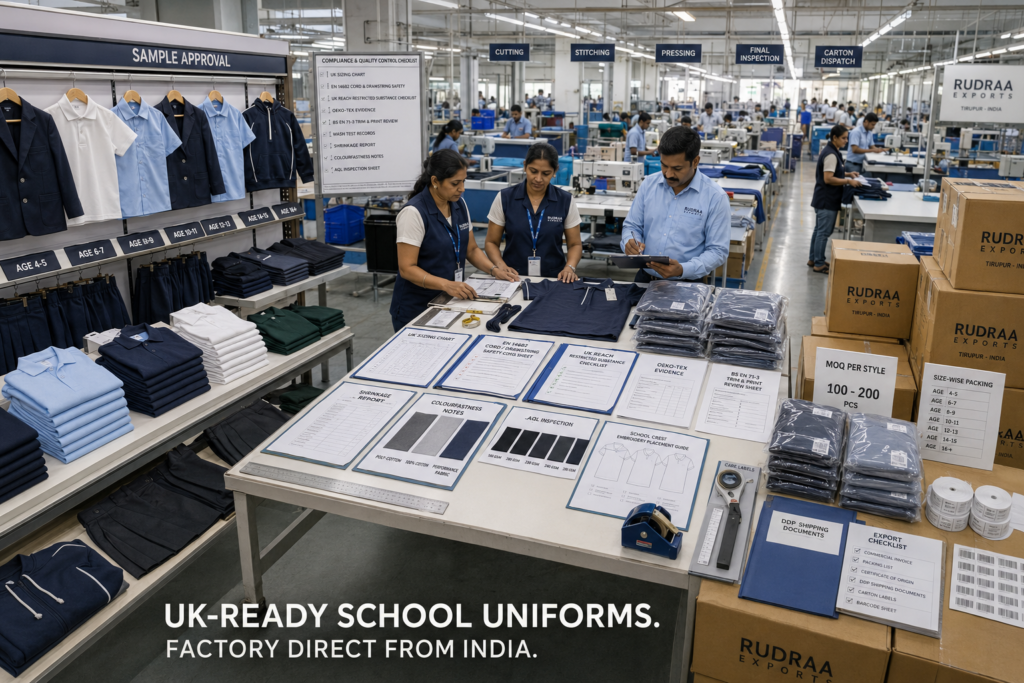
UK school uniform procurement is not only about price.
A school uniform supplier must deliver affordable garments, but also prove that the product is safe, consistent, traceable and suitable for children.
For UK buyers, this means checking chemical safety, cords and drawstrings, sizing, trims, labels, fabric quality, wash performance, documentation and shipping.
That is why many UK schools, academy trusts, retailers and uniform distributors are exploring direct factory sourcing from India.
India, especially Tirupur, offers strong knitwear and schoolwear production capability with practical MOQs, private-label support, documented processes, compliance discussions and FOB or DDP shipping options.
At Rudraa Exports, we help UK buyers source school uniforms from India with factory-direct communication, 300 pcs/style MOQ planning, UK sizing support, fabric selection, safety-by-design checks, QC systems, documentation support and export packing.
Quick Answer
A school uniform manufacturer in India can be a strong option for UK schools, academy trusts, retailers and distributors when buyers need affordable, compliant and repeatable schoolwear at planned volumes. UK buyers should check UK REACH chemical controls, EN 14682 cord and drawstring safety, OEKO-TEX availability, BS EN 71-3 where trims or decorative components are relevant, UK sizing conventions, fabric shrinkage, wash performance, documentation and DDP shipping. For direct factory sourcing from India, practical MOQs are often around 300 pcs/style depending on fabric, colour, logo and complexity.
Planning school uniform sourcing from India for the UK? Contact Rudraa Exports and share your product list, size range, fabric, logo details, compliance requirements, MOQ and preferred FOB/DDP terms.
Why UK Buyers Consider School Uniform Manufacturing in India
UK school uniform buyers face pressure from three sides.
Parents need affordability.
Schools need consistency.
Procurement teams need compliance evidence.
The uploaded guide explains that UK procurement teams must deliver compliant and affordable school uniforms while proving chemical safety, design controls and defensible due diligence under UK product safety expectations.
India Is Useful For
- School polo shirts
- PE T-shirts
- PE hoodies
- School sweatshirts
- Uniform trousers
- Uniform skirts
- Woven shirts
- House-colour garments
- School sportswear
- Private-label schoolwear
- Retail school uniform programs
- Multi-school trust procurement
Why Tirupur Fits School Uniform Production
Tirupur is strong for knitwear and repeat apparel programs.
For schoolwear buyers, this helps with:
- Polo shirt production
- T-shirt production
- Sweatshirt and hoodie production
- Fabric consistency
- Colour repeatability
- Logo embroidery
- Private labels
- Size-wise packing
- Export documentation
- Planned bulk supply
The uploaded guide positions Tirupur-based direct Indian factory sourcing as a model that combines production capacity, traceability and practical MOQs for UK school uniform buyers.
Direct India vs UK Domestic vs Agent Model
UK buyers usually compare three routes:
- Direct Indian factory
- UK domestic manufacturing
- UK agent or trading intermediary
The uploaded source compares these routes across UK REACH controls, OEKO-TEX availability, child safety design, MOQ flexibility, price leverage, documentation readiness, DDP shipping, speed and UK sizing.
Quick Comparison
| Criteria | Direct Indian Factory | UK Domestic | Agent / Trader |
|---|---|---|---|
| Cost efficiency | Strong for planned bulk | Usually highest cost | Agent margin added |
| MOQ | Practical at 300 pcs/style | Possible but costly | Often hidden upstream |
| UK sizing | Good if size chart is locked | Easier local iteration | Can be inconsistent |
| Compliance evidence | Good with proper documentation | Easier oversight | Depends on agent rigor |
| DDP shipping | Possible with exporter | Less relevant | Often handled by agent |
| Emergency top-ups | Not ideal | Best | Depends on stock |
| Traceability | Strong if factory-direct | Strong but expensive | Often lower visibility |
Key Takeaway
Direct India works best for planned bulk and repeat programs.
UK domestic works best for emergency top-ups.
Agents may reduce coordination, but buyers must demand the same test evidence and traceability as they would from a factory.
The uploaded guide says agent convenience should be treated as a service, but quantified against the loss of transparency that can increase recall risk.
Safety Standards UK Buyers Should Understand
School uniforms are children’s clothing.
So UK buyers must think beyond fabric and price.
They must consider product safety, foreseeable misuse, restricted substances, trims, cords, drawstrings, labels and evidence.
The uploaded source says UK enforcement for school uniforms often lands on general product safety and foreseeable misuse hazards, especially cords and drawstrings.
EN 14682: Cords and Drawstrings
Cords and drawstrings can create entrapment or strangulation risk in children’s clothing.
That is why design control matters.
The uploaded guide identifies BS EN 14682:2014 as a practical reference for designing children’s clothing to reduce cord and drawstring risks.
What to Control
- No risky neck drawcords
- Safe hood designs
- Cord length limits
- Waist cord control
- Hem cord control
- Age-based garment zone restrictions
- Pattern-stage safety checks
Example
A PE hoodie for ages 4–7 should avoid neck drawcords and apply EN 14682 design controls at the pattern stage.
The uploaded guide gives this same example and says safety should be enforced at pattern stage, not after sampling.
UK REACH: Chemical Safety
UK REACH controls restricted substances in textile articles.
For school uniforms, buyers should consider chemical controls for:
- Azo dyes
- Formaldehyde
- Nickel in metal trims
- Restricted substances in prints
- Chemical finishes
- Coatings
- Performance treatments
The uploaded guide says UK REACH Annex XVII restricts specific chemicals in textile articles and should be treated as mandatory regardless of origin.
What to Ask the Manufacturer
- Do you follow an RSL?
- Can you provide fabric test evidence?
- Can you support buyer chemical requirements?
- Can trims be checked?
- Can prints or coatings be tested?
- Can reports be linked to the PO?
Buyer Tip
Chemical controls should apply to fabric, trims, prints and finishes, not only the main garment body.
OEKO-TEX Standard 100
OEKO-TEX is voluntary, but useful for UK schoolwear buyers.
It helps show that textiles have been tested for harmful substances.
The uploaded guide explains that OEKO-TEX Standard 100 is valuable because it tests for harmful substances and is updated annually.
What to Check
- Certificate number
- Product class
- Scope
- Facility
- Validity
- Fabric or finished garment coverage
- Annual renewal
Important Point
OEKO-TEX is not a replacement for UK REACH.
It supports the compliance stack, but buyers still need a UK REACH approach.
The uploaded guide says UK REACH and OEKO-TEX should be treated as a compliance stack, not either/or.
BS EN 71: Where It May Apply
School uniforms are not toys.
But some uniform components may need extra child-contact thinking.
The uploaded guide says BS EN 71 often appears where uniforms include toy-like accessories, decorative components, plasticised prints, badges or coated trims that could be mouthed by younger children.
Possible EN 71-3 Review Areas
- Decorative badges
- Coated trims
- Plasticised prints
- Metal components
- Pullers
- Child-contact accessories
Example
A blazer with a decorative metal badge may need child-contact component thinking, including nickel-type restrictions and EN 71-3-style migration review where relevant.
The uploaded guide gives this example for badge and coating risk.
Fabric Options for UK School Uniforms
School uniforms must survive repeated washing, daily use and child activity.
Common fabric choices include poly-cotton, cotton and performance fabrics.
The uploaded guide lists poly-cotton, 100% cotton and performance fabrics as common UK schoolwear options.
1. Poly-Cotton
Best for:
- School shirts
- Uniform polos
- Everyday schoolwear
- Mass procurement
- Easy-care programs
Benefits
- Durable
- Easy care
- Lower shrinkage risk than pure cotton
- Good for frequent washing
- Practical for schoolwear
2. 100% Cotton
Best for:
- Comfortable polos
- Breathable shirts
- Premium schoolwear
- Skin-contact garments
Watch-Out
Shrinkage must be tested.
The uploaded guide says 100% cotton is comfortable and breathable, but shrinkage control must be proven with wash testing.
3. Performance Fabrics
Best for:
- PE kits
- Sports uniforms
- Outdoor activity garments
- Quick-dry schoolwear
Watch-Out
Chemical finishing must be controlled against UK REACH and buyer RSL requirements.
The uploaded guide says performance fabrics are growing in demand, but chemical finishing must be controlled.
UK Sizing and Fit Controls
Sizing problems usually come from poor grading, not only wrong labels.
The uploaded guide says sizing issues usually come from mismatched grading rules and fit blocks, not label numbers.
What to Lock
- UK master size chart
- Measurement points
- Chest
- Waist
- Inside leg
- Body length
- Sleeve length
- Shoulder width
- Garment tolerances
- Shrinkage limit
- Graded nest
Buyer Tip
Approve the UK master size chart before approving colour, logo or trims.
The uploaded guide recommends approving a UK master size chart and graded nest before colour, logo or trim approval.
MOQ for School Uniform Manufacturing in India
MOQ depends on style, fabric, colour, logo, trims and packing.
The uploaded guide says practical MOQs for direct Indian school uniform sourcing are often around 300 pcs/style.
Practical MOQ Direction
| MOQ | Best For |
|---|---|
| 300 pcs/style | Trial or small school program |
| 300 pcs/style | Better planned production |
| 500+ pcs/style | Stronger bulk efficiency |
| 1,000+ pcs/style | Trust-wide or retailer program |
MOQ Works Better When
- Fabric is standard
- Colour count is limited
- Logo method is fixed
- Size chart is locked
- Packaging is standardised
- Testing plan is clear
- Repeat demand is planned
MOQ Becomes Harder When
- Every school has a different colour
- Every style needs separate trims
- Runs are below 300 pcs/style
- Logo placements vary heavily
- Testing cost per style becomes too high
- Specifications are unclear
The uploaded source says direct India may not fit highly volatile SKU counts with tiny runs below 300 pcs/style because sampling and testing overhead becomes disproportionate.
Price and Cost Planning
School uniform pricing depends on:
- Product type
- Fabric
- GSM
- Quantity
- Logo method
- Trims
- Testing
- Packing
- Shipping term
- DDP requirement
The uploaded guide recommends building RFQs that separate fabric and trims, testing, packing and Incoterms such as FOB vs DDP.
RFQ Should Separate
- Fabric cost
- Trim cost
- Cutting and stitching
- Logo embroidery or print
- Testing cost
- Packing cost
- Barcode and labelling cost
- FOB cost
- DDP cost
Buyer Tip
Do not compare only FOB.
Compare landed cost plus compliance evidence.
FOB vs DDP for UK School Uniform Buyers
DDP means delivered duty paid.
It can simplify procurement when the buyer wants goods delivered without managing each import step separately.
The uploaded guide says DDP can simplify procurement if the seller provides transparent cost components and import documentation.
FOB Works If
- You have your own forwarder
- You understand UK import process
- You want freight control
- You already manage customs
DDP Works If
- You want landed-cost clarity
- You want simplified delivery
- You have many receiving locations
- You want fewer customs surprises
- You are moving from local/agent sourcing
DDP Quote Should Show
- Product cost
- Freight
- Duty
- Tax handling
- Clearance
- Final delivery
- Carton count
- Gross weight
- CBM
- Delivery timeline
Fit / Fit-Not Guide
Direct India Is a Strong Fit If
- You plan demand in advance
- You need 300 pcs/style
- You need repeatable schoolwear
- You need UK REACH controls
- You need EN 14682 design discipline
- You want OEKO-TEX-supported fabrics
- You need traceability per PO
- You need private labels and barcode packing
- You want cost efficiency versus local routes
- You can manage technical packs and reports
The uploaded guide says direct sourcing from India works when buyers can plan demand and value repeatability, cost and documentation.
Direct India May Not Fit If
- You need emergency replenishment in days
- Your SKU runs are below 300 pcs/style
- You cannot review test reports
- You cannot manage RSLs
- You cannot lock technical packs
- You need very fast local fittings
- You need constant small top-ups
The uploaded guide says UK domestic sourcing may be better for emergency replenishment, while an agent may help buyers with low compliance maturity, provided the agent guarantees documentation and lab evidence.
Two-Lane Strategy for UK Schoolwear Buyers
A practical approach is to use two lanes.
Lane 1: India for Planned Bulk
Use India for:
- Base polos
- Shirts
- PE kits
- Sweatshirts
- Hoodies
- Repeat annual programs
- Trust-wide uniform production
Lane 2: UK for Emergency Top-Ups
Use UK supply for:
- Last-minute shortages
- Small school-specific top-ups
- Urgent fittings
- Late-season spikes
The uploaded guide recommends a two-lane strategy: offshore for planned bulk and local for urgent top-ups.
Migration Plan: UK to Direct Indian Factory in 60–90 Days
Step 1: Build UK Compliance Checklist
Include:
- EN 14682 cord/drawstring controls
- UK REACH restricted substances approach
- OEKO-TEX decision
- General product safety evidence
- Testing responsibilities
- Documentation owner
The uploaded guide recommends building a UK compliance and evidence checklist in Week 1 before migration.
Step 2: Lock Technical Packs and UK Sizing
Prepare:
- Measurement points
- Tolerances
- Shrinkage limits
- Labelling requirements
- Fabric specs
- GSM
- Pilling
- Colourfastness
- Care instructions
The uploaded guide recommends issuing a UK sizing convention pack with measurement points, tolerances, shrinkage limits and labelling requirements.
Step 3: Choose MOQ, FOB and Commercial Model
Set:
- MOQ per style
- MOQ per colour
- FOB quote
- DDP quote
- Testing cost
- Packing cost
- Incoterms
Step 4: Build Testing and Lab Strategy
Define:
- Type tests
- Batch tests
- Who pays
- Who holds reports
- What triggers re-testing
- Lab route
The uploaded guide recommends deciding which tests are type tests versus batch tests, who pays, who holds reports and what triggers retesting.
Step 5: Plan Logistics
Plan:
- Production lead time
- Sea vs air
- Peak-season buffer
- Carton labels
- Packing lists
- DDP documentation
Step 6: Run Pilot Then Scale
Pilot:
- One core item such as polo
- One complex item such as blazer
- Fit across sizes
- Wash performance
- Documentation completeness
- Traceability records
The uploaded guide recommends piloting one gender-neutral core item and one complex item, then evaluating fit consistency, wash performance and documentation completeness before scale.
UK School Uniform Sourcing Checklist
| # | Checkpoint |
|---|---|
| 1 | Product list confirmed |
| 2 | Age range confirmed |
| 3 | UK size chart prepared |
| 4 | Graded nest approved |
| 5 | Fabric selected |
| 6 | GSM confirmed |
| 7 | Shrinkage limit set |
| 8 | UK REACH approach defined |
| 9 | EN 14682 cord/drawstring review done |
| 10 | OEKO-TEX requirement decided |
| 11 | EN 71-3 component review considered |
| 12 | Logo method confirmed |
| 13 | Care label content prepared |
| 14 | MOQ per style confirmed |
| 15 | MOQ per colour confirmed |
| 16 | Testing plan prepared |
| 17 | FOB quote requested |
| 18 | DDP quote requested |
| 19 | Pilot shipment planned |
| 20 | Traceability per PO required |
How Rudraa Exports Supports UK School Uniform Buyers
Rudraa Exports supports UK buyers with direct school uniform manufacturing from Tirupur, India.
Rudraa Support Includes
- Product brief review
- School uniform quote
- 300 pcs/style MOQ discussion
- Fabric selection
- Poly-cotton options
- Cotton options
- Performance fabric discussion
- UK size chart support
- Graded size discussion
- Logo embroidery support
- Private labels
- Care labels
- Barcode stickers
- Size-wise packing
- Compliance documentation discussion
- UK REACH awareness
- EN 14682 design discussion
- OEKO-TEX evidence discussion
- Testing plan support
- QC checkpoints
- FOB quote
- DDP quote discussion
- Export packing
Products Supported
- School polo shirts
- School T-shirts
- PE T-shirts
- PE hoodies
- School sweatshirts
- Uniform trousers
- Uniform skirts
- School shirts
- Sports uniforms
- House-colour garments
- Private-label schoolwear
Why Rudraa Fits UK Buyers
Rudraa is a strong fit for buyers who need:
- Direct factory sourcing
- Tirupur production capacity
- Traceability discipline
- Practical MOQs
- UK sizing discussion
- Compliance-led sourcing
- Repeatable production
- DDP shipping discussion
- Cost efficiency with documentation
The uploaded guide says Rudraa’s direct-factory model is built for UK buyers who need Tirupur capacity, traceability discipline and practical MOQs while targeting cost efficiency.
Ready to source UK-ready school uniforms from India? Speak with Rudraa Exports and share your tech pack, current sample, fabric, logo method, size range, MOQ per colour and FOB/DDP preference.
FAQ: School Uniform Manufacturer India UK
1. Can UK schools source uniforms from India?
Yes. UK schools, academy trusts, retailers and distributors can source school uniforms from India when compliance, sizing, testing, QC and shipping are planned properly.
2. What safety standards matter for UK school uniforms?
UK buyers should review general product safety, UK REACH chemical controls, EN 14682 cord/drawstring safety, OEKO-TEX evidence and EN 71-3 where trims or decorative child-contact components are relevant.
3. What is EN 14682?
EN 14682 is a practical reference for reducing cord and drawstring hazards in children’s clothing, especially around the head, neck and other risk zones.
4. Does BS EN 71 apply to school uniforms?
School uniforms are not toys, but EN 71-3 may be considered for decorative components, badges, plasticised prints, coatings or trims that could be mouthed by younger children.
5. What MOQ can I expect from India?
For planned school uniform production, practical MOQs are often around 300 pcs/style depending on fabric, colour, logo, testing and complexity.
6. What fabrics are common for UK school uniforms?
Common fabrics include poly-cotton, 100% cotton and performance fabrics, depending on garment type and use.
7. Why is UK sizing important?
UK sizing must be controlled through a master size chart, measurement points, tolerances and graded patterns to avoid returns and inconsistent fit.
8. Is DDP useful for UK school uniform buyers?
Yes. DDP can simplify landed-cost planning and delivery by including duty, tax handling, clearance and final delivery where available.
9. Should buyers still use UK suppliers?
UK suppliers are useful for emergency top-ups, late-season shortages and very urgent replenishment. India is better for planned bulk.
10. What should I ask Rudraa for a quote?
Send your tech pack or current sample, product list, fabric, GSM, size range, logo method, compliance needs, MOQ per colour and FOB/DDP preference.
11. Can Rudraa support UK compliance discussion?
Yes. Rudraa can discuss UK REACH, EN 14682 design safety, OEKO-TEX evidence, testing plans, traceability and documentation requirements.
12. What is the best migration approach?
Use a 60–90 day migration plan: compliance checklist, UK sizing pack, technical packs, testing strategy, FOB/DDP quote, pilot shipment and then scale.
Conclusion
Choosing a school uniform manufacturer in India for UK schools is not only a cost decision.
It is a compliance, sizing, traceability and planning decision.
UK buyers need affordable schoolwear, but they also need evidence: UK REACH controls, EN 14682 cord and drawstring safety, OEKO-TEX support, trim and print review where relevant, UK sizing governance, wash performance, testing records and documentation per PO.
Direct Indian factory sourcing works best for planned school uniform programs where the buyer can lock technical packs, run testing, approve samples and plan demand.
UK domestic sourcing remains useful for emergency top-ups.
A two-lane strategy is often strongest: India for planned bulk and local supply for urgent replenishment.
Rudraa Exports helps UK buyers source school uniforms from Tirupur with practical MOQs, fabric options, UK sizing discussion, safety-by-design awareness, traceability, QC and FOB/DDP shipping support.
Visit rudraaexports.com or contact the Rudraa Exports team to request a UK-ready school uniform quote and compliance-led sampling plan.
Related reading
School Uniform Suppliers in India for Australian Schools: MOQ, Safety Standards and Compliance Guide
School Uniform Manufacturers in Tirupur: Bulk Institutional Wear for Global Buyers