
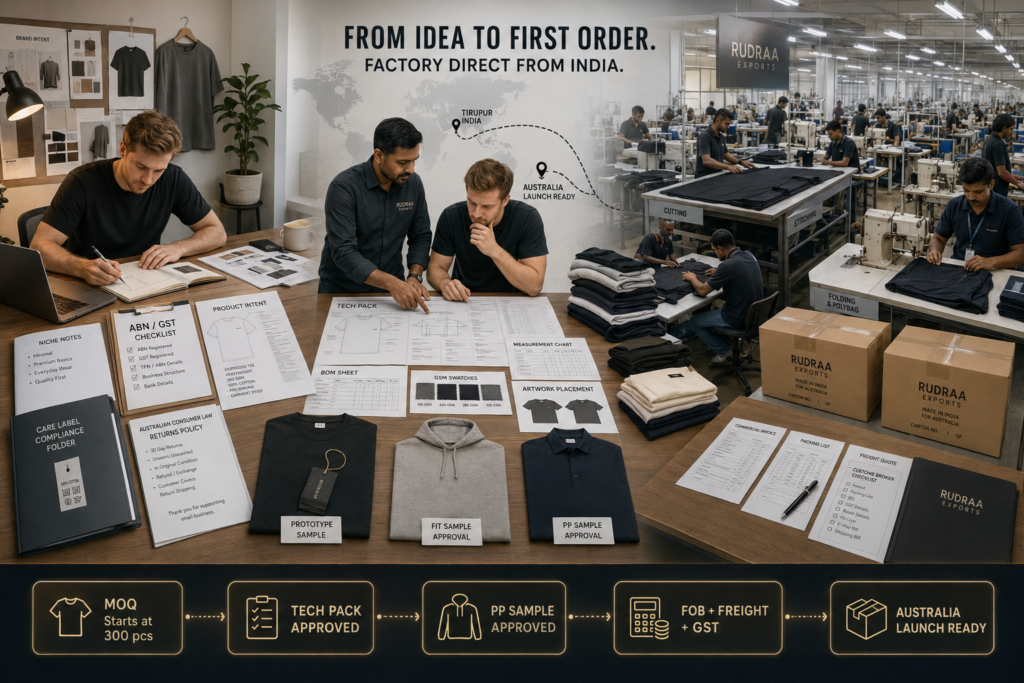
Starting a clothing brand in Australia can feel exciting and confusing at the same time.
You may have a strong idea.
You may know the style you want.
You may already have a logo, moodboard or Instagram page.
But once you move from idea to production, the real questions begin.
Do you need an ABN?
When should you register for GST?
How do you make a tech pack?
How many samples do you need?
What is the minimum order quantity?
Should you manufacture locally or source from India?
How do freight, customs, GST and Australian labelling rules work?
This guide explains how to start a clothing brand in Australia from idea to first bulk order, especially if you are considering factory-direct production with an Indian manufacturer like Rudraa Exports.
The goal is simple: help you move from a rough brand idea to a controlled first production order without wasting money on avoidable mistakes.
Quick Answer
To start a clothing brand in Australia, choose a clear niche, select one hero product, register your ABN, understand GST obligations, prepare a tech pack, create care-label and compliance documentation, sample the garment, approve a pre-production sample, place your first bulk order, choose air or sea freight, handle customs documentation and launch with accurate product pages and returns policy. If you manufacture with Rudraa Exports in India, plan around a 300-piece starting MOQ, proper tech packs, sample approvals, landed-cost calculation and Australian compliance requirements.
Planning your first clothing order from India to Australia? Contact Rudraa Exports and share your product idea, target fabric, GSM, artwork, quantity, size range, launch date and shipping destination.
Why Starting a Clothing Brand Feels Overwhelming
Most first-time founders do not struggle because they lack creativity.
They struggle because clothing production has many moving parts.
The uploaded guide explains that starting a clothing brand can feel overwhelming because founders are learning production, international sourcing and Australian compliance at the same time.
Common Beginner Questions
- What product should I start with?
- Should I make locally or overseas?
- How many pieces should I order?
- What is a tech pack?
- How much does sampling cost?
- What is FOB?
- What is landed cost?
- Do I need care labels?
- Do Australian laws apply if I manufacture overseas?
- How do I import the goods?
- How do I avoid manufacturing mistakes?
The Simple Answer
You do not need to be a manufacturing expert to start.
But you do need a clear process.
The uploaded guide says you do not need manufacturing expertise to start, but you do need a clear process and checklist.
Step 1: Choose a Niche
Do not start with “I want to make clothes.”
That is too broad.
Start with one clear customer and one clear product direction.
Good Niche Examples
- Heavyweight tees for gym-to-street wear
- Oversized streetwear for Australian founders
- Resort shirts for summer travel
- Minimal everyday basics
- Workwear-inspired cotton apparel
- Premium hoodies for lifestyle brands
- Branded merchandise for creators
- Athletic lounge sets
- Sustainable cotton basics
The uploaded guide recommends choosing a niche and one hero product instead of starting with too many SKUs.
Ask Yourself
- Who is this for?
- What problem does it solve?
- Why will someone choose this over existing brands?
- What is the main product?
- What is the target retail price?
- What makes it different?
Founder Tip
Pick one product you can explain in one sentence.
Example:
“Boxy 240 GSM heavyweight tees for Australian streetwear customers who want premium blanks without luxury pricing.”
Step 2: Choose One Hero Product
Many first-time founders start with too many products.
That creates cost, confusion and production delays.
Start with one hero product.
Good First Products
- T-shirt
- Heavyweight T-shirt
- Hoodie
- Polo shirt
- Sweatshirt
- Jogger
- Cap sleeve tee
- Uniform tee
- Creator merchandise tee
Avoid Starting With
- 12 SKUs
- Too many colours
- Complex outerwear
- Tailoring
- Too many trims
- Heavy wash effects
- Products that need advanced fit testing
The uploaded guide recommends shortlisting one hero product, such as a heavyweight tee or fleece hoodie, and running the numbers properly before choosing the production route.
Step 3: Register Your ABN
If you are starting a business in Australia, you should understand ABN setup early.
ABN stands for Australian Business Number.
The uploaded guide says founders should apply for an ABN through official channels and that applying is free through the Australian Business Register.
Why ABN Matters
An ABN helps with:
- Business identity
- Invoicing
- Supplier communication
- Payment setup
- GST registration if required
- Business bank account setup
- Working with logistics providers
Founder Tip
Register your ABN early so your business paperwork stays clean from the start.
Step 4: Understand GST
GST is Goods and Services Tax.
In Australia, GST registration becomes mandatory when your GST turnover reaches the required threshold.
The uploaded guide explains that GST registration is mandatory once GST turnover reaches $75,000 or more, and founders must register within the required timeframe after reaching or expecting the threshold.
Why GST Matters
GST can affect:
- Selling price
- Import costs
- Business invoices
- Cash flow
- BAS lodgement
- Claiming GST credits where eligible
Founder Tip
If you are planning a large launch or expect strong sales, speak to a bookkeeper or accountant early.
Step 5: Understand Australian Consumer Law
Australian Consumer Law applies even if your garments are made overseas.
The uploaded guide says Australian Consumer Law applies to the retailer even when production happens offshore. Products must meet consumer guarantees, including acceptable quality, fitness for purpose and matching the description.
What This Means
Your product must:
- Match the description
- Be acceptable quality
- Be fit for purpose
- Have accurate size and product details
- Have truthful marketing claims
- Have a compliant returns policy
Avoid
- “No refunds” blanket statements
- Misleading product descriptions
- Incorrect fibre claims
- Overstated sustainability claims
- Product photos that do not match bulk goods
The uploaded guide warns that misleading refund wording, such as blanket “No refunds” claims, can create Australian Consumer Law problems.
Step 6: Plan Care Labels and Product Labelling
Care labels should not be added at the last minute.
They should be part of your tech pack.
The uploaded guide explains that Australia’s Care Labelling Information Standard 2023 requires care labels for relevant textile goods.
Your Label Plan Should Include
- Fibre content
- Care instructions
- Size label
- Brand label
- Country of origin where applicable
- Wash symbols or written care instructions
- Placement
- Label artwork
- Label material
Founder Tip
Create a compliance folder before production.
Include:
- Care label copy
- Fibre content
- Returns policy
- Product description
- Packaging details
- Any test reports
- Supplier invoice and production documents
The uploaded guide recommends creating a compliance folder containing care instructions, fibre content plan and ACL-aligned returns policy.
Step 7: Decide Local Australia vs India Manufacturing
Your first major sourcing decision is where to produce.
The uploaded guide compares local Australian production and manufacturing in India across cost, MOQ, lead time, QC, pricing leverage, freight, customs and GST.
Local Australian Manufacturing
Best for:
- Australian-made brand positioning
- Very small runs
- Rapid iteration
- In-person factory visits
- Local content filming
- Complex development requiring hands-on review
Challenges
- Higher labour cost
- Higher setup cost
- Higher unit cost
- Limited pricing leverage
- Harder to scale cost-effectively
The uploaded guide says local Australian production typically carries higher labour and setup costs, with higher CMT rates and early pattern/sampling setup costs.
Indian Manufacturing with Rudraa Exports
Best for:
- Cost-sensitive launches
- 300+ piece first bulk orders
- Repeatable styles
- T-shirts
- Hoodies
- Polos
- Sweatshirts
- Cotton basics
- Factory-direct communication
- Scalable production
Challenges
- Longer shipping timeline
- More documentation required
- Stronger pre-production discipline needed
- More planning required before launch
The uploaded guide says offshore production rewards planners and punishes improvisers because sampling, production booking and international shipping buffers must be managed properly.
Step 8: Know Rudraa Exports’ MOQ
For Rudraa Exports, plan your first bulk order around 300 pieces minimum.
Rudraa MOQ Direction
| Quantity | Meaning |
|---|---|
| Below 300 pcs | Not ideal for Rudraa bulk production |
| 300 pcs | Starting MOQ for suitable first bulk orders |
| 500 pcs | Better production efficiency |
| 1,000+ pcs | Stronger repeat production economics |
Why 300 MOQ Makes Sense
A 300-piece MOQ helps with:
- Better fabric usage
- Better cutting efficiency
- Better print or embroidery setup value
- Better QC structure
- Better unit economics
- More serious production planning
- More scalable reorder pathway
Founder Tip
If you are not ready for 300 pieces, validate demand first through:
- Pre-orders
- Mockups
- Small local samples
- Creator audience testing
- Product photoshoots
- Paid ads waitlist
- Market research
Then move to Rudraa for your first proper bulk order.
Step 9: Build a Product Intent Sheet
Before contacting a manufacturer, create a one-page product intent sheet.
The uploaded guide recommends writing a Product Intent Sheet before contacting a clothing manufacturer for an Australian brand.
Product Intent Sheet Should Include
- Target customer
- Product type
- Fabric weight
- Fit direction
- Branding placements
- Target landed cost
- Target retail price
- Colourways
- Size range
- Launch timeline
- Quantity target
Example
Product: 240 GSM oversized T-shirt
Customer: Australian streetwear buyer
Fit: Boxy, dropped shoulder
Fabric: Cotton jersey
Branding: Puff print front, neck label
MOQ: 300 pcs
Target: First online drop
Step 10: Create a Tech Pack
A tech pack is your production instruction manual.
Without it, the factory is guessing.
The uploaded guide says a tech pack prevents expensive misunderstandings and should include BOM, measurements, tolerances, artwork placements and label specifications.
Tech Pack Should Include
- Flat sketch
- Product photos or reference images
- Fabric composition
- GSM
- Bill of materials
- Size chart
- Measurements
- Tolerances
- Stitch details
- Neck rib details
- Artwork placement
- Print size
- Embroidery placement
- Label artwork
- Care label information
- Packaging requirement
- Colour references
Add This Box
Do Not Change Without Approval
Include:
- GSM
- Shrinkage target
- Main measurements
- Fabric composition
- Print placement
- Colour reference
The uploaded guide recommends adding a “Do Not Change Without Approval” box for GSM, shrinkage target and top measurements.
Step 11: Sampling Process
Sampling protects your bulk order.
Do not skip it.
The uploaded guide recommends planning 2–3 sample rounds and approving a pre-production sample before bulk.
Recommended Sampling Flow
- Prototype / fit sample
- Revised sample
- Pre-production sample
What Each Sample Checks
| Sample | Purpose |
|---|---|
| Prototype / fit sample | Pattern and silhouette |
| Revised sample | Measurement, fabric and trim corrections |
| Pre-production sample | Final production approval |
Founder Tip
Keep a sample feedback log.
Do not write vague comments like “neck feels tight.”
Write:
“Increase neck opening by 1 cm.”
The uploaded guide gives this same example and recommends using photos and numbered comments in a sample feedback log.
Step 12: Approve PP Sample Before Bulk
The PP sample is the final approved production reference.
Do not place bulk production without clear PP sample approval.
PP Sample Should Confirm
- Fabric
- GSM
- Fit
- Measurements
- Stitching
- Embroidery
- Labels
- Packaging
- Care label
- Colour
- Size grading
Important Rule
Never pay a bulk deposit without agreed tech pack version and PP sample approval criteria.
The uploaded guide says founders should never pay a bulk deposit without an agreed tech pack/version number and PP sample approval criteria.
Step 13: Request the Right Quote
Do not ask only:
“How much for T-shirts?”
Ask for a structured quote.
The uploaded guide recommends asking for FOB price, packaging assumptions, cost adders and MOQ/price breaks when requesting pricing.
Quote Should Include
- Product type
- Fabric
- GSM
- MOQ
- Quantity
- FOB price
- Print cost
- Embroidery cost
- Label cost
- Packaging cost
- Carton details
- Sample cost
- Production lead time
- Freight estimate
- Payment terms
For Rudraa, Ask For
- 300 pcs quote
- 500 pcs quote
- 1,000 pcs quote
This helps you understand your price ladder as the brand grows.
Step 14: Calculate Landed Cost
FOB is not your final cost.
You need landed cost.
The uploaded guide says beginners often forget the landed-cost stack, including freight, insurance, customs/broker fees and GST treatment.
Landed Cost Includes
- FOB price
- Freight
- Insurance
- Customs broker fee
- Duty where applicable
- GST handling
- Domestic delivery
- Buffer
Use This Formula
FOB + freight + broker + duty/GST handling + local delivery + buffer = landed cost
Founder Tip
Create a landed-cost spreadsheet before placing bulk.
Step 15: Choose Air or Sea Freight
Freight can protect or destroy your margin.
The uploaded guide says sea freight is cheaper but slower, while air freight is faster but can crush margins.
Sea Freight
Best for:
- Bulk production
- Better margin
- Planned launch
- Reorders
- Hoodies and heavier garments
The uploaded source gives sea freight benchmarks around $40–$80 per CBM.
Air Freight
Best for:
- Urgent launch
- Small top-up
- Samples
- Lightweight products
- Time-sensitive drops
The uploaded source gives air freight benchmarks around $2.50–$8.00 per kg depending on route and demand.
Example
Air freight may work for lightweight samples or a small urgent batch.
But for 300 hoodies, sea freight is usually better for margin.
Step 16: Customs, Duties and Import Documentation
Your shipment needs correct paperwork.
The uploaded guide says Australian Border Force provides tariff classification resources and correct HS coding matters for duty rates.
Documents You Need
- Commercial invoice
- Packing list
- Bill of lading or air waybill
- HS code
- Fibre content
- Country of origin
- Carton count
- Gross weight
- CBM
- Broker import declaration
Customs Broker
For your first shipment, use a customs broker.
The uploaded guide recommends hiring a broker for the first shipment so founders can understand the documents before deciding whether to DIY later.
Step 17: Payment Terms and Buyer Protection
Offshore manufacturing usually needs deposit and balance payment.
The uploaded guide says offshore manufacturing usually involves deposits and balance payments and recommends using formal invoices, clear specifications and staged approvals.
Protect Yourself With
- Formal proforma invoice
- Tech pack version number
- Sample approval record
- Written payment milestones
- Bulk approval criteria
- Proof of payment
- Clear production timeline
- Final QC before balance payment
Founder Tip
Do not pay based only on WhatsApp messages.
Use documents.
Step 18: Prepare for Launch
Before opening sales, check operations.
The uploaded guide recommends confirming that the size chart matches the approved sample, photographing the exact production item, aligning returns policy with ACL, checking care labels and setting reorder triggers.
Pre-Launch Checklist
- Product photos are accurate
- Size chart matches bulk product
- Care label is correct
- Product page matches real garment
- Returns policy follows ACL
- Packaging is ready
- Stock count is correct
- Reorder trigger is planned
- Customer service replies are ready
- First 10 orders are test packed
Reorder Tip
Set a trigger such as:
“Reorder when best-selling size reaches 30% stock.”
The uploaded guide recommends setting reorder triggers, such as reordering when a best size reaches 30% stock.
Fit / Fit-Not Guide
Rudraa Exports Is a Strong Fit If
- You are ready for 300 pcs MOQ
- You have one clear hero product
- You want factory-direct production
- You need better unit economics
- You can prepare a tech pack
- You can approve samples properly
- You can plan freight and customs
- You want scalable repeat production
- You are making T-shirts, hoodies, polos or basics
Local Australia May Be Better If
- You need 10–30 units
- You need Australian-made positioning
- You want weekly iteration
- You need to visit the factory often
- You are making complex tailoring
- You are still changing designs every week
The uploaded guide says local Australian production may be better when the brand promise depends on Australian-made positioning, weekly iteration or very small quantities.
Do Not Go Offshore Yet If
- You do not have a clear niche
- You are changing direction weekly
- You cannot afford sampling and deposit
- You expect the factory to design your brand
- You cannot prepare basic specs
- You cannot handle a 300-piece first bulk order
The uploaded guide says founders should not go offshore yet if they do not have a clear niche, cannot manage cash for sampling and deposit, or expect the factory to design the brand from scratch.
First Clothing Order Checklist for Australian Founders
- Choose one niche
- Choose one hero product
- Register ABN
- Understand GST threshold
- Prepare ACL-safe returns policy
- Prepare care label information
- Create product intent sheet
- Prepare tech pack
- Define GSM
- Define fabric composition
- Define size chart
- Define tolerances
- Define artwork placement
- Define label requirements
- Plan 300 pcs starting MOQ
- Request 300/500/1,000 pcs quote
- Plan prototype sample
- Plan revised sample
- Approve PP sample
- Build landed-cost sheet
- Compare air vs sea freight
- Hire customs broker for first shipment
- Check commercial invoice and packing list
- Photograph exact production product
- Launch with accurate size chart
- Set reorder trigger
How Rudraa Exports Supports Australian First-Time Founders
Rudraa Exports supports Australian founders who are ready to move from idea to first proper bulk production.
Rudraa Support Includes
- Product brief review
- Tech-pack review
- 300 pcs MOQ planning
- Fabric and GSM discussion
- T-shirt production
- Hoodie production
- Polo production
- Sweatshirt production
- Cotton basics production
- Sampling support
- PP sample approval
- Label discussion
- Care label planning
- Print and embroidery discussion
- FOB quote
- Freight planning discussion
- Export packing
- Commercial invoice and packing list support
- First-order production planning
Products Supported
- Heavyweight T-shirts
- Basic T-shirts
- Hoodies
- Sweatshirts
- Polo shirts
- Joggers
- Uniform basics
- Creator merchandise
- Streetwear basics
- Lifestyle apparel
Why Rudraa Fits Australian Brands
Rudraa is a strong fit for Australian founders who need:
- Factory-direct sourcing
- 300 pcs starting MOQ
- Scalable production
- Clear specs
- Sampling discipline
- Better unit economics
- Export-ready packing
- India-to-Australia sourcing support
Ready to plan your first clothing order from India to Australia? Speak with Rudraa Exports and request a quote with your product type, GSM, fabric, size range, artwork, quantity and freight preference.
FAQ: How to Start a Clothing Brand in Australia
1. Do I need manufacturing experience to start a clothing brand?
No. You do not need manufacturing experience, but you need a clear process, product brief, tech pack, sampling plan and first-order checklist.
2. Do I need an ABN to start a clothing brand in Australia?
An ABN is strongly recommended when starting a business because it supports invoicing, supplier communication, tax setup and business operations.
3. When do I need to register for GST?
GST registration becomes mandatory when your GST turnover reaches the required threshold. Speak with an accountant or bookkeeper if you are planning a larger launch.
4. Does Australian Consumer Law apply if I manufacture in India?
Yes. Australian Consumer Law applies to you as the retailer even if the product is manufactured overseas.
5. Do clothing products need care labels in Australia?
Relevant textile goods need care labels under Australian care labelling requirements, so plan label copy before production.
6. Should I manufacture locally or in India?
Manufacture locally if you need tiny runs, Australian-made positioning or rapid iteration. Manufacture in India if you are ready for 300 pcs MOQ and want scalable factory-direct production.
7. What is Rudraa Exports’ MOQ?
Rudraa Exports’ MOQ starts from 300 pieces, depending on product, fabric, colour, artwork and complexity.
8. What is a tech pack?
A tech pack is the instruction manual for your garment. It includes fabric, GSM, measurements, tolerances, artwork, labels, trims and packaging.
9. How many samples should I make before bulk?
Plan 2–3 rounds: prototype or fit sample, revised sample and pre-production sample.
10. What is landed cost?
Landed cost is your total cost after adding FOB price, freight, insurance, broker fees, duty/GST handling, local delivery and buffer.
11. Should I use air or sea freight?
Use air for urgent samples or small time-sensitive shipments. Use sea freight for bulk orders where margin matters.
12. What should I send Rudraa for a quote?
Send your product type, reference images, tech pack, GSM, fabric, artwork, size range, quantity, timeline, label requirements and freight preference.
Conclusion
Starting a clothing brand in Australia is not only about choosing a logo and posting product mockups.
You need a system.
Choose one niche.
Pick one hero product.
Register your ABN.
Understand GST.
Build ACL-safe product pages and returns policy.
Prepare care labels.
Create a tech pack.
Run samples.
Approve a PP sample.
Plan your first 300-piece bulk order.
Calculate landed cost.
Choose freight.
Use a broker for your first import.
Then launch with accurate product photos, size charts and reorder triggers.
Rudraa Exports helps Australian founders move from idea to first proper bulk order with factory-direct garment production from Tirupur, India. For founders ready for a 300-piece starting MOQ, Rudraa can support product development, sampling, tech-pack review, fabric and GSM planning, printing or embroidery discussion, export packing and India-to-Australia sourcing support.
Visit rudraaexports.com or contact the Rudraa Exports team to request a capability deck and quote for your first clothing production order.
Related reading
How to Start a Clothing Brand in Australia: The Correct Order and Realistic Timeline
Low MOQ Clothing Manufacturing for Australian Startup Brands
Small Batch Clothing Manufacturers in India: Low MOQ Options for Startups