
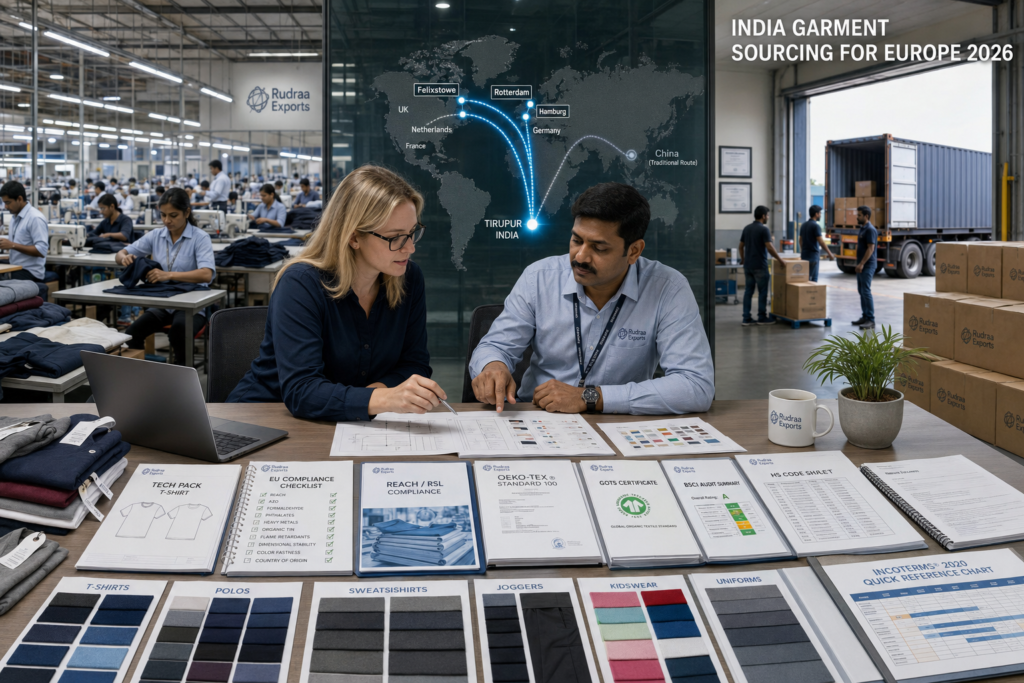
European fashion brands are rethinking apparel sourcing. The old China-first model still works for some categories, but many UK and EU buyers now want more supply-chain resilience, better compliance visibility, flexible production, and stronger margin control.
For knitwear, India is becoming a serious sourcing option — especially Tirupur, Tamil Nadu. Tirupur is one of India’s strongest knitwear manufacturing clusters, with deep specialization in T-shirts, polos, sweatshirts, joggers, babywear, kidswear, underwear, uniforms, and athleisure. For European brands looking for garment manufacturers India for European brands, Tirupur offers a practical route to build a controlled, compliant, and scalable sourcing lane.
But shifting sourcing from China to India should not be done blindly. Buyers must understand landed cost, EU tariff treatment, Rules of Origin, REACH compliance, OEKO-TEX and GOTS evidence, logistics to Rotterdam, Hamburg and Felixstowe, Incoterms, documentation, and pilot-order risk.
At Rudraa Exports, we support European apparel brands with factory-direct knitwear manufacturing from Tirupur, including sampling, bulk production, compliance documentation, quality control, and export shipment planning.
Quick Answer
European brands should consider India, especially Tirupur, for knitwear sourcing when they need factory-direct production, compliance-ready documentation, flexible MOQs, reliable sampling, and a China-plus-one sourcing strategy. Current EU tariff treatment should be checked carefully because India’s GSP apparel benefits were suspended from January 1, 2026, but the EU-India trade deal is expected to improve tariff access after implementation. The safest approach is to cost today using MFN assumptions, build Rules of Origin documentation now, run a controlled Tirupur pilot, and scale only after quality, compliance, and logistics performance are proven.
Planning to source garments from India for Europe? Contact Rudraa Exports to request a European buyer sourcing plan, compliance checklist, and pilot-order timeline.
Why European Brands Are Reconsidering Apparel Sourcing
European brands are under pressure from multiple directions:
- High sourcing concentration risk
- Tariff uncertainty
- Red Sea and Suez shipping disruption
- Rising compliance expectations
- ESG reporting pressure
- Retailer demand for traceability
- Need for flexible production
- Margin pressure from freight, duties, and inventory
- Need for faster replenishment and lower overstock
China remains powerful in apparel manufacturing, but buyers increasingly want alternatives. For knitwear, India — especially Tirupur — offers a strong option.
The goal is not simply to “move from China to India.” The goal is to build a safer sourcing lane that can support European compliance, stable production, clear documentation, and predictable delivery.
India vs China: What European Buyers Should Understand
European brands often compare India and China only on price. That is too narrow.
The right comparison is:
landed cost + compliance risk + delivery reliability + supplier flexibility + future tariff readiness
India vs China Sourcing Comparison
| Factor | China | India / Tirupur |
|---|---|---|
| Scale | Very high | Strong, especially in knitwear |
| Product breadth | Very broad | Strong in cotton knitwear, basics, uniforms, activewear |
| EU tariff treatment | Usually MFN for core apparel lines | MFN in many cases currently; FTA upside after implementation |
| Knitwear specialization | Strong | Very strong in Tirupur |
| MOQ flexibility | Varies; often higher in large factories | More flexible with right supplier |
| Compliance expectations | Mature export systems | Improving rapidly; strong suppliers can support EU needs |
| China-plus-one value | Not applicable | Strong diversification option |
| Best for | Broad, complex, high-scale categories | Knitwear, basics, flexible sourcing, repeat programs |
For many European brands, India is not replacing China completely. It is becoming a strategic second sourcing lane.
EU Duty Reality for Garments from India
Tariffs are one of the biggest areas where buyers must avoid assumptions.
Many core apparel lines under HS Chapters 61 and 62 can face MFN duty in the EU. China generally does not receive EU apparel preference. India had GSP benefits earlier, but reporting in 2026 indicates that EU GSP benefits for several Indian sectors including textiles were suspended from January 1, 2026.
At the same time, EU-India trade agreement developments are important. Recent reporting says the deal is expected to eliminate or reduce tariffs on more than 90% of goods after implementation, with Indian textiles expected to benefit.
Practical Buyer Rule
Cost today using conservative MFN duty assumptions.
Prepare your origin documentation now so you can benefit quickly when any eligible preference becomes claimable after the EU-India agreement is implemented.
Rules of Origin: Do Not Wait Until the FTA Is Live
Rules of Origin decide whether a garment qualifies for preferential duty treatment.
For apparel, origin can depend on where yarn, fabric formation, cutting, sewing, and finishing happen. Many preference systems require more than simple stitching. Buyers must maintain evidence that supports the origin claim.
Origin Evidence Buyers Should Ask For
| Evidence | Why It Matters |
| Yarn or fabric invoices | Supports material origin |
| Fabric processing records | Shows transformation stage |
| Cutting records | Shows garment production location |
| Sewing records | Supports manufacturing origin |
| Packing records | Connects goods to shipment |
| Exporter declaration | Supports origin statement |
| Certificate / statement where required | Supports preference claim |
| Direct shipment evidence | Helps preserve eligibility |
Even if the tariff benefit is not available today, build the origin file from the first order. This prevents scrambling later.
Why Tirupur Is Strong for European Knitwear Buyers
Tirupur is not just a city with garment factories. It is a knitwear cluster.
For European brands sourcing T-shirts, polos, sweatshirts, joggers, leggings, babywear, kidswear, uniforms, and athleisure, this matters because the supporting processes are close together.
Tirupur Cluster Advantages
| Tirupur Strength | European Buyer Benefit |
| Knitting ecosystem | Faster fabric development and repeat production |
| Dyeing and processing support | Better shade control and fabric consistency |
| Printing and embroidery access | Faster branding and customization |
| Trims and packaging network | Easier product completion |
| Skilled knitwear workforce | Better repeatability |
| Export documentation familiarity | Easier EU shipment preparation |
| Sustainability infrastructure | Supports ESG and compliance conversations |
For a European buyer, the practical benefit is less handoff risk. Fabric, dyeing, stitching, printing, packing, and documentation can be coordinated within one sourcing ecosystem.
Best Product Categories to Source from Tirupur
Tirupur is strongest in knitwear and cotton-rich apparel.
Product Fit Table
| Product Category | Tirupur Fit |
| Cotton T-shirts | Very strong |
| Polo shirts | Very strong |
| Sweatshirts | Strong |
| Hoodies | Strong |
| Joggers | Strong |
| Leggings | Strong |
| Kidswear | Strong |
| Babywear | Strong |
| School uniforms | Strong |
| Corporate uniforms | Strong |
| Sportswear basics | Strong |
| Underwear basics | Strong |
| Denim | Not core |
| Structured woven jackets | Not core |
| Tailored suits | Not core |
European buyers should start with Tirupur’s strengths. Do not force the wrong product category into the wrong cluster.
EU Compliance Essentials for Indian Garment Suppliers
European buyers need more than a good sample. They need compliance evidence.
Key EU Buyer Requirements
| Area | What Buyers Should Ask For |
| REACH | Restricted substances control for fabrics, dyes, prints, trims |
| OEKO-TEX | Harmful substance testing evidence where required |
| GOTS | Organic cotton chain-of-custody where organic claims are made |
| BSCI / SMETA | Social compliance audit evidence |
| CSRD readiness | Supplier data for ESG reporting |
| RSL testing | Buyer-specific restricted substance list compliance |
| Labelling | Fiber composition, care, country of origin, size, language needs |
| Traceability | Fabric lots, dye lots, production batches, shipment records |
Do not accept generic “compliance available” statements. Ask for document scope, validity, product linkage, and shipment-level records.
REACH and Chemical Compliance
REACH is one of the most important compliance frameworks for garments sold into the EU.
For knitwear, chemical risk can come from:
- Dyed fabric
- Printed graphics
- Heat transfers
- Plastisol prints
- Trims
- Elastic
- Coatings
- Performance finishes
- Buttons, eyelets, zippers, or metal trims
REACH-Aware Testing Scope
| Component | Risk |
| Dyed fabric | Azo dyes and restricted substances |
| Print film | Phthalates, heavy metals, restricted substances |
| Elastics | Chemical additives |
| Trims | Nickel, lead, cadmium risk |
| Performance finish | PFAS or other restricted chemistry |
| Labels and transfers | Plasticizers and restricted substances |
European buyers should define a Restricted Substances List and testing schedule before production starts.
OEKO-TEX, GOTS, BSCI, and CSRD: What They Mean in Practice
OEKO-TEX
Useful for chemical safety confidence. Buyers should confirm whether the certificate covers the fabric, component, or finished garment.
GOTS
Relevant when the product is claimed as organic cotton. Buyers should ask for scope certificate and transaction certificate where applicable.
BSCI / SMETA
Useful for social compliance and supplier onboarding, especially for European retailers and institutional buyers.
CSRD Readiness
European brands are increasingly expected to report supply-chain data. A supplier that can provide traceability, material records, energy/water-related data where available, and compliance evidence is more useful than one that only provides price.
Logistics from Tirupur to Europe
Tirupur is inland, so goods are usually trucked to ports such as Chennai, Tuticorin, or Cochin depending on freight plan and destination.
Common European destination ports include:
- Rotterdam
- Hamburg
- Felixstowe
- Southampton
- Le Havre
- Antwerp
- Marseille
The uploaded source gives lane benchmarks such as Chennai to Rotterdam around 23–32 days port-to-port and 32–40 days door-to-door, Chennai to Hamburg around 24–28 days port-to-port and 33–39 days door-to-door, and Chennai to Felixstowe around 23–26 days port-to-port and 32–38 days door-to-door.
Europe Logistics Planning Table
| Route | Port-to-Port Planning | Door-to-Door Planning |
| Chennai to Rotterdam | 23–32 days | 32–40 days |
| Chennai to Hamburg | 24–28 days | 33–39 days |
| Chennai to Felixstowe | 23–26 days | 32–38 days |
| Air to Europe | 2–5 days transit | Higher cost |
Freight conditions can change quickly, especially during Red Sea/Suez disruption. Always confirm current sailing schedules and surcharges before booking.
Incoterms for European Buyers
Incoterms affect who controls freight, risk, insurance, and customs responsibilities.
Common Incoterms
| Incoterm | Meaning | Best For |
| FOB | Supplier delivers goods to port/on-board vessel | Buyers who control freight |
| CIF | Supplier arranges freight and insurance to destination port | Buyers wanting freight included |
| FCA | Supplier hands goods to carrier at agreed place | Buyers managing logistics |
| DAP | Supplier delivers to named destination, duties unpaid | Buyers wanting simpler logistics |
| DDP | Supplier delivers duty-paid | Buyers wanting landed delivery, but needs careful tax handling |
Many experienced EU buyers prefer FOB for the first order because it allows them to control the freight forwarder, carrier, and main-leg shipment.
Quality, Testing, and Documentation System
European buyers should treat quality and documentation as one operating system.
Pre-Production Controls
- Final tech pack
- Fabric standard
- GSM target
- Shrinkage limit
- Lab dip approval
- Print or embroidery strike-off
- Measurement tolerance
- Approved golden sample
- Compliance test plan
Production Controls
- Fabric inspection
- Inline inspection
- End-line inspection
- Measurement checks
- AQL final inspection
- Shade control
- Packing inspection
Shipment File
- Commercial invoice
- Packing list
- HS code
- Certificate of origin where required
- Origin evidence file
- Test reports
- Compliance documents
- AQL report
- Freight documents
- Buyer-specific declarations
A European buyer should request the shipment file before goods leave the factory.
Controlled Pilot Plan for European Brands
Do not switch sourcing in one big jump. Start with a controlled pilot.
8-Week to 12-Week Pilot Framework
| Phase | Timeline | Action |
| Discovery | Week 1 | Share tech pack, target price, compliance requirements |
| Feasibility | Week 1–2 | Confirm fabric, MOQ, HS code, duty assumptions |
| Sampling | Week 2–5 | Proto, fit sample, size set, lab dips |
| Compliance setup | Week 3–5 | REACH/RSL, OEKO-TEX/GOTS/BSCI evidence |
| Pilot PO | Week 6 | Confirm order, packing, Incoterm, shipment plan |
| Production | Week 6–12 | Cutting, stitching, QC, packing |
| Pre-shipment review | Before dispatch | Review documents and inspection report |
| Post-shipment review | After delivery | Review quality, delays, landed cost, broker issues |
The goal is to prove quality, compliance, delivery, documentation, and communication before scaling.
Commercial Guardrails for Risk-Averse Buyers
European buyers should protect themselves with clear commercial terms.
Recommended Controls
| Area | Control |
| Payment | Start with secure terms or milestone-based payments |
| Currency | Track USD/EUR/GBP exposure |
| MOQ | Start with manageable pilot quantities |
| Quality | Link balance payment to passed inspection |
| Documentation | Require draft shipment documents before dispatch |
| Delivery | Use ex-factory and latest gate-in dates |
| Claims | Define defect handling and CAPA process |
| Compliance | Make test reports and certificates part of PO terms |
Do not rely only on trust. Put the process in writing.
Why Rudraa Exports
Rudraa Exports is positioned for European brands that want factory-direct Tirupur knitwear manufacturing with practical compliance and export support.
Manufacturing Capabilities
- Factory-direct Tirupur knitwear manufacturing
- 72,000+ units per month production capacity
- T-shirts, polos, sweatshirts, hoodies, joggers, leggings, kidswear, babywear, uniforms, activewear, and private-label knitwear
- MOQs starting from around 300 pieces per style, depending on fabric, colour, logo method, trims, and customization
- Sampling support for suitable programs
- Bulk production planning based on order complexity and approval speed
EU Buyer Support
- REACH-aware material and test planning
- OEKO-TEX, GOTS, BSCI, SMETA, WRAP, AEO and related buyer requirement support where applicable
- Fiber, GSM, shade, measurement, print, embroidery, trims, and packing controls
- AQL 2.5 inspection standards
- Shipment document support for invoice, packing list, certificate of origin, HS code consistency, and freight documents
- Export support for UK, Germany, France, Netherlands, wider EU, Australia, USA, and Middle East markets
Sourcing Advantages
- Factory-direct pricing without trading-company markups
- Up to 40% cost-saving positioning compared with indirect sourcing models
- English-language communication for European buyers
- Support for FOB, CIF, FCA, DAP, and buyer-nominated forwarders
- Multi-port shipping through Chennai, Tuticorin, and Cochin
- Strong fit for China-plus-one knitwear sourcing strategies
Ready to build a European sourcing lane from Tirupur? Speak with Rudraa Exports to request a European buyer information pack, pilot timeline, and compliance checklist.
EU Compliance and Import Checklist
| Area | Checklist Item |
| HS code | Confirm Chapter 61/62 classification |
| Duty | Model MFN duty unless valid preference applies |
| Origin | Maintain yarn/fabric/process evidence |
| Incoterm | Confirm FOB, CIF, FCA, DAP, or DDP |
| REACH | Define restricted substance test plan |
| OEKO-TEX | Verify certificate scope if required |
| GOTS | Confirm scope and transaction certificates for organic |
| BSCI/SMETA | Verify social compliance status |
| CSRD | Collect supplier ESG data where needed |
| Logistics | Confirm port, sailing, transit, surcharge |
| Documents | Prepare invoice, packing list, CO, HS file |
| Pilot | Review quality, landed cost, and clearance performance |
FAQ: Garment Manufacturers India for European Brands
1. Is India a good sourcing option for European apparel brands?
Yes. India is a strong sourcing option, especially for knitwear, cotton apparel, uniforms, babywear, kidswear, and activewear. Tirupur is particularly strong for knitwear manufacturing.
2. Why should European brands consider Tirupur?
Tirupur has a dense knitwear ecosystem covering fabric, dyeing, stitching, printing, embroidery, finishing, packing, and export support, which helps reduce handoff risk and improve repeatability.
3. Are duties lower from India than China into the EU?
Not always right now. India’s GSP apparel benefits were suspended from January 1, 2026, so buyers should model MFN duty unless a valid preference applies. The EU-India trade deal is expected to improve future access after implementation.
4. What products should European brands source from Tirupur?
Tirupur is best for T-shirts, polos, sweatshirts, hoodies, joggers, leggings, babywear, kidswear, uniforms, underwear basics, and athleisure.
5. What compliance documents do EU buyers need?
EU buyers may need REACH/RSL test reports, OEKO-TEX evidence, GOTS certificates for organic products, BSCI or SMETA audit evidence, fiber composition, origin documents, and shipment records.
6. How long does shipping from Tirupur to Europe take?
The uploaded source gives planning ranges of roughly 32–40 days door-to-door from Chennai to Rotterdam, 33–39 days to Hamburg, and 32–38 days to Felixstowe, depending on route and conditions.
7. Which Incoterm is best for first-time European buyers?
FOB is often useful for experienced buyers because they control the main freight. CIF, FCA, DAP, or DDP may work depending on the buyer’s logistics capability and importer setup.
8. What is a safe first order strategy?
Start with a controlled pilot of 10–20 knitwear SKUs or fewer, limited colours, clear fabric standards, defined testing, and pre-shipment document review before scaling.
9. What is China-plus-one sourcing?
China-plus-one means keeping China as one sourcing base while adding another country, such as India, to reduce dependency and improve supply-chain resilience.
10. How can Rudraa Exports help European brands?
Rudraa supports European buyers with Tirupur factory-direct knitwear manufacturing, sampling, MOQ planning, compliance support, quality control, export documents, and logistics coordination.
11. Does Rudraa Exports support REACH and OEKO-TEX requirements?
Rudraa can support buyer-led REACH/RSL testing plans and OEKO-TEX-related documentation where applicable, depending on product, fabric, trims, and market requirements.
12. Why choose Rudraa Exports for European sourcing?
Rudraa is suitable for European brands that need a factory-direct Tirupur knitwear partner with flexible MOQs, direct communication, compliance-ready documentation, AQL inspection, and export support.
Conclusion
European brands do not need to abandon China overnight. But they should build resilient sourcing capacity outside China, especially for knitwear. Tirupur offers a strong India-based option for T-shirts, polos, sweatshirts, kidswear, uniforms, and private-label knitwear.
The key is to source with discipline. Model tariffs conservatively, prepare origin evidence early, embed REACH and certification requirements into the PO, choose the right Incoterm, plan realistic logistics, and start with a controlled pilot.
Visit rudraaexports.com or contact our team directly to share your product category, MOQ, fabric, compliance requirements, and European destination market — and receive a factory-direct European sourcing plan from Tirupur.
Related reading
How German Fashion Brands Source Garments from India: A Step-by-Step Procurement Guide
India–EU Free Trade Agreement 2026: What European Brands Sourcing Garments Need to Know
Best Garment Manufacturers in Tirupur, India: Complete Guide 2026