
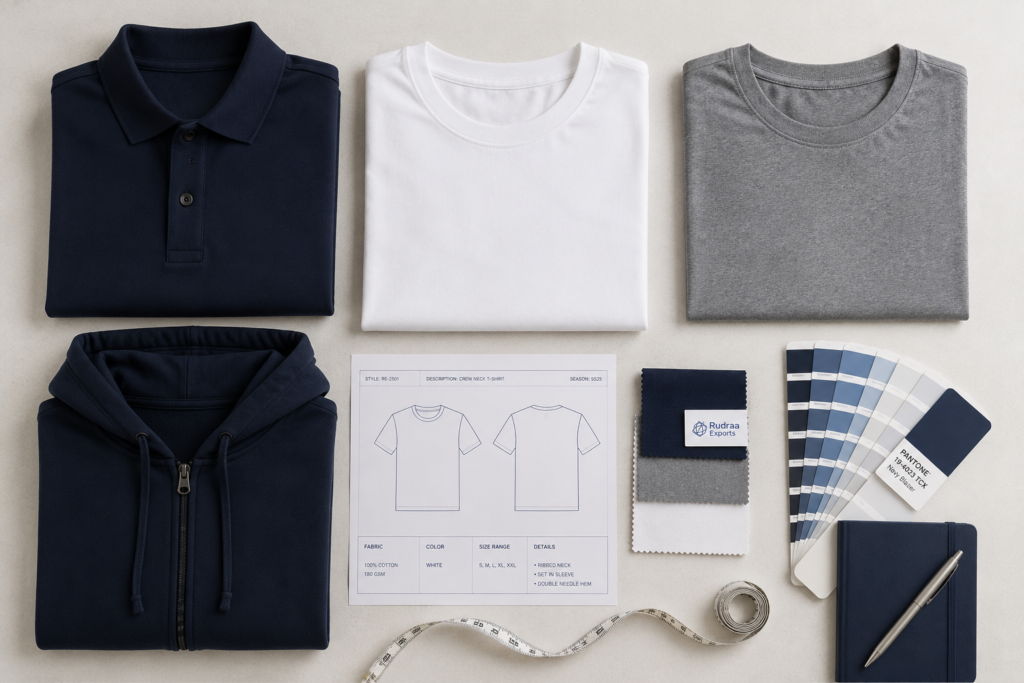
Germany is one of Europe’s most important apparel import markets. For German fashion brands, workwear labels, DTC brands, corporate apparel buyers, and retail procurement teams, sourcing is not only about price. It is about quality discipline, EU compliance, chemical safety, packaging accuracy, reliable delivery, and supplier accountability.
This is why many German buyers are looking at India, especially Tirupur, for knitwear sourcing. Tirupur is one of India’s strongest knitwear manufacturing clusters, built around T-shirts, polos, sweatshirts, joggers, babywear, kidswear, uniforms, and lightweight fleece programs.
For German buyers, the opportunity is clear: factory-direct sourcing from Tirupur can reduce middlemen, improve cost control, support repeat programs, and create a more flexible sourcing lane outside traditional supplier markets. But success depends on process. German brands need supplier due diligence, REACH-aware documentation, Oeko-Tex decision-making, AQL-based inspections, clear Incoterms, correct HS codes, and realistic shipping timelines to Hamburg or Frankfurt.
At Rudraa Exports, we support German and European buyers with factory-direct knitwear manufacturing from Tirupur, including sampling, production planning, compliance support, quality control, export documentation, and logistics coordination.
Quick Answer
German fashion brands source garments from India by shortlisting export-ready Tirupur manufacturers, verifying compliance and capacity, locking tech packs, approving samples, defining REACH and Oeko-Tex requirements, confirming HS codes and duty, setting AQL inspection rules, planning production calendars, and shipping through sea or air routes to Germany. Tirupur is especially strong for knitwear such as T-shirts, polos, sweatshirts, joggers, kidswear, babywear, uniforms, and private-label basics. Rudraa Exports supports German buyers with factory-direct production, quality control, documentation, and scalable knitwear sourcing from Tirupur.
Planning to source knitwear from India to Germany? Contact Rudraa Exports to request a German buyer sourcing checklist and Tirupur sampling plan.
Why Germany Is a Serious Market for Indian Garment Sourcing
Germany is a mature apparel market with strong retail standards and strict buyer expectations. German buyers often demand:
- Consistent quality
- Accurate sizing
- Clean stitching
- Durable fabric
- Chemical compliance
- Traceable production
- Reliable documentation
- On-time delivery
- Correct packaging
- Clear supplier communication
For India-based suppliers, Germany is not a market where vague promises work. Buyers expect systems.
Tirupur is a strong match for German knitwear buyers because the region has a dense apparel ecosystem covering spinning, knitting, dyeing, printing, embroidery, cutting, sewing, finishing, packing, and export documentation.
Why Tirupur Works for German Knitwear Buyers
Tirupur is especially strong for repeatable knitwear production.
Tirupur Advantages for German Buyers
| Tirupur Strength | German Buyer Benefit |
|---|---|
| Knitwear specialization | Strong fit for T-shirts, polos, sweatshirts, joggers |
| Fabric ecosystem | Faster GSM and fabric development |
| Dyeing and processing support | Better shade and shrinkage control |
| Printing and embroidery access | Faster logo and artwork execution |
| Skilled workforce | Repeatable stitching quality |
| Export documentation experience | Smoother Germany-bound shipments |
| Sustainability infrastructure | Supports EU buyer expectations |
| Factory-direct sourcing | Reduces middlemen and improves accountability |
German brands should not treat India as one generic sourcing country. For knitwear, Tirupur is one of the most relevant clusters.
Best Product Categories for Germany from Tirupur
Tirupur is strongest in cotton-rich and knitwear categories.
| Product Category | Fit for Tirupur |
| Basic T-shirts | Very strong |
| Oversized T-shirts | Strong |
| Polo shirts | Very strong |
| Sweatshirts | Strong |
| Hoodies | Strong |
| Joggers | Strong |
| Lightweight fleece | Strong |
| Babywear | Strong |
| Kidswear | Strong |
| Corporate uniforms | Strong |
| School uniforms | Strong |
| Athleisure basics | Strong |
| Denim | Not core |
| Structured woven jackets | Not core |
| Tailored garments | Not core |
German buyers should start with the categories Tirupur handles best instead of forcing unrelated products into the wrong cluster.
Step 1: Supplier Discovery
The first step is shortlisting the right supplier.
German buyers should check product DNA first. A supplier that is good at woven shirts may not be the best supplier for cotton jersey T-shirts. A supplier that makes promotional T-shirts may not be ready for premium oversized streetwear.
Supplier Discovery Checklist
| What to Check | Why It Matters |
| Product category strength | Confirms real manufacturing fit |
| Monthly capacity | Ensures production availability |
| Sampling support | Helps early product development |
| Fabric sourcing ability | Supports GSM, composition, and handfeel |
| Compliance experience | Reduces EU onboarding risk |
| Export documentation | Supports German customs clearance |
| Quality process | Prevents bulk defects |
| Communication style | Reduces delays and misunderstandings |
What to Ask Before Sampling
- Do you make this product category regularly?
- What fabric options can you source?
- What is your monthly capacity?
- What are your MOQs?
- What certifications can you support?
- Can you share recent test report examples?
- What is your sampling timeline?
- Do you support FOB and CIF?
- Can you prepare export documentation for Germany?
Do not start sampling before basic feasibility is clear.
Step 2: Supplier Audit and Due Diligence
German procurement teams should verify systems, not just samples.
A nice sample is not enough. The supplier must be able to repeat that quality in bulk.
Audit Areas
| Audit Area | What to Verify |
| Incoming fabric control | GSM, shade, shrinkage, defects |
| Chemical control | Dyes, inks, trims, restricted substances |
| Needle policy | Safety and production discipline |
| Metal detection | Required for certain buyer programs |
| Inline QC | Defect control during production |
| Final QC | Shipment-level inspection |
| Subcontracting control | Avoids hidden supplier risk |
| Traceability | Tracks fabric, trims, production batches |
| Corrective actions | Shows improvement system |
German buyers should ask for a corrective-action plan before placing bulk orders if gaps are found.
Step 3: Sampling and Product Development
Sampling should be treated like a technical development process.
Recommended Sampling Flow
| Stage | Purpose |
| Fabric swatch | Confirms material, GSM, handfeel |
| Lab dip | Confirms colour |
| Proto sample | Tests first construction |
| Fit sample | Confirms measurements and fit |
| Size set | Confirms grading across sizes |
| Print / embroidery strike-off | Confirms branding execution |
| Pre-production sample | Final approval before bulk |
| TOP sample | First output from production line |
German buyers should avoid changing specifications after pre-production approval. Late changes increase cost, lead time, and defect risk.
Step 4: Build the EU Compliance Matrix
German buyers must consider EU compliance early.
Key Compliance Areas
| Compliance Area | What to Check |
| REACH | Restricted substances in fabric, dyes, prints, trims |
| Oeko-Tex | Product safety assurance where required |
| GOTS | Organic cotton chain-of-custody where organic claims are made |
| BSCI / SMETA | Social compliance evidence |
| Fiber labelling | Accurate composition |
| Care labelling | Correct washing and care symbols |
| Origin marking | Correct country-of-origin information |
| Packaging | Polybag, recycling, warning labels where needed |
| CSRD data readiness | Supplier information for ESG reporting |
A German buyer should create a compliance annex and attach it to the purchase order.
Step 5: Oeko-Tex, REACH, and Chemical Safety
German buyers are especially sensitive to chemical compliance.
REACH-Aware Risk Areas
| Component | Risk |
| Dyed fabric | Restricted dyes and chemical residues |
| Prints | Heavy metals, phthalates, restricted substances |
| Heat transfers | Adhesive and film chemistry |
| Metal trims | Nickel, lead, cadmium |
| Elastics | Chemical additives |
| Performance finishes | Restricted chemistry |
| Labels | Ink and substrate safety |
If the buyer requires Oeko-Tex, ask whether the certificate applies to fabric, component, or finished garment. Do not rely only on a logo. Verify scope and validity.
Step 6: Commercials, Incoterms, and Duties
German buyers should define commercial terms clearly before bulk order.
Commercial Terms to Confirm
| Area | What to Define |
| Incoterm | FOB, CIF, FCA, DAP, DDP |
| Payment terms | Deposit, balance, LC, milestone terms |
| MOQ | Per style, colour, and fabric |
| Quantity tolerance | Plus/minus percentage allowed |
| Rework responsibility | Who pays if inspection fails |
| Retesting cost | Who pays if test fails |
| Delivery window | Ex-factory and shipment dates |
| Claim window | Time allowed for defect claims |
Duty and HS Code
The uploaded source notes that German buyers should confirm HS codes and EU duty in TARIC, and gives HS 61091000 as an example where MFN duty can be a significant landed-cost factor.
Final classification should always be confirmed with a customs broker.
Step 7: Production Planning in Tirupur
A clear calendar prevents delays.
Production Calendar Gates
| Gate | Required Before Moving Forward |
| Fabric booking | Tech pack and fabric approval |
| Bulk dyeing | Lab dip and colour approval |
| Bulk cutting | Fabric test and shade approval |
| Printing / embroidery | Strike-off approval |
| Sewing | PP sample approval |
| Packing | Final inspection plan |
| Shipping | Document review and booking confirmation |
German buyers should request weekly WIP reports with photos and red/amber/green status.
Step 8: AQL Quality Control for German Buyers
German buyers often have strict quality expectations.
AQL inspection gives both buyer and factory a common language.
Common AQL Planning
| Defect Type | Common AQL Approach |
| Critical defects | 0 tolerance |
| Major defects | AQL 1.5 or 2.5 depending on buyer risk |
| Minor defects | AQL 4.0 commonly used |
| Measurement defects | Based on tolerance table |
| Shade defects | Based on approved shade band |
| Packing defects | Based on carton and label accuracy |
QC Layers
- Fabric inspection
- Shade band approval
- Inline inspection
- Mid-line inspection
- Final AQL inspection
- Measurement audit
- Packing inspection
- Carton marking check
A final inspection alone is not enough. German buyers should use multi-layer QC.
Step 9: Packaging and Labelling for Germany
Packaging and labelling mistakes can delay clearance or create retail problems.
Packaging and Labelling Checklist
| Item | What to Confirm |
| Fiber label | Accurate composition |
| Care label | Correct care instructions |
| Size label | Correct EU sizing |
| Country of origin | Correct origin marking |
| Polybag | Correct size and warning if needed |
| Barcode | Matches SKU and carton |
| Carton marking | Matches packing list |
| Carton weight | Within handling limits |
| Retail packaging | Matches buyer spec |
| Sustainability claim | Supported by documentation |
German buyers should attach packaging and label artwork files to the tech pack.
Step 10: Shipping to Germany
Most Germany-bound knitwear shipments move by sea to Hamburg or by air to Frankfurt for urgent orders.
The uploaded source gives a practical planning range of about 28–40 days port-to-port from South India to Hamburg, while air freight to Frankfurt can be planned faster depending on route and handling.
Shipping Options
| Route | Best For |
| Sea freight to Hamburg | Bulk orders and planned replenishment |
| Air freight to Frankfurt | Urgent launches and top-up stock |
| Split shipment | One urgent colourway by air, bulk by sea |
| FOB | Buyer controls freight |
| CIF | Supplier includes freight to destination port |
| DAP / DDP | Useful but needs careful importer/tax setup |
Shipment Documents
- Commercial invoice
- Packing list
- HS code sheet
- Certificate of origin where required
- Bill of Lading or Air Waybill
- Test reports if required
- Compliance certificates
- Buyer declarations
- Carton packing details
Clean documents reduce customs delays.
Why Rudraa Exports
Rudraa Exports is positioned for German brands that need factory-direct Tirupur knitwear manufacturing with compliance-ready production support.
Manufacturing Capabilities
- Factory-direct Tirupur knitwear manufacturing
- 72,000+ units per month production capacity
- T-shirts, polos, sweatshirts, hoodies, joggers, babywear, kidswear, uniforms, activewear, and private-label knitwear
- MOQ discussions starting from around 300 pieces for suitable programs
- Sampling support for German and European buyers
- Bulk production planning for repeat programs
Germany and EU Buyer Support
- REACH-aware material and test planning
- Oeko-Tex, GOTS, BSCI, SMETA, WRAP, AEO, and related requirement support where applicable
- ISO 9001:2015 certified manufacturing approach
- AQL 2.5 inspection standards
- Fabric, GSM, shade, measurement, shrinkage, print, embroidery, trims, label, and packing controls
- Export documentation support for Germany-bound shipments
- Support for FOB, CIF, DAP, and buyer-nominated forwarders
Buyer Advantages
- Factory-direct pricing without trading-company markups
- Up to 40% cost-saving positioning compared with indirect sourcing models
- English-language communication for German buyers
- Export support through Chennai, Tuticorin, and Cochin
- Shipment planning to Hamburg and Frankfurt
- Clearer compliance and documentation workflow
Ready to source knitwear from Tirupur to Germany? Speak with Rudraa Exports to request a German buyer information pack, sampling calendar, and compliance checklist.
10-Point Pre-Order Checklist for German Buyers
| # | Checklist Item |
| 1 | Final tech pack locked |
| 2 | Fabric, GSM, colour, and artwork approved |
| 3 | REACH-aware test plan defined |
| 4 | Oeko-Tex requirement confirmed |
| 5 | Supplier audit and CAP closed |
| 6 | HS code and duty checked in TARIC |
| 7 | Incoterm and payment terms agreed |
| 8 | AQL inspection plan confirmed |
| 9 | Packaging and labelling specs attached |
| 10 | Shipping route and document set confirmed |
FAQ: German Fashion Brands Sourcing from India
1. Is India a good sourcing country for German fashion brands?
Yes. India is a strong sourcing option for German brands, especially for knitwear, cotton basics, T-shirts, polos, sweatshirts, kidswear, babywear, uniforms, and private-label apparel.
2. Why is Tirupur suitable for German buyers?
Tirupur is suitable because it has a dense knitwear manufacturing ecosystem covering fabric, dyeing, stitching, printing, embroidery, finishing, packing, and export documentation.
3. What products should German brands source from Tirupur?
German buyers should focus on T-shirts, polos, hoodies, sweatshirts, joggers, babywear, kidswear, uniforms, athleisure basics, and other knitwear categories.
4. What compliance documents are important for Germany?
Important documents include REACH/RSL test reports, Oeko-Tex evidence where required, GOTS certificates for organic claims, BSCI or SMETA audit evidence, fiber composition records, and shipment documents.
5. What is AQL inspection?
AQL is a sampling-based inspection method used to decide whether a production lot is acceptable. German buyers often use strict AQL standards for major and minor defects.
6. How long does shipping from India to Germany take?
Sea freight from South India to Hamburg can be planned around 28–40 days port-to-port depending on routing and conditions, while air freight to Frankfurt is faster but more expensive.
7. Should German buyers choose FOB or CIF?
FOB is useful when the buyer wants control over freight and carrier selection. CIF may be useful when the buyer wants the supplier to include freight to the destination port.
8. What is the safest first order strategy?
Start with a controlled pilot using a small number of knitwear SKUs, limited colours, clear fabric specs, defined compliance requirements, and AQL inspection before scaling.
9. Does Rudraa Exports support German buyers?
Yes. Rudraa supports German buyers with Tirupur factory-direct knitwear manufacturing, sampling, quality control, compliance documentation, export documents, and shipment planning.
10. Why choose Rudraa Exports for Germany sourcing?
Rudraa is suitable for German brands that need factory-direct communication, flexible MOQs, Tirupur knitwear expertise, REACH-aware documentation, AQL inspection, and export support to Germany.
Conclusion
German fashion brands need more than a low-cost supplier. They need a factory-direct sourcing partner that understands quality discipline, EU compliance, packaging accuracy, AQL inspection, documentation, and realistic shipping timelines.
Tirupur is a strong sourcing hub for German knitwear buyers because it offers fabric access, skilled production, export experience, and category strength in T-shirts, polos, sweatshirts, joggers, babywear, kidswear, uniforms, and private-label basics.
The safest approach is to shortlist the right factory, verify systems, lock the tech pack, define REACH and Oeko-Tex requirements, confirm HS code and duty, plan AQL inspections, and ship with clean documentation.
Visit rudraaexports.com or contact our team directly to share your product category, MOQ, German destination market, compliance requirements, and launch timeline — and receive a factory-direct Tirupur sourcing plan from Rudraa Exports.
Related reading
Garment Manufacturers India for European Brands: Complete Sourcing Guide 2026
India–EU Free Trade Agreement 2026: What European Brands Sourcing Garments Need to Know
How to Import T-Shirts from Tirupur, India to Europe in 2026