
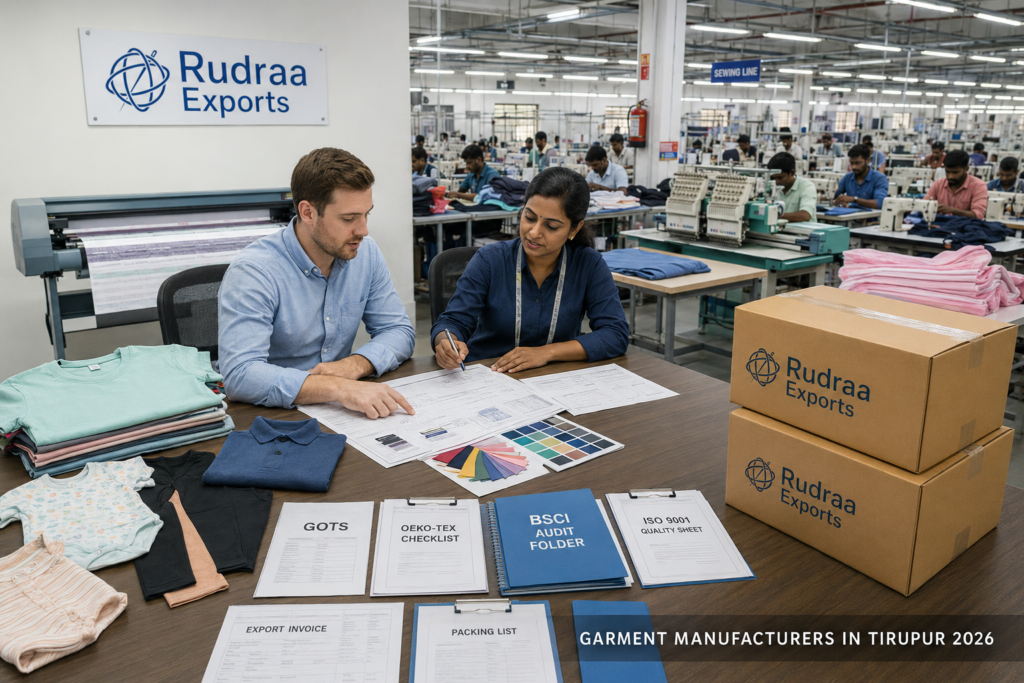
If you are searching for garment manufacturers in Tirupur India, you are already looking at one of the strongest knitwear sourcing hubs in Asia. Tirupur, located in Tamil Nadu, is widely known as India’s knitwear capital because the city has built a dense manufacturing ecosystem around T-shirts, polos, babywear, leggings, activewear, sweatshirts, joggers, and export-ready cotton knitwear.
For overseas buyers, Tirupur is not just another factory location. It is a complete apparel production cluster where spinning, knitting, dyeing, printing, embroidery, stitching, finishing, packing, and export support are available within the same region. That matters because garment sourcing is not only about whether a supplier can make a product. The real question is whether the supplier can make it repeatedly, consistently, compliantly, and on time.
Many overseas brands make the same mistake when sourcing from India: they compare only FOB price. That is too shallow. A cheaper garment is not actually cheaper if it creates shade variation, shrinkage issues, late delivery, wrong documentation, failed chemical testing, or customer complaints. The right Tirupur garment manufacturer should reduce risk, not just reduce unit cost.
At Rudraa Exports, we support overseas brands looking for factory-direct OEM and ODM knitwear manufacturing from Tirupur with structured sampling, fabric sourcing, quality control, compliance support, export documentation, and scalable production planning.
Quick Answer
Tirupur is one of the best places to source knitwear from India because it has a vertically integrated apparel ecosystem covering fabric, dyeing, printing, stitching, finishing, packing, and export documentation. Overseas brands should choose garment manufacturers in Tirupur based on product category expertise, certification readiness, MOQ flexibility, OEM/ODM capability, quality systems, export experience, and communication discipline. Rudraa Exports is positioned as a factory-direct Tirupur knitwear manufacturer for buyers who want T-shirts, polos, babywear, leggings, activewear, corporate apparel, and private-label garments with scalable production and export-ready support.
Planning to source garments from Tirupur? Contact Rudraa Exports to share your tech pack, target MOQ, product category, fabric requirement, and destination market.
Why Tirupur Matters for Overseas Knitwear Buyers
Tirupur became a major knitwear export hub because it has something many sourcing locations do not have: concentration. The region has a deep network of yarn suppliers, knitting units, dyeing houses, printing vendors, embroidery units, stitching factories, finishing teams, packing facilities, freight forwarders, and export service providers.
That density gives buyers a real advantage.
When fabric, dyeing, stitching, printing, and packing are all handled within the same industrial ecosystem, the buyer gets better control over timelines and fewer handoff delays. In a fragmented supply chain, fabric may be sourced from one region, dyed somewhere else, stitched elsewhere, and printed by another vendor. Every handoff creates risk. Tirupur reduces that risk because the production chain is closer and more coordinated.
Tirupur Cluster Advantage
| Tirupur Strength | Buyer Benefit |
|---|---|
| Knitwear specialization | Strong fit for T-shirts, polos, leggings, babywear, and activewear |
| Local fabric ecosystem | Faster fabric sourcing and GSM matching |
| Dyeing and processing support | Better shade control and shorter approval loops |
| Printing and embroidery access | Easier customization and logo development |
| Skilled workforce | Better repeatability in bulk production |
| Export documentation experience | Smoother international shipment handling |
| Sustainability infrastructure | Stronger ESG and buyer-compliance positioning |
For overseas brands, this means Tirupur is not only useful for cheap production. It is useful for repeatable production.
What Products Are Tirupur Garment Manufacturers Strongest In?
Tirupur is strongest in knitwear. That is the simple answer.
If your product category is woven jackets, denim jeans, structured suits, or luxury tailoring, Tirupur may not be the first place to start. But if your brand focuses on knitwear, Tirupur should be on your shortlist.
Core Product Categories
| Product Category | Tirupur Fit |
| Round-neck T-shirts | Very strong |
| Polo shirts | Very strong |
| Corporate T-shirts | Very strong |
| Babywear | Strong |
| Kidswear | Strong |
| Leggings | Strong |
| Joggers | Strong |
| Sweatshirts and hoodies | Strong |
| Activewear | Strong |
| Sportswear | Strong |
| Private-label basics | Very strong |
| Promotional apparel | Very strong |
This is where many buyers need to be honest. Do not choose a factory only because it says “we make all garments.” Choose a supplier whose production strength matches your product category.
Why the Right Manufacturer Matters More Than the Cheapest Supplier
A low quote can be tempting, especially for new brands. But garment manufacturing failures usually cost more than the savings.
A weak supplier can create:
- Wrong GSM
- Poor shrinkage control
- Fabric shade mismatch
- Low-quality stitching
- Print cracking
- Embroidery puckering
- Late sampling
- Poor size grading
- Weak packing control
- Missing labels
- Wrong export documents
- Failed compliance checks
- Unclear communication
Overseas buyers should look for a system, not just a supplier.
A proper Tirupur garment manufacturer should be able to explain:
- How samples are developed
- How fabric is sourced
- How shrinkage is checked
- How colour approval works
- How inline inspection is done
- How AQL final inspection works
- How packing is controlled
- How export documents are prepared
- How compliance evidence is managed
If a factory cannot explain its process clearly, it is not ready for serious export buyers.
What Overseas Brands Should Look For in Tirupur Garment Manufacturers
When shortlisting garment manufacturers in Tirupur India, buyers should evaluate five major areas: product capability, quality systems, certification readiness, communication, and export support.
Supplier Evaluation Table
| Evaluation Area | What to Check | Why It Matters |
| Product expertise | Similar products made before | Reduces development mistakes |
| Factory ownership | Direct factory or trader | Improves accountability |
| Production capacity | Monthly capacity and line availability | Prevents delivery failure |
| MOQ flexibility | Per style, colour, and fabric | Helps startups and growing brands |
| Sampling process | Fit sample, size set, PP sample | Prevents bulk mistakes |
| Quality control | Inline, end-line, final inspection | Reduces defects |
| Certifications | GOTS, OEKO-TEX, BSCI, ISO 9001 | Supports buyer compliance |
| Export documentation | Invoice, packing list, origin documents | Reduces customs delays |
| Communication | Single point of contact and update rhythm | Prevents confusion |
| Traceability | Fabric lots, production batches, inspection records | Helps resolve issues quickly |
The biggest mistake is choosing a supplier based only on price and WhatsApp speed. Fast replies do not mean strong production systems.
Certifications Overseas Buyers Should Ask For
Certifications are not just marketing badges. They are proof points that help procurement teams, compliance teams, and international buyers reduce risk.
But buyers must understand what each certification actually proves.
Certification Comparison
| Certification / Standard | What It Helps Prove | What Buyers Must Still Check |
| GOTS | Organic textile chain-of-custody and processing controls | Scope certificate, transaction certificate, product eligibility |
| OEKO-TEX STANDARD 100 | Product chemical safety | Whether fabric, prints, labels, and trims are covered |
| amfori BSCI | Social compliance and worker welfare framework | Audit result, CAP status, factory scope |
| ISO 9001:2015 | Quality management system | Actual inspection records and production controls |
| WRAP | Responsible apparel production | Facility scope and certification validity |
| SMETA | Ethical trade audit evidence | Latest audit report and corrective actions |
| GRS | Recycled material chain-of-custody | Transaction certificates and material percentage |
A certificate is useful only if it is valid, relevant, and tied to the actual factory making your goods.
What to Verify
Before trusting any certification, ask for:
- Certificate number
- Legal entity name
- Site address
- Validity date
- Scope of certification
- Certification body
- Product/process coverage
- Latest audit summary where relevant
- Corrective action status where relevant
Do not accept certification logos pasted into a PDF without checking scope and validity.
OEM vs ODM: Which Model Should Overseas Brands Choose?
When working with garment manufacturers in Tirupur, you will usually hear two terms: OEM and ODM.
OEM Garment Manufacturing
OEM means Original Equipment Manufacturing. In this model, you provide the complete product specification, and the factory manufactures according to your tech pack.
OEM is best if you already have:
- Tech pack
- Measurement chart
- Fabric specification
- Artwork
- Branding details
- Packaging instructions
- Label files
- Fit reference
- Compliance requirements
ODM Garment Manufacturing
ODM means Original Design Manufacturing. In this model, the factory supports product development more actively. It may suggest fabric, fit, GSM, trims, finishing, construction, or sample direction.
ODM is useful if you are:
- A startup brand
- Testing a new product category
- Unsure about fabric selection
- Looking for construction guidance
- Building a private-label range
- Developing corporate or promotional apparel
- Creating a knitwear capsule collection
OEM vs ODM Comparison
| Factor | OEM | ODM |
| Buyer input | Complete tech pack | Product idea or reference |
| Factory role | Manufacture to spec | Support development and manufacturing |
| Best for | Established brands | Startups and new product lines |
| Speed | Faster if specs are clear | May take longer due to development |
| Control | Higher buyer control | Shared development input |
| Risk | Depends on tech pack quality | Depends on factory development capability |
If your team has strong product development, choose OEM. If you need guidance, choose ODM support.
MOQ Expectations in Tirupur
MOQ depends on fabric, colour, style, GSM, print method, trims, and customization.
A simple cotton T-shirt using standard fabric may have a lower MOQ than a custom-dyed organic cotton polo with embroidery, special labels, and retail packaging.
MOQ Drivers
| MOQ Factor | Why It Affects Quantity |
| Fabric type | Custom fabric or organic cotton may require higher minimums |
| Colour count | Each colour may need separate dyeing and cutting |
| GSM | Non-standard GSM may require special sourcing |
| Print method | Screen printing, DTG, DTF, embroidery all have different setup costs |
| Trims | Custom labels, buttons, elastics, tags may have vendor MOQs |
| Product complexity | Hoodies and polos are more complex than basic tees |
| Packing | Custom packaging can increase minimums |
For new buyers, the smart approach is to start with fewer styles, fewer colours, and one core fabric. Do not start with ten styles and six colours unless you have the budget and operational discipline to manage it.
RFQ Template for Overseas Buyers
To get an accurate quote from a Tirupur garment manufacturer, send a structured RFQ instead of a vague message.
RFQ Checklist
| Field | Example |
| Product | Men’s crew-neck T-shirt |
| Fabric | 100% combed cotton single jersey |
| GSM | 180 GSM |
| Colour | Black and white |
| Water-based chest print | |
| Quantity | 1,000 pieces |
| Size range | S–XXL |
| Labels | Main label, size label, care label |
| Packing | Individual polybag, size sticker, export carton |
| Destination | Germany / UK / USA / UAE |
| Incoterm | FOB / CIF / DAP |
| Certification | OEKO-TEX required, BSCI preferred |
| Timeline | Required ex-factory date |
This level of detail prevents fake low quotes. A vague RFQ gives vague pricing.
Sampling Process for Tirupur Garment Manufacturing
Sampling is the stage where buyers prevent bulk mistakes.
A serious manufacturer should not push directly from reference image to bulk order. That is reckless.
Recommended Sampling Ladder
| Sample Type | Purpose |
| Fabric swatch | Confirms fabric, GSM, and handfeel |
| Lab dip | Confirms colour |
| Fit sample | Confirms silhouette and measurements |
| Size set sample | Confirms grading across sizes |
| Print / embroidery strike-off | Confirms branding execution |
| Pre-production sample | Final approved sample before bulk |
| TOP sample | First pieces from production line |
For overseas buyers, the pre-production sample should become the approved reference for bulk production. This avoids arguments later over fit, colour, stitching, or finishing.
Quality Control Process Buyers Should Expect
Quality control should happen before, during, and after production.
Do not rely only on final inspection.
Quality Control Workflow
| QC Stage | What It Checks |
| Incoming fabric inspection | GSM, shade, fabric defects, shrinkage risk |
| Trims inspection | Labels, thread, buttons, elastics, tags |
| Cutting inspection | Marker, size ratio, fabric defects |
| Inline inspection | Stitching, measurements, print placement |
| End-line inspection | Finishing, appearance, loose threads |
| Final AQL inspection | Shipment-level pass/fail decision |
| Packing inspection | Carton count, size ratio, labels, barcodes |
AQL inspection is important for export buyers because it creates measurable quality control. Instead of saying “quality looks good,” the buyer and factory agree on defect limits before shipment.
Why Traceability Matters
Traceability helps identify what went wrong if there is a problem.
If a garment has shade variation, you need to know which dye lot was used. If shrinkage is high, you need to know which fabric lot was used. If a print fails, you need to know which print batch and ink system were used.
Traceability Should Cover
- Fabric lot
- Dye lot
- Print batch
- Trim supplier
- Production date
- Line number
- QC records
- Packing carton
- Shipment batch
For overseas brands, traceability is not only about sustainability claims. It is also about problem-solving.
Export Documentation Buyers Should Expect
A Tirupur garment manufacturer working with overseas buyers should understand export documents.
Common documents include:
- Commercial invoice
- Packing list
- Bill of Lading or Air Waybill
- Shipping bill / export declaration
- Certificate of origin where required
- Inspection report
- Test reports if applicable
- Insurance certificate if applicable
- Buyer-specific compliance declarations
Before shipment, buyers should ask for draft documents. This prevents basic errors in HS code, invoice value, consignee details, carton count, and product description.
Shipping and Incoterms
Before confirming an order, buyers should agree on Incoterms.
Common Incoterms
| Incoterm | Meaning | Best For |
| FOB | Supplier delivers goods to port/on-board vessel | Experienced importers |
| CIF | Supplier includes freight and insurance to destination port | Buyers wanting freight included |
| DAP | Supplier delivers to named place, duties unpaid | Buyers wanting simpler delivery |
| DDP | Supplier delivers duty-paid | Buyers wanting maximum logistics support |
FOB is often clean for cost comparison. CIF and DAP can be easier for newer buyers. DDP should be used carefully because duty, tax, and importer responsibility must be clear.
Why Rudraa Exports
Rudraa Exports is positioned for overseas brands that need a factory-direct OEM/ODM knitwear partner from Tirupur.
Manufacturing Capabilities
- Factory-direct Tirupur T-shirt and knitwear manufacturing
- 72,000+ units per month production capacity
- T-shirts, polo shirts, sweatshirts, hoodies, joggers, leggings, babywear, kidswear, activewear, corporate apparel, and private-label knitwear
- MOQs starting from around 300 pieces per style, depending on fabric, colour, logo method, and customization
- OEM support for tech-pack-driven production
- ODM support for fabric, fit, trims, and development guidance
Quality and Compliance
- ISO 9001:2015 certified manufacturing approach
- AQL 2.5 inspection standards
- Support for buyer-defined GSM, shrinkage limits, Pantone references, measurement tolerances, print/embroidery specs, and packing rules
- Certification-aligned sourcing support for GOTS, OEKO-TEX, BSCI, WRAP, SMETA, GRS, and related buyer standards where applicable
- Traceability support across fabric lots, production batches, samples, inspection records, and packing lists
International Buyer Advantages
- Factory-direct pricing without trading-company markups
- Up to 40% cost-saving positioning compared with indirect sourcing models
- English-language communication for overseas buyers
- Export support for USA, UK, EU, Australia, and Middle East markets
- Multi-port shipping through Chennai, Tuticorin, and Cochin
- Support for export documentation, shipment planning, and buyer-nominated freight forwarders
Ready to shortlist a factory-direct Tirupur garment manufacturer? Speak with Rudraa Exports for a structured quote, sampling plan, MOQ discussion, and export-ready production roadmap.
10-Point New Buyer Start Kit
Use this checklist before approaching garment manufacturers in Tirupur India.
| # | Checklist Item |
| 1 | Define product category, fabric composition, GSM, colours, and size range |
| 2 | Decide whether you need OEM or ODM support |
| 3 | Set compliance requirements: GOTS, OEKO-TEX, BSCI, ISO 9001, WRAP, or SMETA |
| 4 | Prepare RFQ pack with tech pack, artwork, labels, trims, packing, and quantity |
| 5 | Ask for certification proof with scope and validity |
| 6 | Confirm MOQ by style, colour, fabric, and trim |
| 7 | Lock sampling path: fit, size set, PP sample, TOP sample |
| 8 | Define QC gates: incoming, inline, final AQL, packing inspection |
| 9 | Confirm Incoterm, payment terms, and production calendar |
| 10 | Estimate landed cost with freight, duty, local charges, and inspection costs |
This checklist will save you from the most common sourcing mistakes.
FAQ: Garment Manufacturers in Tirupur India
1. Why is Tirupur famous for garment manufacturing?
Tirupur is famous for knitwear manufacturing, especially T-shirts, polos, babywear, leggings, activewear, and cotton-based export garments. Its strength comes from a dense cluster of fabric, dyeing, stitching, printing, finishing, and export support units.
2. Is Tirupur good for overseas brands?
Yes. Tirupur is suitable for overseas brands because many factories are export-oriented and familiar with sampling, quality control, packing, labeling, compliance documents, and international shipping requirements.
3. What products can Tirupur garment manufacturers make?
Tirupur manufacturers are strongest in knitwear categories such as T-shirts, polo shirts, sweatshirts, hoodies, joggers, leggings, kidswear, babywear, activewear, corporate apparel, and private-label basics.
4. What is the difference between OEM and ODM manufacturing?
OEM means the buyer provides complete specifications and the factory manufactures accordingly. ODM means the factory also helps with product development, fabric suggestions, fit direction, and design support.
5. What certifications should I ask for?
Useful certifications include GOTS for organic textiles, OEKO-TEX for harmful substance testing, BSCI or SMETA for social compliance, WRAP for responsible production, and ISO 9001 for quality management systems.
6. What MOQ should I expect from Tirupur garment manufacturers?
MOQ depends on product type, fabric, colour count, print method, trims, and packaging. Basic styles using standard fabrics may support lower MOQs, while custom fabrics, organic materials, and complex trims usually need higher quantities.
7. How do I get an accurate quote from a Tirupur manufacturer?
Send a complete RFQ with product type, fabric, GSM, measurements, quantity, colour, artwork, labels, packaging, destination country, Incoterm, and compliance requirements. Vague requests create unreliable pricing.
8. How should I verify a Tirupur garment supplier?
Ask for factory details, product samples, certification proof, production capacity, export documents, QC process, recent inspection formats, and references if available. Check whether the supplier is a direct factory or trader.
9. Is factory-direct sourcing better than using a trader?
Factory-direct sourcing gives better pricing transparency, faster communication, stronger production accountability, and fewer handoff errors. Traders may be useful for convenience but often add margin and reduce visibility.
10. What quality checks should I expect?
You should expect fabric inspection, trims inspection, inline inspection, end-line checks, final AQL inspection, measurement audits, packing verification, and shipment document review.
11. Can Rudraa Exports support small and large buyers?
Yes. Rudraa Exports supports startup brands, private-label buyers, corporate programs, and bulk export buyers with MOQ discussions, sampling, production planning, and scalable knitwear manufacturing.
12. Why choose Rudraa Exports?
Rudraa Exports is suitable for buyers who want factory-direct Tirupur knitwear manufacturing, OEM/ODM support, export documentation, AQL-based quality control, traceability, and communication without unnecessary trading-company layers.
Conclusion
Tirupur is one of India’s strongest garment manufacturing hubs for overseas knitwear buyers. But choosing the right supplier requires more than finding the lowest price. Buyers should evaluate product expertise, factory ownership, certifications, sampling discipline, QC systems, traceability, export documentation, and communication quality before placing an order.
The best garment manufacturers in Tirupur India do not simply stitch garments. They help buyers manage product development, quality, compliance, timelines, and export risk.
Visit rudraaexports.com or contact our team directly to share your tech pack, product category, target MOQ, fabric requirement, and destination market — and receive a factory-direct OEM/ODM garment manufacturing plan from Tirupur.
Related reading
School uniform procurement case study: 18 schools, 25,000 units delivered
Rudraa Exports vs Shahi Exports: Factory-Direct Garment Manufacturer Comparison 2026
How to Import T-Shirts from Tirupur, India to Europe in 2026