
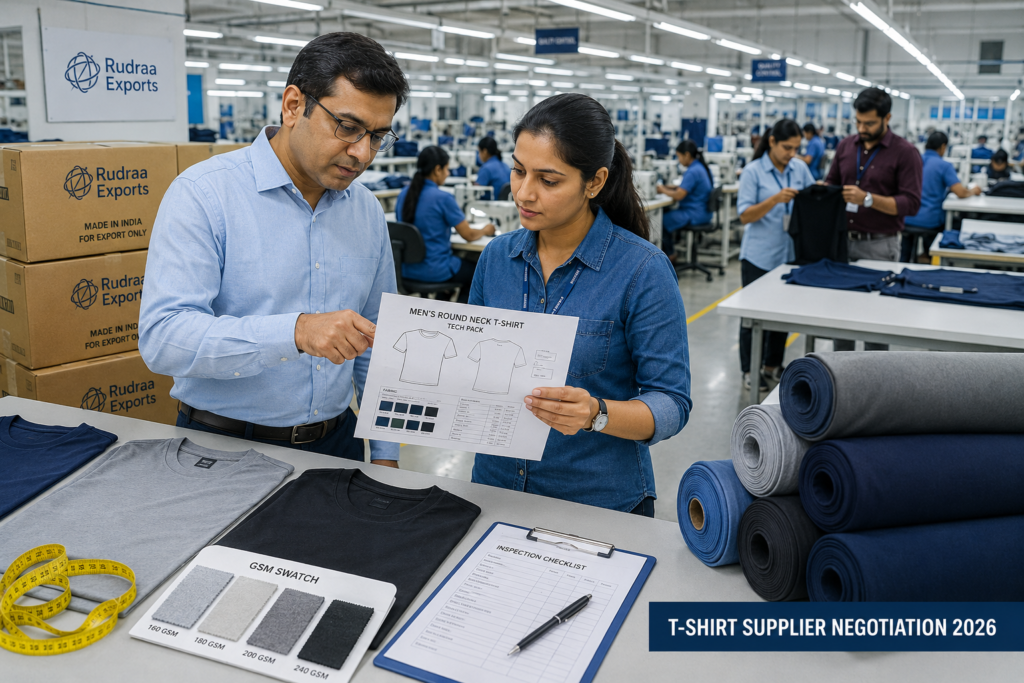
Negotiating with a Tirupur T-shirt supplier in 2026 is not about asking, “Can you reduce the price?” That is amateur buying. Serious procurement teams negotiate the full commercial system: FOB structure, MOQ, yarn volatility, production capacity, quality checkpoints, payment risk, packaging, compliance, and long-term scale-up rights.
Tirupur is one of India’s strongest knitwear and round-neck T-shirt manufacturing clusters, but not every supplier quotes the same way. A factory-direct manufacturer, a buying agent, and a trading company may all offer “180 GSM cotton round-neck T-shirts,” but the final cost, control level, documentation quality, and risk exposure can be completely different.
At Rudraa Exports, we work with international buyers looking for factory-direct Tirupur T-shirt manufacturing, clear communication, export-ready documentation, and practical sourcing support. This guide rewrites the uploaded negotiation playbook into a buyer-ready framework covering price, MOQ, lead time, quality, payment terms, Incoterms, compliance, and supplier control for 2026 sourcing decisions.
Quick Answer
To negotiate with a Tirupur T-shirt supplier in 2026, buyers should negotiate the full deal structure, not only the unit price. Start with FOB terms, fabric GSM, quantity tiers, open-book costing, MOQ per color, lead-time milestones, inspection standards, payment terms, packaging costs, and compliance documentation. For basic men’s cotton round-neck T-shirts, direct factory FOB pricing can vary by volume, fabric, and specification, while agent routes often add margin. The safest negotiation strategy is to lock product specs, quality checkpoints, cost assumptions, and scale-up terms before confirming bulk production.
Need a custom negotiation-ready quote for your T-shirt program? Contact Rudraa Exports to share your tech pack, quantity, GSM, print method, and destination market.
Why Most Buyers Negotiate T-Shirts the Wrong Way
Most buyers make one basic mistake: they negotiate only the final unit price.
That is weak negotiation because the supplier can reduce the visible price and recover margin somewhere else. They may reduce fabric quality, adjust GSM tolerance, use cheaper trims, increase packaging charges, delay sampling, increase MOQ, shorten inspection flexibility, or quote unclear freight terms.
A better buyer negotiates the price architecture.
That means asking:
- What fabric basis is used?
- What GSM tolerance is included?
- Is the quote FOB, CIF, CFR, or DDP?
- Which port is used?
- Are trims and labels included?
- Is testing included?
- What is the MOQ per color?
- What is the sample timeline?
- What happens if the inspection fails?
- What payment term protects both sides?
- What happens if yarn prices move?
- Is pricing locked for future orders?
If these details are not locked, the “low price” is not real. It is just an incomplete quote.
FOB, CIF, DDP: Start with the Right Price Structure
Before negotiating unit price, decide the Incoterm. This matters because many cost disputes happen when buyers compare FOB from one supplier with CIF or DDP from another supplier.
Most direct factories in Tirupur commonly quote FOB through ports such as Tuticorin VOC Port or Chennai. Agents may offer CIF or DDP with freight and margin embedded. That can look convenient, but it often hides the real factory cost.
| Term | What It Means | Best For | Buyer Risk |
|---|---|---|---|
| FOB | Supplier delivers goods to port/on-board vessel | Buyers controlling freight | Buyer manages freight and destination charges |
| CIF | Supplier includes cost, insurance, and freight | Buyers wanting freight included | Freight margin may be hidden |
| DDP | Supplier delivers duty-paid to destination | Buyers wanting door delivery | Highest hidden-cost risk |
| Ex-Factory | Buyer collects from factory | Advanced buyers with local logistics | Buyer handles export process |
For serious sourcing, FOB is usually the cleanest comparison point. It lets buyers compare factory cost without confusing it with freight, duties, destination handling, or agent markup.
A strong RFQ should say:
“Please quote FOB Tuticorin VOC Port or Chennai Port, Incoterms 2020, with shipment window, carton details, and documentation included.”
Negotiate the Cost Sheet, Not Just the Unit Price
A T-shirt price is built from multiple cost elements. If the supplier gives only a single number, you do not know what you are actually negotiating.
Ask for an open-book or semi-open cost sheet.
| Cost Component | What Buyers Should Ask |
|---|---|
| Fabric | Yarn count, cotton type, GSM, knitting, dyeing, wastage |
| CM cost | Cutting, sewing, finishing, labor, overhead |
| Trims | Neck labels, care labels, size labels, thread, tape |
| Printing | Screen print, DTF, DTG, embroidery, discharge print |
| Washing / finishing | Compacting, bio-wash, softener, enzyme wash |
| Testing | Shrinkage, colorfastness, GSM, chemical testing |
| Packing | Polybag, barcode, carton, hangtag, carton marking |
| Export documentation | Invoice, packing list, BL, certificate of origin |
This approach prevents the supplier from saying “price increased” without explaining why.
The uploaded negotiation guide also highlights yarn volatility as a major driver of FOB price, especially for cotton T-shirts. Buyers should negotiate a yarn-index or pass-through clause if pricing needs to be valid over a longer production season.
Volume-Based Pricing: How to Negotiate Better Tiers
T-shirt pricing improves when quantity increases. But buyers must define whether the volume tier applies by total order quantity, per style, per color, or cumulative seasonal volume.
This is where many buyers get trapped.
A supplier may say:
“5,000 pieces price is lower.”
But later they may clarify:
“That is 300 pieces per color.”
That changes the deal completely.
Ask the supplier to quote a tier grid.
| Quantity | Buyer Should Ask For |
|---|---|
| 500 pcs | Pilot order price |
| 1,000 pcs | Small bulk price |
| 5,000 pcs | Commercial order price |
| 10,000 pcs | Scale price |
| 20,000 pcs | High-volume price |
The uploaded source notes a practical observed pattern of small unit reductions as order volume rises for basic cotton tees, but buyers should validate this against current fabric cost, GSM, print method, and order structure.
A smart clause is:
“Tiered pricing should apply to cumulative shipped quantities across purchase orders within 6 or 12 months, with rebates credited quarterly.”
That gives the buyer scale benefits even if orders are split across multiple shipments.
Factory-Direct vs Agent Route: What Changes in Negotiation?
Factory-direct sourcing and agent sourcing are not the same. An agent may help manage sourcing, but the buyer usually pays through commission, margin, or bundled pricing.
| Factor | Factory-Direct Supplier | Buying Agent / Trading Route |
|---|---|---|
| Pricing transparency | Higher potential | Often margin-embedded |
| Communication | Direct with production team | Buyer → agent → factory |
| MOQ flexibility | Depends on factory | Sometimes lower through pooling |
| Quality accountability | Easier to trace | Can become diluted |
| Freight terms | Usually FOB-focused | May bundle CIF/DDP |
| Customization control | Stronger if factory is capable | Depends on selected factory |
| Best for | Serious repeat sourcing | Convenience sourcing |
The uploaded guide states that agent routes can carry embedded commission and that the apples-to-apples FOB delta between direct and agent sourcing may be much lower than exaggerated marketing claims. That means buyers should not blindly accept “factory-direct is 40% cheaper” unless they compare the exact same spec, quantity, Incoterm, and compliance requirement.
The honest point: factory-direct sourcing can reduce cost, but only if the buyer controls specs and compares correctly.
MOQ Negotiation: Do Not Ask Only for “Minimum Quantity”
MOQ is not one number. It has layers.
Buyers should negotiate:
| MOQ Type | Meaning |
|---|---|
| Total MOQ | Minimum total pieces per purchase order |
| Style MOQ | Minimum per design/style |
| Color MOQ | Minimum per color |
| Size MOQ | Minimum or practical ratio per size |
| Fabric MOQ | Minimum fabric dyeing/knitting quantity |
| Print MOQ | Minimum for screen setup or print process |
For example, a supplier may accept 1,000 pieces total but require 300 pieces per color. Another supplier may accept 500 pieces total but charge more because fabric and dyeing efficiency is poor.
A good negotiation structure is:
Pilot order + scale-up option.
For example:
- Pilot PO: 500–1,000 pieces
- If quality and delivery KPIs are met, buyer gets locked pricing for a larger follow-up order
- Follow-up window: 6–9 months
- CM cost or tier pricing agreed in advance
This gives the buyer lower risk and gives the supplier a path to larger business.
Lead Time Negotiation: Use a Critical Path, Not a Promise
“45–60 days” is not a production plan. It is a vague estimate.
A professional buyer should ask for a dated critical path.
| Milestone | What to Lock |
|---|---|
| Tech pack confirmation | Final specs, measurements, GSM, fabric |
| Lab dip | Shade approval date |
| Proto sample | First sample date |
| Fit sample | Fit correction timeline |
| PPS | Pre-production sample approval |
| Bulk fabric | Knitting, dyeing, compacting timeline |
| Inline inspection | Inspection date during production |
| Final inspection | AQL inspection before shipment |
| Ex-factory date | Goods ready date |
| On-board date | Vessel/air shipment date |
The uploaded guide emphasizes that lead time should be negotiated as a dated critical path, not a loose statement. This is correct. Without milestone dates, the buyer cannot identify delay early.
A strong clause is:
“If PPS approval is delayed due to supplier-side correction, bulk shipment date must be revised only with buyer approval.”
This prevents suppliers from blaming the buyer for delays caused by factory errors.
Capacity Reservation: Useful for Repeat Buyers
If you plan repeat orders, negotiate capacity reservation. This matters during peak seasons when factories prioritize larger or more profitable customers.
Ask for:
- Monthly sewing capacity
- Current utilization
- Line allocation
- Production calendar
- Peak-season availability
- Reserved capacity based on forecast
A practical structure:
Buyer gives a rolling forecast. Supplier reserves capacity. Buyer commits to a minimum utilization percentage or gives release notice before a deadline.
This is fair to both sides. The supplier cannot hold capacity for free forever, and the buyer cannot expect guaranteed space without commitment.
Quality Negotiation: Lock Inspection Standards Before Production
Quality disputes are expensive because buyers and suppliers often define quality differently. A buyer may reject a garment due to shade variation or measurement tolerance, while the supplier may say it is “commercially acceptable.”
Avoid this by defining objective standards before production.
| Quality Area | What to Specify |
|---|---|
| Fabric inspection | 4-point system or agreed fabric inspection method |
| GSM tolerance | Example: ±5% or buyer-approved range |
| Shrinkage | Washing test standard and acceptable limit |
| Colorfastness | Washing, rubbing, perspiration test requirements |
| Measurement tolerance | POM-wise tolerance table |
| Stitching defects | Major/minor defect classification |
| Print quality | Wash durability, cracking, placement tolerance |
| Final inspection | AQL 2.5 major / 4.0 minor where suitable |
The uploaded playbook recommends fabric inspection, inline inspection, midline inspection, and final random inspection, along with recognized AQL-based acceptance. That is the correct approach for serious T-shirt sourcing.
Payment Terms: Reduce Risk Without Killing Supplier Cash Flow
Payment negotiation is not about forcing the supplier into bad terms. If the supplier has to buy yarn, book fabric, arrange dyeing, and start production, they need working capital.
But buyers also need protection.
Common first-order terms may include:
| Payment Term | Buyer Protection | Supplier Comfort |
|---|---|---|
| 30% advance / 70% against BL | Moderate | Good |
| LC at sight | Strong | Strong if bankable |
| CAD against documents | Moderate | Moderate |
| Open account 30–60 days | Strong for buyer | Risky for supplier |
| Milestone payment | Balanced | Balanced |
A smart structure for early relationship orders:
- Deposit at yarn booking
- Second payment after PPS approval or production start
- Balance against BL after final inspection pass
For mature relationships, buyers may negotiate LC at sight or open account terms, but only after supplier reliability is proven.
Packaging and Private Label Costs: Always Quote Line-by-Line
Packaging can quietly increase landed cost. Do not let it remain vague.
Ask for line-by-line costs for:
- Woven neck label
- Printed neck label
- Care label
- Size label
- Hangtag
- Barcode sticker
- Polybag
- Carton
- Carton print
- Inner packing
- UPC labeling
- Retail-ready folding
The uploaded guide provides typical add-on examples such as woven labels, care labels, polybags, carton print, hangtags, and UPC-related costs. These should be negotiated upfront instead of discovered after sampling.
IP, Overruns, and Surplus Control
For T-shirt buyers, IP risk is not always about complex design theft. Often, the bigger risk is label misuse, unauthorized overruns, factory seconds, rejected goods, or surplus products leaking into local markets.
Your agreement should cover:
✅ No unauthorized production
✅ No resale of rejected goods
✅ No use of buyer labels for other customers
✅ No subcontracting without written approval
✅ Surplus handling rules
✅ Destruction or mutilation evidence for defective branded stock
✅ Ownership of artwork, screens, patterns, and packaging assets
This is especially important for private-label brands and corporate merchandise buyers.
Compliance Requirements by Market
Different destination markets have different compliance needs. Do not ask the supplier vaguely, “Can you export to the USA?” Instead, define the compliance requirement.
| Market | Buyer Should Check |
|---|---|
| USA | Fiber labeling, CPSIA where relevant, restricted substances, carton compliance |
| EU / UK | REACH alignment, fiber labels, due diligence, sustainability claim evidence |
| Australia | Label accuracy, QA tolerance, retailer requirements |
| Middle East | Label language/sticker rules, destination-specific documentation |
| Global retail | SMETA, WRAP, BSCI, OEKO-TEX, GOTS, buyer RSL |
The uploaded guide correctly notes that buyers should verify destination-specific legal requirements from official sources. Do not rely only on supplier verbal confirmation.
Negotiation Sequence Buyers Should Follow
Use this sequence. Do not jump straight to price.
- Share basic product requirement
- Sign NDA if designs or private-label details are sensitive
- Confirm factory profile and compliance documents
- Ask for capacity and production calendar
- Share tech pack and measurement specs
- Request open cost sheet or detailed quote
- Negotiate MOQ and volume tiers
- Lock fabric, GSM, print method, trims, and packaging
- Agree sample stages and approval deadlines
- Confirm AQL, testing, and inspection plan
- Negotiate payment terms
- Confirm Incoterms, port, and documentation
- Add IP, surplus, and subcontracting clauses
- Place pilot PO
- Scale only after quality and delivery KPIs are proven
This is how professional buyers avoid surprises.
Why Rudraa Exports
Rudraa Exports is built for buyers who want factory-direct Tirupur T-shirt sourcing without unnecessary middleman confusion.
Manufacturing Advantages
- Factory-direct Tirupur T-shirt and knitwear manufacturing
- 72,000+ units per month production capacity
- Custom round-neck T-shirts, polos, uniforms, sportswear, and private-label knitwear
- Fabric sourcing, sampling, production, finishing, packing, and export documentation support
- MOQs starting from around 300 pieces per style, depending on product and customization
Quality and Compliance Advantages
- ISO 9001:2015 certified manufacturing approach
- AQL 2.5 inspection standards
- Support for buyer-aligned documentation and compliance requirements
- Certification-aligned sourcing support, including OEKO-TEX, GOTS, GRS, BSCI, SMETA, WRAP, and related buyer standards where applicable
- Practical control over fabric, stitching, finishing, labeling, packing, and export documents
International Buyer Advantages
- Factory-direct pricing without trading-company markups
- Up to 40% cost-saving positioning compared with indirect sourcing models
- English-language communication
- Export support for EU, US, Australia, and Middle East buyers
- Multi-port shipping support through Tuticorin VOC, Chennai, and Cochin
- FTA-eligible documentation support for relevant markets, including UAE CEPA, Australia ECTA, UK-related documentation, and EFTA TEPA readiness
Ready to negotiate your next T-shirt order directly with a Tirupur factory? Speak with the Rudraa Exports team for transparent pricing based on your fabric, GSM, MOQ, print method, and export destination.
FAQ: Negotiating with Tirupur T-Shirt Suppliers
1. What is the best way to negotiate with a Tirupur T-shirt supplier?
The best way is to negotiate the full quote structure, not just the final price. Confirm fabric, GSM, quantity tiers, MOQ per color, print method, packaging, testing, Incoterms, lead time, inspection standards, and payment terms before confirming the order.
2. Should I choose FOB, CIF, or DDP when sourcing T-shirts?
FOB is usually the cleanest option for comparing factory pricing because it separates manufacturing cost from freight and destination charges. CIF and DDP can be useful, but they often include hidden logistics margins.
3. What MOQ should I expect for custom T-shirts from Tirupur?
MOQ depends on fabric, color, GSM, dyeing, and customization. Buyers should ask for MOQ per order, per style, per color, and per size ratio instead of accepting one vague MOQ number.
4. How can I reduce T-shirt unit cost?
Increase order quantity, reduce color fragmentation, simplify packaging, use standard fabrics, plan repeat orders, and negotiate tiered pricing. Buyers can also negotiate cumulative seasonal volume instead of only single-PO pricing.
5. What should be included in a T-shirt supplier cost sheet?
A useful cost sheet should include fabric, yarn basis, GSM, dyeing, cutting, stitching, trims, print, washing, testing, packing, wastage, documentation, and FOB cost. Without this, price negotiation is incomplete.
6. How do I protect quality before bulk production?
Use sealed samples, lab dips, pre-production samples, fabric inspection, inline inspection, final inspection, and AQL standards. Define measurement tolerance, shrinkage limits, colorfastness, print durability, and defect classification before production.
7. What payment terms are common with Indian T-shirt suppliers?
For first orders, 30% advance and 70% against BL or CAD is common. LC at sight can reduce supplier risk, while open account terms are usually available only after trust is built.
8. How do I negotiate lead time?
Ask for a dated critical path covering lab dips, samples, PPS approval, bulk fabric, inline inspection, final inspection, ex-factory date, and shipment date. Do not accept only “45–60 days” without milestones.
9. How do I avoid hidden charges?
Ask for all add-ons line-by-line, including labels, hangtags, polybags, barcodes, carton printing, testing, documentation, freight handling, and inspection costs. Hidden costs usually appear when the RFQ is incomplete.
10. Is factory-direct sourcing cheaper than using agents?
Factory-direct sourcing can be cheaper because it removes agent margin, but savings depend on the exact product, quantity, compliance requirement, and Incoterm. Always compare identical specs before believing any savings claim.
11. What should I include in a supplier agreement?
Include product specs, pricing, payment terms, delivery dates, inspection rules, defect remedies, IP ownership, no unauthorized subcontracting, surplus control, confidentiality, and cancellation rights for delay or quality failure.
12. Why should buyers consider Rudraa Exports?
Buyers should consider Rudraa Exports if they want a factory-direct Tirupur manufacturer for custom T-shirts, private-label basics, moderate-volume programs, export documentation support, and transparent pricing without trading-company markups.
Conclusion
Negotiating with a Tirupur T-shirt supplier in 2026 requires discipline. A low unit price means nothing if the fabric basis is unclear, MOQ is misunderstood, packaging costs are hidden, inspection standards are weak, or payment terms expose the buyer to risk. Serious buyers negotiate the full system: FOB terms, cost sheet, volume tiers, yarn pass-through, MOQ, lead time, quality checkpoints, payment terms, private-label packaging, IP protection, and compliance documentation.
Visit rudraaexports.com or contact our team directly to share your tech pack, target MOQ, GSM, print method, and destination market — and receive a transparent factory-direct quote for your 2026 T-shirt sourcing program.
Related reading
T-Shirt Manufacturer Payment Terms Guide for International Buyers in 2026
How to Start a T-Shirt Supply Partnership with an OEM Manufacturers
What Does It Actually Cost to Produce Custom T-Shirts in 2026? Factory-Direct Cost Breakdown