
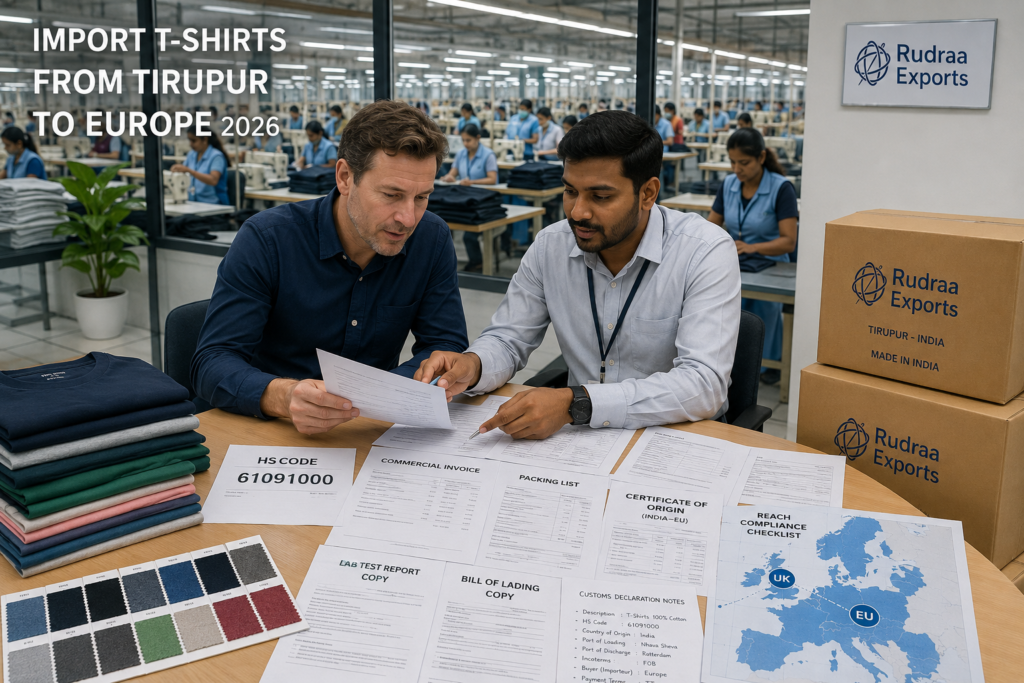
Importing T-shirts from Tirupur to Europe can be commercially attractive, but it is not something buyers should handle casually. A cheap FOB quote means nothing if the shipment gets delayed at customs, fails REACH testing, uses the wrong HS code, misses origin evidence, or creates unexpected duty and VAT exposure.
For European buyers, 2026 is a year where landed-cost planning matters more than ever. EU and UK tariff rules, origin schemes, chemical compliance, customs documentation, and shipping workflows all need to be checked before production starts — not after the goods are packed.
Tirupur remains one of India’s strongest knitwear and T-shirt manufacturing hubs. But importing from Tirupur successfully requires more than finding a factory. Buyers need a clear import workflow covering HS classification, fabric composition, REACH compliance, test reports, commercial invoice accuracy, packing list consistency, certificate of origin, freight terms, customs clearance, VAT, and final warehouse delivery.
At Rudraa Exports, we support European buyers sourcing cotton T-shirts, polos, corporate apparel, kidswear, sportswear, and private-label knitwear from Tirupur with factory-direct production, export documentation support, compliance planning, and shipment coordination.
Quick Answer
To import T-shirts from Tirupur, India to Europe in 2026, buyers should first confirm the HS code, usually HS 61091000 for cotton knitted T-shirts, then verify the current EU or UK duty treatment, prepare REACH compliance evidence, approve production samples, confirm test requirements for fabric, dyes, prints, and trims, and ensure the commercial invoice, packing list, certificate of origin, and shipping documents match exactly. EU buyers should verify current duty in TARIC, while UK buyers should check DCTS or India–UK FTA eligibility with their customs broker before claiming any preference.
Planning your first T-shirt import from Tirupur? Contact Rudraa Exports to share your tech pack, fabric composition, destination country, quantity, and required delivery date.
Why Import Planning Matters More in 2026
Many buyers think importing is simple: place order, manufacture garments, ship cartons, clear customs, receive goods. That is too shallow.
For apparel, small mistakes create expensive delays.
Common import problems include:
- Wrong HS code
- Incorrect fabric composition on invoice
- Missing EORI number
- Weak origin documentation
- Wrong duty assumption
- REACH test gaps
- Invoice and packing list mismatch
- Unclear Incoterms
- Delayed certificate of origin
- Customs broker queries
- VAT cash-flow surprises
- Shipment holds due to chemical compliance concerns
The worst mistake is testing and checking only after arrival. If a T-shirt fails REACH-related chemical screening after reaching Europe, the buyer may face delays, re-testing, product holds, withdrawals, or write-offs.
DIY Importing vs Partnering with Rudraa Exports
European buyers can manage importing themselves or work with a direct-factory partner that coordinates the production and export side.
| Criteria | DIY Importing | Partnering with Rudraa Exports |
|---|---|---|
| HS classification | Buyer and broker manage classification | Factory-side style data supports consistent HS usage |
| Duty planning | Buyer must check TARIC, GOV.UK, and broker advice | Rudraa supports landed-cost inputs, but broker confirms final duty |
| REACH compliance | Buyer builds RSL and testing plan | Rudraa supports pre-shipment test planning by fabric, print, and trims |
| Document accuracy | Multiple parties may create mismatches | Coordinated export document pack reduces inconsistency |
| Origin evidence | Buyer tracks origin requirements | Rudraa supports certificate/origin documentation where applicable |
| Testing strategy | Often reactive after arrival | Can be planned before shipment |
| Speed | Depends on buyer coordination | More controlled factory-to-export workflow |
| Internal workload | Higher | Lower |
| Best for | Teams with strong customs/compliance capability | Lean brands wanting predictable factory-owned support |
The blunt reality: DIY importing is fine only if your team actually understands customs, compliance, testing, and freight. If not, you are not saving money — you are just moving risk onto yourself.
Step 1: Confirm the Correct HS Code
For cotton knitted T-shirts, the common HS code is:
HS 61091000 — T-shirts, singlets and other vests, of cotton, knitted or crocheted.
This is commonly used for basic cotton round-neck T-shirts, cotton crew necks, cotton V-necks, and similar knitted cotton tops. But the final code can change depending on fiber composition, garment construction, gender classification, and product type.
HS Code Examples
| Product | Likely HS Area |
| 100% cotton knitted T-shirt | 61091000 |
| Polyester T-shirt | 610990 or related man-made fiber code |
| Cotton polo shirt | May fall under a different heading depending on construction |
| Sweatshirt | Usually not 6109 |
| Kids cotton T-shirt | Classification may still follow material and construction |
| Tank top / vest | May fall within 6109 if knitted/crocheted |
Do not treat HS code as “the forwarder’s problem.” The factory, buyer, and broker must all use consistent product descriptions.
Step 2: Understand EU Duty Reality
EU buyers importing from India must verify duty treatment before confirming landed cost.
For cotton T-shirts under HS 61091000, buyers should check the current EU TARIC line for:
- Customs duty
- Suspensions or preferences
- Origin conditions
- Product-specific measures
- Import controls
- Destination-country VAT handling
If preferential access is not available or not claimable, buyers should budget using MFN duty. If a trade agreement or preference applies, the buyer must confirm eligibility, rules of origin, and required documents before claiming it.
EU Import Cost Structure
A basic EU landed-cost model usually looks like this:
FOB value + freight + insurance = CIF value
Then:
CIF value × customs duty rate = duty
Then:
CIF value + duty + includable fees = VAT base
Then:
VAT base × destination VAT rate = import VAT
Example Structure
| Cost Item | Example |
| FOB garment value | €6,400 |
| Freight and insurance | €850 |
| CIF value | €7,250 |
| Customs duty | CIF × applicable duty rate |
| VAT base | CIF + duty + includable fees |
| Import VAT | VAT base × destination VAT rate |
Do not finalize product margin based only on FOB. FOB is not your landed cost.
Step 3: Understand UK Import Treatment
UK buyers must check UK-specific customs rules, not EU rules.
UK importers should confirm:
- UK EORI number
- Commodity code
- Import duty
- VAT
- Rules of origin
- UK DCTS eligibility where applicable
- India–UK FTA implementation status and eligibility
- Commercial invoice requirements
- Packing list requirements
- Certificate of origin or origin statement requirements
- Importer of record responsibility
The UK has its own trade preference system and its own post-Brexit customs processes. Buyers should not copy an EU import workflow and assume it works for the UK.
UK Import Checklist
| Requirement | Why It Matters |
| UK EORI | Required for customs identification |
| Commodity code | Determines duty treatment |
| Rules of origin | Needed for preference claims |
| Commercial invoice | Customs valuation and declaration |
| Packing list | Carton and shipment verification |
| Origin evidence | Supports duty preference where applicable |
| VAT planning | Affects cash flow |
| Broker review | Reduces clearance mistakes |
If you claim a duty preference without proper origin evidence, the shipment can be challenged later. That is not worth the risk.
Step 4: Build a REACH Compliance Plan
REACH compliance is one of the most important parts of importing garments into the EU.
REACH is the EU chemical regulation that restricts or controls many substances used in products placed on the EU market. For T-shirts, the main compliance risks usually come from dyed fabric, printed graphics, trims, finishes, and accessories.
Do not ask a supplier vaguely, “Is this REACH compliant?” That question is too weak.
Ask for a test plan tied to the exact product.
Key REACH Risks for T-Shirts
1. Azo Dyes
Azo dye restrictions are highly relevant for dyed textiles. Certain azo colorants can release restricted aromatic amines.
For cotton T-shirts, buyers should test or verify:
- Dyed main fabric
- Contrast panels
- Rib
- Neck tape
- Sewing thread if dyed
- Printed areas where relevant
2. Phthalates in Prints
Phthalates can be a risk in certain plasticized print systems, especially some plastisol-type graphics or soft PVC-like materials.
A T-shirt can pass fabric testing and still fail because of the print.
That is the trap many buyers miss.
3. Metals in Accessories
Basic T-shirts usually have fewer metal components, but some designs include:
- Metal logo tabs
- Decorative eyelets
- Zipper pulls on hybrid tops
- Metal trims
- Hangtag attachments
If metal parts are used, nickel, lead, and cadmium risk should be considered.
4. PFAS or POPs in Finishes
For ordinary cotton T-shirts, PFAS risk may be low. But if the garment uses stain-resistant, water-repellent, or performance finishing, chemical risk increases.
5. SVHC and SCIP Triggers
If any component contains substances of very high concern above applicable thresholds, EU supply-chain notification duties may apply. Most basic cotton T-shirts may not trigger this, but prints, coatings, trims, or accessories can change the risk profile.
REACH Testing Matrix for T-Shirts
| Component | Risk Area | Suggested Buyer Action |
| Dyed cotton fabric | Azo dyes, restricted substances | Test per colour family |
| Printed logo | Phthalates, heavy metals, restricted substances | Test print film separately |
| Neck rib | Azo dyes, composition | Include in material scope |
| Sewing thread | Dyestuff risk | Confirm supplier declaration or test if needed |
| Heat transfer | Plasticizers, restricted substances | Test transfer material |
| Metal trim | Nickel, lead, cadmium | Test if used |
| Performance finish | PFAS / POPs risk | Request finish declaration and testing |
The important point: test the actual risk areas, not only the easiest fabric swatch.
Step 5: Prepare the Required Import Documents
Document mismatch is one of the most common reasons for customs delay.
For T-shirts from Tirupur to Europe, buyers usually need:
- Commercial invoice
- Packing list
- Bill of Lading or Air Waybill
- Certificate of origin where required
- Origin statement where applicable
- Test reports
- Compliance declarations
- Insurance certificate if applicable
- Buyer-specific declarations
- Importer EORI details
- Product specification sheet
- HS code confirmation
- Carton marking details
Commercial Invoice Must Include
| Field | Why It Matters |
| Seller and buyer details | Customs identification |
| Invoice number and date | Declaration reference |
| Incoterm | Determines cost responsibility |
| Currency | Customs valuation |
| HS code | Duty classification |
| Product description | Must match classification |
| Fabric composition | Supports HS and compliance |
| Quantity | Must match packing list |
| Unit value and total value | Duty and VAT calculation |
| Country of origin | Origin and preference checks |
| Payment terms | Trade documentation |
Packing List Must Include
| Field | Why It Matters |
| Carton count | Customs and warehouse verification |
| Gross weight | Freight and clearance |
| Net weight | Customs and inventory |
| Dimensions | Freight planning |
| SKU/style | Warehouse receiving |
| Size/color breakdown | Buyer distribution |
| Carton marking | Reduces receiving errors |
A commercial invoice saying one thing and packing list saying another is a stupid but common way to delay a shipment.
Step 6: Choose the Right Incoterm
Incoterms decide who controls and pays for each part of the shipment.
Common options include:
| Incoterm | Buyer Control | Supplier Responsibility | Best For |
| FOB | Buyer controls main freight | Supplier delivers to port/on board | Experienced importers |
| CIF | Supplier arranges freight and insurance to destination port | Supplier handles freight to port of arrival | Buyers wanting freight included |
| DAP | Supplier delivers to named place, duties unpaid | Supplier handles more logistics | Buyers wanting simpler delivery |
| DDP | Supplier delivers duty-paid | Supplier handles maximum responsibility | Buyers wanting landed simplicity |
FOB is often clean for cost comparison. CIF can be useful if the buyer wants freight included. DDP may look convenient, but it can hide cost and responsibility issues if not handled professionally.
For first-time buyers, do not choose an Incoterm casually. Ask your freight forwarder or broker to confirm which option suits your import capability.
Step 7: Plan the Shipping Workflow from Tirupur
Tirupur shipments usually follow this broad workflow:
- Production completion
- Final inspection
- Packing and carton marking
- Document draft review
- Cargo handover to forwarder
- Inland movement to port or airport
- Export customs clearance in India
- Vessel or air departure
- Arrival in EU or UK
- Import customs clearance
- Duty and VAT settlement
- Inland movement to warehouse
- Goods receipt and carton verification
Sea Freight vs Air Freight
| Freight Mode | Best For | Risk |
| Sea freight | Bulk planned orders | Longer transit and port variability |
| Air freight | Urgent replenishment or samples | Much higher cost |
| Split shipment | Launch support + cost control | Needs careful carton planning |
| Courier | Samples and documents | Not for bulk |
For most European buyers, sea freight is best for planned bulk orders. Air freight should be used only when time matters more than freight cost.
Step 8: Avoid Common Import Mistakes
Mistake 1: Assuming the Same Duty for EU and UK
The EU and UK are different customs systems. Check both separately.
Mistake 2: Testing Only the Fabric
Prints, transfers, trims, and accessories can create compliance failures.
Mistake 3: Using Vague Product Descriptions
“Garments” is not enough. Customs documents should describe the product clearly, such as “100% cotton knitted men’s round-neck T-shirts.”
Mistake 4: Ignoring VAT Cash Flow
VAT can be a major cash item. Plan it before shipment.
Mistake 5: Claiming Preference Without Origin Evidence
Do not claim a duty reduction unless the origin documents and rules of origin support it.
Mistake 6: Not Reviewing Draft Documents
Always check invoice, packing list, HS code, origin statement, buyer address, carton count, and value before shipment.
DIY Importing vs Rudraa-Supported Import Workflow
DIY Works If:
- You have an experienced broker
- You understand HS classification
- You run an internal REACH/RSL program
- You can review import documents properly
- You can coordinate testing before shipment
- You can manage forwarders and customs queries
- You can handle landed-cost modeling
Rudraa Support Works If:
- You want factory-direct coordination from Tirupur
- You need export document support
- You want compliance planning before shipment
- You need test scope aligned to BOM risk
- You want fewer handoffs between factory, forwarder, and buyer
- You are importing into multiple European markets
- You want predictable shipment planning
Migration Plan: From Agent-Based Buying to Direct Tirupur Importing
Many buyers begin with agents because it feels simpler. But as volumes grow, agent-based buying can create cost opacity and weak control.
Use this transition plan.
Phase 1: Build a Customs Baseline
Confirm:
- Product category
- HS code
- Fabric composition
- Import country
- Duty treatment
- VAT process
- EORI readiness
- Incoterm preference
Phase 2: Build a Compliance Matrix
Map each product component to risk:
| Component | Compliance Risk |
| Main fabric | Azo dyes, composition, restricted substances |
| Phthalates, heavy metals | |
| Rib | Dye and composition risk |
| Labels | Material and chemical declarations |
| Trims | Nickel, lead, cadmium |
| Finish | PFAS / POPs risk if used |
Phase 3: Run a Pilot Shipment
Start with a controlled pilot order, such as 2,000–5,000 pieces.
Require:
- Full document pack
- Lab reports where needed
- Packing list accuracy
- HS code consistency
- Certificate of origin
- Broker review before sailing
Phase 4: Review and Improve
After the shipment clears, review:
- Customs queries
- Document errors
- Clearance time
- Test report gaps
- Freight delays
- Actual landed cost
- Warehouse receiving issues
Then update the template before scaling.
Why Rudraa Exports
Rudraa Exports helps European buyers import T-shirts and knitwear from Tirupur with factory-direct production and practical export support.
Manufacturing Capabilities
- Factory-direct Tirupur T-shirt and knitwear manufacturing
- 72,000+ units per month production capacity
- Cotton T-shirts, polos, corporate apparel, kidswear, sportswear, and private-label knitwear
- MOQs starting from around 300 pieces per style, depending on fabric, colour, logo method, and customization
- OEM/ODM support for fabric selection, sampling, fit, logo methods, labels, packing, and export documentation
Compliance and Quality Support
- ISO 9001:2015 certified manufacturing approach
- AQL 2.5 inspection standards
- Support for buyer-defined GSM, shrinkage limits, Pantone references, print/embroidery specs, and packing controls
- Support for REACH-aligned test planning for fabric, prints, trims, and finishes where required
- Certification-aligned sourcing support for OEKO-TEX, GOTS, GRS, WRAP, SMETA, BSCI, and related buyer standards where applicable
- Traceability support across fabric lots, production batches, samples, inspection records, and packing lists
Import and Export Documentation Support
- Commercial invoice support
- Packing list support
- Certificate of origin coordination where required
- HS code consistency support based on product data
- Shipping document coordination
- FCL and LCL shipment planning
- Air and sea freight coordination
- Support for buyer-nominated freight forwarders and brokers
Ready to import T-shirts from Tirupur with fewer customs and compliance surprises? Speak with Rudraa Exports for a style-specific quote, REACH-aware test plan, and shipment-ready document checklist.
FAQ: Importing T-Shirts from Tirupur to Europe
1. What is the HS code for cotton T-shirts?
The common HS code for cotton knitted T-shirts is HS 61091000. The final classification should still be confirmed by your customs broker based on composition, construction, and product details.
2. What documents are needed to import T-shirts into the EU?
EU buyers usually need a commercial invoice, packing list, Bill of Lading or Air Waybill, EORI details, certificate of origin where required, HS code, product description, and compliance documents such as test reports where applicable.
3. What documents are needed to import T-shirts into the UK?
UK buyers usually need a commercial invoice, packing list, UK EORI, commodity code, origin documents, customs declaration details, Bill of Lading or Air Waybill, and duty/VAT documentation.
4. Do Indian T-shirts get preferential duty access into the EU?
Duty treatment can change depending on EU preference schemes and trade agreements. Buyers should check current TARIC measures and confirm with their customs broker before shipment.
5. Can Indian T-shirts qualify under UK DCTS?
Some goods from eligible developing countries may benefit under the UK DCTS, but eligibility depends on rules of origin and correct documentation. Buyers should verify with GOV.UK guidance and their broker before claiming preference.
6. What REACH risks apply to T-shirts?
The main REACH risk areas for T-shirts include azo dyes in dyed fabrics, phthalates in certain prints, metals in trims or accessories, and restricted substances in finishes or coatings.
7. Is a generic REACH certificate enough?
No. Buyers should request test reports or declarations tied to the actual fabric, colour, print, trim, and style. A generic certificate is weak protection.
8. Should prints be tested separately?
Yes, especially plastisol, heat transfer, PVC-like, or large graphic prints. A T-shirt can pass fabric testing but fail because of the print layer.
9. Which Incoterm is best for first-time European buyers?
FOB is clean for experienced importers with their own freight forwarder. CIF or DAP can be easier for buyers who want more logistics support. DDP should be used carefully because it requires strong duty and tax handling.
10. How can I avoid customs delays?
Use accurate HS codes, matching invoice and packing list details, correct origin documentation, complete consignee information, proper EORI numbers, and pre-shipment document review.
11. Should I test garments before shipment or after arrival?
Before shipment. Testing after arrival is risky because failed goods are already in Europe and can create holds, rework, returns, or write-offs.
12. Why choose Rudraa Exports for EU and UK imports?
Rudraa Exports helps buyers manage factory-direct production, document preparation, REACH-aware test planning, HS consistency, packing accuracy, quality inspection, and shipment coordination from Tirupur.
Conclusion
Importing T-shirts from Tirupur to Europe in 2026 requires more discipline than asking for a FOB price. Buyers must confirm HS classification, check EU or UK duty treatment, plan REACH compliance, test actual risk areas, prepare accurate export documents, choose the right Incoterm, and coordinate freight before production ends.
The safest import workflow is simple: define product data clearly, verify duty and origin rules before pricing, test fabric and prints before shipment, check documents before cargo moves, and work with a factory that understands export discipline.
Visit Rudraa Exports or contact the team directly to share your tech pack, composition, print method, order volume, destination country, and preferred Incoterm — and receive a factory-direct import plan built for EU and UK buyers in 2026.
Related reading
India vs China T-Shirt Manufacturing in 2026: Which Is Better for Your Brand?