
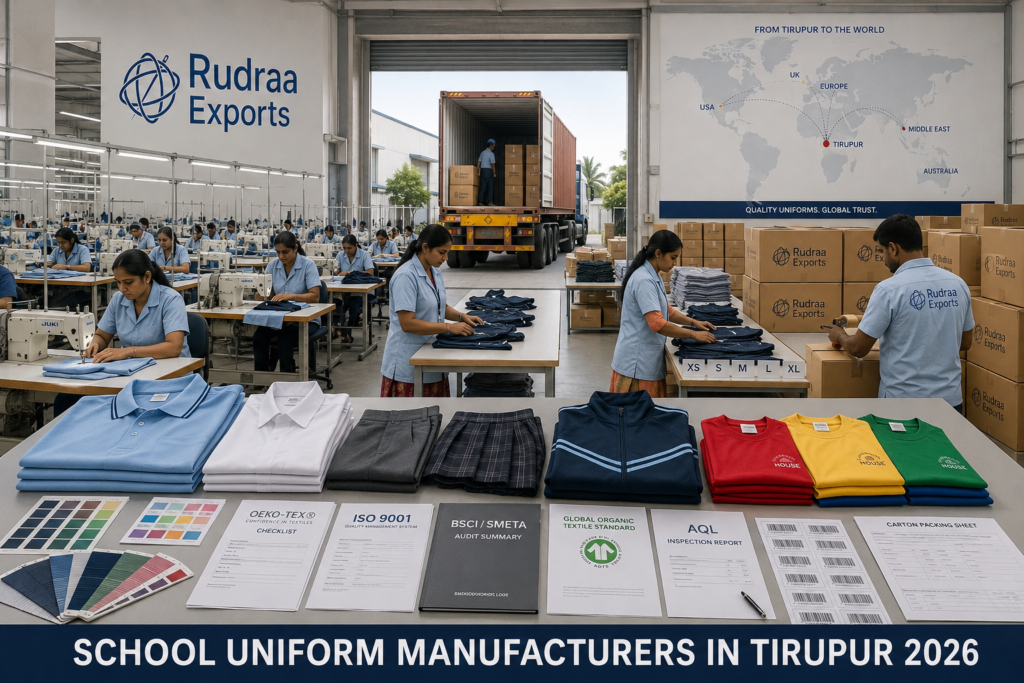
School uniform sourcing is not the same as fashion sourcing. Procurement teams buying uniforms at scale are not only looking for the lowest FOB price. They need consistent shade, strong stitching, accurate sizing, durable fabric, repeat-order reliability, compliance documents, clean packing, and on-time delivery before the academic year or institutional rollout begins.
This is why school uniform manufacturers in Tirupur are becoming a strong choice for global buyers. Tirupur is not just a garment factory location. It is a dense knitwear and apparel manufacturing ecosystem with fabric sourcing, dyeing, cutting, stitching, embroidery, printing, finishing, packing, and export documentation support available within the same region.
For schools, education groups, hospitality companies, corporates, sports institutions, and public procurement teams, that ecosystem matters. It reduces handoff risk and helps buyers manage large repeat programs with better accountability.
At Rudraa Exports, we support overseas institutions and bulk buyers looking for factory-direct school uniforms, corporate uniforms, PE kits, polo shirts, trousers, skirts, house T-shirts, and repeat institutional apparel programs from Tirupur.
Quick Answer
Tirupur is a strong sourcing hub for school uniforms and institutional wear because it combines knitwear specialization, export-ready production, dyeing and processing support, skilled labor, compliance familiarity, and mature documentation workflows. Global buyers should choose a Tirupur uniform manufacturer based on shade consistency, sizing control, wash durability, certification readiness, MOQ flexibility, sampling speed, bulk lead time, AQL inspection, and export execution. Rudraa Exports supports institutional buyers with factory-direct production, 72,000+ units/month capacity, sampling support, compliance-aligned documentation, and repeat-order uniform planning.
Planning a school uniform or institutional wear program? Contact Rudraa Exports to share your SKU list, fabric, GSM, colours, logo, annual quantity, and delivery market.
Why School Uniform Procurement Needs a Different Approach
School uniforms are worn repeatedly, washed frequently, and expected to look consistent across students, grades, campuses, and years. A small quality issue becomes a large operational problem when thousands of students or employees are affected.
Common uniform sourcing problems include:
- Navy shade mismatch across repeat lots
- Inconsistent sizing between batches
- Collar deformation after washing
- Pilling on polos and PE T-shirts
- Shrinkage beyond tolerance
- Embroidery puckering
- Late ETD during peak season
- Missing compliance documents
- Wrong carton labels or size ratios
- Replenishment quantities not available
For institutional buyers, the real cost is not just the garment price. The real cost includes complaints, replacement stock, emergency air freight, delayed academic-year supply, customs issues, and internal procurement stress.
Why Tirupur Works for Institutional Uniforms
Tirupur is one of India’s strongest knitwear and apparel export hubs. Its biggest advantage is not only production capacity. Its advantage is the cluster.
Uniform programs need fabric, dyeing, stitching, embroidery, packing, and documentation to work together. Tirupur’s ecosystem helps reduce the delays that happen when these processes are spread across different regions.
Tirupur Advantage for Uniform Buyers
| Tirupur Strength | Buyer Benefit |
|---|---|
| Knitwear and uniform manufacturing depth | Strong fit for polos, PE kits, T-shirts, sweatshirts, and institutional basics |
| Local fabric and trims ecosystem | Faster material sourcing and replenishment |
| Dyeing and processing support | Better shade continuity across repeat lots |
| Printing and embroidery access | Better branding and logo control |
| Skilled garment workforce | Consistent stitching and bulk production support |
| Export documentation familiarity | Easier international shipment planning |
| Sustainability infrastructure | Stronger ESG and institutional procurement positioning |
For global buyers, Tirupur reduces the “learning curve” risk because many suppliers are already familiar with export packing, buyer QA checks, AQL inspection, lab testing, and documentation requirements.
Rudraa Exports Institutional Wear Portfolio
Rudraa Exports supports multiple institutional garment categories for overseas buyers.
School Uniforms
- School polo shirts
- House T-shirts
- PE T-shirts
- Sports kits
- Shorts
- Trousers
- Skirts
- Sweatshirts
- Hoodies
- Warm-up layers
- Grade-wise uniform sets
Corporate and Institutional Wear
- Corporate polo shirts
- Staff T-shirts
- Hoodies and sweatshirts
- Front-office uniforms
- Field team apparel
- Event uniforms
- Employee branding apparel
Hospitality and Workwear Basics
- Front-of-house polos
- Utility shirts
- Kitchen or support basics
- Durable daily-use uniform items
- Repeat replenishment apparel
A single supplier managing the complete uniform system helps reduce approval loops. Buyers can maintain the same measurement standards, shade references, trims, labels, packing formats, and quality expectations across the full program.
What Global Buyers Should Check Before Choosing a School Uniform Manufacturer
A school uniform supplier should be evaluated like a long-term institutional partner, not a one-time vendor.
Supplier Evaluation Table
| Evaluation Area | What to Check | Why It Matters |
| Product range | Polos, PE kits, trousers, skirts, sweatshirts | Confirms complete uniform capability |
| Capacity | Monthly production and peak-season planning | Prevents delivery failure |
| Sampling speed | 7–14 day sampling capability | Helps early approval before bulk |
| Bulk lead time | 45–60 day planning range | Supports academic-year calendars |
| MOQ | Replenishment-friendly MOQ by style/colour | Prevents overstock |
| Shade control | Lab dips, shade bands, golden samples | Prevents colour mismatch |
| Sizing system | Grade-wise chart and tolerances | Reduces returns and exchange issues |
| Wash durability | Shrinkage, pilling, seam strength | Protects long-term wear |
| Certifications | ISO 9001, OEKO-TEX, BSCI, SMETA, GOTS | Supports procurement approval |
| Export documents | Invoice, packing list, COO, BL/AWB | Prevents customs delays |
The strongest suppliers are not those who say “we can do everything.” They are the ones who can prove repeatability.
Colour and Shade Consistency
Colour consistency is one of the biggest risks in school uniform sourcing.
A school’s navy, maroon, green, red, or house colour must remain consistent across batches. If one delivery looks different from the next, parents, students, and school administrators notice immediately.
Controls Buyers Should Require
- Lab dip approval
- Pantone or TCX reference
- Physical shade band
- Approved golden sample
- Dye lot tracking
- Shade sorting rules
- Reorder shade continuity process
- Written approval before bulk dyeing
Example
If a school group orders navy polos for three campuses, the navy shade must match across all deliveries. Without shade control, one campus may receive darker polos and another may receive lighter polos. That creates visible inconsistency and damages brand standards.
Durability and Wash Performance
Uniforms are worn more often than regular fashion garments. School polos, PE kits, and trousers may be washed multiple times every week.
That means buyers must specify durability clearly.
Durability Checks
| Uniform Risk | Control Method |
| Pilling | Anti-pilling yarn or finish |
| Shrinkage | Shrinkage target and wash testing |
| Seam failure | Stitch specs and seam reinforcement |
| Collar deformation | Collar stability and rib quality |
| Colour fading | Colourfastness requirement |
| Logo damage | Embroidery/print durability test |
| Fabric thinning | Correct GSM and yarn selection |
For school polos, reinforced shoulder seams, stable collars, and anti-pilling fabric are often worth the upgrade because uniforms are daily-use products.
Sizing Architecture for School Uniforms
Sizing is more complex in schoolwear because buyers may need sizes for different age groups, body types, and campuses.
What Buyers Should Provide
- Grade-wise size requirement
- Size chart per garment
- Measurement tolerance table
- Fit sample approval
- Size set approval
- Size ratio by campus or region
- Replenishment size forecast
Common Sizing Mistakes
| Mistake | Result |
| One generic size chart | Poor fit across age groups |
| No tolerance table | Disputes during inspection |
| No size set sample | Bulk grading issues |
| Wrong size ratio | Overstock in slow sizes |
| No replenishment plan | Fast sizes run out mid-year |
Uniform buyers should approve at least key sizes before bulk production.
MOQs for School Uniforms
MOQ matters because institutional programs often need both large annual orders and small replenishment orders.
Rudraa Exports supports MOQ discussions starting from around 300 pieces per style and colour, depending on fabric, colour, logo method, trims, and customization. For uniform buyers, this is useful because not every SKU moves at the same speed.
MOQ Planning Table
| Use Case | MOQ Planning Need |
| Pilot campus rollout | Low MOQ by style/colour |
| Annual school program | Bulk MOQ and price tiers |
| Replenishment order | Small repeat quantities |
| New campus opening | Fast repeat production |
| House T-shirts | Colour-wise MOQ planning |
| PE kits | Size-wise replenishment logic |
Even if your annual volume is high, always negotiate replenishment MOQ. This prevents overbuying slow-moving sizes.
Lead Times for Institutional Uniforms
A realistic school uniform timeline must include sampling, approvals, bulk production, inspection, packing, and shipping.
Rudraa Uniform Timeline
| Stage | Typical Timeline |
| Sampling | 7–14 days |
| Pre-production approval | Depends on buyer response |
| Bulk production | 45–60 days |
| Final inspection and packing | 3–7 days |
| Export documentation and dispatch | Depends on route |
For school-year supply, buyers should plan backward from the date uniforms must reach the warehouse, not the first day of school.
Suggested Calendar
| Stage | Planning Window |
| T-90 to T-75 | Spec finalization and sampling |
| T-75 to T-60 | PP sample approval and material booking |
| T-60 to T-15 | Bulk production and inline inspections |
| T-15 to shipment | Final inspection, packing, documents, booking |
Do not wait until the last month before school opening. That is how emergency air freight happens.
Certifications for School Uniform Buyers
Institutional buyers often need supplier documents for internal procurement approval.
Certification Guide
| Certification | Why It Matters for Uniforms |
| ISO 9001:2015 | Quality management and process control |
| OEKO-TEX Standard 100 | Harmful substance testing for skin-contact textiles |
| BSCI | Social compliance framework |
| SEDEX/SMETA | Ethical trade audit methodology |
| GOTS | Organic textile chain-of-custody where organic cotton is used |
| AEO | Customs/export process maturity where applicable |
| WRAP | Responsible production framework where required |
Buyers should verify certificate scope, validity, site coverage, and product relevance before awarding a long-term uniform program.
Export Process for Global Institutional Buyers
Uniform exports need accurate paperwork. A good supplier should help buyers prepare and verify the export document set.
Export Document Checklist
- Commercial invoice
- Packing list
- Shipping bill / export declaration
- Bill of Lading or Air Waybill
- Certificate of origin where required
- Test reports if needed
- Compliance certificates
- Inspection report
- Insurance certificate if CIF
- Buyer-specific declarations
Before shipment, buyers should review scanned draft documents. A small mismatch between invoice and packing list can delay clearance.
FOB vs CIF for Uniform Imports
Rudraa Exports can support FOB and CIF discussions depending on buyer preference.
| Term | Meaning | Best For |
| FOB | Buyer controls main freight from port | Experienced importers |
| CIF | Supplier includes freight and insurance to destination port | Buyers wanting freight included |
| DAP | Supplier delivers to named place, duties unpaid | Buyers wanting more logistics support |
| DDP | Supplier delivers duty-paid | Buyers needing landed delivery support |
FOB is clean for experienced importers. CIF is useful when the buyer wants freight included. DDP should be used carefully because duty, VAT, importer responsibility, and customs handling must be clear.
Case Study: Annual Recurring School Uniform Program
Buyer Profile
A multi-campus education group with schools in the UK and Middle East needs annual school uniforms and replenishment support.
Program Size
Approximately 48,000 pieces per year across polos, trousers, skirts, PE kits, and seasonal sweatshirts.
Workflow
| Stage | Action |
| Tender alignment | Buyer shares fabric, GSM, colour, logo, packing, and compliance requirements |
| Sampling | Rudraa develops samples in 7–14 days |
| Approval | Buyer confirms wash performance, sizing, logo durability, and golden sample |
| Bulk order | 45–60 day production plan starts |
| QC | Inline checks and final AQL inspection |
| Shipping | FOB or CIF shipment based on campus destination |
| Replenishment | Repeat SKUs ordered based on size demand |
Result
The buyer reduces emergency buying, keeps shade standards consistent, reuses compliance documents, and improves annual procurement planning.
Uniform Procurement Readiness Checklist
Use this checklist before placing a school uniform order.
Program Basics
- SKU list with photos or sketches
- Annual volume forecast
- Delivery split schedule
- Size chart per style
- Tolerance table
- Campus or branch-wise quantity plan
Materials and Performance
- Fabric composition
- GSM
- Knit type: pique, jersey, fleece
- Shrinkage target
- Colour standard
- Shade band requirement
- Wash performance expectation
Branding and Trims
- Logo method
- Embroidery or print placement
- Button, zipper, elastic, drawcord, and label details
- Care label
- Size label
- Packaging and carton marking
Quality Governance
- AQL level
- PP sample approval
- Inline inspection
- Final inspection
- Golden sample retention
- Defect classification
- CAPA timeline
Commercial and Logistics
- MOQ per SKU
- Replenishment MOQ
- Bulk lead time
- Payment terms
- Incoterm
- Shipping route
- Document list
- Pre-alert process
Why Rudraa Exports
Rudraa Exports is positioned for global buyers who need a factory-direct uniform manufacturer from Tirupur for repeat institutional programs.
Manufacturing Capabilities
- Factory-direct Tirupur uniform and knitwear manufacturing
- 72,000+ units per month production capacity
- School polos, PE kits, house T-shirts, trousers, skirts, sweatshirts, hoodies, corporate uniforms, hospitality basics, and sportswear
- MOQs starting from around 300 pieces per style and colour, depending on fabric, logo method, and customization
- Sampling support within 7–14 days for standard institutional programs
- Bulk production planning around 45–60 days depending on complexity
Quality and Compliance
- ISO 9001:2015 certified manufacturing approach
- AQL 2.5 inspection standards
- Support for OEKO-TEX, BSCI, SEDEX/SMETA, GOTS, AEO, WRAP, and related buyer requirements where applicable
- Shade control through lab dips, shade bands, and golden samples
- Support for shrinkage, colourfastness, pilling, sizing, and logo durability controls
- Traceability support across fabric lots, dye lots, trims, production batches, inspection records, and packing lists
International Buyer Advantages
- Factory-direct pricing without trading-company markups
- Up to 40% cost-saving positioning compared with indirect sourcing models
- English-language communication for procurement teams
- Export support for Europe, USA, Australia, and Middle East markets
- FOB and CIF shipment support
- Export documentation support for commercial invoice, packing list, certificate of origin, and shipping documents
Ready to source school uniforms from Tirupur? Speak with Rudraa Exports for a sample pack, bulk quote, MOQ plan, and production timeline.
FAQ: School Uniform Manufacturers in Tirupur
1. Why source school uniforms from Tirupur?
Tirupur is strong for school uniforms because it has a dense knitwear and apparel manufacturing ecosystem covering fabric, dyeing, stitching, printing, embroidery, finishing, packing, and export support.
2. What school uniform products can Tirupur manufacturers make?
Tirupur manufacturers can support school polo shirts, house T-shirts, PE kits, trousers, skirts, shorts, sweatshirts, hoodies, sportswear, and institutional knitwear basics.
3. What MOQ should buyers expect for school uniforms?
MOQ depends on fabric, colour, logo method, trims, and customization. Rudraa Exports supports discussions starting from around 300 pieces per style and colour for suitable programs.
4. How long does school uniform sampling take?
For standard institutional programs, sampling can usually be planned within 7–14 days, depending on fabric, logo, trims, and approval complexity.
5. What is the bulk lead time for school uniforms?
Bulk production commonly takes around 45–60 days depending on SKU count, order volume, fabric availability, colour approvals, logo method, and packing requirements.
6. What certifications are important for school uniforms?
Important certifications include ISO 9001, OEKO-TEX Standard 100, BSCI, SEDEX/SMETA, GOTS for organic cotton, WRAP, and AEO where relevant.
7. Why is OEKO-TEX important for school uniforms?
OEKO-TEX Standard 100 helps support harmful substance testing for skin-contact textiles, which is important for children’s garments and institutional procurement.
8. How do buyers prevent shade mismatch in school uniforms?
Buyers should approve lab dips, physical shade bands, Pantone or TCX references, golden samples, and dye lot tracking before bulk production.
9. Should school uniforms be tested for wash performance?
Yes. School uniforms are washed frequently, so buyers should define shrinkage, colourfastness, pilling, seam strength, and logo durability expectations.
10. Is FOB or CIF better for school uniform imports?
FOB is better for experienced importers with their own freight forwarder. CIF is useful when buyers want freight and insurance included to the destination port.
11. Can Rudraa Exports support annual recurring uniform programs?
Yes. Rudraa Exports can support annual and recurring institutional programs with sampling, bulk production, replenishment MOQ planning, shade control, QC, and export documentation.
12. Why choose Rudraa Exports for school uniforms?
Rudraa Exports is suitable for global buyers who need factory-direct Tirupur production, institutional uniform expertise, compliance-aligned documentation, AQL inspection, replenishment planning, and export support.
Conclusion
School uniform manufacturing is a repeat-program business, not a one-time buying exercise. Global buyers need a supplier that can manage shade consistency, sizing, durability, compliance, MOQ planning, replenishment, export documents, and delivery timelines across multiple academic cycles.
Tirupur gives institutional buyers a strong manufacturing base because of its knitwear ecosystem, export experience, sustainability infrastructure, and supply-chain depth. Rudraa Exports adds factory-direct communication, structured sampling, AQL-based quality control, compliance support, and export-ready documentation for overseas buyers.
Visit rudraaexports.com or contact our team directly to share your school uniform requirement, SKU list, logo, fabric, annual volume, destination market, and delivery deadline — and receive a factory-direct institutional uniform sourcing plan from Tirupur.
Related reading
School uniform procurement case study: 18 schools, 25,000 units delivered
School Uniform Suppliers in India for Australian Schools: MOQ, Safety Standards and Compliance Guide