
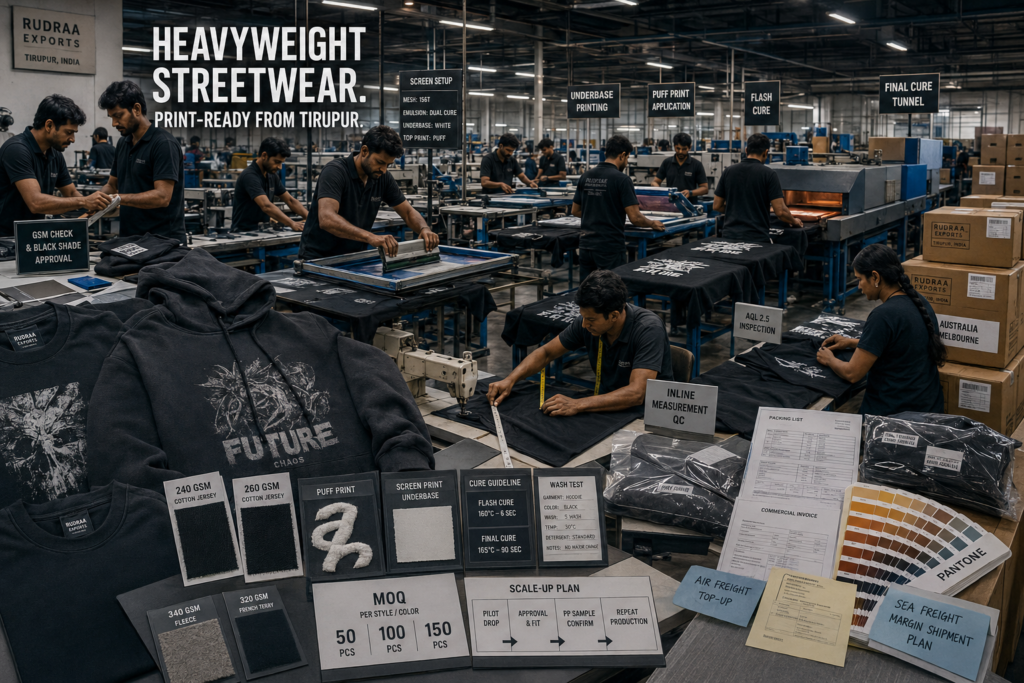
Australian streetwear brands usually do not fail because the design idea is weak.
They fail because execution breaks.
The T-shirt feels too light.
The black shade looks washed out.
The print cracks after wash.
The puff print collapses.
The hoodie fabric does not feel premium.
The MOQ is too high.
The shipment is late.
Or the founder pays for a “premium blank” but receives a garment that does not match the approved sample.
That is why Australian founders searching for a heavyweight tee manufacturer India Australia need more than a low quote.
They need fabric control, print discipline, realistic MOQs, clear sampling, factory-direct communication and proper export planning.
Tirupur, India is one of the strongest sourcing bases for heavyweight cotton knits, screen-printed garments, puff print hoodies and low-MOQ streetwear production.
At Rudraa Exports, we help Australian streetwear and lifestyle brands develop heavyweight 220–260 GSM tees, hoodies, sweatshirts and print-heavy garments from Tirupur with factory-direct production, sample approvals, print strike-offs, QC checks, FOB planning and export packing.
Quick Answer
Tirupur is a strong sourcing base for Australian streetwear brands that need heavyweight 220–260 GSM tees, print-heavy hoodies, screen printing, puff print and low MOQs. A realistic first run is often 50–150 pcs per style/colour when fabric, print and approvals are controlled properly. For black garments, buyers should specify GSM tolerance, shrinkage target, black shade, underbase, mesh count, cure settings, puff additive, print strike-off and wash testing before bulk. Factory-direct sourcing reduces agent layers and improves communication between the buyer, factory and print team.
Planning a heavyweight streetwear drop for Australia? Contact Rudraa Exports and share your tech pack, target GSM, artwork, print method, MOQ and delivery destination.
Why Australian Streetwear Brands Look to Tirupur
Australian streetwear and lifestyle founders often need smaller runs than large retail brands.
But they still need premium execution.
The uploaded guide explains that Australian streetwear labels often fail on execution issues such as wrong fabric weight, weak blacks, cracking prints, late shipments and unrealistic MOQs.
Tirupur Is Useful For
- Heavyweight T-shirts
- Oversized streetwear blanks
- 220 GSM cotton tees
- 240 GSM premium tees
- 260 GSM heavyweight tees
- Print-heavy black tees
- Puff print hoodies
- Screen printed hoodies
- French terry hoodies
- Fleece hoodies
- Leisurewear sets
- Low-MOQ streetwear drops
- Australian brand capsules
The uploaded guide says Tirupur can deliver heavyweight cotton jersey, fleece/terry hoodies and export-grade screen and puff prints without forcing brands into 500–1,000 piece commitments.
Why Heavyweight Fabric Needs Better Control
A heavyweight tee is not just a thicker T-shirt.
It needs the right balance of:
- GSM
- Yarn
- Knit structure
- Shrinkage
- Drape
- Neck rib quality
- Side seam stability
- Print compatibility
- Wash performance
The uploaded source says Tirupur production ranges include cotton jersey from 180–320 GSM and fleece from 220–260 GSM at fabric stage, which covers the sweet spot for heavyweight tees and leisurewear sets.
Heavyweight Tee GSM Guide
| GSM | Buyer Feel | Best For |
|---|---|---|
| 220 GSM | Premium but still breathable | Elevated basics |
| 240 GSM | Heavier hand feel and opacity | Streetwear drops |
| 260 GSM | True heavyweight and boxy | Premium oversized blanks |
The uploaded guide positions 220 GSM as premium, 240 GSM as heavier with better opacity, and 260 GSM as true heavyweight for boxy streetwear blanks.
What to Benchmark Before Sending a PO
Before placing a purchase order, Australian buyers should benchmark the factory properly.
The uploaded guide recommends locking the technical baseline before negotiating price: GSM tolerance, shrinkage target, black shade, print method and cure requirements.
Supplier Scorecard for Heavyweight Streetwear
| Criteria | Target |
|---|---|
| Tee GSM | 220–260 GSM |
| GSM tolerance | Written, such as ±5% |
| Hoodie fabric | Fleece or French terry |
| Hoodie finished weight | 300–400 GSM direction depending on spec |
| MOQ | 50–150 pcs/style/colour |
| Print method | Screen print, puff, discharge or water-based |
| Dark garment control | White underbase and controlled cure |
| Lead time | Dated sampling and bulk calendar |
| QC | Inline checks and final inspection |
| Communication | One point of contact and approval checkpoints |
The uploaded guide includes a supplier scorecard covering tee fabric GSM, hoodie fabric GSM, MOQ, print options, dark garment printing, lead time, QC/compliance and communication.
Factory-Direct vs Agent Model
For print-heavy streetwear, the sourcing model matters.
A design may look simple, but production is technical.
The uploaded guide says print-heavy streetwear is where hidden costs and miscommunication compound because the real work happens in fabric knitting, dye-lot control, screen setup and curing discipline.
Factory-Direct Benefits
- Faster technical communication
- Better GSM control
- Better black shade control
- Direct print-house feedback
- Faster strike-off corrections
- Better underbase control
- Better curing accountability
- Lower hidden markup risk
- More transparent costing
- Better low-MOQ production planning
The uploaded source says factory-direct relationships compress the feedback loop between the tech pack and the teams controlling fabric, sewing and print parameters.
Agent Model Risks
- Spec drift
- Slower approvals
- More translation layers
- Markup without print accountability
- Less visibility into curing
- Less direct control over shade
- Delayed correction cycles
The uploaded guide says agents can be useful when buyers do not have a factory network, but low-MOQ print-heavy programs can suffer from spec drift, slow approvals and unclear accountability.
Screen Print on Black Garments
Black streetwear looks premium only when the print is controlled.
A weak white underbase or under-cured print can ruin the garment.
The uploaded guide explains that dark tees and hoodies need an underbase for opacity and that underbase printing requires specific mesh and flash discipline.
What to Control
- White underbase
- Mesh count
- Ink system
- Flash temperature
- Flash time
- Final cure
- Garment dryness
- Wash test
- Fibrillation
- Print cracking
Screen Print Checklist for Black Garments
| Print Area | What to Confirm |
|---|---|
| Underbase | Yes/no and opacity target |
| Mesh count | Based on detail and deposit |
| Ink | Plastisol, discharge or water-based |
| Flash | Time and temperature |
| Cure | Final cure setting |
| Wash test | Cracking, fade and hand feel |
| Black shade | Approved swatch or lab dip |
The uploaded guide says underbases often use around 86–160 t/in mesh depending on opacity and detail, and final cure commonly sits in 270–320°F ranges depending on ink and substrate.
Puff Print Hoodies and Tees
Puff print gives streetwear a premium textured look.
But it is sensitive.
If the ink deposit, additive ratio, mesh count or cure is wrong, puff height can become inconsistent.
The uploaded guide explains that puff print requires controlled cure, proper mesh choice, additive ratio and wash testing on the exact fabric.
Puff Print Risks
- Uneven puff height
- Cracking
- Scorching on black garments
- Poor edge sharpness
- Collapse after wash
- Rough hand feel
- Under-cure
Puff Print Checklist
| Area | What to Confirm |
|---|---|
| Additive ratio | Based on ink system |
| Mesh | Lower mesh for thicker deposit |
| Cure | Controlled temperature and time |
| Fabric | Exact bulk fabric used for strike-off |
| Wash test | Minimum practical wash review |
| Artwork | Simple enough for clean puff height |
The uploaded guide says puff often uses lower mesh counts, such as 43t–62t, to lay down thicker deposit for height.
Low MOQ for Australian Streetwear Brands
Low MOQ is important for Australian founders because the local market is smaller.
A first run should prove demand, not create deadstock.
The uploaded guide focuses on 50–150 pcs per style for Australian founders producing heavyweight tees and hoodies with screen or puff print options.
Practical MOQ Direction
| MOQ | Best For |
|---|---|
| 50 pcs/style/colour | Pilot drop |
| 100 pcs/style/colour | Better startup test |
| 150 pcs/style/colour | Stronger small-batch run |
| 300+ pcs/style/colour | Better efficiency |
| 500+ pcs/style/colour | Repeat scale production |
Low MOQ Works Better When
- Fabric is stock-supported
- One black standard is used
- Artwork is print-ready
- Colour count is limited
- Print placements are controlled
- Approvals are fast
- Packaging is simple
The uploaded guide says Tirupur supports smaller orders for startups and MSMEs, and factory-direct partners are more likely to treat 50–150 pcs as a real run.
Fabric Choices for Heavyweight Tees and Hoodies
Heavyweight Cotton Jersey
Best for:
- Oversized tees
- Boxy streetwear tees
- Premium blanks
- High-coverage graphics
- Drop-shoulder fits
- Thick black tees
Fleece Hoodies
Best for:
- Warm streetwear hoodies
- Heavy leisurewear
- Winter capsules
- Puff print hoodie drops
French Terry Hoodies
Best for:
- Breathable hoodies
- Year-round streetwear
- Premium lounge sets
- Less bulky hoodie programs
Buyer Tip
Confirm finished garment feel, not only fabric GSM.
A hoodie’s final feel depends on fabric, brushing, shrinkage, finishing and construction.
Sampling Flow for Print-Heavy Streetwear
Sampling is where most bulk problems should be caught.
Recommended Sampling Flow
- Fabric and colour approval
- Size set sample
- Print strike-off
- Pre-production sample
The uploaded guide recommends fabric/colour approval, size set sample, print strike-off and PPS before bulk.
What to Check
| Stage | What It Confirms |
|---|---|
| Fabric approval | GSM, hand feel and colour |
| Size set | Fit and measurements |
| Print strike-off | Opacity, puff height and cure |
| PPS | Final bulk standard |
Important Rule
For black garments, the strike-off must be on the actual fabric and colour.
The uploaded source says print strike-offs should be done on the actual fabric/colour, especially for black garments.
Bulk Production and QC Checkpoints
Once sampling is approved, the bulk run still needs inspection.
The uploaded guide recommends inline measurement checks, print QC and final AQL-style inspection during bulk production.
QC Should Include
- Fabric GSM check
- Shrinkage check
- Black shade check
- First 10 pcs per size measurement check
- Underbase opacity review
- Print registration check
- Cure verification
- Puff height check
- Stitching check
- Final inspection
Print QC Should Check
- Underbase coverage
- Colour accuracy
- Sharp edges
- No cracking
- No scorch marks
- No tackiness
- No fibrillation issue
- Wash performance
Lead Times for Heavyweight Tees and Hoodies
Lead time depends on fabric, colour, sampling, print complexity, bulk quantity and approvals.
The uploaded guide gives a practical baseline of 2–3 weeks for sampling and approvals, plus 3–5 weeks for bulk cut-make-trim and printing depending on complexity.
Practical Timeline
| Stage | Timeline Direction |
|---|---|
| Spec lock | Day 0–3 |
| Quote | Day 3–5 |
| Sampling | Week 1–3 |
| Bulk production | Week 3–7 |
| Freight to Australia | Week 7–10 depending on mode |
Buyer Tip
The goal is not the shortest lead time.
The goal is the most reliable lead time.
Freight to Australia
Australian founders usually choose between air and sea.
The uploaded guide says freight selection is where many first runs blow out and recommends choosing mode based on drop calendar.
Air Freight
Best for:
- Fixed launch date
- Influencer drop
- Event collab
- First 100–150 pcs
- Urgent hero colour
Sea Freight
Best for:
- Replenishment
- Proven sellers
- Better margin
- Larger repeat production
- Planned inventory
Buyer Tip
For the first urgent drop, air may protect the launch.
For repeat production, sea protects the margin.
The uploaded guide gives this same decision logic for Australian founders.
Australia Duties and GST
Australian import costs should be checked before shipping.
The uploaded guide says Australian import charges typically include customs duty where applicable and GST, and buyers should confirm final details using Australian Border Force guidance.
Landed Cost Should Include
- FOB value
- Freight
- Duty
- GST
- Clearance
- Local delivery
- Carton handling
- Any inspection cost
Documents Needed
- Commercial invoice
- Packing list
- HS code
- Fibre content
- Country of origin
- Carton count
- Gross weight
- CBM
Fit / Fit-Not Guide
Tirupur Factory-Direct Is a Strong Fit If
- You make heavyweight tees
- You need 220–260 GSM jersey
- You make hoodies or sweatshirts
- You need screen print
- You need puff print
- You use black garments
- You need low MOQs
- You can approve samples quickly
- You can send proper artwork
- You want factory-direct communication
The uploaded guide says Tirupur is particularly strong when the range is knit-based and the brand identity is print-led.
It May Not Be a Fit If
- You need 7–10 day replenishment
- Your range is mostly woven
- You need technical outerwear
- You cannot approve digitally
- You delay lab dips or strike-offs
- You cannot provide print-ready artwork
- You want bulk without sampling
The uploaded source says Tirupur may not fit ultra-fast replenishment, mostly woven/technical outerwear ranges, or buyers who cannot approve quickly.
Print Communication Checklist
Before screens are burned, send a clear print spec.
The uploaded guide says this checklist can reduce most print errors for black garments and puff effects.
Screen Print and Puff Spec Checklist
- Artwork in vector format
- Raster artwork at 300 DPI where needed
- Print size in mm
- Placement reference from HPS
- Number of colours
- Pantone references
- Underbase yes/no
- Soft underbase or maximum opacity
- Mesh count guidance
- Puff requirement yes/no
- Ink system
- Flash setting
- Cure setting
- Wash test request
- Moisture/humidity control
Important Rule
Do not write “large print.”
Write the print size in millimetres.
The uploaded guide specifically warns that print size should be in mm, not vague terms like “large.”
Heavyweight Streetwear Production Checklist
| # | Checkpoint |
|---|---|
| 1 | Product category selected |
| 2 | Tee GSM selected |
| 3 | Hoodie fabric selected |
| 4 | GSM tolerance defined |
| 5 | Shrinkage target defined |
| 6 | Black shade reference approved |
| 7 | Size chart prepared |
| 8 | Artwork sent in vector |
| 9 | Print size in mm confirmed |
| 10 | Print placement confirmed |
| 11 | Underbase requirement confirmed |
| 12 | Puff requirement confirmed |
| 13 | Mesh count discussed |
| 14 | Cure process discussed |
| 15 | Wash test requested |
| 16 | MOQ per style/colour confirmed |
| 17 | Fabric swatch approved |
| 18 | Size set sample approved |
| 19 | Print strike-off approved |
| 20 | PPS approved before bulk |
How Rudraa Exports Supports Australian Streetwear Brands
Rudraa Exports supports Australian brands with factory-direct heavyweight knitwear and print-heavy production from Tirupur, India.
Rudraa Support Includes
- Heavyweight tee production
- 220 GSM tee discussion
- 240 GSM tee discussion
- 260 GSM tee discussion
- Oversized tee development
- Fleece hoodie production
- French terry hoodie production
- Screen print discussion
- Puff print discussion
- Underbase planning
- Print strike-off support
- Black shade approval
- GSM checking
- Shrinkage discussion
- Size set support
- PPS approval
- Neck label discussion
- Hem tag discussion
- Polybag and carton planning
- Inline QC
- Final inspection
- FOB quote
- Australia export packing discussion
Products Supported
- Heavyweight T-shirts
- Oversized streetwear tees
- Boxy fit tees
- Black graphic tees
- Screen print tees
- Puff print tees
- Hoodies
- Sweatshirts
- Fleece garments
- French terry garments
- Leisurewear sets
- Low-MOQ streetwear drops
Why Rudraa Fits Australia-Bound Streetwear
Rudraa is a strong fit for founders who need:
- Low MOQ discussion
- Tirupur knitwear capability
- Factory-direct communication
- Heavyweight GSM options
- Screen print and puff print planning
- Dark garment print control
- Sample-to-bulk discipline
- QC checkpoints
- Export-ready packing
The uploaded guide says a factory-direct relationship reduces translation layers and speeds up approvals, sampling and corrective action for Australian heavyweight streetwear programs.
Ready to develop heavyweight tees or puff print hoodies from Tirupur? Speak with Rudraa Exports and share your tech pack, GSM target, artwork, print method, MOQ and Australia delivery destination.
FAQ: Heavyweight Tee Manufacturer India Australia
1. Can Australian brands source heavyweight tees from India?
Yes. Tirupur, India is a strong sourcing base for Australian brands that need 220–260 GSM cotton tees, oversized blanks and print-heavy streetwear.
2. What GSM is best for heavyweight T-shirts?
220 GSM is premium and breathable, 240 GSM gives heavier hand feel and opacity, and 260 GSM is suitable for true heavyweight streetwear blanks.
3. Can Rudraa manufacture puff print hoodies?
Rudraa can discuss puff print hoodie production with proper artwork, fabric, strike-off approval, cure control and wash testing.
4. What MOQ can I expect?
MOQ depends on fabric, colour, print and garment type. A practical low-MOQ discussion may start around 50–150 pcs/style/colour for suitable programs.
5. Why is black garment printing difficult?
Black garments need controlled white underbase, opacity, curing and wash testing to prevent dull colours, cracking or under-curing.
6. Should print strike-offs be done on the actual fabric?
Yes. Strike-offs should be done on the actual bulk fabric and colour, especially for black garments and puff print effects.
7. What should I send for a quote?
Send your tech pack, GSM target, fit, size chart, artwork, print size, print placement, colour references, MOQ and destination.
8. Is factory-direct better than using an agent?
For print-heavy low-MOQ streetwear, factory-direct sourcing gives better technical communication, faster approvals and fewer translation layers.
9. How long does production take?
Sampling may take around 2–3 weeks, while bulk cut-make-trim and printing may take around 3–5 weeks depending on complexity and approvals.
10. Should I ship by air or sea to Australia?
Use air for urgent launches or first hero drops. Use sea for replenishment and repeat production where margin matters.
11. What print details should I confirm?
Confirm artwork format, print size in mm, placement, Pantone colours, underbase, mesh count, ink system, puff additive, flash, cure and wash test.
12. Can Rudraa support low-MOQ Australian streetwear drops?
Yes. Rudraa can discuss low-MOQ heavyweight tee and hoodie production from Tirupur with factory-direct communication and export packing support.
Conclusion
Australian streetwear founders need more than creativity to build a successful drop.
They need reliable execution.
For heavyweight tees and print-heavy hoodies, the important details are GSM, shrinkage, black shade, print method, underbase, mesh count, cure control, puff height, wash testing, sampling and final QC.
Tirupur is a strong sourcing base because it combines knitwear production, heavyweight jersey capability, fleece/terry options, printing knowledge and export experience.
For Australian brands, a factory-direct relationship is especially valuable because it reduces agent layers and improves communication between design, fabric, production and print teams.
Rudraa Exports helps Australian streetwear and lifestyle brands source heavyweight tees and print-heavy hoodies from Tirupur with 220–260 GSM fabric planning, low MOQ discussion, screen print and puff print support, strike-offs, QC and export packing.
Visit rudraaexports.com or contact the Rudraa Exports team to request a quote for heavyweight tees, puff print hoodies or a low-MOQ Australian streetwear drop.
Related reading
Best T-Shirt Manufacturers in Tirupur: 2026 Buyer Guide
What GSM Means in T-Shirts: Complete Fabric Weight Guide for Buyers