
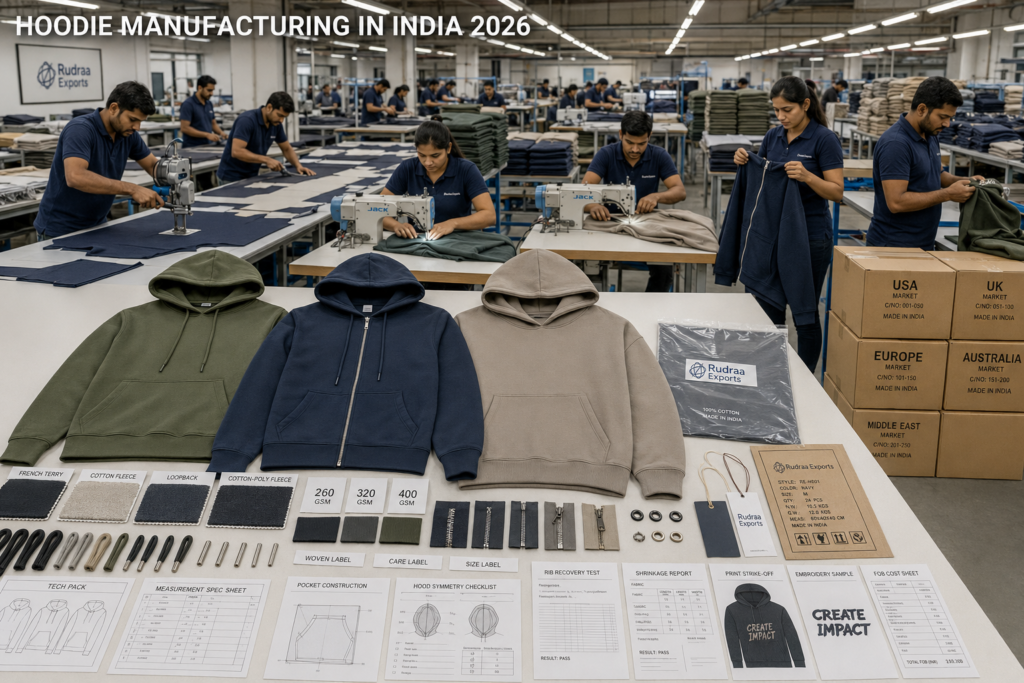
Hoodie Manufacturing in India: GSM, Fabric Types, MOQ and Pricing Guide for Brands
Hoodies are no longer only winter garments.
Today, brands use hoodies for streetwear, corporate merchandise, college apparel, sportswear, teamwear, travel retail, premium basics, uniforms, and private-label fashion drops.
But hoodie manufacturing is more technical than many buyers expect.
A hoodie involves fabric weight, GSM, shrinkage, hood shape, rib recovery, pocket construction, drawcord quality, zipper quality, embroidery stability, print durability, measurement control, and packing standards.
If these details are not controlled before bulk production, the final hoodie may feel too light, shrink after washing, lose rib shape, show poor embroidery, or fail to match the approved sample.
India, especially Tirupur, is a strong sourcing destination for knitwear-based hoodie programs because the cluster supports fabric sourcing, knitting, dyeing, printing, embroidery, stitching, finishing, quality control, and export packing.
At Rudraa Exports, we help global brands, streetwear founders, corporate buyers, and private-label businesses manufacture hoodies from Tirupur, India, with factory-direct pricing, sampling support, GSM guidance, MOQ planning, customization, QC, and export documentation.
Quick Answer
Hoodie manufacturing in India usually involves fabric selection, GSM selection, tech pack review, sampling, fit approval, trim approval, printing or embroidery approval, bulk production, quality inspection, packing, and export shipment. Common hoodie fabrics include French terry, cotton fleece, brushed fleece, cotton-poly fleece, and loopback fabrics. Lightweight hoodies often use 240–280 GSM, midweight hoodies use 300–340 GSM, and premium heavyweight hoodies may use 380–420 GSM. MOQ, pricing, and lead time depend on fabric, GSM, colour count, trims, decoration, and order quantity.
Planning to manufacture custom hoodies in India? Contact Rudraa Exports to request hoodie fabric options, GSM swatches, MOQ details, and a factory-direct quote.
Why Hoodie Manufacturing Needs Clear Specifications
A hoodie may look simple, but it has many technical parts.
Hoodie Components
| Component | What Must Be Controlled |
|---|---|
| Body fabric | GSM, composition, shrinkage, handfeel |
| Hood | Shape, lining, drawcord, symmetry |
| Kangaroo pocket, welt pocket, zipper pocket | |
| Rib | Cuff and hem recovery |
| Drawcord | Flat, round, tipped, colour |
| Zipper | Nylon, metal, one-way, two-way |
| Placement, technique, wash durability | |
| Embroidery | Density, backing, placement |
| Labels | Neck label, size label, care label |
| Packing | Folding, polybag, carton marking |
A strong hoodie program starts with a clear tech pack and sample approval process.
Why Tirupur Is Strong for Hoodie Manufacturing
Tirupur is one of India’s most important knitwear hubs.
For hoodie manufacturing, Tirupur is useful because many required processes are available within the same ecosystem.
Tirupur Hoodie Manufacturing Advantages
| Tirupur Strength | Buyer Benefit |
|---|---|
| Knitwear specialization | Strong fit for fleece and terry garments |
| Fabric sourcing | Access to cotton and cotton-blend knit fabrics |
| Dyeing and finishing | Better control over colour and handfeel |
| Printing support | Screen print, digital print, and placement options |
| Embroidery support | Logo and private-label branding |
| Export experience | Easier for USA, UK, EU, Australia, and Middle East buyers |
| MOQ flexibility | Useful for small and mid-size brands |
| Factory-direct models | Fewer middlemen and clearer accountability |
The uploaded source highlights Tirupur as a strong hoodie sourcing decision point because of its knitwear depth, export-ready systems, and evolving sustainability stack.
Common Hoodie Fabric Types
The fabric you choose decides the feel, warmth, structure, durability, print result, and cost of the hoodie.
1. French Terry Hoodies
French terry has loops on the inside and a smoother surface outside.
It is usually lighter and more breathable than brushed fleece.
Best For
- Corporate hoodies
- All-season hoodies
- Mild climate markets
- Premium casualwear
- Lightweight streetwear
- Travel merchandise
Typical GSM Range
| French Terry Type | Common GSM |
|---|---|
| Lightweight French terry | 240–260 GSM |
| Midweight French terry | 260–300 GSM |
| Heavy French terry | 300+ GSM |
Advantages
- Breathable
- Cleaner surface for printing
- Good for all-season wear
- Less bulky than fleece
- Comfortable for layering
Limitations
- Less warm than brushed fleece
- May not feel heavy enough for premium winter hoodies
2. Cotton Fleece Hoodies
Cotton fleece is soft, warm, and commonly used for premium hoodies.
It may be brushed inside to create a warmer and softer feel.
Best For
- Streetwear
- Premium hoodie blanks
- Winter hoodies
- College hoodies
- Corporate winter merchandise
- Retail basics
Typical GSM Range
| Cotton Fleece Type | Common GSM |
|---|---|
| Light fleece | 280–300 GSM |
| Midweight fleece | 300–350 GSM |
| Heavy fleece | 380–420 GSM |
The uploaded source notes that market examples commonly show French terry around 240–260 GSM and fleece around 300–350 GSM for hoodie programs.
Advantages
- Warm and soft
- Strong premium feel
- Good for embroidery
- Good structure
- Strong streetwear appeal
Limitations
- Higher fabric cost
- Heavier shipping weight
- May feel too warm in hot climates
- Needs shrinkage control
3. Cotton-Poly Blend Fleece Hoodies
Cotton-poly fleece combines cotton comfort with polyester durability.
Common blends include:
- 80% cotton / 20% polyester
- 70% cotton / 30% polyester
- 60% cotton / 40% polyester
Best For
- Teamwear
- Corporate hoodies
- College merchandise
- Travel apparel
- Active lifestyle hoodies
- Everyday casualwear
Advantages
- Better shape retention
- Lower shrinkage than 100% cotton
- Faster drying
- Good durability
- Often cost-efficient
Limitations
- Less natural than 100% cotton
- Handfeel depends on yarn and finishing
- Print curing must be controlled carefully
4. Loopback Hoodies
Loopback fabric is closely related to French terry.
It has a looped back surface and a smooth face.
Best For
- Premium casual hoodies
- All-season streetwear
- Light to midweight hoodie programs
- Corporate merchandise
- European and mild climate markets
Advantages
- Breathable
- Clean appearance
- Good drape
- Suitable for print and embroidery
- Less bulky than brushed fleece
Hoodie GSM Guide
GSM means grams per square metre.
It tells you the weight of the fabric.
For hoodies, GSM is one of the most important cost and feel drivers.
Hoodie GSM Comparison
| GSM Tier | Range | Feel | Best For |
|---|---|---|---|
| Lightweight | 240–280 GSM | Breathable, easier to layer | Corporate merch, mild climates |
| Midweight | 300–340 GSM | Balanced warmth and structure | Streetwear, college, DTC basics |
| Heavyweight | 380–420 GSM | Premium, warm, structured | Winter retail, premium streetwear |
| Ultra-heavy | 450+ GSM | Very dense and bold | Niche streetwear capsules |
Best GSM by Hoodie Use Case
| Use Case | Recommended GSM |
|---|---|
| Corporate hoodie | 260–320 GSM |
| Streetwear hoodie | 320–420 GSM |
| Premium blank hoodie | 380–450 GSM |
| College hoodie | 300–340 GSM |
| Travel hoodie | 260–320 GSM |
| Winter hoodie | 350–420 GSM |
| Lightweight merch hoodie | 240–280 GSM |
| Zip hoodie | 280–360 GSM |
| Oversized hoodie | 340–450 GSM |
How GSM Affects Hoodie Cost
Higher GSM usually increases cost because it uses more fabric per garment.
It also affects:
- Fabric cost
- Dyeing cost
- Finishing cost
- Carton weight
- Freight cost
- Landed cost
Example
A 260 GSM French terry hoodie will usually cost less than a 400 GSM heavy fleece hoodie because the heavy fleece uses more material and creates more shipment weight.
Buyer Tip
Do not choose heavy GSM only because it sounds premium.
Choose GSM based on:
- Climate
- Retail price
- Brand positioning
- Customer use case
- Decoration method
- Shipping cost
- Fit and silhouette
Hoodie MOQ in India
MOQ means Minimum Order Quantity.
For hoodies, MOQ depends on:
- Fabric type
- GSM
- Colour
- Dyeing requirement
- Rib requirement
- Drawcord
- Zipper
- Embroidery
- Label
- Packaging
- Size range
Common MOQ Logic
| MOQ Driver | Why It Matters |
|---|---|
| Fabric dyeing | Custom colours need minimum dye lots |
| GSM | Special heavy GSM may need planned fabric |
| Rib matching | Cuff and hem rib must match body |
| Colour count | More colours split the quantity |
| Trim customization | Custom drawcords, zips, labels add MOQ |
| Decoration | Print and embroidery setup need minimums |
The uploaded source notes that buyers should confirm MOQ by style, colour, and fabric dye lot because one MOQ number can hide different minimums.
How to Reduce Hoodie MOQ Pressure
| Problem | Better Approach |
|---|---|
| Too many colours | Start with 1–2 core colours |
| Too many trims | Use standard trims first |
| Special dyeing | Choose available fabric colours |
| Heavy GSM only | Test midweight first |
| Wide size range | Start with core sizes |
| Complex artwork | Use one clear decoration placement |
| Custom zipper | Use standard zipper for first run |
For new brands, MOQ flexibility is often more important than the absolute lowest unit price.
Hoodie Pricing in India
Hoodie pricing depends on the full specification.
A factory cannot give an accurate price without knowing the fabric, GSM, quantity, colours, trims, print, embroidery, labels, packing, and export requirement.
Hoodie Cost Components
| Cost Component | What It Includes |
|---|---|
| Fabric | Main body fabric and rib |
| Dyeing | Colour development and bulk dyeing |
| CMT | Cutting, stitching, finishing |
| Trims | Drawcord, eyelet, zipper, thread |
| Decoration | Print, embroidery, patch |
| Labels | Neck, size, care labels |
| Packing | Polybag, carton, barcode, hangtag |
| QC | Inline and final inspection |
| Export | Documentation and packing support |
Indicative Hoodie Pricing Framework
| Tier | Fabric / GSM | Order Volume | Typical FOB Planning Range |
|---|---|---|---|
| Basic hoodie | 240–280 GSM French terry | 500 pcs | Lower to mid range |
| Midweight hoodie | 300–340 GSM fleece | 1,000 pcs | Mid range |
| Premium hoodie | 380–420 GSM heavy fleece | 3,000 pcs | Higher range |
The uploaded source gives an indicative India/Tirupur pricing framework based on French terry, cotton fleece, heavyweight fleece, order volume, fabric, CMT, trims, and typical FOB ranges.
Buyer Tip
Always request two prices:
- Blank hoodie FOB price
- Decoration add-on price per placement
This helps you compare suppliers clearly.
Customization Options for Hoodies
Hoodies are highly customizable.
Common Customization Options
| Custom Area | Options |
|---|---|
| Fabric | French terry, fleece, cotton-poly blend |
| GSM | 240–450+ GSM |
| Fit | Regular, relaxed, oversized, cropped |
| Hood | Single-layer, double-layer, lined |
| Kangaroo, welt, zipper pocket | |
| Sleeve | Raglan, set-in, dropped shoulder |
| Rib | 1×1, 2×2, contrast rib |
| Drawcord | Flat, round, tipped, contrast |
| Zipper | Nylon, metal, one-way, two-way |
| Screen, DTG, puff, discharge | |
| Embroidery | Chest, sleeve, hood, patch |
| Labels | Woven, printed, heat transfer |
| Packaging | Polybag, carton, barcode, hangtag |
Pullover Hoodie vs Zip Hoodie
Pullover Hoodie
A pullover hoodie is simple and popular for streetwear and casualwear.
Best For
- Streetwear
- College hoodies
- Corporate merch
- Casual retail
- Premium blanks
Advantages
- Cleaner front design
- Lower trim complexity
- Good for large front prints
- Usually easier to manufacture
Zip Hoodie
A zip hoodie uses a front zipper.
Best For
- Corporate apparel
- Teamwear
- Travel apparel
- Layering
- Active lifestyle wear
Advantages
- Easier to wear and remove
- More functional
- Good for uniforms
- Better layering option
Extra Checks for Zip Hoodies
- Zipper quality
- Zipper wave
- Placket alignment
- Zipper stopper
- Shrinkage around zipper
- Symmetry after washing
Hoodie Quality Control Checklist
Hoodies need specific QC checks.
QC Areas
| QC Area | What to Check |
|---|---|
| GSM | Matches approved fabric |
| Shrinkage | Within accepted limit |
| Hood | Symmetry and size |
| Placement and attachment | |
| Rib | Recovery and colour match |
| Drawcord | Length, colour, tipping |
| Zipper | Smooth function and alignment |
| Placement and wash durability | |
| Embroidery | Density, backing, puckering |
| Measurements | Within tolerance |
| Stitching | Seam strength and neatness |
| Packing | Folding, polybag, carton marks |
Hoodie-Specific Failure Points
- Hood twisting
- Pocket slanting
- Rib loosening
- Shrinkage after wash
- Zipper wave
- Print cracking
- Embroidery puckering
- Shoulder seam pulling
- Sleeve length variation
The uploaded source highlights hoodie-specific QC areas such as seam strength, zipper durability, hood symmetry, cuff and hem rib recovery, pilling control, and measurement tolerances.
Hoodie Sampling Process
Before bulk production, approve samples carefully.
Sample Stages
| Sample | Purpose |
|---|---|
| Fabric swatch | Checks fabric and GSM |
| Lab dip | Checks colour |
| Proto sample | First physical hoodie |
| Fit sample | Checks measurement and fit |
| Size set | Checks grading across sizes |
| Print strike-off | Checks print quality |
| Embroidery sample | Checks logo execution |
| Pre-production sample | Final bulk reference |
| TOP sample | First production output |
Buyer Tip
For hoodies, always check the garment after wash.
Shrinkage and rib recovery are easier to catch before bulk than after customer complaints.
Hoodie Lead Time in India
Lead time depends on fabric availability, GSM, colour, trims, sample approvals, decoration, production load, and export packing.
Typical Timeline
| Stage | Typical Time |
|---|---|
| Tech pack review | 1–3 working days |
| Fabric swatch / lab dip | 5–10 working days |
| Proto / fit sample | 7–14 working days |
| Size set / PP sample | 7–14 working days |
| Bulk fabric and trims | Depends on availability |
| Bulk production | 20–45 working days depending on order |
| Final QC and packing | 3–7 working days |
| Export shipment | Depends on destination |
The uploaded source notes that some Tirupur suppliers quote hoodie bulk production cycles around 20–45 days depending on approvals, fabric booking, and factory planning.
Direct Factory vs Agent for Hoodie Manufacturing
A direct factory relationship gives better control.
Comparison
| Area | Direct Factory | Agent / Trader |
|---|---|---|
| Pricing | More transparent | Agent margin added |
| Communication | Direct with production team | Messages pass through layers |
| Fabric selection | Clearer | Depends on factory network |
| Sampling | Faster feedback loop | Slower due to relays |
| QC | More accountable | Depends on agent process |
| MOQ | More flexible discussion | May be hidden or bundled |
| Responsibility | One production partner | Blame can shift |
For hoodies, direct communication matters because decisions about GSM, rib, hood shape, shrinkage, embroidery, and finishing must be technical.
Why Rudraa Exports
Rudraa Exports supports hoodie manufacturing from Tirupur with factory-direct production, sampling, QC, customization, and export support.
Hoodie Manufacturing Capabilities
- Pullover hoodies
- Zip hoodies
- Oversized hoodies
- Streetwear hoodies
- Corporate hoodies
- College hoodies
- Teamwear hoodies
- Cotton fleece hoodies
- French terry hoodies
- Cotton-poly blend hoodies
- Private-label hoodies
- Printed and embroidered hoodies
Production Support
- Fabric and GSM guidance
- Hoodie tech pack review
- MOQ planning
- Fabric swatch support
- Lab dip coordination
- Fit sample development
- Size set support
- Print and embroidery approval
- Rib and trim selection
- AQL 2.5 inspection standards
- Export packing and documentation support
Manufacturing Strengths
- Factory-direct Tirupur knitwear manufacturing
- 72,000+ units per month production capacity
- MOQ discussions starting from around 300 pieces for suitable programs
- T-shirts, polos, sweatshirts, hoodies, joggers, leggings, kidswear, babywear, uniforms, activewear, corporate apparel, and private-label knitwear
- Multi-port shipping through Chennai, Tuticorin, and Cochin
Buyer Advantages
- Factory-direct pricing without trading-company markups
- Up to 40% cost-saving positioning compared with indirect sourcing models
- Better control over fabric, trims, sampling, and QC
- Stronger support for small-to-mid hoodie programs
- Export support for USA, UK, Europe, Australia, Middle East, and global buyers
Ready to manufacture hoodies in India? Speak with Rudraa Exports to share your hoodie tech pack, target GSM, quantity, colour count, decoration method, and destination market.
Hoodie Manufacturing Checklist for Buyers
| # | Checklist Item |
|---|---|
| 1 | Confirm hoodie type: pullover or zip |
| 2 | Choose fabric: fleece, French terry, or blend |
| 3 | Choose GSM range |
| 4 | Confirm fit: regular, relaxed, oversized |
| 5 | Confirm hood construction |
| 6 | Confirm pocket style |
| 7 | Confirm rib quality |
| 8 | Confirm drawcord and zipper if needed |
| 9 | Confirm print or embroidery placement |
| 10 | Confirm labels and packaging |
| 11 | Request fabric swatches |
| 12 | Approve lab dips |
| 13 | Approve fit sample |
| 14 | Approve size set |
| 15 | Approve PP sample |
| 16 | Run shrinkage and wash checks |
| 17 | Define QC checkpoints |
| 18 | Confirm MOQ by style and colour |
| 19 | Confirm blank and decoration pricing separately |
| 20 | Approve packing and export documents |
FAQ: Hoodie Manufacturing in India
1. Is India good for hoodie manufacturing?
Yes. India, especially Tirupur, is strong for knitwear-based hoodie manufacturing, including cotton fleece, French terry, cotton-poly blends, printed hoodies, embroidered hoodies, and private-label hoodie programs.
2. Which city is best for hoodie manufacturing in India?
Tirupur is one of the best cities for hoodie manufacturing because it has a strong knitwear ecosystem, fabric sourcing, dyeing, printing, embroidery, stitching, finishing, and export support.
3. What GSM is best for hoodies?
For lightweight hoodies, 240–280 GSM works well. For midweight hoodies, 300–340 GSM is common. For premium heavyweight hoodies, 380–420 GSM is suitable.
4. What is the best fabric for hoodies?
French terry is good for breathable all-season hoodies. Cotton fleece is good for warm premium hoodies. Cotton-poly blends are good for durability and lower shrinkage.
5. What is the MOQ for hoodie manufacturing in India?
MOQ depends on fabric, GSM, colour, trims, print, embroidery, and factory setup. Some suitable programs may start with low MOQs, while custom dyed and heavy GSM programs may require higher quantities.
6. How much does hoodie manufacturing cost in India?
Hoodie cost depends on GSM, fabric type, quantity, trims, print, embroidery, labels, packing, and export requirements. Buyers should request separate blank hoodie and decoration pricing.
7. Can I manufacture private-label hoodies in India?
Yes. Private-label hoodies can be manufactured with custom labels, size labels, care labels, hangtags, polybags, cartons, prints, embroidery, and packaging.
8. What is better for hoodies: French terry or fleece?
French terry is more breathable and lighter, making it good for all-season hoodies. Fleece is warmer and softer, making it better for premium or winter hoodies.
9. Can Rudraa Exports manufacture oversized hoodies?
Yes. Rudraa can support oversized hoodies, streetwear hoodies, heavyweight hoodies, printed hoodies, embroidered hoodies, and private-label hoodie programs.
10. What should I include in a hoodie tech pack?
Include hoodie type, fabric, GSM, measurements, tolerances, hood construction, pocket details, rib specs, drawcord, zipper, print or embroidery placement, labels, packing, and QC requirements.
11. How long does hoodie production take in India?
Production timing depends on fabric and trim availability, approvals, order size, and decoration. Bulk production may take around 20–45 working days for many programs after approvals, depending on the factory plan.
12. Can Rudraa Exports export hoodies to USA, UK, EU, and Australia?
Yes. Rudraa supports hoodie manufacturing and export packing for USA, UK, Europe, Australia, Middle East, and other global markets.
Conclusion
Hoodie manufacturing in India can be a strong option for brands that need quality, customization, MOQ flexibility, and export-ready production.
The key is to choose the right fabric, GSM, fit, trims, decoration method, and quality control plan before bulk production starts.
French terry works well for breathable all-season hoodies. Cotton fleece works well for warm and premium hoodies. Cotton-poly blends help with durability and lower shrinkage. GSM should be chosen based on market, climate, retail price, and customer expectation.
For global buyers, Tirupur offers a strong knitwear ecosystem for hoodie development, sampling, bulk production, finishing, packing, and export support.
Rudraa Exports helps brands move from hoodie concept to approved sample to bulk shipment through factory-direct manufacturing, technical guidance, QC, and export documentation.
Visit rudraaexports.com or contact our team directly to share your hoodie design, target GSM, fabric type, MOQ, colour count, and destination market — and receive a factory-direct hoodie manufacturing plan from Rudraa Exports.
Related reading
Hoodie Manufacturer in India: Why Source from Tirupur and When a Direct Factory Makes Sense
3 Factory Practices You Must Verify Before Placing a Heavyweight Knitwear Order
What GSM Means in T-Shirts: Complete Fabric Weight Guide for Buyers