
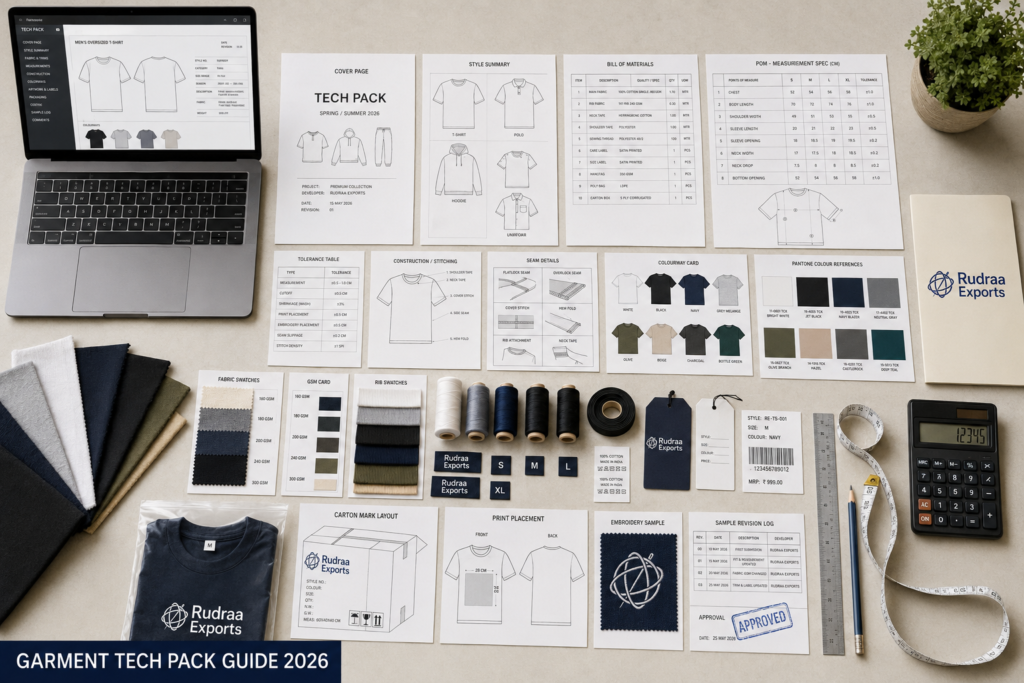
A garment tech pack is the most important document you send to a manufacturer.
It tells the factory exactly what to make.
Without a tech pack, the factory has to guess your fabric, measurements, stitching, trims, labels, colours, artwork placement, packaging, and quality expectations. When the factory guesses, samples come back wrong. Bulk production becomes risky. Costing becomes unclear. Timelines stretch.
A good tech pack becomes the single source of truth for your garment.
It helps the designer, buyer, merchandiser, pattern maker, sample room, production team, quality inspector, and packaging team stay aligned.
At Rudraa Exports, we help clothing brands, DTC founders, corporate apparel buyers, and private-label businesses convert product ideas into production-ready tech packs for T-shirts, polos, hoodies, sweatshirts, joggers, leggings, kidswear, babywear, uniforms, and export-ready knitwear from Tirupur, India.
Quick Answer
A garment tech pack is a detailed manufacturing document that explains how a garment should be made. It usually includes a cover page, technical flat sketches, Bill of Materials, measurement spec sheet, construction and stitching details, colourways, artwork placement, labels, packaging instructions, and revision history. A good tech pack helps factories create accurate samples, quote correctly, reduce mistakes, control quality, and move from sample to bulk production with fewer delays.
Planning to develop your first garment tech pack? Contact Rudraa Exports to share your product idea, reference sample, target GSM, MOQ, and launch timeline.
What Is a Garment Tech Pack?
A garment tech pack is a blueprint for manufacturing.
It explains the garment in technical detail so the factory can produce it correctly.
A Tech Pack Helps Define
- Product type
- Style code
- Fabric
- GSM
- Measurements
- Tolerances
- Stitching
- Trims
- Labels
- Colourways
- Artwork placement
- Packaging
- Quality checkpoints
- Revision history
The uploaded source describes a tech pack as the single source of truth that tells a manufacturer exactly what to make, including measurements, stitching, materials, colours, labels, and updates.
Why a Tech Pack Matters
A tech pack protects both buyer and factory.
For the buyer, it reduces the risk of wrong samples, unclear pricing, and bulk production mistakes.
For the factory, it gives clear instructions before costing, sourcing, sampling, and production.
Without a Tech Pack
| Problem | What Happens |
|---|---|
| No clear measurements | Fit becomes inconsistent |
| No fabric spec | Wrong GSM or handfeel |
| No BOM | Trims or labels may be missed |
| No stitching details | Factory uses default construction |
| No artwork placement | Print or embroidery may shift |
| No packaging details | Export packing becomes inconsistent |
| No revision log | Old changes may be repeated |
A clear tech pack reduces these problems before they become expensive.
Who Needs a Tech Pack?
You need a tech pack if you are developing:
- T-shirts
- Polo shirts
- Hoodies
- Sweatshirts
- Joggers
- Leggings
- Kidswear
- Babywear
- Activewear
- Corporate uniforms
- Workwear
- Private-label apparel
- Custom fashion garments
Even a simple T-shirt needs a basic tech pack.
The more custom the garment, the more detailed the tech pack should be.
Best Tools to Create a Tech Pack
You do not need expensive software to start, but you do need structure.
Tech Pack Tool Comparison
| Tool / Method | Best For | Limitation |
|---|---|---|
| Illustrator + PDF | Technical flats and professional layout | Higher learning curve |
| Excel / Google Sheets | Measurement specs, BOM, costing | Weak for visuals unless paired with sketches |
| Canva templates | Beginner-friendly layouts | Can look good but lack technical depth |
| Tech-pack platforms | Version control and structured workflow | Monthly software cost |
| Simple PDF template | First-time founders | Needs manual discipline |
The uploaded source compares manual Illustrator PDFs, Excel or Google Sheets, Canva templates, and specialist tech-pack platforms as different ways to create a tech pack.
Beginner Recommendation
For most first-time brands, a simple setup works:
- Canva or Illustrator for visual pages
- Google Sheets or Excel for measurements and BOM
- PDF export for factory sharing
- One revision log for all updates
The tool matters less than the clarity of the information.
The 8 Essential Sections of a Garment Tech Pack
A complete tech pack should include eight core sections.
Tech Pack Structure
| Section | Purpose |
|---|---|
| 1. Cover / Style Summary | Identifies the style |
| 2. Technical Flat Sketches | Shows garment construction visually |
| 3. Bill of Materials | Lists all materials and trims |
| 4. Measurement Spec Sheet | Defines fit and size grading |
| 5. Construction & Stitching Details | Explains how to make the garment |
| 6. Colourways & Artwork Placement | Controls colour and branding |
| 7. Labels & Packaging | Defines retail/export finishing |
| 8. Revision History | Tracks every update |
1. Cover Page / Style Summary
The cover page is the garment’s identity card.
Tip: Turn your measurement spec into a clean, branded size chart in seconds with our free Size Chart Builder — enter your brand name, choose a garment and unit, and download a ready-to-use size chart PDF for your tech pack.
It helps the factory understand what the style is before going into details.
Cover Page Should Include
| Item | Example |
|---|---|
| Brand name | Buyer brand |
| Style name | Oversized T-shirt |
| Style code | RE-TEE-001 |
| Season / drop | Summer 2026 |
| Product category | Men’s knit T-shirt |
| Size range | XS–XXL |
| Sample due date | 15 July 2026 |
| Target quantity | 1,000 pieces |
| Version number | V1.0 |
| Approval owner | Buyer / designer name |
Buyer Tip
Add version number and date on the cover page.
Example:
Version 1.2 — Updated 18 June 2026 — Approved by Buyer
This prevents old files from being used accidentally.
2. Technical Flat Sketches
Technical flats are simple front and back drawings of the garment.
They are not fashion illustrations.
They should show construction clearly.
Technical Flats Should Show
- Front view
- Back view
- Side details if needed
- Pocket position
- Collar shape
- Sleeve shape
- Hem detail
- Rib detail
- Placket detail
- Hood detail
- Print or embroidery placement
- Stitching lines
- Special panels
Example
For a hoodie, the flat sketch should show:
- Hood shape
- Drawcord
- Kangaroo pocket
- Rib cuff
- Rib hem
- Sleeve seam
- Shoulder seam
- Chest embroidery placement
- Back print placement if any
Common Mistake
Many beginners send lifestyle photos or moodboard images only.
These are useful references, but they are not technical flats.
A factory needs clear flat sketches to understand construction.
3. Bill of Materials
The Bill of Materials, or BOM, lists every component used in the garment.
This is where you control fabric, trims, labels, and packaging.
BOM Should Include
| BOM Item | Details to Add |
|---|---|
| Main fabric | Composition, GSM, knit type |
| Rib fabric | Composition, GSM, placement |
| Thread | Colour and type |
| Labels | Main label, size label, care label |
| Trims | Buttons, zippers, drawcords, eyelets |
| Artwork | Print, embroidery, patch |
| Packing | Polybag, carton, barcode, hangtag |
| Special finish | Wash, enzyme, softener, compacting |
Example BOM Entry
| Item | Placement | Specification | Colour | Notes |
|---|---|---|---|---|
| Main fabric | Body | 100% combed cotton, 180 GSM, single jersey | Black | Finished and compacted |
| Rib | Neck | 1×1 rib, 220 GSM | Black | Neck rib 2 cm finished width |
| Label | Neck | Woven brand label | Black / white | Centre back neck |
Buyer Tip
If a material changes, update the BOM immediately.
An outdated BOM is one of the biggest causes of sample mistakes.
4. Measurement Spec Sheet
The measurement spec sheet controls fit.
It tells the factory how each size should measure.
Measurement Spec Should Include
- POM number
- Point of Measure name
- How to measure
- Base size measurement
- Size grading
- Tolerance
- Unit of measurement
- Diagram if needed
Example Measurement Spec
| POM | How to Measure | Size M | Tolerance |
|---|---|---|---|
| Chest | 1 inch below armhole, flat seam to seam | 60 cm | ±1 cm |
| Body length | HPS to hem | 70 cm | ±1 cm |
| Shoulder | Shoulder point to shoulder point | 54 cm | ±1 cm |
| Sleeve length | Shoulder seam to cuff | 22 cm | ±0.5 cm |
| Neck rib width | Finished rib width | 2 cm | ±0.2 cm |
Why Tolerance Matters
No garment factory can produce every piece at the exact same measurement.
Tolerance defines the acceptable variation.
For example, if chest is 60 cm ±1 cm, then 59–61 cm is acceptable.
Without tolerance, fit disputes become subjective.
5. Construction and Stitching Details
This section tells the factory how to sew the garment.
If you do not specify construction, the factory may use its default method.
Construction Details Should Include
| Area | What to Specify |
|---|---|
| Neck | Rib width, stitch type, tape if needed |
| Shoulder | Seam type, reinforcement |
| Sleeve | Attachment method |
| Hem | Fold width, stitch type |
| Shape, opening, bartack points | |
| Hood | Lining, drawcord, eyelets |
| Side seam | Stitch type |
| Stress points | Reinforcement |
| SPI | Stitches per inch if required |
Example
For a premium T-shirt:
- Neck rib: 2 cm finished width
- Shoulder seam: overlock with shoulder tape
- Sleeve hem: 2.5 cm fold with coverstitch
- Bottom hem: 2.5 cm fold with coverstitch
- Side seam: 4-thread overlock
- Label: centre back neck, clean stitching
Buyer Tip
Add close-up reference photos for difficult construction areas.
6. Colourways and Artwork Placement
Colour and artwork must be exact.
Do not write only “cream” or “blue” unless you are okay with factory interpretation.
Colourway Page Should Include
- Colour name
- Pantone or TCX reference if available
- Fabric colour
- Rib colour
- Thread colour
- Print colour
- Embroidery colour
- Label colour
- Lab dip reference
Artwork Placement Should Include
| Artwork Detail | Example |
|---|---|
| Artwork file name | logo_front.ai |
| Technique | Screen print / embroidery |
| Size | 8 cm wide |
| Position | Left chest |
| Measurement from point | 7 cm below HPS |
| Colour | White |
| Finish | Matte print |
Example Placement Instruction
Left chest embroidery: 8 cm wide, positioned 7 cm below HPS and 9 cm from centre front.
This is much clearer than saying “small logo on chest.”
7. Labels and Packaging Instructions
Labels and packaging are part of the product.
They affect compliance, brand presentation, warehouse receiving, and customer experience.
Label Details
Include:
- Main brand label
- Size label
- Care label
- Country-of-origin label
- Fibre content
- Wash care symbols
- Barcode label if needed
- Batch or style code if needed
Packaging Details
Include:
- Folding method
- Polybag size
- Size sticker
- Barcode sticker
- Hangtag
- Tissue paper if needed
- Carton quantity
- Carton dimensions
- Carton marks
- Export packing instructions
Example Packaging Instruction
Each T-shirt folded individually, packed in clear recyclable polybag with size sticker at top-right corner, 50 pieces per export carton, carton labelled with style, colour, size breakdown, net weight, gross weight, and PO number.
8. Revision History
Revision history is the section beginners often ignore.
But it is one of the most important parts of a tech pack.
Every change should be written down.
Revision Log Example
| Version | Date | Change | Approved By |
|---|---|---|---|
| V1.0 | 01 June 2026 | First tech pack issued | Buyer |
| V1.1 | 07 June 2026 | Chest increased by 2 cm | Buyer |
| V1.2 | 12 June 2026 | Logo moved 1.5 cm up | Buyer |
| V1.3 | 15 June 2026 | Fabric changed to 180 GSM combed cotton | Buyer |
Buyer Rule
No change is final until it is updated in the tech pack.
Do not rely only on WhatsApp messages, emails, or verbal updates.
How to Submit a Tech Pack to a Manufacturer
Once the tech pack is ready, send it in a clean, organized format.
What to Send
- Final PDF tech pack
- Artwork files
- Logo files
- Measurement sheet if separate
- Reference images
- Label artwork
- Packaging artwork
- Target quantity
- Size ratio
- Colour ratio
- Target price
- Required sample type
- Delivery timeline
Email / Message Format
Subject: Tech Pack Submission for Sample Development — [Style Name]
Hi Team,
Please find attached the tech pack for [style name / code].
We would like to request sample development and costing based on the attached details.
Please confirm:
- Tech pack received
- Any unclear points
- Sample cost
- Sample lead time
- Bulk MOQ
- Estimated bulk price
- Fabric and trim availability
- Suggested improvements from factory side
Thank you.
Common Tech Pack Mistakes
| Mistake | Result |
|---|---|
| No measurement tolerance | Fit disputes |
| No BOM | Wrong materials |
| No construction details | Factory uses default stitching |
| No colour reference | Shade mismatch |
| No artwork placement measurement | Print or embroidery moves |
| No label instructions | Compliance or branding issue |
| No packaging details | Warehouse problems |
| No revision log | Old changes repeat |
| Sending many files without one final PDF | Confusion |
| Approving sample but not updating tech pack | Bulk mismatch |
Simple Tech Pack Checklist
| # | Checklist Item |
|---|---|
| 1 | Cover page added |
| 2 | Style code added |
| 3 | Version number added |
| 4 | Front and back flats added |
| 5 | Fabric spec added |
| 6 | BOM completed |
| 7 | Measurement POM table completed |
| 8 | Tolerances added |
| 9 | Construction callouts added |
| 10 | Colourways added |
| 11 | Artwork placement added |
| 12 | Label instructions added |
| 13 | Packaging instructions added |
| 14 | Quality checkpoints added |
| 15 | Revision log updated |
| 16 | Final PDF exported |
| 17 | Artwork files attached |
| 18 | Manufacturer questions answered |
| 19 | Sample changes recorded |
| 20 | Approved PP sample linked to final tech pack |
How Rudraa Exports Uses Tech Packs
Rudraa Exports uses tech packs as the control document for sampling and production.
Tech Pack Review Support
Rudraa can review:
- Product feasibility
- Fabric suitability
- GSM selection
- Construction details
- Measurement tolerances
- Print or embroidery placement
- Trim requirements
- Packaging instructions
- Export packing needs
- Sampling readiness
Production Workflow
The tech pack guides:
- Merchandising
- Fabric sourcing
- Pattern development
- Sampling
- Lab dips
- Print strike-offs
- Embroidery approval
- Fit corrections
- Pre-production approval
- Bulk production
- Quality inspection
- Packing and export documentation
A clear tech pack helps the factory produce closer to the buyer’s expectation from the first sample.
Why Rudraa Exports
Rudraa Exports supports clothing brands and global buyers with factory-direct knitwear manufacturing from Tirupur, India.
Manufacturing Capabilities
- Factory-direct Tirupur knitwear manufacturing
- 72,000+ units per month production capacity
- T-shirts, polos, sweatshirts, hoodies, joggers, leggings, kidswear, babywear, uniforms, activewear, corporate apparel, and private-label knitwear
- MOQ discussions starting from around 300 pieces for suitable programs
- Sampling support for startups and global buyers
- Bulk production planning for repeat programs
Buyer Support
- Tech pack review
- Fabric and GSM guidance
- BOM review
- Sample development
- Fit and measurement feedback
- Lab dip coordination
- Print and embroidery approval
- AQL 2.5 inspection standards
- Packaging and label guidance
- Export documentation support
Buyer Advantages
- Factory-direct pricing without trading-company markups
- Up to 40% cost-saving positioning compared with indirect sourcing models
- Better technical communication
- Lower sampling confusion
- Stronger production accountability
- Export support for USA, UK, Europe, Australia, Middle East, and global buyers
- Multi-port shipping through Chennai, Tuticorin, and Cochin
Ready to turn your idea into a production-ready tech pack? Speak with Rudraa Exports to share your design, reference product, target GSM, MOQ, and sample requirement.
FAQ: How to Write a Garment Tech Pack
1. What is a garment tech pack?
A garment tech pack is a technical document that tells a manufacturer how to make a garment. It includes sketches, measurements, fabrics, trims, stitching, labels, packaging, and revision notes.
2. Do I need a tech pack to manufacture clothes?
Yes. A tech pack is strongly recommended because it reduces sample mistakes, improves costing accuracy, and gives the factory clear production instructions.
3. Can I make a tech pack without fashion experience?
Yes. You can create a basic tech pack using templates, Google Sheets, Canva, Illustrator, or a tech-pack platform if you follow a clear structure.
4. What should be included in a tech pack?
A tech pack should include cover page, technical flats, BOM, measurement spec sheet, construction details, colourways, artwork placement, labels, packaging, and revision history.
5. What is a BOM in a tech pack?
BOM means Bill of Materials. It lists all materials used in the garment, including fabric, rib, thread, labels, trims, artwork, hangtags, polybags, and cartons.
6. What is POM in a tech pack?
POM means Point of Measure. It defines where and how each measurement should be taken, such as chest, body length, shoulder, sleeve, and hem.
7. Why are tolerances important?
Tolerances define acceptable measurement variation. For example, if chest is 60 cm ±1 cm, then 59–61 cm may be acceptable.
8. Can I use Canva for a tech pack?
Yes, Canva can help with layout and visuals, but it should be supported with proper measurement specs, BOM, construction callouts, and revision tracking.
9. What file format should I send to a manufacturer?
Send one clear PDF tech pack, along with editable artwork files, logo files, label files, and any source measurement sheets if needed.
10. Should the tech pack be updated after sampling?
Yes. Every sample correction should be updated in the tech pack before the next sample or bulk production.
11. Can Rudraa Exports help review tech packs?
Yes. Rudraa can review tech packs for fabric, GSM, construction, measurements, sampling feasibility, packaging, and export production readiness.
12. What happens if I do not have a tech pack?
If you do not have a tech pack, the factory may still help based on reference samples or photos, but the risk of miscommunication, wrong samples, and unclear costing is higher.
Conclusion
A garment tech pack is the foundation of successful clothing manufacturing.
It is the document that turns your design idea into clear factory instructions.
A strong tech pack includes cover page, technical flats, BOM, measurement specs, tolerances, stitching details, colourways, artwork placement, labels, packaging, and revision history.
For beginners, the tech pack does not need to be complicated, but it must be clear. The goal is simple: reduce assumptions.
When the manufacturer has clear instructions, your samples are more accurate, your costing is cleaner, your revisions are easier, and your bulk production becomes safer.
For brands sourcing T-shirts, polos, hoodies, sweatshirts, joggers, kidswear, babywear, uniforms, and private-label apparel from India, Rudraa Exports can help review your tech pack and guide it into sample development and production.
Visit rudraaexports.com or contact our team directly to share your design idea, reference product, tech pack draft, or target garment — and receive a factory-direct manufacturing review from Rudraa Exports.
Related reading
How to Perfect Garment Patterns for a Flawless Fit: Guide for Clothing Brands
How to Get Samples from a Garment Manufacturer in India: Step-by-Step Buyer Guide
Cut-and-Sew vs Blank Customisation: Which Model Fits Your Australian Streetwear Brand?