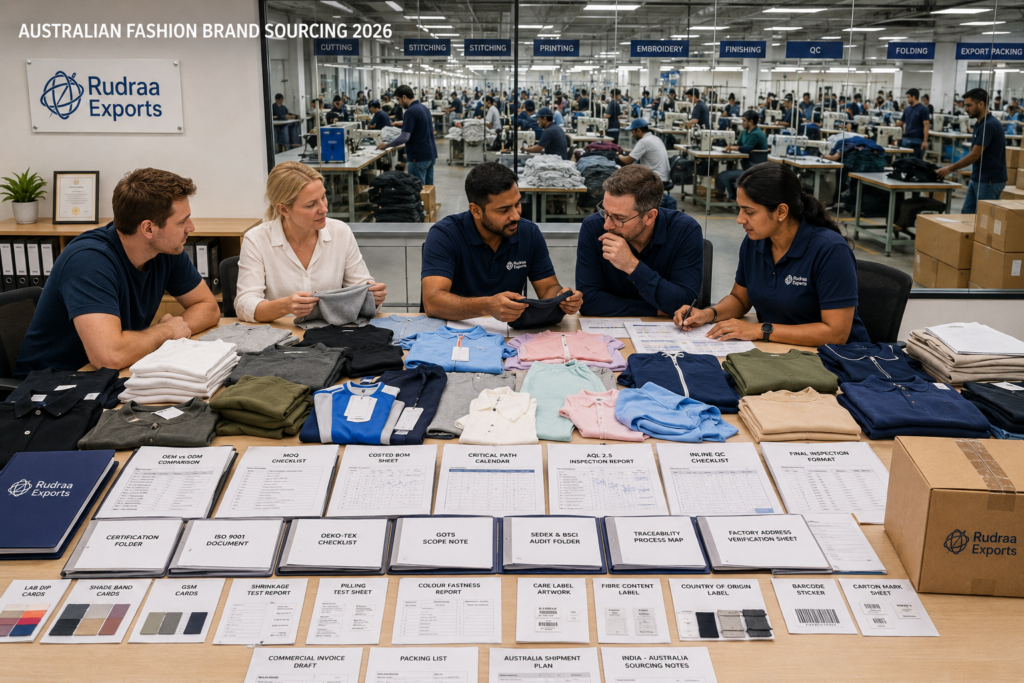
For Australian fashion brands, choosing an overseas garment manufacturer is not only a cost decision.
It is a risk decision.
The right manufacturer can help you build consistent products, protect launch timelines, control quality, manage compliance documentation, and scale repeat orders.
The wrong manufacturer can create delays, poor fit, shade mismatch, shrinkage issues, unclear pricing, weak communication, and expensive bulk production mistakes.
This matters even more for knitwear products such as T-shirts, polos, hoodies, sweatshirts, fleece, joggers, kidswear, babywear, uniforms, and private-label basics.
Knitwear quality depends on fabric GSM, shrinkage control, colour consistency, stitching, finishing, measurements, and repeat production discipline.
At Rudraa Exports, we help Australian fashion brands source knitwear and private-label apparel from Tirupur, India, with factory-direct production, sampling support, MOQ planning, AQL inspection, compliance documentation, export packing, and shipment coordination.
Quick Answer
Australian fashion brands should choose a garment manufacturer by checking OEM/ODM capability, MOQ by style and colour, fabric MOQ, sampling timeline, bulk lead time, AQL inspection process, certification documents, factory transparency, cost breakdown, communication quality, and export readiness. For knitwear, Tirupur in India is a strong sourcing hub because it has fabric, dyeing, printing, embroidery, stitching, finishing, QC, and export support in one ecosystem. A direct-factory partner like Rudraa Exports can reduce middle layers and improve visibility from sampling to shipment.
Planning to source garments from India for your Australian fashion brand? Contact Rudraa Exports to request a factory-direct sourcing review.
Why Australian Fashion Brands Need a Structured Supplier Vetting Process
A reliable manufacturer should not be selected only because they reply quickly or offer a low price.
You need proof.
A Reliable Manufacturer Should Provide
| Area | What to Verify |
|---|---|
| Product capability | Can they make your garment type? |
| OEM / ODM model | Do they execute your design or offer ready blocks? |
| MOQ | Is MOQ by style, colour, fabric, or order? |
| Lead time | Do they provide a written critical path? |
| QC system | Do they use inline and final inspection? |
| AQL standard | Is AQL level clearly defined? |
| Certifications | Are documents valid and relevant? |
| Costing | Is price itemised? |
| Traceability | Do they own production or subcontract? |
| Export support | Can they handle packing and documents? |
The uploaded source explains that Australian brands should vet manufacturers with a structured scorecard, proof-based checks, and staged commitments instead of relying on claims.
What “Reliable” Means in Garment Manufacturing
A reliable manufacturer repeatedly meets your specifications, timeline, quality standard, and compliance expectations.
Reliability Means
- Samples match your tech pack
- Bulk matches approved sample
- Fabric GSM is controlled
- Shrinkage stays within tolerance
- Colours match approved lab dips
- Measurements stay within tolerance
- QC checks are documented
- Lead time is realistic
- Communication is clear
- Export documents are accurate
- Problems are escalated early
Reliability is not a promise.
It is a system.
Why Tirupur Is a Strong Knitwear Base for Australian Brands
Tirupur, Tamil Nadu, is one of India’s strongest knitwear manufacturing hubs.
It is especially suitable for Australian brands sourcing:
- T-shirts
- Polo shirts
- Hoodies
- Sweatshirts
- Joggers
- Leggings
- Kidswear
- Babywear
- School uniforms
- Corporate apparel
- Activewear
- Private-label basics
Tirupur Strengths for Australian Buyers
| Tirupur Strength | Buyer Benefit |
|---|---|
| Knitwear specialization | Better for tees, fleece, sweats and basics |
| Fabric availability | Cotton, blends, fleece, French terry, rib |
| Dyeing and finishing | Better colour and shrinkage control |
| Printing and embroidery | Useful for branding and graphics |
| Export experience | Supports global shipment workflows |
| Cluster ecosystem | Fewer handoffs and faster coordination |
| Compliance culture | Better support for retailer requirements |
| Direct factory options | More transparent pricing and accountability |
The uploaded source notes that Tirupur is widely regarded as India’s knitwear capital and is frequently cited as a major driver of India’s knitwear exports.
Direct Factory vs Agent vs Trading Company vs Platform
Australian brands can source through different models.
Each has advantages and risks.
Sourcing Model Comparison
| Model | Best For | Main Risk |
|---|---|---|
| Direct factory | Quality control, repeat orders, cost transparency | Buyer must vet properly |
| Sourcing agent | First-time importers, multi-country sourcing | Less pricing transparency |
| Trading company | Convenience and bundled sourcing | Subcontracting and traceability risk |
| Online platform | Supplier discovery | Claims may not equal capability |
| Buying office | Large multi-category programs | Higher service cost |
The uploaded source compares direct factory sourcing, sourcing agents, trading companies, and online platforms, explaining that Australian brands should match the sourcing model to their stage and risk tolerance.
Why Direct Factory Sourcing Works for Knitwear
A direct factory relationship can reduce confusion and cost.
Direct Factory Advantages
| Advantage | Why It Helps |
|---|---|
| Better unit economics | Fewer middle layers |
| Direct accountability | Factory owns production |
| Faster technical feedback | Fit and fabric issues handled directly |
| Clearer costing | Fabric, trims, CMT and packing can be separated |
| Better QC visibility | Inline and final checks are easier to track |
| Easier repeat orders | Same team controls approved specs |
| Lower traceability risk | Production path is clearer |
The uploaded source gives an example where agent or trader margins can significantly increase total order cost compared with a direct factory model.
OEM vs ODM: What Australian Brands Should Know
Before contacting suppliers, decide whether you need OEM or ODM.
OEM Manufacturing
OEM means Original Equipment Manufacturing.
You provide the design, tech pack, measurements, fabric direction, trims, labels, and packaging instructions.
The factory manufactures according to your specification.
ODM Manufacturing
ODM means Original Design Manufacturing.
The factory provides existing blocks, designs, or fabric options that you can modify.
OEM vs ODM Comparison
| Criteria | OEM | ODM |
|---|---|---|
| Design control | High | Medium |
| Speed | Slower | Faster |
| Uniqueness | Higher | Lower |
| Development work | Buyer-led | Factory-supported |
| Best for | Strong brand identity | Fast market entry |
| IP control | Stronger | Depends on agreement |
The uploaded source explains that OEM gives stronger design ownership and spec control, while ODM can reduce development time by using existing designs or blocks.
MOQ: What Australian Brands Should Ask
MOQ means Minimum Order Quantity.
Do not ask only: “What is your MOQ?”
Ask more specifically.
MOQ Questions
| Question | Why It Matters |
|---|---|
| What is MOQ per style? | Style-level planning |
| What is MOQ per colour? | Colour split affects cost |
| What is fabric MOQ? | Fabric may drive true minimum |
| What is trim MOQ? | Labels, zippers, elastic may add limits |
| Can you support sampling MOQ? | Useful for new brands |
| What happens on repeat order? | Reorders may get better terms |
| Is low MOQ available for stock fabric? | Helps first launches |
Buyer Tip
A low MOQ is not always better.
Very low MOQ with custom fabric may create high unit cost, shade issues, or fabric compromises.
Lead Time: What Is Realistic?
A reliable manufacturer should give a written critical path.
Critical Path Should Include
| Stage | What to Track |
|---|---|
| Tech pack review | Feasibility and questions |
| Fabric sourcing | Stock or custom |
| Lab dip | Colour approval |
| Sampling | Proto, fit, size set |
| Print / embroidery | Strike-off approval |
| PP sample | Final bulk approval |
| Bulk production | Cutting, sewing, finishing |
| QC | Inline and final inspection |
| Packing | Labels, cartons, ratios |
| Export documents | Invoice, packing list, shipment documents |
| Freight | Air or sea shipment |
The uploaded source notes that brands should request a critical path timeline before approving sampling, because reliable factories plan first and promise second.
Quality Control and AQL
AQL means Acceptable Quality Limit.
It is a common inspection system used to decide whether a shipment passes or fails based on sampled pieces.
Common AQL Planning
| AQL Level | Use Case |
|---|---|
| AQL 1.5 | Premium or stricter quality programs |
| AQL 2.5 | Common general apparel inspection |
| AQL 4.0 | Budget or less strict programs |
QC Stages to Confirm
| QC Stage | What to Check |
|---|---|
| Fabric inspection | GSM, shade, defects, shrinkage |
| Cutting inspection | Panel accuracy and marker control |
| Inline inspection | Stitching and measurements during production |
| Midline inspection | Early defect correction |
| Final inspection | AQL, labels, packing and carton checks |
| Shipment sample | Confirms final production output |
The uploaded source recommends asking every supplier to confirm their inspection standard, such as AQL 2.5, and share a recent final inspection report format.
Certification and Compliance Checklist
Australian brands should verify certificates instead of accepting logo claims.
Common Certifications and Standards
| Certification / Standard | Why It Matters |
|---|---|
| ISO 9001:2015 | Quality management system |
| OEKO-TEX Standard 100 | Chemical safety |
| GOTS | Organic textile processing and traceability |
| GRS / RCS | Recycled material claims |
| BSCI | Social compliance |
| SEDEX / SMETA | Ethical trade visibility |
| WRAP | Responsible production |
| AQL inspection | Quality acceptance system |
What to Request
Ask for:
- Certificate copy
- Certificate number
- Validity date
- Scope
- Factory legal entity
- Product category covered
- Processing unit coverage
- Audit summary if available
The uploaded source highlights that Australian brands should request certificate numbers, audit summaries, and documents that match the legal entity they are paying.
Australia-Specific Sourcing Considerations
Australian fashion brands should also plan for import, labelling, compliance, and landed cost.
Key Areas to Check
| Area | What to Confirm |
|---|---|
| Fibre content label | Accurate material composition |
| Country of origin | Correct origin statement |
| Care instructions | Washing and care guidance |
| Kidswear safety | Small parts and drawcord risks |
| Packaging | Barcode, carton marks, polybag warning if needed |
| Export documents | Commercial invoice and packing list |
| Incoterms | FOB, CIF, DDP depending on agreement |
| Landed cost | Freight, duty, GST, clearance and local delivery |
Buyer Tip
Do not leave labelling decisions until shipment stage.
Confirm fibre, care, size, barcode, and country-of-origin requirements before bulk production.
Red Flags When Choosing a Garment Manufacturer
Be careful if a supplier shows these signs.
Supplier Red Flags
| Red Flag | Why It Is Risky |
|---|---|
| No factory address | Traceability issue |
| No certificate numbers | Compliance may be weak |
| Vague “we can do everything” claim | Capability may be unclear |
| No inspection report format | QC system may be weak |
| All-in price only | Cost breakdown is hidden |
| MOQ keeps changing | Fabric or capacity issue |
| Unrealistic lead time | Delays likely |
| Slow sampling communication | Bulk communication may be worse |
| No process flow map | Subcontracting risk |
| No clear escalation path | Problems may not get solved |
The uploaded source warns that inconsistent MOQs, vague pricing, missing audit documents, slow communication, missing compliance documents, and unclear traceability should be treated as stop-or-investigate signals.
Step-by-Step Vetting Process for Australian Brands
Use a phased approach before placing a large PO.
Phase 1: Shortlist
Define:
- Product category
- Target MOQ
- Target FOB
- Fabric
- GSM
- Required certifications
- AQL target
- Destination market
- Timeline
Request:
- Factory profile
- Capability deck
- Product photos
- Machine list
- Monthly capacity
- Export experience
- Costing format
Phase 2: Proof Checks
Verify:
- Factory address
- Legal entity
- Certification documents
- Audit records
- QC process
- Inspection stages
- Production unit list
- Subcontracting policy
- Export documentation support
Phase 3: Sampling
Approve:
- Fabric swatch
- Lab dip
- Proto sample
- Fit sample
- Print or embroidery strike-off
- Size set
- PP sample
Run tests for:
- Shrinkage
- Pilling
- Colour fastness
- Measurement tolerance
- Wash durability
Phase 4: Controlled First Order
Start with:
- One style
- One or two colours
- Clear size ratio
- Approved fabric
- Approved PP sample
- Defined QC checkpoints
- Confirmed packing and documents
Then scale after the first order performs well.
The uploaded source recommends staged supplier validation through shortlisting, proof checks, sampling with pass/fail gates, pre-production confirmation, and a controlled first bulk order.
Printable Manufacturer Vetting Checklist
| # | Checklist Item |
|---|---|
| 1 | OEM or ODM model confirmed |
| 2 | Product category capability verified |
| 3 | MOQ confirmed by style and colour |
| 4 | Fabric MOQ confirmed |
| 5 | Trim MOQ confirmed |
| 6 | Written critical path received |
| 7 | AQL level agreed |
| 8 | Inline inspection confirmed |
| 9 | Final inspection format received |
| 10 | Certificate copies received |
| 11 | Certificate scope checked |
| 12 | Factory address verified |
| 13 | Production unit list received |
| 14 | Costing itemised |
| 15 | Fabric test plan agreed |
| 16 | Labelling plan confirmed |
| 17 | Packing plan confirmed |
| 18 | Escalation contact confirmed |
| 19 | PP sample approved |
| 20 | First order kept controlled |
Why Rudraa Exports
Rudraa Exports supports Australian fashion brands with factory-direct knitwear manufacturing from Tirupur, India.
Product Categories Supported
- T-shirts
- Polo shirts
- Hoodies
- Sweatshirts
- Joggers
- Leggings
- Kidswear
- Babywear
- Nightwear
- Uniforms
- Corporate apparel
- Activewear
- Private-label knitwear
Buyer Support
- OEM and private-label manufacturing support
- Tech pack review
- Fabric and GSM guidance
- Sampling support
- Pattern and fit review
- Lab dip coordination
- Print and embroidery approval
- Label and packaging support
- AQL 2.5 inspection standards
- Export packing and documentation support
- Shipment coordination through Indian ports
Manufacturing Strengths
- Factory-direct Tirupur knitwear manufacturing
- 72,000+ units per month production capacity
- MOQ discussions starting from around 300 pieces for suitable programs
- 500+ workers / professionals
- Multi-port shipping through Chennai, Tuticorin, and Cochin
- Export support for Australia, USA, UK, Europe, Middle East, and global buyers
Buyer Advantages
- Fewer middle layers
- Clearer cost discussion
- Better communication from sampling to shipment
- Stronger visibility over fabric, trims, QC and packing
- Better support for repeat knitwear programs
- Factory-direct pricing without trading-company markups
- Up to 40% cost-saving positioning compared with indirect sourcing models
- Export-ready production support for Australian brands
Ready to source knitwear from India for your Australian fashion brand? Speak with Rudraa Exports to share your tech pack, product category, MOQ, fabric, GSM, certification needs, and delivery timeline.
FAQ: Garment Manufacturer for Australian Fashion Brands
1. How do I find a reliable garment manufacturer for my Australian fashion brand?
Use a structured vetting process. Check product capability, MOQ, lead time, QC system, AQL level, certifications, factory address, cost breakdown, sampling process, and export documentation.
2. Is India good for Australian fashion brands?
Yes. India is a strong option for Australian fashion brands, especially for knitwear categories such as T-shirts, polos, hoodies, sweatshirts, joggers, kidswear, uniforms, activewear, and private-label basics.
3. Why choose Tirupur for knitwear manufacturing?
Tirupur is one of India’s strongest knitwear hubs, with fabric, dyeing, printing, embroidery, stitching, finishing, QC, and export support available within the cluster.
4. Should I work with a direct factory or sourcing agent?
A direct factory is better when you need cost transparency, technical control, repeat production, and clear accountability. A sourcing agent may help if you need multi-country sourcing or full coordination support.
5. What is the MOQ for garment manufacturing in India?
MOQ depends on product type, fabric, colour, size range, trims, labels, packaging, and certification needs. Some suitable programs may start lower, while custom fabric or complex products may require higher quantities.
6. What is OEM clothing manufacturing?
OEM means the buyer provides the design and technical details, and the factory manufactures according to the buyer’s specification.
7. What is ODM clothing manufacturing?
ODM means the factory provides existing styles, blocks, or designs that the buyer can adapt for faster market entry.
8. What is AQL in garment inspection?
AQL means Acceptable Quality Limit. It is used to inspect a sample quantity from bulk production and decide whether the shipment passes or fails.
9. What certifications should Australian brands check?
Australian buyers may check ISO 9001, OEKO-TEX, GOTS, GRS, BSCI, SEDEX / SMETA, WRAP, and buyer-specific compliance requirements depending on the product and market.
10. What should I send to get a quote from Rudraa Exports?
Send your tech pack, reference sample photos, product category, fabric composition, GSM, quantity, colours, size range, print or embroidery details, labels, packaging, certification needs, and destination in Australia.
11. Can Rudraa Exports export garments to Australia?
Yes. Rudraa supports export-ready garment production for Australian buyers, including sampling, production, QC, packing, and documentation support.
12. How can I reduce sourcing risk?
Start with a focused product line, verify certificates, approve samples properly, define AQL, use a controlled first order, and scale only after the first bulk order performs well.
Conclusion
Finding a reliable garment manufacturer for your Australian fashion brand requires more than comparing prices.
You need to verify capability, MOQ, lead time, quality systems, AQL inspection, certification documents, factory transparency, communication, export readiness, and cost structure.
For knitwear-focused brands, Tirupur is a strong sourcing base because it offers fabric, processing, stitching, printing, finishing, QC, and export support in one manufacturing ecosystem.
A direct-factory partner can help Australian brands reduce middle layers, improve cost visibility, control sampling, reduce production risk, and build repeatable knitwear programs.
Rudraa Exports helps Australian fashion brands manufacture T-shirts, polos, hoodies, sweatshirts, joggers, leggings, uniforms, kidswear, activewear, and private-label knitwear from Tirupur with factory-direct coordination, AQL inspection, export packing, and documentation support.
Visit rudraaexports.com or contact our team directly to share your range plan, tech pack, MOQ, fabric, GSM, certification needs, and Australian delivery timeline — and receive a factory-direct sourcing plan from Rudraa Exports.
Related reading
What Australian Brands Need to Know Before Ordering from an Overseas Garment Factory
How to Verify a Brand-New Overseas Garment Manufacturer Before Paying a Deposit
Best Garment Manufacturers in Tirupur, India: Complete Guide 2026