
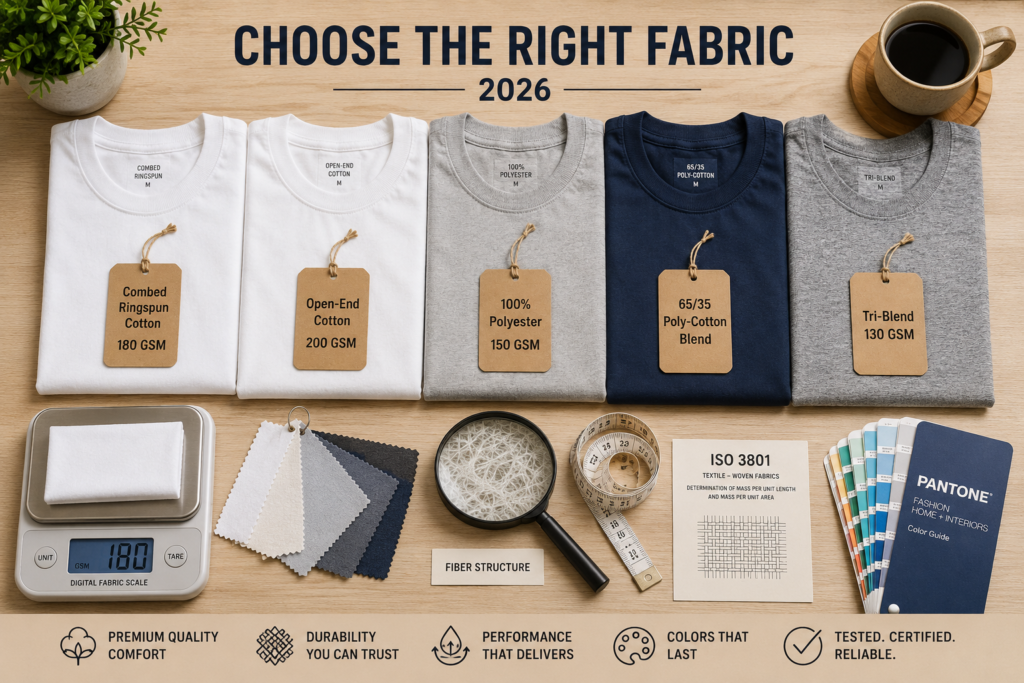
Custom T-shirts look simple — but fabric decisions silently drive your unit cost, print quality, returns rate, and compliance risk. In bulk programs (teamwear, corporate uniforms, private-label basics, event merch), the wrong fabric typically shows up later as shrinkage after laundering, pilling on the chest where lanyards rub, color fade that breaks brand standards, or a “premium” handfeel that doesn’t survive five washes.
This 2026 guide gives sourcing managers and brand owners a specification-led framework for choosing the right T-shirt fabric. You’ll learn the real differences between cotton (ringspun vs open-end), polyester, and blends — plus how to evaluate GSM, breathability, durability, care, and supply reliability. Concrete sourcing scenarios, factory-ready GSM testing tips using ISO 3801/ASTM D3776, and a downloadable checklist template are included.
At the end, you’ll see how Rudraa Exports — a factory-direct Tirupur, India manufacturer — operationalizes this framework for international buyers in 2026.
Quick Answer: How Do I Choose the Right Fabric for Custom T-Shirts in 2026?
To choose the right fabric for custom T-shirts in bulk in 2026, follow a 6-step framework: (1) define end-use and climate first, (2) choose between cotton, polyester, or blends based on performance needs, (3) specify yarn type (combed ringspun for premium, open-end for budget bulk), (4) set GSM targets (120–150 lightweight, 150–180 midweight, 200+ heavyweight), (5) require testable performance metrics (shrinkage <2% for blends, <5–8% for cotton; pilling grade 3+ on ISO 12945; colorfastness via AATCC TM 61), and (6) verify with ISO 3801 or ASTM D3776 GSM testing. The best T-shirt fabric depends on use: combed ringspun cotton for premium retail basics, 65/35 poly-cotton for corporate uniforms, 100% polyester for performance and sports, and tri-blends for vintage soft lifestyle drops.
Why Fabric Choice Is a Sourcing Decision (Not Just a Handfeel Preference)
For bulk buyers, the “right” T-shirt fabric is the one that meets end-use performance at the lowest total landed cost while staying within brand and compliance guardrails.
You’re not buying a swatch — you’re buying a repeatable production outcome across batches, sizes, colors, and seasons. The wrong fabric specification creates downstream costs that easily exceed any per-unit savings:
- Returns from shrinkage and shape distortion
- Reprints from poor color contrast or fading
- Replacement orders from premature pilling
- Customer complaints from inconsistent reorders
- Compliance failures from missing certifications
The Core T-Shirt Fabric Families in 2026
Most custom T-shirts are single-jersey knits made from three fabric families:
1. Cotton
- Combed ringspun — Premium, smoother, stronger
- Carded open-end (OE) — Cost-efficient, coarser, robust
2. Polyester Jersey
- Typically chosen for shape stability, durability, and performance use
3. Blends
- 65/35 poly-cotton — Uniform and workhorse blend
- Tri-blends (poly/cotton/rayon) — Soft, vintage aesthetic
GSM (Grams Per Square Meter): The Universal Fabric Weight Benchmark
Fabric mass per unit area is expressed as GSM — the most important single number in T-shirt fabric specification.
| GSM Range | Category | Best For |
|---|---|---|
| 120–150 GSM | Lightweight | Hot climates, summer drops, lower shipping weight |
| 150–180 GSM | Midweight | Balanced comfort and durability, corporate basics |
| 200+ GSM | Heavyweight | Structure, opacity, premium “substantial” feel, cool markets |
Critical buyer rule: Nominal GSM can drift by lot. Always test using ISO 3801 or ASTM D3776 standards and require per-lot verification.
The 6-Step Fabric Selection Framework for 2026
Step 1: Start with End-Use and Climate (Then Work Backward to Fiber + GSM)
Before comparing cotton vs polyester, define the operating context:
Decision lens:
- Heat + humidity + movement → Polyester or performance blends (moisture management)
- Everyday retail/casual → Combed ringspun cotton or cotton-rich blends (comfort + print versatility)
- Institutional uniforms → 65/35 blends (dimensional stability, easy care)
- Performance/sports → Polyester or poly-spandex blends
- Premium streetwear → Heavyweight ringspun cotton (200+ GSM)
GSM mapping by climate:
| Climate | Recommended GSM |
|---|---|
| Tropical/hot markets | 120–150 GSM |
| Temperate/all-season | 150–180 GSM |
| Cool weather/premium streetwear | 200+ GSM |
Real-world examples:
- Resort merch (Southeast Asia): 130–150 GSM combed ringspun reduces heat retention while preserving premium handfeel
- Logistics warehouse uniforms: 160–220 GSM 65/35 blend improves shape retention across shifts and wash cycles
- Winter promo drop: 220+ GSM combed cotton signals quality with boxier silhouette
Step 2: Choose Cotton Intelligently — Combed Ringspun vs Open-End
“100% cotton” is not one quality level. Two cotton tees can have the same GSM but very different performance because of how the yarn was spun.
Combed Ringspun Cotton (Premium Default)
Combed ringspun is made from better-aligned fibers and tighter twisting. Industry research consistently shows ringspun is smoother, softer, and stronger than open-end cotton.
Performance benchmark: Ringspun yarns are typically 15–20% stronger than open-end yarns, translating to better wear resistance over time.
Typical GSM range: 120–160 GSM (lightweight/summer) up to 220 GSM (premium heavyweight).
Where ringspun wins:
- Premium handfeel for DTC and private-label basics
- Better print base with consistent color reproduction
- Lower complaint rates on “scratchiness”
- Stronger long-term wear performance
Best-fit programs:
- Private-label essentials (160 GSM combed ringspun positions “soft premium basics”)
- Corporate gifting (premium feel carries brand even with small logos)
- Tour merch (softness drives kiosk conversion)
- DTC fashion brands prioritizing customer reviews
Carded Open-End (OE) Cotton (Cost-Efficient Workhorse)
OE cotton is used for budget or mass event tees. Typically coarser and less refined, frequently available around 180–200 GSM where heavier weight reduces show-through.
Where OE fits:
- Large event runs where unit cost dominates
- Programs where “sturdy” matters more than softness
- Short-to-medium wear expectation
- Suppliers with strong OE capacity and tight lead times
Best-fit programs:
- Political/civic event tees (cost-sensitive, heavy GSM reduces stage-light transparency)
- School house tees (handles rough use)
- Budget retail packs labeled “value basics”
Cotton risk controls for bulk buyers:
- Specify shrinkage and skew limits in QC plan (cotton can shrink 5–8% without control)
- Confirm whether fabric is pre-shrunk or compacted
- Align stitch density with durability targets
Step 3: Evaluate Polyester Jersey for Performance and Color Consistency
Polyester is a workhorse fiber where appearance after laundering and performance use matter.
Polyester performance benchmarks:
- Shrinkage: Often less than 0.5% after multiple washes for 100% polyester
- Wrinkle resistance: Significantly higher than cotton
- Color retention: Polyester retains color better than cotton — critical for strict brand color standards
- Typical T-shirt construction: ~150 GSM polyester jersey, sometimes with spandex for stretch
When polyester is the best business decision:
- Sportswear, event staff, outdoor activations
- Uniform programs needing consistent color and sizing stability
- High-laundering environments where drying time matters
- Brand programs with strict Pantone color requirements (red, blue, navy)
Case study: University sports team
A university athletics department runs 1,200 units per season for training, travel, and fan engagement. Selection: ~150 GSM polyester jersey for:
- Predictable sizing after laundering (low shrinkage)
- Consistent color across reorders
- Reduced replacement needs from polyester’s durability advantage
Outcome: Fewer mid-season top-up orders and a more uniform look across squads.
Polyester sourcing cautions:
- Heat sensitivity — finishing and printing processes must align
- If sustainability claims are required, recycled polyester (rPET) is the option — but requires GRS traceability documentation
Step 4: Use Blends Strategically — 65/35 Poly-Cotton and Tri-Blends
Blends solve real sourcing problems by balancing comfort, cost, stability, and print outcomes.
65/35 Poly-Cotton: The Uniform Workhorse
The 65/35 blend is widely used for easy care and wrinkle resistance, appearing across 160–220 GSM range depending on use case.
Performance advantages:
- Dimensional stability: Often <2% shrinkage vs cotton’s higher potential
- Pilling resistance: Improved when engineered correctly
- Tensile strength: Increasing polyester content boosts strength
Best-fit programs:
- Quick-service restaurant uniforms (shape retention, reduced wrinkling, front-of-house consistency)
- Transit and municipal teams (consistent fit reduces re-issuing)
- Merchandise with frequent reorders (blend stability reduces lot-to-lot surprises)
Tri-Blends (Poly/Cotton/Rayon): Soft + Vintage
Tri-blends are known for softness and heathered aesthetic.
Common construction:
- Typical ratio: 50% polyester / 25% cotton / 25% rayon
- Typical weight: ~3.4 oz/yd² (approximately 115–130 GSM)
- Heavier options: 4.3 oz class available for more opacity
Where tri-blends fit:
- Lifestyle brands with “broken-in” handfeel as selling point
- Music and venue merch with vintage aesthetics
- Light, drapey silhouettes for fashion drops
Best-fit programs:
- Craft brewery merch (relaxed drape, soft touch = premium casual wear)
- Summer festival retail (improved breathability)
- DTC capsule collections with oversized fits
Critical printing consideration: The heathered look from tri-blends can reduce contrast for some print colors. Always require strike-offs on actual fabric before bulk approval.
Blend risk controls:
- Specify pilling resistance testing using ISO 12945 (graded 1–5; aim for grade 3+ minimum)
- Validate colorfastness using AATCC TM 61 for laundering colorfastness
Step 5: Translate Performance Metrics into Spec Language
Bulk buyers reduce risk by turning “soft” and “durable” into measurable criteria.
A) GSM and Weight Verification
Always specify:
- Target GSM + tolerance (commonly ±5–10 GSM)
- Test method reference: ISO 3801 or ASTM D3776
- Per-lot testing requirement
How to test fabric GSM at the factory:
- Request the factory to measure mass per unit area using ISO 3801 or ASTM D3776 procedures
- Require documentation of:
- Test method reference
- Specimen conditioning details
- Number of swatches tested
- Average GSM result
- For high-risk programs, send bulk fabric offcuts to a third-party lab for verification
B) Breathability and Moisture Management
“Breathability” is wearer experience driven by fiber, knit structure, and finish:
- Lightweight cotton (120–150 GSM): Hot climate comfort
- Polyester: Sweat management and quick-dry behavior
- Tri-blends (~115–130 GSM): Breathable due to light weight and drape
C) Durability Specifications
Durability commonly fails in four ways. Specify limits for each:
| Failure Mode | Specification |
|---|---|
| Yarn strength | Ringspun for 15–20% strength advantage over OE |
| Pilling | Minimum grade 3 on ISO 12945 (1–5 scale) |
| Shrinkage | Cotton: limit to <5% length/width; Blends/poly: <2% |
| Colorfastness | AATCC TM 61 test report required |
Step 6: Sustainability and Supply-Chain Availability
Sustainability is a sourcing constraint in 2026, not a marketing afterthought.
Sustainable fiber options:
Organic Cotton (GOTS-certified)
- Reduces conventional agricultural input dependence
- Key risk: Availability and certification continuity across seasons
- Required documentation: GOTS Scope Certificate + Transaction Certificates (TCs) per shipment
Recycled Polyester (rPET, GRS-certified)
- Reduces virgin petrochemical feedstock dependence
- Key risk: Supply variability by color and denier
- Required documentation: GRS or RCS certification with content percentage
Buyer best practice: Treat sustainability as a spec item with documentation requirements — not a “nice-to-have” note. Don’t publish claims until documentation is verified.
Bulk T-Shirt Fabric Selection Checklist for 2026
A. Program Definition
✅ End-use: Sports/active, Casual retail, Uniform/workwear, Event promo
✅ Target climate: Hot/humid, Temperate, Cold/seasonal
✅ Expected laundering: Home wash, Industrial/commercial, High-frequency
B. Fabric Selection
✅ Fiber: 100% cotton, 100% polyester, 65/35 blend, Tri-blend (specify ratio)
✅ Cotton type: Combed ringspun OR Open-end (OE)
✅ Target GSM category: Lightweight (120–150) / Midweight (150–180) / Heavyweight (200+)
✅ Target GSM + tolerance: ___ GSM ±___ (agree with supplier)
C. Verification and Test Methods
✅ GSM method: ISO 3801 OR ASTM D3776
✅ Shrinkage limits: length ≤%, width ≤%
✅ Pilling requirement: minimum grade ___ (ISO 12945)
✅ Colorfastness to laundering: AATCC TM 61 test report required
D. Printing and Decoration
✅ Decoration method: Screen print, DTG, Heat transfer (DTF/Vinyl), Embroidery, Sublimation
✅ Color/handfeel expectations: Matte vs bright; vintage/heather acceptable?
E. Approval Gates
✅ Lab reports received: GSM, Shrinkage, Pilling, Colorfastness
✅ Golden sample signed
✅ Reorder fabric continuity plan documented
Quick Reference: Which Fabric for Which Use Case?
| End Use | Recommended Fabric | GSM | Why |
|---|---|---|---|
| Premium DTC basics | Combed ringspun cotton | 160–180 | Softness + print quality + brand premium feel |
| Corporate uniforms | 65/35 poly-cotton | 180–220 | Easy care + shape retention + low shrinkage |
| Event/promo merch | Open-end cotton | 180–200 | Cost-efficient + sturdy |
| Sports/performance | 100% polyester | 140–160 | Moisture management + quick dry |
| Vintage lifestyle | Tri-blend (50/25/25) | 115–130 | Soft hand + heathered aesthetic |
| Premium streetwear | Combed ringspun heavyweight | 220+ | Boxy structure + drape + premium signal |
| Hot climate retail | Combed ringspun lightweight | 130–150 | Breathability + comfort |
| High-laundering uniforms | 65/35 blend or polyester | 160–200 | Low shrinkage + colorfast |
| Athleisure | Cotton/elastane | 150–180 | Stretch + comfort + recovery |
| Sustainable DTC | GOTS organic cotton | 140–180 | Certified organic + chain-of-custody |
Frequently Asked Questions
What GSM is best for a premium T-shirt?
Premium typically falls in 150–180 GSM for comfort plus durability balance, or 200+ GSM for heavier structure and substantial drape. For hot climates, premium can still be 120–150 GSM if softness and breathability are the priority. Specify target + tolerance and test using ISO 3801 or ASTM D3776.
Is 100% cotton always better than a blend for T-shirts?
Not for bulk programs. Cotton offers comfort and brand storytelling but can shrink 5–8% without controls. 65/35 blends often shrink less than 2% and offer better wrinkle resistance and pilling performance. The “better” choice depends on your end-use, laundering reality, and returns risk tolerance.
How do I verify GSM and prevent fabric weight switching by suppliers?
Specify GSM test methods in your PO and QC plan, requiring results aligned to ISO 3801 or ASTM D3776. Request average GSM from multiple specimens per lot and keep a retained reference swatch from the approved lot for comparison on reorders.
What’s more durable: ringspun cotton or open-end cotton?
Research comparing yarn systems indicates ring-spun yarns are 15–20% stronger than open-end yarns, supporting better durability in wear. For retail basics needing both durability and comfort, combed ringspun is the safer specification than OE.
Are tri-blend T-shirts good for bulk custom printing?
They can be — especially for soft, lifestyle programs. However, tri-blends are lightweight (115–130 GSM) with a heathered look that can reduce print contrast for some colors. Always require strike-offs on actual tri-blend fabric for key colorways before approving bulk.
What’s the difference between combed and carded cotton?
Combed cotton has shorter fibers removed through an additional combing process, leaving longer, smoother, stronger fibers. Carded cotton uses all fiber lengths after basic alignment. Combed cotton is softer, smoother, and more uniform — preferred for premium tees.
How does GSM affect T-shirt cost?
Higher GSM uses more fabric per square meter, raising fabric cost roughly proportionally. A 200 GSM tee uses approximately 33% more fabric than a 150 GSM tee. GSM also affects shipping weight, which impacts freight cost on large orders. Always model both fabric cost and freight together.
What’s the best fabric for printing on T-shirts?
100% combed ringspun cotton is the most versatile for screen printing and DTG. 65/35 poly-cotton works well for vinyl, DTF, and most screen printing but requires specific ink profiles. 100% polyester is best for dye-sublimation. Tri-blends can print well but require strike-off testing for color accuracy on heathered backgrounds.
Should I choose organic cotton or recycled polyester for sustainable T-shirts?
Organic cotton (GOTS) is best when natural fiber positioning matters and you can document chain-of-custody continuity across seasons. Recycled polyester (rPET, GRS) is best for performance use cases or when reducing virgin petrochemical feedstock matters. Both require certification documentation before publishing sustainability claims.
What is ISO 3801 and ASTM D3776 for fabric testing?
ISO 3801 and ASTM D3776 are international standards for determining fabric mass per unit area (GSM). Both methods specify specimen preparation, conditioning, and measurement procedures. Always specify which standard your supplier should use and require documented test results per lot.
How long should a properly specified T-shirt last?
Wear life depends on fabric, construction, and laundering. Polyester tees typically retain shape and color through 50+ wash cycles. Combed ringspun cotton lasts 25–50 washes with proper care. 65/35 blends often outlast 100% cotton due to better dimensional stability and pilling resistance.
What fabric should I choose for hot, humid climates?
For hot climates, prioritize breathability and quick-dry performance: lightweight combed ringspun cotton (130–150 GSM) for comfort and softness, or lightweight polyester (140–150 GSM) for sweat management. Avoid heavy weights above 180 GSM in tropical markets.
Why Rudraa Exports for Custom T-Shirt Fabric Sourcing in 2026
Rudraa Exports operates as a factory-direct Tirupur, India manufacturer with vertical access to the full fabric ecosystem international buyers need in 2026:
Fabric capabilities:
- Cotton: Combed ringspun (premium), carded open-end (budget), organic GOTS-certified
- Polyester: Performance jerseys for sportswear and uniforms
- Blends: 65/35 poly-cotton, tri-blends, cotton-elastane for stretch
- Recycled options: rPET with GRS documentation
- GSM range: 120 GSM lightweight to 240+ GSM heavyweight
Quality verification systems:
- ISO 9001:2015 certified quality management
- ISO 3801 / ASTM D3776 GSM testing per lot
- ISO 12945 pilling resistance grading
- AATCC TM 61 colorfastness testing
- Documented shrinkage limits per fabric type
Supply continuity advantages:
- Factory-direct accountability with no agents or trader markups
- 72,000+ units monthly capacity for scalable programs
- Up to 40% cost savings versus trading-company sourcing
- Tirupur cluster access to certified fabric mills
- Multi-port shipping through Tuticorin, Chennai, and Cochin
- FTA-eligible documentation for India’s UK, UAE, Australia, EFTA trade agreements
Rudraa Exports is particularly well-suited for DTC fashion brands, corporate uniform programs, private-label retailers, and importers serving regulated markets in EU, US, Australia, and Middle East — buyers who need fabric decisions backed by documented testing and consistent reorder supply.
Conclusion: Make Fabric Specification a Repeatable System
The fastest way to reduce fabric risk on your next bulk T-shirt PO is to standardize the decision into a repeatable system:
- Lock end-use + climate first — don’t start with “cotton vs poly”
- Choose fiber + yarn type based on performance (ringspun vs OE, poly vs blend)
- Set GSM targets using recognized benchmarks (120–150 / 150–180 / 200+)
- Require testable metrics — GSM by ISO 3801/ASTM D3776, plus shrinkage, pilling (ISO 12945), and colorfastness (AATCC TM 61)
- Approve with evidence — lab reports + pre-production sample + retained swatch
- Build continuity plan for reorders across seasons
This system protects margin, defends quality claims, and creates documentation buyers need for compliance reviews in 2026.
Ready to specify the right fabric for your next custom T-shirt program?
Visit rudraaexports.com to share your tech pack, target MOQ, performance requirements, and destination market — and receive transparent factory-direct pricing built for international buyers in 2026.
Related reading
What GSM Means in T-Shirts: Complete Fabric Weight Guide for Buyers
How to Source Fabric in India for Your Clothing Brand: Mills, MOQs and Quality Guide