
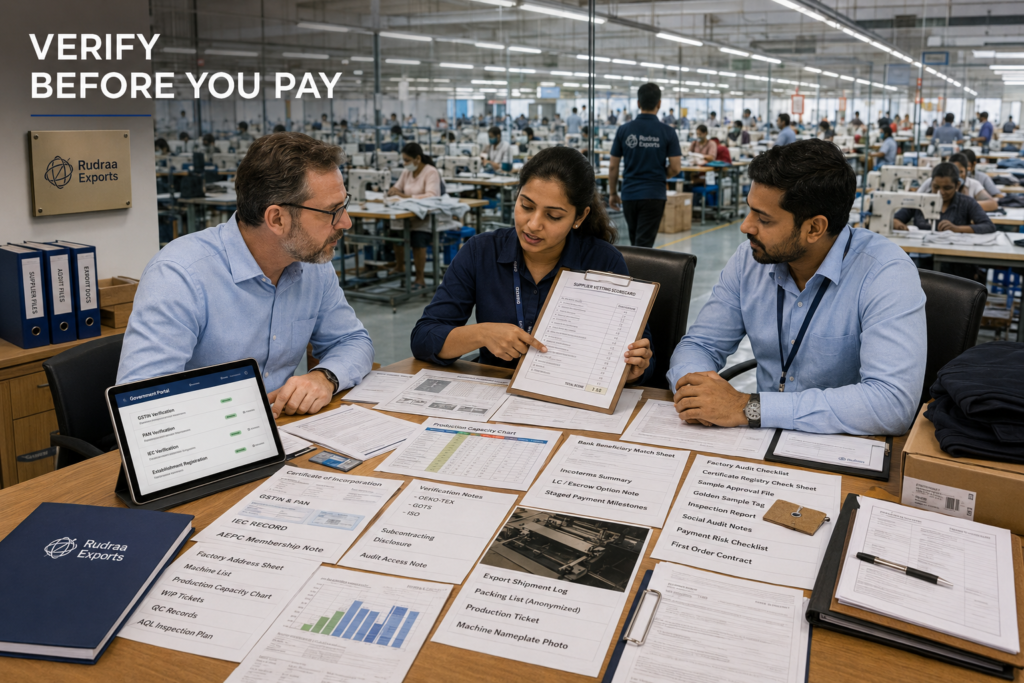
India is one of the strongest sourcing bases for apparel brands.
It offers flexible customization, strong knitwear capability, manageable MOQs, export-ready production and sustainable manufacturing options.
But first-time international buyers also face real risks.
Some suppliers are genuine factories.
Some are sourcing offices.
Some are traders.
Some may present themselves as factories when they do not control production.
And a few may be outright scams.
That is why learning how to vet a garment manufacturer in India is essential before you send a deposit, approve sampling or commit to bulk production.
A reliable supplier should be able to prove who they are, where they produce, what certifications they hold, how they manage QC, whether subcontracting is used, and how payments are protected.
At Rudraa Exports, we believe serious sourcing should be built on documentation, traceability, inspection access, clear communication and payment structures that protect both buyer and factory.
Quick Answer
To vet a garment manufacturer in India, first verify legal identity through company documents, GSTIN, PAN and IEC. Then confirm the real factory address, production capacity, machine list, audit access, quality-control records, certification scope, subcontracting disclosure, payment terms, bank beneficiary match and inspection rights. Do not pay 100% upfront. Use staged payments, LC, escrow or inspection-linked milestones for first orders. A reliable manufacturer should welcome verification instead of avoiding it.
Looking for a verified garment manufacturer in India? Contact Rudraa Exports and share your product category, quantity, fabric, compliance needs and destination market.
Why Vetting Matters Before You Source from India
India has a large and capable garment export industry.
The uploaded guide explains that sourcing garments from India offers advantages such as customization flexibility, manageable MOQs, premium knitwear capability and sustainable production options.
But the same opportunity also attracts risky suppliers.
Common Buyer Risks
- Fake factory claims
- Shared-office exporters
- Forged certifications
- Fake shipment records
- Advance-payment scams
- Personal bank account requests
- Undisclosed subcontracting
- Wrong production unit
- Expired certificates
- No audit access
- Poor QC records
- No inspection gates
The uploaded guide warns that first-time international buyers can face shell factories, forged certifications, advance-payment scams and undisclosed subcontracting.
Simple Rule
Do not judge a manufacturer only by website, Instagram photos, WhatsApp replies or low pricing.
Verify the proof.
Vetting Scorecard: What to Check First
Before negotiating price, build a pass/fail scorecard.
The uploaded guide recommends building a scorecard before pricing so glossy presentations do not override risk controls.
Garment Manufacturer Vetting Scorecard
| Vetting Area | What Good Looks Like | Red Flag |
|---|---|---|
| Legal identity | Company documents, GSTIN, PAN, IEC | “We’ll share later” |
| Export eligibility | Valid IEC and export records | No export proof |
| Factory reality | Real production site and audit access | Only virtual tour |
| Capacity | Machine list and WIP evidence | No production proof |
| QC system | Inline, final, AQL and CAPA records | “We do QC” only |
| Certifications | Scope and registry verification | PDF-only certificate |
| Compliance | Fire exits, PPE, working records | Audit not allowed |
| Subcontracting | Disclosed and auditable | Secret production |
| Payment safety | LC, escrow or staged milestones | 100% upfront |
| Bank match | Beneficiary matches company | Personal account |
The uploaded source provides a vetting criteria table covering legal identity, export eligibility, factory reality, QC, certification authenticity, compliance, subcontracting and payment safety.
Step 1: Verify Legal Identity
A real manufacturer should be able to share basic company documents.
Documents to Request
- Certificate of Incorporation
- GSTIN
- PAN
- IEC
- Registered address
- Factory address
- Bank account details
- Invoice entity details
The uploaded guide says buyers should request Certificate of Incorporation, GSTIN, PAN and IEC, and confirm that details match the address and bank account.
What to Check
Make sure the following match:
- Company name
- Invoice name
- Bank beneficiary name
- GST/PAN details
- IEC holder
- Factory or registered address
- Email domain where possible
Red Flags
- Bank account name is different
- Supplier asks payment to personal account
- GST or IEC is not shared
- Address keeps changing
- Invoice company and production company differ
- Documents are cropped or unclear
Rule
If identity, address and bank beneficiary do not align, pause the transaction.
The uploaded guide says if identity, address and bank beneficiary name do not align, buyers should stop and not “fix it later.”
Step 2: Confirm Export Eligibility
For international sourcing, the supplier should be export-ready.
Ask For
- IEC proof
- Export shipment history
- AEPC membership where applicable
- Anonymised shipment log
- Packing list sample
- Commercial invoice sample
- Export documentation process
The uploaded guide recommends requesting AEPC proof and recent anonymised shipment logs where possible.
Why This Matters
A supplier may make garments locally but not understand export documentation.
That can create problems with:
- Invoice accuracy
- Packing lists
- HS codes
- Freight booking
- Customs documentation
- Buyer compliance records
Step 3: Verify the Factory Is Real
A website can be fake.
A video tour can be staged.
A shared office can be presented as a factory.
So the buyer must verify the real production site.
The uploaded guide describes the risk of a “shared office” exporter that avoids sharing IEC/GST and requests large upfront payment.
Ask For
- Factory address
- Google map pin
- Factory photos
- Machine list
- Production line details
- Maintenance logs where available
- WIP tickets
- Cutting tickets
- Production capacity
- Audit access
Best Verification
Use:
- On-site audit
- Third-party factory audit
- Surprise audit right
- Video walkthrough with live date/time
- Machine nameplate photos
- WIP tickets matching PO references
The uploaded source recommends on-site audit, photographing machine nameplates and production tickets to confirm factory reality and capacity.
Red Flags
- Only virtual tour allowed
- No factory address
- Address differs from certificate
- No production tickets
- No capacity evidence
- Audit not allowed
- Factory name differs from invoice entity
Step 4: Check Quality Management System
A reliable manufacturer must have a measurable QC system.
Do not accept only “we check quality.”
Ask For
- Inline QC sheet
- Endline QC sheet
- Final inspection report
- AQL plan
- Measurement tolerance sheet
- Defect classification
- CAPA example
- Rework process
- QC responsibility chart
The uploaded guide says buyers should review inline and endline QC sheets and ask for corrective-action examples.
QC Records Should Show
- Style number
- PO number
- Inspection date
- Checked quantity
- Defect type
- Defect count
- Measurement result
- Rework decision
- Inspector name
- Final status
Red Flags
- No QC documents
- No measurement method
- No AQL understanding
- No corrective-action history
- “Trust us” response
- QC only after packing
Step 5: Verify Certifications Properly
Certifications are useful only when they are valid and in scope.
A certificate PDF alone is not enough.
Certifications Buyers May Ask For
- ISO
- OEKO-TEX
- GOTS
- SA8000
- SMETA
- WRAP
- BSCI
- Factory audit reports
The uploaded guide says buyers should cross-check certificates in official registries where available and confirm facility address and process scope.
What to Check
- Certificate number
- Facility name
- Facility address
- Scope
- Product category
- Process coverage
- Validity date
- Issuing body
- Transaction certificate where required
Example Risk
A supplier may share a GOTS certificate, but the scope may cover only trading and not actual processing.
The uploaded guide gives this example and says registry checks can catch wrong-scope certification before a brand builds marketing claims on it.
Red Flags
- Expired certificate
- Wrong facility address
- Scope does not cover product
- Certificate only covers trader
- No registry match
- Supplier refuses verification
- Certification claim used only for marketing
Step 6: Check Social and EHS Readiness
Social and EHS checks are important when buyers care about ethical sourcing, worker safety or retailer compliance.
What to Check
- Fire exits
- PPE
- Working hours records
- Overtime records
- Wage records where audit allows
- Clean production areas
- Chemical storage
- Emergency exits
- First-aid access
- Audit openness
The uploaded guide lists fire exits, PPE, working hours records and audit openness as signs of social/EHS compliance readiness.
Red Flags
- Locked exits
- No PPE
- Overtime not recorded
- Audit refused
- Chemical storage unclear
- Worker safety not documented
Step 7: Confirm Subcontracting Control
Subcontracting is not always bad.
But hidden subcontracting is risky.
A supplier should disclose where each process happens.
Ask Which Processes Are In-House
- Knitting
- Dyeing
- Cutting
- Stitching
- Printing
- Embroidery
- Washing
- Finishing
- Packing
The uploaded guide warns that buyers should compare cutting tickets with installed capacity and check invoices to detect undisclosed subcontracting.
Ask For
- Subcontractor names
- Subcontractor addresses
- Audit rights
- Process responsibility
- Certification coverage
- Quality accountability
Red Flags
- “No subcontracting” but capacity is too small
- Supplier refuses process transparency
- Different factory shown during production
- Certification does not cover actual production unit
- No audit rights for subcontractors
The uploaded guide says the contract should bind the producing units, not only the front office.
Step 8: Protect Payment Terms
Payment risk is one of the biggest concerns for first-time buyers.
Do not pay 100% upfront.
The uploaded guide warns that 100% advance payment is risky and can leave buyers with limited leverage if shipment is delayed or not performed.
Safer Payment Options
| Payment Method | How It Helps |
|---|---|
| Staged payment | Ties money to milestones |
| LC | Bank-backed documentary structure |
| Escrow | Holds funds until conditions are met |
| Inspection-linked payment | Final payment after QC pass |
| Small pilot PO | Limits first-order risk |
The uploaded guide recommends using LC, escrow or staged payments tied to inspection gates.
Red Flags
- 100% upfront demanded
- Personal bank account
- Beneficiary name changes
- Payment urgency pressure
- Discount offered for unsafe payment
- Refuses LC or escrow without explanation
Step 9: Use Inspection Gates
For first orders, inspections protect both sides.
Recommended Inspection Sequence
- Inline inspection
- Final pre-shipment inspection
- Basic lab tests where needed
The uploaded guide recommends inline inspection, final PSI with AQL sampling and basic lab tests for first orders.
What Inspection Can Catch
- Measurement issues
- Stitching defects
- Labelling errors
- Packing mistakes
- Shade variation
- Wrong trims
- Quantity mismatch
- Print defects
- Workmanship problems
Payment Tip
Tie final payment to clean inspection reports and correct shipping documents.
The uploaded source says payments should be tied to objective evidence such as clean inspection reports and correct shipping documents.
Step 10: Put Everything in the Contract
Do not wait for a problem before writing terms.
Contract Should Include
- Supplier entity
- Producing unit
- Product specs
- Golden sample reference
- Measurement tolerances
- AQL standard
- Rework rules
- Payment terms
- Inspection rights
- Subcontracting disclosure
- Incoterms
- Delivery dates
- Delay remedy
- Dispute clause
- Arbitration clause where needed
The uploaded guide recommends writing the contract before bulk and adding AQL, Incoterms and remedy language.
Supplier Types You Will Meet in India
Not every supplier calling itself a manufacturer is the same.
The uploaded guide explains that first-time buyers usually meet three supplier types: direct factory exporter, manufacturer plus sourcing office, and trader or agent posing as a factory.
Type 1: Direct Factory Exporter
This is usually the best model for control.
What It Means
The company you contract with is the company that cuts, sews and ships.
Benefits
- Easier audit
- Clearer accountability
- Better QC access
- Better certification scope verification
- Better production transparency
- Better payment milestone control
The uploaded source describes direct factory exporters as the easiest model to audit and align with certifications when properly scoped.
Buyer Controls
- Ask for production plan
- Ask for shipment log
- Confirm WIP tickets
- Use milestone payments
- Use pre-shipment inspection
Type 2: Manufacturer Plus Sourcing Office
This can work well, but it needs transparency.
What It Means
The buyer talks to an office team, while production may happen at a related or partner facility.
What to Verify
- Who owns the factory?
- Which unit produces?
- Which entity invoices?
- Which facility holds certificates?
- Who is legally responsible?
- Are subcontractors disclosed?
The uploaded guide says buyers should treat “who you talk to” and “who produces” as separate verification tasks.
Type 3: Trader or Agent Posing as a Factory
This is the highest-risk model.
A trader may be legitimate, but risk increases when they hide the real factory.
Red Flags
- Refuses factory address
- Refuses audit
- Uses another company’s photos
- Cannot show production tickets
- Cannot prove capacity
- Requests payment to different beneficiary
- Claims certificates that do not match facility
- Offers only video tours
The uploaded guide says if buyers cannot verify legal identity, factory address, audit access and safe payment instrument, they should assume they are not dealing with a reliable manufacturer.
Fit / Fit-Not Guide
This Vetting Approach Is a Strong Fit If
- You are a first-time international buyer
- You need traceability
- You need certifications
- You want to avoid scams
- You need payment protection
- You plan repeat production
- You want to make organic or chemical safety claims
- You can manage documents
- You can fund inspections
- You want long-term reliability
The uploaded guide says this conservative vetting approach is built for first-time international buyers who want repeatable controls, not heroic judgment calls.
Proceed Differently If
- You only want the absolute cheapest option
- You cannot afford audits or inspections
- You cannot handle documentation
- You want to move fast without controls
- You are willing to pay 100% upfront
- You do not need repeatability
The uploaded guide says if you cannot fund at least a pre-shipment inspection and basic contract, shrink the first PO size instead of shrinking controls.
Low-Risk Path from First PO to Stable India Supply Line
Phase 1: Desk Verification
Before sampling, collect:
- Incorporation certificate
- GSTIN
- PAN
- IEC
- Factory profile
- Factory address
- Certificate documents
- Bank beneficiary details
The uploaded guide recommends doing identity and certificate verification before sampling.
Phase 2: Sampling With Contract Scaffolding
Before bulk, lock:
- Product specs
- Measurement sheet
- Construction details
- Label rules
- AQL language
- Incoterms
- Golden sample reference
The uploaded guide recommends locking specs, adding AQL language and including Incoterms clarity before bulk.
Phase 3: Controlled Bulk With Inspection Gates
For the first two POs, use:
- Inline inspection
- Final pre-shipment inspection
- Basic lab tests where needed
- Inspection-linked payment
The uploaded source recommends independent inspections for first orders and using inspection gates before final payments.
Phase 4: Scale After Proof
Scale only when:
- Shipment is on time
- Defect rate is acceptable
- Certifications remain valid
- Supplier accepts verification
- QC records are consistent
- Documentation is correct
The uploaded guide says scaling should be based on consistent pass results against the scorecard, not only a friendly relationship.
Airtight First-Order Checklist
Legitimacy
- IEC received
- GSTIN received
- PAN received
- Entity name matches invoice
- Entity name matches bank beneficiary
- Address is consistent
- AEPC evidence requested where relevant
The uploaded guide includes these legitimacy checks in its airtight first-order checklist.
Factory and Capability
- Factory address confirmed
- Audit access granted
- Machine list reviewed
- WIP tickets reviewed
- Shipment log reviewed
- Capacity evidence checked
Certifications
- Certificate number checked
- Scope reviewed
- Facility address matched
- GOTS registry checked where applicable
- OEKO-TEX certificate checked where applicable
- ISO treated as process indicator
Quality
- Measurement sheet agreed
- Tolerances agreed
- Golden sample retained
- AQL written into contract
- Rework terms defined
Payments
- 100% upfront avoided
- Staged payment considered
- LC or escrow considered
- Final payment linked to inspection
Disputes
- Governing law defined
- Arbitration clause added where relevant
- Seat and venue specified where needed
The uploaded guide includes dispute controls such as arbitration clause, governing law and seat in the first-order checklist.
How Rudraa Exports Supports Buyer Verification
Rudraa Exports supports buyers who want transparent factory-direct sourcing from Tirupur.
Rudraa Support Includes
- Factory-direct communication
- Company documentation support
- Product capability discussion
- Factory process explanation
- Sampling stages
- Golden sample control
- QC checkpoints
- AQL-based inspection discussion
- CAPA process discussion
- Certification scope discussion where applicable
- Subcontracting clarity
- Payment milestone discussion
- FOB/DDP planning
- Export documentation support
- Packing list and invoice clarity
- Repeat order traceability
Products Supported
- T-shirts
- Polo shirts
- Sweatshirts
- Hoodies
- Joggers
- Leggings
- Nightwear
- Kidswear
- Babywear
- Corporate apparel
- Private-label knitwear
- Export knitwear programs
Why Rudraa Fits Serious Buyers
Rudraa is a strong fit for buyers who want:
- Clear documentation
- Inspection access
- Factory-direct communication
- Quality records
- Traceability
- Export readiness
- Payment milestone clarity
- Long-term production partnership
The uploaded guide says transparent exporters such as Rudraa Exports set the benchmark by sharing documentation, supporting inspection access and providing certification traceability.
Ready to verify your next supplier properly? Speak with Rudraa Exports and share your product category, MOQ, compliance requirements and destination.
FAQ: How to Vet a Garment Manufacturer in India
1. How do I verify a garment manufacturer in India?
Verify company documents, GSTIN, PAN, IEC, factory address, bank beneficiary name, certification scope, audit access, QC records and shipment history.
2. What documents should I ask for?
Ask for Certificate of Incorporation, GSTIN, PAN, IEC, factory profile, export shipment proof, certification documents and bank details.
3. How do I know if a factory is real?
Confirm factory address, machine list, WIP tickets, production photos, audit access and third-party verification.
4. Is a certificate PDF enough?
No. Check certificate number, scope, facility name, validity and registry match where possible.
5. What is the biggest payment red flag?
The biggest red flag is 100% upfront payment or payment to a personal or mismatched bank account.
6. Should I use LC or escrow?
For first orders, LC, escrow or staged payments tied to inspection milestones can reduce payment risk.
7. What is hidden subcontracting?
Hidden subcontracting happens when a supplier secretly sends production to another unit without buyer approval or audit access.
8. Should I inspect the first order?
Yes. Use inline inspection and final pre-shipment inspection for early orders, especially with new suppliers.
9. What should be in the contract?
Include specs, golden sample, AQL, payment terms, inspection rights, subcontracting disclosure, Incoterms, delivery terms and dispute clauses.
10. Is a trader always bad?
No. A trader can be useful, but risk increases if they hide the producing factory, certification scope or payment structure.
11. Can Rudraa Exports support verification?
Yes. Rudraa can support buyers with factory-direct communication, documentation, sampling, QC records, inspection planning and export paperwork.
12. What should I do if documents do not match?
Pause the order. Do not send payment until identity, address, invoice and bank beneficiary details are reconciled.
Conclusion
India is a powerful sourcing base for apparel buyers, but safe sourcing requires verification.
Do not rely only on promises.
Ask for legal documents. Match GST, PAN, IEC, invoice and bank beneficiary details. Verify the factory address. Check audit access. Confirm machine capacity. Review QC records. Validate certification scope. Disclose subcontracting. Avoid 100% upfront payment. Use staged payments, LC or escrow where suitable. Add inspection gates before final payment.
The goal is simple:
Turn trust into proof.
Reliable manufacturers do not avoid verification. They welcome it.
Rudraa Exports helps apparel buyers source from Tirupur with transparent documentation, factory-direct communication, sampling controls, QC systems, traceability, inspection planning and export-ready production support.
Visit rudraaexports.com or contact the Rudraa Exports team to start a verified sourcing discussion for your next garment order from India.
Related reading
How to Verify a Brand-New Overseas Garment Manufacturer Before Paying a Deposit
How to Find Reliable OEM Clothing Manufacturers: A Buyer’s Vetting Guide