
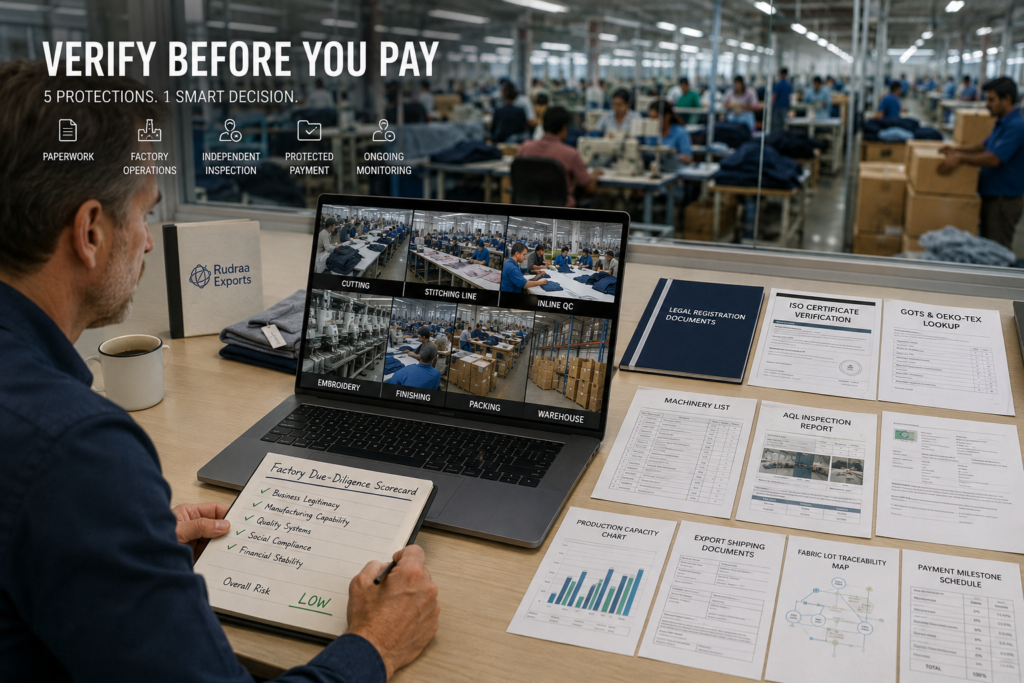
Finding a garment manufacturer online is easy.
Proving that the supplier is legitimate, capable and reliable is much harder.
A new overseas manufacturer may have a professional website, attractive product photos and confident WhatsApp communication. However, that does not confirm whether the business owns a factory, uses undisclosed subcontractors, holds valid certifications or can manufacture your garments consistently.
Once an international deposit has been paid, the buyer’s leverage becomes significantly weaker.
Australian apparel brands also remain responsible for the quality and claims attached to the products they sell. A manufacturing problem overseas can quickly become an Australian customer complaint, return, refund or reputational issue.
The safest approach is not simply to trust the supplier.
It is to verify the supplier using a repeatable process.
This guide explains how to verify a new garment manufacturer through five layers:
- Paperwork and certificate validation
- Operational factory verification
- Independent audits and inspections
- Payment and contract safeguards
- Ongoing monitoring after the first order
At Rudraa Exports, we support international buyers with factory-direct garment production, production visibility, traceability records, quality-control checkpoints, export documentation and third-party inspection coordination.
Quick Answer
Before paying a new overseas garment manufacturer, verify the legal business identity, factory address, ownership, certification numbers, audit reports, machinery, capacity, quality-control documents, export history and material traceability. Conduct a structured live video audit, use an independent factory audit or pre-shipment inspection, and connect payment milestones to sample approval and inspection results. Continue monitoring the supplier after the first shipment because capability and compliance can change over time.
Planning to verify an Indian garment manufacturer? Contact Rudraa Exports to request a factory capability and production-transparency discussion.
Why Supplier Verification Matters
The lowest quotation is rarely the biggest risk in overseas sourcing.
The biggest risk is credibility.
A supplier may appear suitable but still be:
- A trader presenting itself as a factory
- A small unit overstating capacity
- A legitimate factory using unapproved subcontractors
- A supplier showing expired certificates
- A business using certificates belonging to another legal entity
- A factory without the machinery needed for your category
- A manufacturer with weak quality-control discipline
- A supplier with no real export experience
The uploaded source explains that new overseas manufacturers must be verified through evidence rather than websites, logos or sales communication.
The Five-Step Manufacturer Verification Framework
| Step | Verification Area | Main Objective |
|---|---|---|
| 1 | Paperwork validation | Confirm the company and certificates are genuine |
| 2 | Operational transparency | Confirm the factory exists and can make the product |
| 3 | Independent confirmation | Validate claims through third parties |
| 4 | Payment safeguards | Protect money and define commercial remedies |
| 5 | Ongoing monitoring | Prevent quality or compliance decline |
Step 1: Validate the Factory’s Paperwork
Documents should be treated as evidence to investigate, not automatic proof.
Ask the supplier for a structured compliance pack containing complete PDF documents rather than cropped screenshots or social-media images.
Business Documents to Request
| Document | What to Check |
|---|---|
| Company registration | Legal name and registration number |
| Factory address | Must match the production location |
| Tax registration | Legal business status |
| Export registration | Ability to export commercially |
| Bank account details | Beneficiary name matches legal entity |
| Factory ownership proof | Confirms manufacturer or trader status |
| Association membership | Supports industry legitimacy |
| Certificate copies | Number, scope, issuer and validity |
| Audit reports | Facility scope and non-conformances |
| Insurance documents | Where applicable |
Verify ISO Certificates
ISO 9001 and ISO 14001 can indicate structured quality or environmental management systems.
But an ISO logo on a website is not proof.
Verify These Details
- Certificate number
- Legal entity name
- Factory address
- Certification scope
- Issuing certification body
- Accreditation body
- Issue date
- Expiry date
- Surveillance-audit status
The uploaded source recommends validating management-system certificates through official or accredited verification systems and checking that the scope actually covers garment manufacturing.
Important Limitation
ISO certification does not guarantee that every garment will be defect-free.
It shows that a management system exists. The buyer must still verify product quality through samples, inspections and production records.
Verify GOTS and OEKO-TEX Claims
Sustainability and chemical-safety claims need stronger verification because the certificate may apply only to one part of the supply chain.
For example, a fabric mill may hold a certificate while the garment factory does not.
Check the Following
| Certification Area | What to Verify |
|---|---|
| Certified legal entity | Same company you are buying from |
| Site address | Matches the production facility |
| Product scope | Covers the relevant product or material |
| Validity period | Current, not expired |
| Chain of custody | All relevant processing stages covered |
| Transaction certificate | Available where required |
| Label or certificate number | Verifiable in official database |
The uploaded source highlights the importance of verifying each certified entity and supply-chain stage rather than relying only on a certificate PDF.
Understand Social Audits Correctly
WRAP, SMETA, BSCI and SA8000 are often discussed during supplier selection, but they are not identical.
Common Compliance Evidence
| Framework | Evidence to Request |
|---|---|
| WRAP | Valid facility certification and site match |
| SMETA | Audit report, findings and corrective action plan |
| BSCI | Audit result and improvement records |
| SA8000 | Certification or validated programme evidence |
| Sedex | Supplier profile and audit access where available |
Important Warning
SMETA is an audit methodology, not a traditional product certificate.
A supplier offering only a “SMETA certificate” without an audit report, scope and corrective action details should be questioned.
Step 2: Prove the Factory Exists and Can Manufacture Your Product
Once documents have been checked, move to operational evidence.
A supplier may be legally registered and still lack the machinery, workforce or process controls required for your product.
Conduct a Structured Live Video Audit
Do not accept only a pre-recorded promotional video.
Schedule a live walkthrough and control the agenda.
Areas to See Live
- Factory entrance and signage
- Reception or administrative office
- Fabric warehouse
- Fabric inspection area
- Cutting section
- Sewing lines
- Printing or embroidery area
- Finishing section
- Inline quality-control points
- Final inspection area
- Packing section
- Finished-goods warehouse
- Dispatch area
The uploaded source recommends using a structured live video verification rather than an informal factory tour.
Make the Video Difficult to Fake
Ask the supplier to:
- Show the current date on a phone screen
- Walk continuously without edited cuts
- Show factory signage and surrounding area
- Show today’s production order
- Open random cartons or fabric rolls
- Show employee and line boards
- Show recent QC records
- Show machinery operating live
Confirm Factory Ownership
Ask directly:
Are you the factory, a trader, an exporter or a buying office?
Trading companies are not automatically bad, but the business model must be transparent.
Proof of Direct Manufacturing
| Proof | What It Shows |
|---|---|
| Factory registration | Legal facility identity |
| Machinery list | Production capability |
| Continuous factory video | Operational presence |
| Employee records | Actual workforce |
| Utility or lease records | Facility control |
| Production schedules | Current manufacturing activity |
| Line-wise output data | Capacity evidence |
Verify Machinery for Your Product
A supplier manufacturing basic T-shirts may not be equipped for technical activewear, bonded garments or premium embroidery.
Example Machinery Checks
| Product | Relevant Machinery |
|---|---|
| T-shirts | Overlock, flatlock, coverstitch |
| Hoodies | Heavy-fabric sewing, bartack, coverstitch |
| Activewear | Flatlock, stretch-seam equipment |
| Polo shirts | Collar and placket machinery |
| Embroidery | Multi-head embroidery machines |
| Printed garments | Screen, transfer or digital-print setup |
| Outerwear | Zipper, lining and specialised sewing equipment |
Test Traceability with One Material
Select one fabric and ask the supplier to map it backwards.
For example:
Organic cotton jersey → garment factory → dye house → knitting unit → spinner → cotton source
Request:
- Supplier names
- Batch numbers
- Fabric roll IDs
- Test reports
- Purchase records
- Dye-lot details
- Cutting records
- Finished-garment lot mapping
The uploaded source recommends using a single-material traceability exercise to test whether the supplier can connect upstream materials with finished production.
Step 3: Use Independent Verification
After reviewing the supplier’s evidence, confirm it independently.
The purpose of third-party verification is to reduce dependence on information supplied by the factory itself.
Book a Factory Audit
A technical factory audit can review:
- Machinery
- Capacity
- Quality systems
- Production flow
- Fabric control
- Maintenance
- Worker skills
- Warehouse controls
- Subcontracting
- Traceability
- Social compliance
- Safety practices
Common Third-Party Providers
- QIMA
- SGS
- Intertek
- Bureau Veritas
- TÜV SÜD
The uploaded source recommends using independent audit and inspection providers for technical, quality and social-compliance validation.
Audit Types
| Audit Type | Main Purpose |
|---|---|
| Technical factory audit | Capability, machinery and QC system |
| Social audit | Labour, safety and working conditions |
| Environmental audit | Waste, chemicals and environmental controls |
| Security audit | Supply-chain and site-security practices |
| Quality-system audit | SOPs, records and corrective actions |
Use Corrective Action Plans
An audit finding does not always mean the supplier should be rejected.
What matters is whether the supplier:
- Accepts the finding
- Creates a corrective action plan
- Provides closure evidence
- Prevents recurrence
- Completes corrections before production approval
Connect the corrective action plan to a commercial decision.
Example:
Corrective actions closed and approved → pilot order may begin
Use Pre-Shipment Inspection
A pre-shipment inspection is commonly performed when most of the order is complete and packed.
Inspection Areas
- Quantity
- Measurements
- Workmanship
- Fabric
- Colours
- Printing
- Embroidery
- Labels
- Barcodes
- Packaging
- Carton markings
- Product function
- Buyer specifications
The uploaded source describes pre-shipment inspection as a key independent control before payment release and shipment.
Verify Export Experience
Ask for anonymised proof of previous exports.
Export Evidence
| Document | What It Confirms |
|---|---|
| Bill of Lading | Previous international shipment |
| Air Waybill | Air export experience |
| Commercial invoice | Export documentation format |
| Packing list | Quantity and SKU control |
| Certificate of Origin | Origin-document experience |
| Shipping bill | Export process familiarity |
| Freight-forwarder reference | Logistics capability |
Hard Red Flag
Stop the process if the supplier asks you to:
- Undervalue the invoice
- Mark commercial goods as gifts
- Use false product descriptions
- Hide the actual manufacturer
- Avoid proper customs documentation
These requests can create legal, tax and customs risks for the buyer.
Step 4: Protect Payments and Contracts
A legitimate supplier can still fail to deliver.
Payment structure should reduce the buyer’s exposure if quality, timing or documentation fails.
Avoid Full Upfront Payment
A safer first-order structure may include:
- Initial deposit after verification
- Second payment after pre-production sample approval
- Balance after inspection pass
- Final release against shipping documents
- Optional holdback for serious defects or delays
Exact terms depend on order size, relationship and supplier strength.
Connect Payments to Proof
| Payment Stage | Evidence Required |
|---|---|
| Deposit | Verified supplier and signed order |
| Production release | Approved PP sample |
| Second payment | Material purchase and production evidence |
| Balance | Passed PSI and approved documents |
| Holdback release | Shipment or post-delivery condition |
Define What “Pass” Means
Inspection conditions should be written into the purchase order or manufacturing agreement.
Include:
- Fabric composition
- GSM
- Colour standard
- Measurement tolerances
- Stitching requirements
- Print or embroidery standards
- Shrinkage limits
- Colourfastness requirements
- Label requirements
- Packing method
- Carton specifications
- AQL level
Payment Protection Options
| Method | Suitable For |
|---|---|
| Escrow | Smaller or marketplace-based orders |
| Letter of Credit | Larger, document-controlled orders |
| Documentary collection | Established relationships |
| Milestone bank transfer | Common first-order structure |
| Trade-assurance programme | Platform-based sourcing |
Manufacturing Agreement Clauses
Your agreement should address:
- Design and intellectual-property ownership
- Confidentiality
- Non-subcontracting without approval
- Approved factory location
- Material substitutions
- Quality standards
- Inspection rights
- Delivery dates
- Late-delivery consequences
- Rework or replacement
- Credits and refunds
- Product claims
- Governing law
- Dispute resolution
The uploaded source recommends tying payment releases to measurable milestones and clearly defining remedies, inspection rights and subcontracting restrictions.
Step 5: Monitor the Factory After the First Shipment
Supplier verification does not end when the first order arrives.
Factories may perform well during onboarding and weaken later because of:
- Higher volumes
- Peak-season pressure
- Worker turnover
- New subcontractors
- Material changes
- Ownership changes
- Expired certificates
- Compressed timelines
Use Inspections Strategically
For a new supplier, consider:
- Fabric inspection before cutting
- During-production inspection
- Inline quality checks
- Pre-shipment inspection
- Container loading check
Recheck Certifications
Recheck certificates:
- Annually
- Before a major new order
- When the factory address changes
- When the legal entity changes
- When a new certified material is introduced
- When claims are added to marketing
The uploaded source explains that certificates can expire, scopes can change and ownership can shift, making recurring verification necessary.
Monitor Performance Metrics
| Metric | What It Measures |
|---|---|
| OTIF | On-time, in-full delivery |
| Defect rate | Quality consistency |
| AQL result | Shipment acceptance |
| Sample lead time | Development reliability |
| Bulk lead time | Production performance |
| CAP closure | Corrective-action discipline |
| Response time | Communication quality |
| Claim rate | Post-delivery issues |
| Reorder consistency | Repeat-production control |
Create Stop/Go Triggers
Examples:
| Trigger | Action |
|---|---|
| Two late samples | Reduce or delay bulk commitment |
| Critical PSI failure | Reinspect before shipment |
| Unapproved subcontracting | Stop production or terminate |
| Invalid certificate | Remove associated product claim |
| Repeated shade mismatch | Require root-cause correction |
| Hidden charges | Reopen commercial approval |
| Traceability gap | Stop certified claim |
15-Point Garment Manufacturer Due-Diligence Checklist
Use this checklist before paying a deposit to any new overseas manufacturer.
| # | Verification Requirement |
|---|---|
| 1 | Legal entity name and registration |
| 2 | Full factory address |
| 3 | Confirmation of factory or trader status |
| 4 | Factory ownership or lease evidence |
| 5 | Verified ISO certificate details |
| 6 | Verified GOTS/OEKO-TEX claims where applicable |
| 7 | Latest social audit and corrective action status |
| 8 | Structured live factory video walkthrough |
| 9 | Product-relevant machinery list |
| 10 | Workforce and capacity statement |
| 11 | Inline and final QC documents |
| 12 | Material and lot traceability evidence |
| 13 | Anonymised export documents |
| 14 | Written acceptance of third-party inspection |
| 15 | Payment milestones linked to approval and PSI |
The uploaded source provides a similar verification pack covering legal identity, certifications, factory video, machinery, capacity, quality documents, traceability, export evidence, inspections and payment terms.
Red Flags When Verifying a New Garment Manufacturer
Identity Red Flags
- Bank account name does not match company
- Factory address cannot be confirmed
- Supplier refuses a live video call
- Business claims to be a factory but shows no machinery
- Certificate belongs to another company
- Website photos appear copied
Certification Red Flags
- Certificate number is missing
- Scope does not include apparel manufacturing
- Facility address does not match
- Certificate has expired
- Supplier offers screenshots instead of source verification
- “SMETA certificate” provided without an audit report
- Organic claim lacks chain-of-custody evidence
Operational Red Flags
- Unrealistic capacity claims
- Very short lead time without explanation
- No quality-control records
- No material lot tracking
- Refusal to allow inspections
- Heavy undisclosed subcontracting
- Different production locations shown at different times
Commercial Red Flags
- 100% payment demanded upfront
- Personal bank account requested
- Price changes after deposit
- Incoterms remain unclear
- Supplier recommends false customs declarations
- No written remedy for defects
- Pressure to skip sample approval
How Rudraa Exports Supports Verification-Ready Manufacturing
Rudraa Exports supports international buyers seeking a transparent, factory-direct garment manufacturing relationship from Tirupur, India.
Buyer Verification Support
- Factory capability discussions
- Live production visibility
- Product-relevant machinery review
- Production capacity planning
- Tech-pack review
- Fabric and GSM confirmation
- Material traceability support
- Sample development
- PP sample approval
- Inline quality-control updates
- AQL 2.5 inspection support
- Third-party inspection coordination
- Export documentation
- Carton and SKU traceability
- Repeat-order monitoring
Products Supported
- T-shirts
- Polo shirts
- Hoodies
- Sweatshirts
- Joggers
- Activewear
- Kidswear
- Babywear
- Nightwear
- School uniforms
- Corporate apparel
- Private-label knitwear
Why Buyers Choose a Direct-Factory Model
- Fewer communication layers
- Better visibility into production
- Easier material verification
- Faster technical clarification
- Better inspection coordination
- Clearer accountability
- Better repeat-order control
- Reduced risk of hidden subcontracting
Ready to compare a new supplier against a verification-ready factory model? Speak with Rudraa Exports and share your product, MOQ, compliance requirements and destination market.
FAQ: Verifying an Overseas Garment Manufacturer
1. How do I know whether a garment supplier is a real factory?
Request the legal company name, factory address, machinery list, live continuous video walkthrough, employee and production records, and independent audit access. Check whether the bank beneficiary matches the legal business.
2. How do I verify an ISO certificate?
Check the certificate number, legal entity, site address, scope, issuing body, accreditation and expiry date using appropriate accredited verification channels.
3. How do I verify GOTS certification?
Use the official GOTS public database and confirm the legal entity, site address, certified scope and validity. Request transaction certificates where required.
4. How do I verify OEKO-TEX certification?
Use the official label or certificate checking system and match the number, product scope, company and validity period.
5. Is SMETA a certificate?
No. SMETA is an audit methodology. Buyers should request the audit report, scope, findings and corrective action plan rather than relying on a certificate-style document.
6. Should I arrange a factory audit before ordering?
A technical factory audit is strongly recommended for substantial first orders, complex garments, compliance-sensitive programmes or suppliers you have not visited.
7. What is a pre-shipment inspection?
A pre-shipment inspection checks completed goods, quantities, measurements, workmanship, labels, packaging and buyer specifications before shipment and final payment.
8. Should I pay a garment factory 100% upfront?
Full upfront payment creates high buyer risk. First orders are safer when payment is split into milestones tied to sample approval, production evidence and inspection results.
9. How can I verify the factory’s export experience?
Request anonymised Bills of Lading, commercial invoices, packing lists, shipping bills or freight-forwarder references from previous international shipments.
10. What should I check during a factory video call?
Check signage, cutting, sewing, printing, embroidery, QC, finishing, packing, warehouse, current production records and machinery relevant to your products.
11. How often should certifications be rechecked?
Recheck at least annually and whenever the legal entity, address, product scope, material claim or production facility changes.
12. What should I send Rudraa Exports to discuss production?
Send your product category, tech pack or reference images, fabric, GSM, MOQ, colours, size range, branding, certifications required, target market and delivery date.
Conclusion
Verifying a new overseas garment manufacturer should never depend on a professional website, a certificate logo or a persuasive sales conversation.
A reliable supplier should be able to provide verifiable evidence.
Start with legal documents and certificates. Confirm the factory through a structured live walkthrough. Validate capability using machinery, quality records, traceability and export proof. Use third-party audits and inspections. Protect payments with measurable milestones. Continue monitoring after the first shipment.
The strongest sourcing relationships are not built on blind trust.
They are built on transparency, verification and repeatable performance.
Rudraa Exports supports Australian and global apparel buyers with factory-direct garment production, production visibility, material traceability, quality-control documentation, third-party inspection coordination and export support.
Visit rudraaexports.com or contact the Rudraa Exports team to discuss your garment manufacturing and supplier-verification requirements.
Related reading
How to Find Reliable OEM Clothing Manufacturers: A Buyer’s Vetting Guide
What Australian Brands Need to Know Before Ordering from an Overseas Garment Factory
Tirupur Garment Certifications Guide for Buyers in 2026
How to Vet a Garment Manufacturer in India: Avoid Scams, Protect Payments and Buy with Confidence