
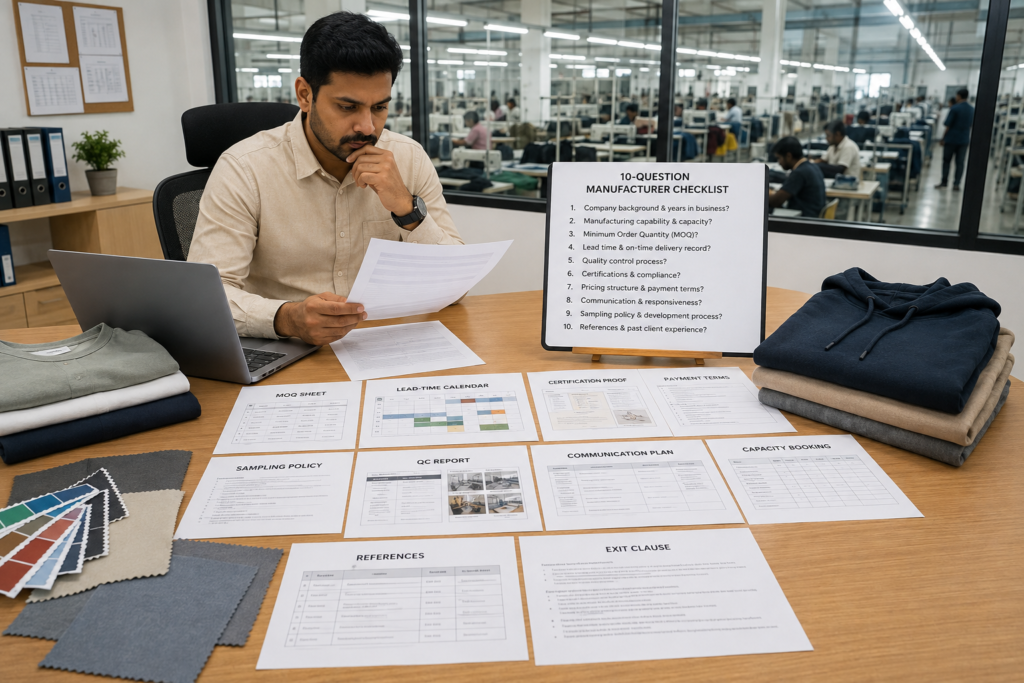
Choosing a clothing manufacturer is one of the biggest decisions a fashion founder will make.
A good manufacturer can help you move from idea to sample to bulk production with clarity.
A poor manufacturer can create wrong samples, MOQ surprises, delayed launches, quality failures, hidden costs and stressful disputes.
Many first-time founders lose money not because their product idea is bad, but because they choose a factory without asking the right questions.
Before you send a deposit, approve bulk fabric or announce your launch date, you need to check how the manufacturer handles MOQ, lead time, sampling, payment, quality control, certifications, communication, capacity and dispute resolution.
At Rudraa Exports, we help apparel brands source knitwear from Tirupur, India with factory-direct communication, ISO 9001:2015 process discipline, sampling control, AQL-based quality checks, export packing and transparent production planning.
Quick Answer
The most important questions to ask before choosing a clothing manufacturer are: What is your MOQ by style, colour and size? What lead time are you committing to? What certifications do you hold and what is in scope? What payment terms do you offer? How does sampling work? What QC system do you follow? Who is my point of contact? What capacity do you really have? Can you provide references or proof of past work? What happens if timelines or quality fail? A serious manufacturer should answer these questions clearly in writing before you pay a deposit.
Looking for a transparent knitwear manufacturer in India? Contact Rudraa Exports and share your product type, quantity, fabric, timeline and quality expectations.
Why These Questions Matter
A clothing manufacturer should not be selected only by price.
Price matters, but it is not the only risk.
The real risk is hidden in unclear terms.
Common Founder Problems
- MOQ is higher than expected
- MOQ applies per colour, not total order
- Sampling cost is unclear
- Sample revisions are not defined
- Factory lead time keeps shifting
- Payment terms expose the buyer
- QC standard is not agreed
- Defects are discovered too late
- Production capacity is overpromised
- The factory changes materials without approval
- There is no exit clause if production fails
The uploaded guide explains that first-time founders often face preventable manufacturing problems such as MOQ surprises, lead-time delays, sampling cost disputes and quality-control failures.
Simple Rule
If a manufacturer cannot answer basic production questions clearly, do not send the deposit yet.
The 10 Questions to Ask Before Choosing a Clothing Manufacturer
Ask every factory these questions in writing.
Email or a shared document is better than a casual call.
The uploaded guide recommends asking every factory these 10 questions in writing because avoidance or vague answers are due-diligence signals.
1. What Is Your MOQ by Style, Colour and Size?
MOQ means minimum order quantity.
But MOQ is not always simple.
A factory may quote MOQ by:
- Style
- Colour
- Size
- Fabric
- Print design
- Dye lot
- Total order
- Product category
Why This Question Matters
Many founders think MOQ means total pieces.
But the factory may mean MOQ per colour.
That changes the entire order plan.
The uploaded guide gives a scenario where a founder budgets for 120 units and later learns the factory MOQ is 300 per colour.
What to Ask
- Is MOQ per style or per colour?
- Is MOQ per size?
- Does custom dyeing increase MOQ?
- Does print design increase MOQ?
- Can I use stock fabric for lower MOQ?
- What happens if I order below MOQ?
Good Answer Looks Like
A good manufacturer gives a clear MOQ sheet by product type, fabric and complexity.
Rudraa Direction
Rudraa discusses MOQ based on product, fabric, colour count, print, trims and production feasibility, so buyers understand what is practical before sampling.
2. What Lead Times Are You Committing To?
Lead time is not only sewing time.
Lead time includes fabric, sampling, approvals, production, finishing, packing and shipping.
What Can Delay Lead Time?
- Fabric availability
- Lab dip approval
- Sample revisions
- Print strike-off approval
- Holiday periods
- Peak-season capacity
- Late payment
- Late trims
- Buyer comments
- Custom packaging
- Shipping congestion
The uploaded guide says credible factories should share a dated timeline from sampling to approvals, PPC, cutting, sewing, finishing and packing, while calling out holiday or greige-fabric risks.
What to Ask
- What is the sample lead time?
- What is the bulk lead time?
- What can delay production?
- Do you give a time-and-action plan?
- Do you include holiday buffers?
- When is the production slot confirmed?
Good Answer Looks Like
A good manufacturer provides a production calendar, not just a casual promise.
3. Which Certifications Do You Hold and What Is in Scope?
Certifications only matter if they are real, valid and relevant to the order.
A factory may say it has certifications, but the buyer must check:
- Certificate number
- Scope
- Facility name
- Validity date
- Product coverage
- Process coverage
The uploaded guide says buyers should verify scope certificate numbers and public database records where applicable.
What to Ask
- Are you ISO certified?
- Is the certificate valid?
- Which facility is covered?
- Does the certificate cover this product type?
- Can you support organic or sustainable documentation if required?
- Can you provide scope documents?
Rudraa Direction
Rudraa operates with ISO 9001:2015-certified systems and documented process controls for production discipline.
The uploaded source positions Rudraa Exports as an ISO 9001:2015-certified full-cycle knitwear factory in Tirupur.
4. What Payment Terms Protect Both Sides?
Payment terms should be clear before sampling or bulk.
Common Payment Structures
| Payment Term | Meaning |
|---|---|
| 30/70 TT | 30% deposit, 70% before shipment |
| Milestone payment | Payment linked to production stage |
| LC at sight | Bank-backed payment for larger programs |
| 50/50 | Sometimes used for first orders or complex projects |
The uploaded guide notes that 30/70 TT remains a common export default, while LC options exist for some programs.
What to Ask
- What deposit is required?
- When is the balance due?
- Is final payment linked to QC readiness?
- What happens if bulk fails inspection?
- Are sample fees credited to bulk?
- What refund or credit rules apply?
Good Answer Looks Like
A good manufacturer provides payment milestones and explains what happens if production is delayed or rejected.
5. How Does Sampling Work?
Sampling is where many mistakes are caught.
A factory should explain its sample process clearly.
Common Sample Stages
- Proto sample
- Fit sample
- Size set
- Pre-production sample
- Gold-seal sample
The uploaded guide says Rudraa defines sample stages such as proto, fit, size set and pre-production, then records approvals so bulk matches the gold-seal reference.
What to Ask
- What sample types are required?
- How much does each sample cost?
- How many revisions are included?
- How long does each revision take?
- Who owns the sample?
- Is the sample cost credited to bulk?
- What becomes the production reference?
Good Answer Looks Like
A good manufacturer gives a sample policy, revision process and approval record.
Buyer Tip
Do not skip sample revisions only to save money.
The uploaded guide explains that Reddit founder advice often warns that skipping revisions to save money can cost more during bulk fixes.
6. What Is Your QC System and Defect Tolerance?
QC means quality control.
A factory should not only say “we check quality.”
It should explain how it checks.
Ask About
- Inline QC
- Final inspection
- Measurement checks
- Fabric checks
- Print checks
- AQL level
- Defect classification
- Rework process
- Final QC report
The uploaded guide states that common export AQL settings include 2.5 major and 4.0 minor, while premium programs may use tighter tolerances.
Common AQL Direction
| Defect Type | Common Direction |
|---|---|
| Critical | 0 |
| Major | 2.5 |
| Minor | 4.0 |
What to Ask
- What AQL level do you follow?
- What is considered a major defect?
- What is considered a minor defect?
- Do you share QC reports?
- Can I hire third-party inspection?
- What happens if the inspection fails?
Good Answer Looks Like
A good manufacturer shares QC templates and agrees to measurable standards.
7. Who Is My Point of Contact?
Communication failures create production failures.
A buyer should know exactly who is responsible for updates.
What to Ask
- Who is my merchandiser?
- Who handles sampling?
- Who handles production updates?
- Who handles QC issues?
- What is the escalation path?
- How often will I receive updates?
- Will there be a shared tracker?
The uploaded guide says Rudraa uses structured updates, WIP trackers and scheduled calls to avoid silent weeks.
Good Answer Looks Like
A good manufacturer gives a named contact, update rhythm and escalation process.
8. What Capacity Do You Truly Have in Peak Season?
A factory may accept your order but later delay it because a larger buyer takes priority.
This is a common sourcing risk.
What to Ask
- How many lines are available?
- What is monthly capacity?
- What capacity is free for my order?
- When is my slot booked?
- What happens during peak season?
- Can you support reorder volume?
- Do you outsource production when overloaded?
The uploaded guide explains that peak-season overbooking is a recurring founder complaint and recommends confirming line booking before marketing dates are committed.
Good Answer Looks Like
A good manufacturer discloses available capacity and confirms booking before fabric commitment.
9. Can You Provide References or Verifiable Order History?
References reduce uncertainty.
Not every factory can disclose client names, but it should be able to provide some proof of process.
What to Ask
- Can you provide references where permitted?
- Can you show anonymised shipment proof?
- Can you show QC reports?
- Can you show packing standards?
- Can you show similar product examples?
- Can you show export documentation samples?
The uploaded guide says many founders never ask for references or verifiable order history and learn too late.
Good Answer Looks Like
A good manufacturer gives references where permitted or process evidence when client names are confidential.
10. What Are the Exit Clauses if Timelines or QC Fail?
This is the question most founders avoid.
But it matters.
Before production starts, both sides should know what happens if:
- Timeline fails
- QC fails
- Bulk does not match PP sample
- Factory cannot deliver
- Buyer cancels late
- Material is already purchased
- Rework is required
- Refund or credit is needed
The uploaded guide says Reddit founders often skip contracts until problems hit and recommends written terms around delays, rework and termination-for-cause.
What to Ask
- What happens if production is delayed?
- What happens if QC fails?
- Who pays for rework?
- Can I terminate for repeated failure?
- What happens to deposit if production cannot continue?
- What happens to raw material already purchased?
Good Answer Looks Like
A good manufacturer supports written terms around delay, rework, credit and termination-for-cause.
Factory vs Agent vs Small Workshop
Choosing a manufacturer is also about choosing an operating model.
The uploaded guide compares direct export-capable factories, sourcing agents/trading companies and small CMT workshops using the same 10-question checklist.
Direct Export-Capable Factory
Best for:
- Repeatable quality
- Export programs
- Clear QC
- Capacity planning
- Factory-direct accountability
- Long-term growth
Strength
A direct factory gives clearer accountability and better visibility into sampling, QC and production capacity.
Risk
You still need to verify what is in-house and what is outsourced.
The uploaded source advises buyers to ask what is in-house versus outsourced, such as printing, embroidery or washing.
Sourcing Agent or Trading Company
Best for:
- Vendor discovery
- Ultra-low MOQ exploration
- Buyers needing coordination
- Multiple small workshops
Strength
Agents may help when buyers cannot meet standard factory MOQs.
Risk
You must ask who actually owns quality, production slot and rework cost.
The uploaded guide says if an agent is involved, buyers should require the producing unit’s name, address and inspection access.
Small CMT Workshop or Micro-Factory
Best for:
- Very small runs
- Market testing
- Near-shore production
- Flexible development
Strength
Small workshops can be flexible and support lower MOQs.
Risk
Capacity bottlenecks can happen if a bigger client comes in.
The uploaded source says small workshops may be useful for testing but can have capacity bottlenecks and should be supported by a backup plan.
Fit / Fit-Not Guide
Rudraa Exports Is a Strong Fit If
- You need repeatable knitwear quality
- You want measurable QC
- You need AQL-aligned inspection
- You want a full-cycle export partner
- You need size sets and PP sample control
- You need labelling and packing support
- You want capacity that can grow
- You want ISO 9001:2015 process discipline
- You need factory-direct communication
- You are planning repeat orders
The uploaded guide says Rudraa is a strong fit for brands needing repeatable knitwear quality, full-cycle export execution and capacity that can grow with them.
Rudraa May Not Be Best If
- You need ultra-low MOQ for early testing
- You need only 300 units per colour with high variation
- You are not producing knitwear
- You need heavy woven tailoring
- You need seam-taped technical shells
- You need denim-centric production
- You are still changing the product every week
The uploaded guide says Rudraa may not be the best fit for ultra-low MOQ testing or non-knitwear categories such as heavy woven tailoring, technical shells or denim-centric lines.
Migration Plan: From Sampling to Bulk with Risk Controls
Phase 1: Pre-Qualification
Before sampling, verify:
- Factory profile
- Factory address
- Product capability
- In-house processes
- Outsourced processes
- Certification details
- MOQ structure
- Lead-time range
- Capacity availability
The uploaded guide recommends pre-qualification to verify the factory is real, export-capable and aligned with the product.
Phase 2: Sampling With Written Control Points
Define:
- Proto sample
- Fit sample
- Size set
- PP sample
- Sample cost
- Revision count
- Approval process
- Gold-seal reference
The uploaded source recommends treating the PP sample as the legal quality baseline and attaching key measurements and construction notes to the PO.
Phase 3: Bulk Order With Inspection-Linked Milestones
Before bulk, confirm:
- Lead time
- Payment milestone
- Fabric booking
- QC standard
- AQL level
- Third-party inspection option
- Rework rules
- Shipment window
The uploaded guide recommends tying payment and bulk milestones to measurable production checkpoints and QC readiness.
Phase 4: Reorder Governance
For repeat orders, keep:
- Gold-seal sample
- Approved tech pack
- Approved BOM
- Size tolerance
- Fabric reference
- Packing standard
- Change-control rule
- Capacity booking
The uploaded guide recommends a written reorder change-control rule: no construction, fabric or measurement changes without written buyer approval.
Clothing Manufacturer Due-Diligence Checklist
| # | Question | Proof to Request |
|---|---|---|
| 1 | What is your MOQ by style, colour and size? | MOQ sheet |
| 2 | What lead time are you committing to? | Time-and-action calendar |
| 3 | Which certifications do you hold? | Scope certificate |
| 4 | What payment terms do you offer? | Proforma invoice |
| 5 | How does sampling work? | Sample policy |
| 6 | What QC system do you follow? | QC plan and AQL level |
| 7 | Who is my point of contact? | Named merchandiser |
| 8 | What capacity do you truly have? | Capacity and line booking |
| 9 | Can you provide references? | References or process proof |
| 10 | What happens if timelines or QC fail? | Contract terms |
How Rudraa Exports Supports Due-Diligence
Rudraa Exports supports apparel buyers with transparent answers before production begins.
Rudraa Support Includes
- Factory-direct communication
- Product brief review
- MOQ discussion
- Lead-time planning
- Time-and-action calendar
- ISO 9001:2015 process discipline
- Sampling stages
- Proto sample
- Fit sample
- Size set
- PP sample
- Gold-seal sample approval
- AQL-based QC planning
- Defect classification
- Inline QC
- Final inspection
- WIP tracker
- Capacity discussion
- Packing standards
- Export documentation
- Reorder change control
Products Supported
- T-shirts
- Polo shirts
- Hoodies
- Sweatshirts
- Joggers
- Leggings
- Nightwear
- Kidswear
- Babywear
- Corporate apparel
- Private-label knitwear
Why Rudraa Fits Growing Brands
Rudraa is a strong fit when buyers want:
- Clear communication
- Factory-direct accountability
- Written answers
- Production transparency
- Repeatable knitwear quality
- Export-ready documentation
- Measurable QC
- Long-term sourcing partnership
The uploaded guide invites buyers to use the 10 questions as a shortlist filter and challenge Rudraa Exports with them before starting a due-diligence conversation.
Ready to evaluate a factory properly? Speak with Rudraa Exports and share your product details, MOQ target, timeline and quality expectations.
FAQ: Questions to Ask Before Choosing a Clothing Manufacturer
1. What is the first question to ask a clothing manufacturer?
Ask about MOQ by style, colour and size. This prevents budget surprises before sampling or bulk production.
2. Why is MOQ important?
MOQ decides whether your order is commercially practical. It may apply per colour or per design, not only to the total order.
3. What should I ask about lead times?
Ask for sample lead time, bulk lead time, production calendar, fabric booking risks, holiday risks and approval deadlines.
4. Should I ask for certifications?
Yes. Ask for certificate numbers, scope, facility name and validity. Do not accept vague claims without proof.
5. What payment terms are common?
30/70 TT is common in export manufacturing, but payment milestones should be clearly linked to production and QC readiness.
6. How many sample rounds should I expect?
Many brands need proto, fit, size-set and pre-production sample stages depending on product complexity.
7. What QC standard should I ask for?
Ask whether the factory follows AQL inspection, defect classification, inline QC and final inspection.
8. Why does point of contact matter?
A named merchandiser and update system prevent silent weeks, missed approvals and production confusion.
9. Should I ask for references?
Yes. Ask for references where permitted or anonymised proof such as QC records, packing standards or shipment evidence.
10. What if production fails?
Ask for written terms covering delays, rework, QC failure, credits, refunds and termination-for-cause before bulk starts.
11. Is a direct factory better than an agent?
A direct factory is better for repeat quality, accountability and export control. An agent may help when you need vendor discovery or very small mixed lots.
12. Can Rudraa Exports answer these questions before production?
Yes. Rudraa can answer these due-diligence questions in writing, share QC templates and map a sampling-to-bulk timeline for knitwear programs.
Conclusion
Choosing a clothing manufacturer should not be based only on price, Instagram photos or a smooth first call.
A serious buyer needs written answers.
Ask about MOQ, lead time, certifications, payment terms, sampling, QC, communication, capacity, references and exit clauses before sending a deposit.
These questions protect your cash flow, launch calendar, product quality and brand trust.
The best manufacturer is not the one that promises everything.
It is the one that explains what is possible, what is risky, what must be approved and what happens if something goes wrong.
Rudraa Exports helps brands source knitwear from Tirupur with factory-direct accountability, ISO 9001:2015 process systems, sample approvals, AQL-based QC, export packing and transparent communication.
Visit rudraaexports.com or contact the Rudraa Exports team to ask the 10 due-diligence questions before starting your next garment production order.
Related reading
What Australian Brands Need to Know Before Ordering from an Overseas Garment Factory
How to Find a Reliable Garment Manufacturer for Your Australian Fashion Brand
How to Vet a Garment Manufacturer in India: Avoid Scams, Protect Payments and Buy with Confidence