
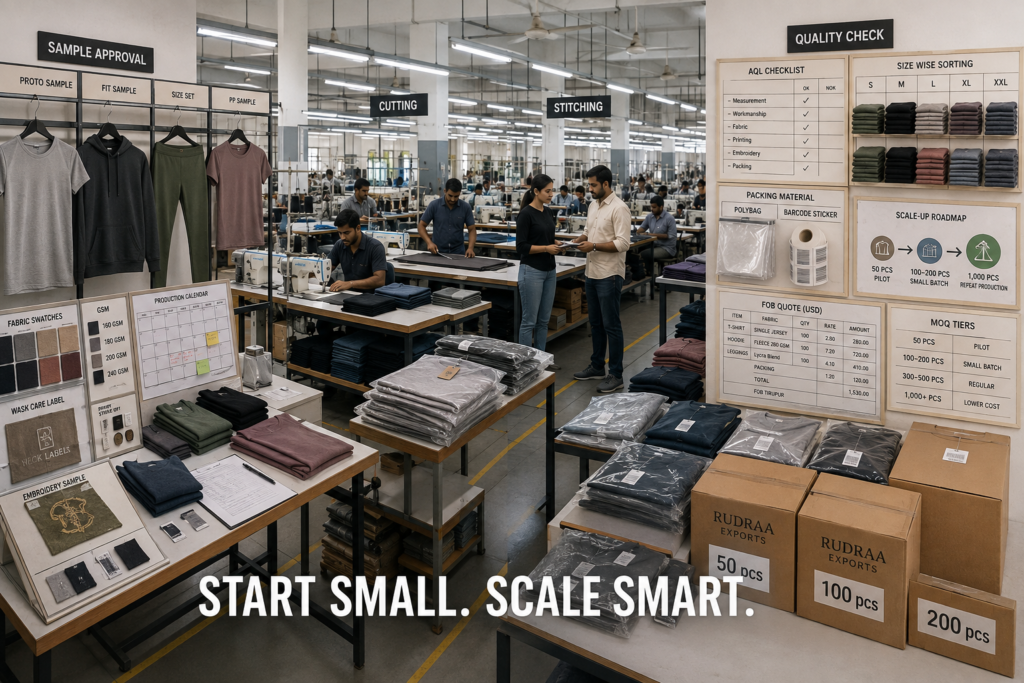
Starting a clothing brand does not mean you should order thousands of pieces immediately.
Smart founders test first.
They validate fit, fabric, price, customer response and sell-through before scaling.
That is why many startups look for small batch clothing manufacturers in India.
A small batch gives you enough quantity to test the product properly, but not so much that one mistake destroys your budget.
In India, especially in Tirupur, small batch clothing production usually means 300 pieces per style.
The uploaded guide explains that small batch in India typically means 300 pieces per style, which is enough to run a real production line while still allowing startups to validate fit, fabric and sell-through before scaling.
At Rudraa Exports, we help startup brands plan low-MOQ knitwear production from India with practical MOQ guidance, fabric options, sampling support, QC checks, line-item costing and a clear scale-up path from pilot runs to repeat bulk production.
Quick Answer
Small batch clothing manufacturers in India are best for startups that want to produce 300 pieces per style before committing to bulk. A 50-piece run is useful for testing fit and demand, 100 pieces is often a better startup MOQ sweet spot, and 300 pieces gives better value before moving into real bulk. For small batch success, keep designs simple, use available fabrics where possible, prepare a minimal tech pack, approve samples properly, avoid too many colours, and work with a direct factory rather than an unclear trader.
Looking for low MOQ clothing production in India? Contact Rudraa Exports and share your product category, quantity, fabric, size range, artwork and target launch timeline.
What Is Small Batch Clothing Manufacturing?
Small batch clothing manufacturing means producing a limited quantity of garments before scaling to larger production.
For startups, this is usually used to test:
- Product demand
- Fit
- Fabric feel
- Size curve
- Pricing
- Customer feedback
- Wash performance
- Sell-through speed
- Brand positioning
Small Batch Quantity Range
| Quantity | Meaning |
|---|---|
| 50 pcs | Pilot micro-batch |
| 100 pcs | Startup MOQ sweet spot |
| 200 pcs | Small bulk / better value |
| 500+ pcs | Early scale production |
| 1,000+ pcs | Repeatable production system |
The uploaded source compares 50, 100 and 200 pcs as different startup MOQ tiers, each with different cost, flexibility, sampling and risk implications.
Why Startups Should Start Small
A startup should not treat the first order like a final bulk production run.
The first order is a learning run.
A Small Batch Helps You Test
- Does the product sell?
- Which size sells fastest?
- Does the fit work?
- Does the fabric feel premium enough?
- Does the colour perform well?
- Does the print last after wash?
- Does the product photograph well?
- Do customers complain about anything?
- Should you reorder or redesign?
The uploaded guide says the pilot should be treated as a test, not only as a launch, because the goal is data such as fit feedback, wash tests and sell-through by size.
50 vs 100 vs 200 pcs: What Changes?
The difference between 50, 100 and 200 pcs is not only quantity.
It changes cost, flexibility, factory priority, fabric choice and risk.
The uploaded guide explains that as order size moves from 50 to 100 to 200 pcs, per-unit cost drops, fabric options improve, customization becomes easier and scheduling becomes more stable.
MOQ Tier Comparison
| Criteria | 50 pcs | 100 pcs | 200 pcs |
|---|---|---|---|
| Best use | Pilot test | Startup sweet spot | Best value before bulk |
| Cost | Highest per unit | Better | Best within small batch |
| Fabric choice | Mostly stock fabrics | Better options | More flexibility |
| Print options | Keep simple | More viable | Most options feasible |
| Sampling adjustment | Less likely | More likely | More likely |
| Factory scheduling | Less stable | More predictable | More stable |
| Risk | Low cash exposure, high unit cost | Balanced | Better unit cost, higher cash exposure |
50 pcs: Pilot Micro-Batch
A 50-piece order is useful when you are still testing the product.
Best For
- First product drop
- Limited edition launch
- DTC testing
- Fit validation
- Basic T-shirts
- Simple leggings
- Simple hoodies
- Minimal branding
The uploaded guide says 50 pcs works well for testing fit, sizing, first category launches and limited drops where scarcity is part of marketing.
What Works at 50 pcs
- One fabric
- One colour
- Basic print
- Basic embroidery
- Standard trims
- Simple size range
- Stock fabric
- Simple packing
What to Avoid at 50 pcs
- Too many colours
- Custom dyeing
- Heavy embellishment
- Multiple print placements
- Complex packaging
- Imported trims
- Too many size splits
The uploaded source warns that at 50 pcs, brands should focus on fit, fabric hand-feel and basic branding instead of trying to perfect every detail.
100 pcs: Startup MOQ Sweet Spot
A 100-piece order is often more practical than 50 pcs.
It gives the factory more room to manage production properly while still keeping founder risk controlled.
Best For
- Branded T-shirts
- Hoodies with simple embroidery
- Leggings with grading checks
- First real product drop
- Low MOQ private label
- Small DTC launch
The uploaded guide calls 100 pcs the startup MOQ sweet spot because it balances per-unit cost, basic branding and consistent QC.
What Works at 100 pcs
- Neck label
- Wash-care label
- Basic embroidery
- 1–2 colour print
- Size range like XS–XXL
- Lab dip discussion
- Basic packaging
- Better shade control
Startup Mistake to Avoid
Do not send vague specs.
Missing stitch type, measurement tolerance or print placement can lead to remake costs and delays.
The uploaded guide says spec-sheet gaps are a common mistake at 100 pcs and can cause remake costs or delays.
200 pcs: Small Bulk and Best Value
A 200-piece order gives better unit economics.
It is still small enough for a startup, but large enough to unlock more production stability.
Best For
- Repeatable core styles
- Better margins
- 1–2 colourways
- Retail-ready packing
- Better fabric control
- More reliable production scheduling
- First serious reorder
The uploaded guide describes 200 pcs as small bulk and the best value before real bulk, with better fabric consistency and fewer compromises.
What Works at 200 pcs
- Better packaging
- Barcode stickers
- Size stickers
- Improved QC planning
- Fabric reservation
- Shade control
- More print options
- Stronger production priority
Key Point
Choose 200 pcs when you have already validated the product or have strong pre-order confidence.
Small Batch Pricing in India
Pricing depends on:
- Product type
- GSM
- Fabric composition
- Colour
- Quantity
- Embroidery
- Labels
- Packaging
- Sampling
- QC
- Shipping term
The uploaded guide explains that FOB ranges can vary widely because a plain 180 GSM T-shirt and a premium 200 GSM compact cotton T-shirt with custom trims are different products.
Indicative FOB Direction
| Product | MOQ Tier | FOB Direction |
|---|---|---|
| 180–200 GSM combed cotton T-shirt | 100 pcs | ₹210–₹260 |
| 300 GSM fleece hoodie | 100 pcs | ₹290–₹420 |
| 240 GSM cotton-lycra leggings | 200 pcs | ₹120–₹145 |
The uploaded source gives these indicative FOB ranges for T-shirts, hoodies and leggings in small batch contexts.
Buyer Tip
Always ask for a line-item quote.
Line-Item Quote Should Include
- Fabric
- Cutting
- Sewing
- Embroidery
- Labels
- Packaging
- Sampling
- QC
- Freight where applicable
The uploaded guide says a line-item quote is the fastest way to compare factories and catch hidden trader markups.
What You Can Customize at Low MOQ
Low MOQ does not mean unlimited customization.
The lower the quantity, the more practical the order should be.
Good Low-MOQ Customization
| Customization | 50 pcs | 100 pcs | 200 pcs |
|---|---|---|---|
| Stock fabric | Good | Good | Good |
| Basic screen print | Good | Good | Good |
| Neck label | Limited | Good | Good |
| Wash-care label | Limited | Good | Good |
| Embroidery | Basic | Good | Better |
| Custom dye | Difficult | Possible | Better |
| Complex packaging | Avoid | Possible | Better |
| Puff / high-density print | Avoid | Possible | Better |
| Appliqué | Avoid | Limited | Better |
The uploaded guide explains that 50 pcs usually works best with available components, while 100 and 200 pcs allow more controlled branding, shade lots and packaging.
Best Product Types for Small Batch Production
1. T-Shirts
Good for:
- First drops
- Merchandise
- Brand testing
- Streetwear basics
- Logo tees
Keep simple:
- One body
- One or two colours
- One print placement
- Standard GSM
2. Hoodies
Good for:
- Streetwear launches
- Premium merch
- Winter capsules
- DTC drops
Keep controlled:
- One fleece base
- One colourway first
- Simple embroidery or print
- Standard rib and drawcord
The uploaded guide gives hoodie examples and notes that hoodie costs rise with customization, fleece choice and print/embroidery.
3. Leggings
Good for:
- Women’s essentials
- Activewear testing
- Cotton-lycra basics
- Size curve validation
Control:
- Fabric recovery
- Waist elastic
- Size grading
- Wash performance
The uploaded source gives an example of a leggings brand using a pilot to identify waist elastic issues before scaling.
4. Sweatshirts
Good for:
- Core brand products
- College merchandise
- Loungewear
- Streetwear drops
Control:
- GSM
- Shrinkage
- Rib recovery
- Pilling
- Print durability
5. Joggers
Good for:
- Lounge sets
- Tracksuit drops
- Athleisure brands
- Co-ord testing
Control:
- Waistband
- Drawcord
- Pocket construction
- Fabric shrinkage
Sampling for Small Batch Clothing
Sampling protects your bulk order.
Do not skip it.
Recommended Sampling Ladder
- Proto sample
- Fit sample
- Size set
- PP sample
The uploaded guide says structured sampling should include proto, fit, size set and PP sample to reduce bulk mismatch risk.
What Each Sample Checks
| Sample | Purpose |
|---|---|
| Proto sample | Construction and first shape |
| Fit sample | Fit on body |
| Size set | Grading and size curve |
| PP sample | Final bulk production standard |
Important Rule
Never skip PP approval if you care about consistency.
The uploaded source specifically says never to skip PP approval if consistency matters.
Minimal Tech Pack for Small Batch Orders
A full technical pack is ideal.
But at minimum, send a basic production spec.
Minimal Tech Pack Should Include
- Product reference
- Flat sketch
- Size chart
- Measurements
- Tolerances
- Fabric composition
- GSM
- Trim list
- Label details
- Print placement
- Embroidery placement
- Packaging needs
- Colour references
- Quantity by size
The uploaded guide recommends building a minimal tech pack before requesting quotes, including flat sketch, measurements, tolerances, fabric spec, trim list and print or embroidery placements.
Why This Helps
Better specs lead to:
- Fewer sample rounds
- Faster quotes
- Fewer misunderstandings
- Better pricing accuracy
- Lower timeline risk
The uploaded source says better specs reduce sample rounds and timeline risk.
Lead Times for Small Batch Clothing in India
Small batch does not always mean instant production.
Sampling, approvals and production still take time.
The uploaded guide says development typically takes around 2–3 weeks when sampling is managed properly, while production is commonly 30–45 days for 100–200 pcs after approvals are locked.
Practical Timeline
| Stage | Timeline Direction |
|---|---|
| Development and sampling | 2–3 weeks |
| Production after approval | 30–45 days |
| Door-to-door planning | 75–120 days depending on shipping and season |
The uploaded source also notes that monsoon can add 2–3 weeks to door-to-door timelines in some cases.
Lead-Time Tip
Plan from launch date backward.
Do not announce a launch before:
- Fabric is confirmed
- Sample is approved
- Production slot is booked
- Packaging is decided
- Shipping method is clear
QC Best Practices for Small Batch Orders
Small batches still need quality control.
A 50-piece order can fail if QC is ignored.
QC Should Check
- Fabric GSM
- Shrinkage
- Measurement tolerance
- Print placement
- Embroidery quality
- Stitching defects
- Seam strength
- Labels
- Size ratio
- Packing accuracy
The uploaded guide recommends confirming fabric GSM and shrinkage upfront, approving PP sample before bulk and using measurable checkpoints such as measurement tolerance, print placement and seam strength.
Simple QC Rule
Even for a small order, define what counts as acceptable and unacceptable.
How to Vet Genuine Small Batch Factories
Some suppliers are factories.
Some are traders.
Some only coordinate production.
The uploaded guide recommends vetting genuine factories before paying sampling fees by checking compliance, live walkthroughs and approval discipline.
Vetting Checklist
Ask for:
- Factory profile
- Product categories
- Machine details
- Live video walkthrough
- Cutting area view
- Sewing line view
- Printing or embroidery area
- Final inspection table
- Sample approval process
- QC report format
- Compliance documents where applicable
- Previous product examples
Red Flags
- No factory address
- Only catalogue photos
- No live walkthrough
- No sample policy
- No QC format
- Refuses PP approval
- Vague MOQ answers
- All-in price with no cost breakdown
- No clarity on who actually produces
Direct Factory vs Trader
A direct factory is usually better when you want traceability and production control.
Direct Factory Benefits
- Clearer pricing
- Better communication
- Real production visibility
- Better sample-to-bulk control
- Lower hidden markup risk
- Easier QC follow-up
- Better scale-up path
The uploaded guide explains that a direct factory model reduces cost opacity and traceability gaps, which are common failure points for startups.
Trader Risk
A trader may still help, but risk increases when:
- You do not know the producing factory
- Pricing is not transparent
- QC is filtered
- Responsibility is unclear
- Factory access is blocked
From 50 pcs Pilot to 1,000 pcs System
Scaling should not mean changing everything.
It should mean improving what already worked.
The uploaded guide explains that scaling is less about finding a cheaper factory and more about locking a reliable process.
Step 1: Build Minimal Tech Pack
Prepare specs before quoting.
Step 2: Run Sampling
Use proto, fit, size set and PP sample.
Step 3: Run 50 pcs Pilot
Collect feedback on:
- Fit
- Size demand
- Wash performance
- Print durability
- Fabric feel
- Returns
- Sell-through
Step 4: Move to 100–200 pcs
Standardise:
- Fabric
- Fit block
- Labels
- Packaging
- Size ratio
- QC checks
The uploaded source recommends keeping fabric and block stable, standardising trims and reducing colourways when moving from pilot to 100–200 pcs.
Step 5: Prepare for 500–1,000 pcs
Add:
- Fabric approval
- Shade band
- PP approval
- Inline checks
- Final random inspection
- Compliance documents
- Bulk SOP checklist
The uploaded guide recommends setting inspection standards, compliance systems and a bulk SOP before scaling to 500–1,000 pcs.
Fit / Fit-Not Guide
Small Batch India Is a Strong Fit If
- You want to test demand
- You need 50–200 pcs
- You are building knitwear
- You want T-shirts, hoodies, leggings or sweatshirts
- You can keep designs simple
- You can approve samples properly
- You want factory-direct transparency
- You plan to scale after testing
Small Batch India May Not Be Best If
- You want every detail custom at 50 pcs
- You need many colours at tiny quantities
- You need very complex trims
- You cannot prepare basic specs
- You need delivery immediately
- You want the lowest possible unit price at low quantity
The uploaded guide warns that if the product needs custom dye, heavy embellishment or complex fit, buyers should avoid forcing it into 50 pcs and move toward 100–200 pcs instead.
Small Batch Clothing Manufacturer Checklist
| # | Checkpoint |
|---|---|
| 1 | Product category selected |
| 2 | Quantity tier chosen |
| 3 | Fabric selected |
| 4 | GSM defined |
| 5 | Colour count reduced |
| 6 | Size ratio planned |
| 7 | Minimal tech pack prepared |
| 8 | Print or embroidery placement defined |
| 9 | Label requirement defined |
| 10 | Packaging requirement defined |
| 11 | Line-item quote requested |
| 12 | Sampling fees clarified |
| 13 | Proto sample planned |
| 14 | Fit sample planned |
| 15 | Size set planned if needed |
| 16 | PP sample required |
| 17 | QC checkpoints defined |
| 18 | Lead-time calendar prepared |
| 19 | Factory walkthrough requested |
| 20 | Scale-up path discussed |
How Rudraa Exports Supports Small Batch Clothing Startups
Rudraa Exports supports startup brands that want to test and scale knitwear production from Tirupur, India.
Rudraa Support Includes
- Startup product brief review
- Low MOQ discussion
- 50–200 pcs feasibility planning
- Fabric and GSM guidance
- T-shirt production
- Hoodie production
- Sweatshirt production
- Leggings production
- Jogger production
- Private-label trims
- Neck labels
- Wash-care labels
- Basic packaging
- Print and embroidery discussion
- Minimal tech-pack review
- Sampling stages
- PP sample approval
- QC checkpoints
- Line-item costing
- Pilot-to-scale planning
- Export packing support
Products Supported
- T-shirts
- Hoodies
- Sweatshirts
- Joggers
- Leggings
- Nightwear
- Loungewear
- Corporate apparel
- Private-label knitwear
- Small brand merchandise
Why Rudraa Fits Startups
Rudraa is a strong fit for startups that need:
- Factory-direct communication
- Realistic MOQ guidance
- Practical fabric options
- Clear costing
- Sampling control
- QC support
- Scale-up planning
- Tirupur knitwear capability
- Pilot-to-bulk production path
The uploaded guide says Rudraa’s Tirupur-based, factory-direct model is useful for founders learning how to balance quality, speed and cost.
Ready to produce your first 50–200 pcs batch? Speak with Rudraa Exports and share your product reference, tech pack, quantity, fabric, GSM, colour count and launch timeline.
FAQ: Small Batch Clothing Manufacturers in India
1. What is small batch clothing manufacturing?
Small batch clothing manufacturing means producing a limited quantity, usually 300 pieces per style, to test demand before scaling.
2. Can I manufacture only 50 pieces in India?
Yes, 50 pcs may be possible for simple products using available fabrics and minimal customization, but per-unit cost will be higher.
3. Is 100 pcs a better MOQ than 300 pcs?
Often yes. 100 pcs usually gives better production practicality, more stable QC and better pricing than 50 pcs.
4. Why is 200 pcs considered better value?
At 200 pcs, setup costs are spread across more units, fabric consistency improves and the factory can plan production more efficiently.
5. What products are best for small batch production?
T-shirts, hoodies, sweatshirts, joggers and leggings are good small batch options when specs are clear and customization is practical.
6. What should I avoid at 50 pcs?
Avoid too many colours, custom dyeing, complex trims, heavy embellishment, multiple print placements and fully custom packaging.
7. How long does small batch production take?
Development may take around 2–3 weeks, while production often takes 30–45 days after approvals for 100–200 pcs programs.
8. Do I need a tech pack for small batch production?
Yes. Even a minimal tech pack helps reduce mistakes, improve quotes and avoid sample-to-bulk mismatch.
9. What samples should I approve before bulk?
Approve proto, fit, size set where needed and PP sample before bulk production.
10. How do I avoid traders?
Ask for factory profile, live walkthrough, machine details, production area view, QC format and clear sample approval process.
11. Can Rudraa Exports support low MOQ startups?
Yes. Rudraa can discuss 50–200 pcs feasibility for suitable knitwear programs and help plan a realistic pilot-to-scale path.
12. What should I send Rudraa for a quote?
Send product reference, quantity, fabric preference, GSM, size range, artwork, label needs, packaging requirements and delivery destination.
Conclusion
Small batch clothing manufacturing in India is a smart way for startups to test before scaling.
A 50-piece pilot helps you learn.
A 100-piece order gives better balance.
A 200-piece batch gives stronger value before moving into real bulk.
But low MOQ does not mean no process.
You still need fabric clarity, measurements, tolerances, sampling, PP approval, QC checks, realistic timelines and factory verification.
The safest startup path is simple:
Start small, keep the first version practical, collect real customer feedback, standardise what works, then scale to 500 and 1,000 pcs with the same fabric, fit and QC rhythm.
Rudraa Exports helps startup brands source small batch clothing from India with factory-direct communication, realistic MOQ planning, fabric and GSM guidance, sampling, QC and pilot-to-scale production support.
Visit rudraaexports.com or contact the Rudraa Exports team to discuss your first 50–200 pcs clothing production run.
Related reading
How to Launch Your Clothing Brand with Small-Batch Production: 50–200 Unit Guide
How to Start a Clothing Brand with No Experience: Complete Manufacturing Guide 2026
How to Start a Clothing Brand in Australia: From Idea to First Order