
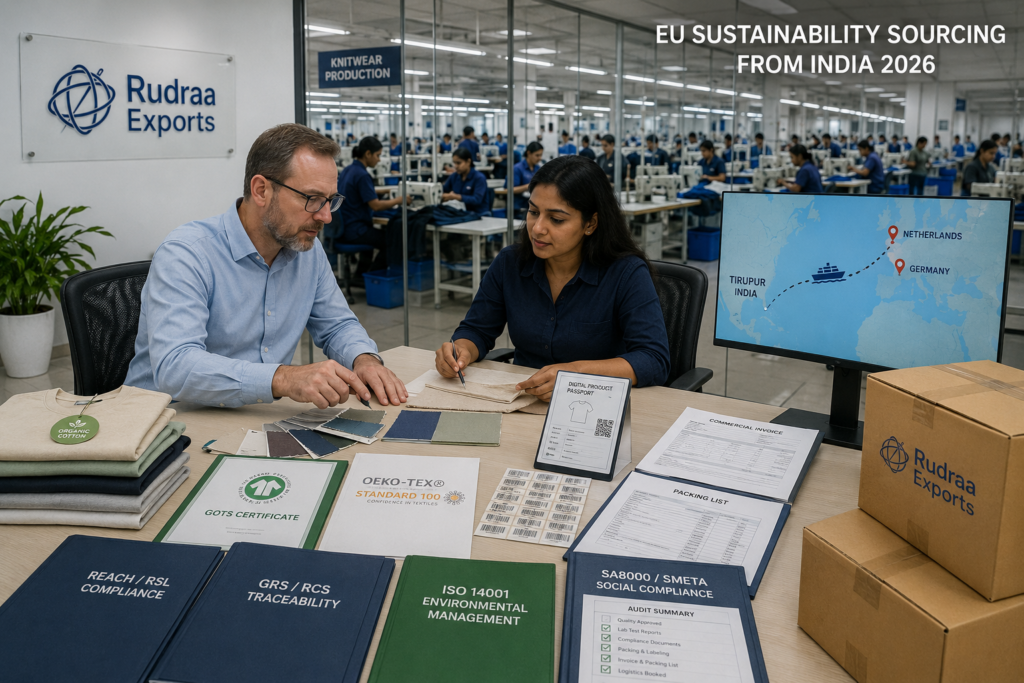
European apparel brands sourcing from India are entering a new compliance environment. Sustainability is no longer only a marketing message. It is becoming a product requirement, a reporting requirement, and a claims-verification requirement.
For brands selling into Germany, the Netherlands, Scandinavia, France, and wider EU markets, buyers now need clear answers to practical questions:
Where did the fibre come from?
Which factory made the garment?
Was the fabric tested for harmful substances?
Can the supplier prove traceability?
Are sustainability claims backed by valid certificates?
Is the product ready for Digital Product Passport requirements?
Can the brand defend its green claims if challenged?
This is why European buyers sourcing from India must move from informal sustainability promises to structured documentation. India has a deep textile manufacturing ecosystem, strong knitwear capability, and access to recognised standards such as GOTS, OEKO-TEX, GRS, WRAP, SA8000, SMETA, BSCI, ISO 9001, and ISO 14001. But buyers still need the right process to verify documents, audit suppliers, and connect every claim to proof.
At Rudraa Exports, we support European brands with factory-direct garment manufacturing from Tirupur, India, including sustainability documentation, traceability support, certification readiness, quality control, and export compliance workflows.
Quick Answer
European brands sourcing garments from India must prepare for EU sustainability rules such as ESPR, Digital Product Passport, CSRD, Green Claims scrutiny, textile waste rules, chemical compliance, and stronger proof requirements for sustainability claims. Buyers should request valid certificates, traceability records, chemical test reports, environmental data, social audit evidence, and product-level documentation from Indian suppliers. The safest approach is to treat sustainability as part of production, not marketing, and build supplier documentation before garments enter the EU market.
Planning to source sustainable garments from India? Contact Rudraa Exports to request a sustainability compliance checklist and factory verification plan.
Why EU Sustainability Compliance Matters for Apparel Brands
The EU is moving from voluntary sustainability messaging to enforceable product and reporting rules.
In the past, many brands could say:
“We use sustainable materials.”
“Our products are eco-friendly.”
“Our factory follows ethical practices.”
That is no longer enough.
European buyers and regulators increasingly expect proof. Apparel brands must now prepare for:
- Product-level sustainability data
- Digital Product Passport readiness
- Traceable fibre and material records
- Stronger chemical compliance
- Claims verification
- Supplier ESG reporting
- Restrictions on destroying unsold textiles
- Audit-ready documentation
- Social and environmental supplier evidence
If your Indian supplier cannot provide documents, the risk moves to your brand.
Key EU Sustainability Rules Apparel Brands Should Understand
1. EU Strategy for Sustainable and Circular Textiles
The EU Strategy for Sustainable and Circular Textiles sets the direction for textiles sold in the EU. It pushes the market toward products that are more durable, repairable, recyclable, traceable, and lower impact.
For apparel brands, this means future sourcing decisions should consider:
- Durability
- Repairability
- Recyclability
- Recycled fibre use
- Waste reduction
- Microplastic reduction
- Circular design
- Traceability
- Product-level proof
This strategy is the roadmap behind many upcoming textile requirements.
2. ESPR: Ecodesign for Sustainable Products Regulation
The Ecodesign for Sustainable Products Regulation, or ESPR, is one of the most important EU sustainability regulations for textiles.
It may affect apparel through requirements such as:
- Product durability
- Recyclability
- Repairability
- Minimum recycled content
- Chemical restrictions
- Environmental performance information
- Product data requirements
- Digital Product Passport
For brands sourcing from India, this means supplier data must be collected in a structured way.
3. Digital Product Passport for Textiles
The Digital Product Passport, or DPP, will require brands to store and share product-level data digitally.
For garments, this may include:
- Product identifier
- Fibre composition
- Material origin
- Manufacturing site
- Chemical compliance data
- Durability information
- Repair information
- Recyclability information
- Certification details
- Declaration of conformity
- Batch or lot traceability
The difficult part is not adding a QR code. The difficult part is collecting accurate supplier data behind that QR code.
4. CSRD: Corporate Sustainability Reporting Directive
CSRD increases sustainability reporting requirements for many European companies.
Even if a smaller apparel brand is not directly in scope, it may still receive data requests from:
- Retail partners
- Investors
- Wholesale buyers
- Marketplaces
- Enterprise customers
- German and Scandinavian buyers
- Larger EU companies in the value chain
These stakeholders may ask for information about:
- Energy use
- Water use
- Waste
- Emissions
- Chemicals
- Labour practices
- Traceability
- Social audits
- Corrective action plans
Indian suppliers that can provide clean, structured data will become more valuable to European buyers.
5. Green Claims and Greenwashing Risk
The EU is moving toward stronger rules on environmental claims.
This means brands must avoid vague claims such as:
- Eco-friendly
- Sustainable
- Conscious
- Green
- Planet-positive
- Low impact
Unless these claims are backed by clear, verifiable evidence.
Safer Sustainability Claim Examples
| Risky Claim | Safer Claim |
|---|---|
| Eco-friendly T-shirt | Made with GOTS-certified organic cotton, certificate available |
| Sustainable hoodie | OEKO-TEX STANDARD 100 tested fabric, certification number available |
| Green factory | Manufactured in an ISO 14001-certified facility |
| Ethical production | Factory audited under WRAP / SA8000 / SMETA, scope verified |
| Low-impact garment | Specific impact data shown with methodology |
Brands should build marketing claims from documents, not from slogans.
What EU Buyers Should Ask Indian Garment Suppliers
European buyers should create a supplier compliance request pack before placing orders.
Supplier Compliance Documents
| Area | Documents to Request |
| Legal identity | Factory registration, tax ID, address proof |
| Certifications | GOTS, OEKO-TEX, SA8000, WRAP, ISO 14001, SMETA, BSCI |
| Product testing | REACH/RSL test reports, harmful substances reports |
| Traceability | BOM, fabric lots, dye lots, production batch records |
| Social compliance | Payroll records, working hours, audit reports |
| Environmental data | Energy, water, waste, emissions where available |
| Chemical management | Chemical inventory, SDS, restricted substance policy |
| Subcontracting | Approved subcontractor list |
| Organic claims | GOTS scope certificate and transaction certificate |
| Recycled claims | GRS/RCS documentation where applicable |
Do not only ask, “Are you certified?” Ask for certificate scope, validity, site address, and product coverage.
Certifications European Buyers Commonly Need
Certifications are not a replacement for legal compliance, but they help create audit-ready proof.
Certification Comparison Table
| Certification | What It Supports | Why EU Buyers Ask |
| GOTS | Organic textile processing and chain of custody | Organic cotton claims |
| OEKO-TEX STANDARD 100 | Harmful substance testing | Product safety assurance |
| OEKO-TEX STeP | Facility-level sustainability management | Process and chemical control |
| SA8000 | Social accountability and labour conditions | Human rights due diligence |
| WRAP | Ethical manufacturing and lawful production | Factory compliance baseline |
| ISO 14001 | Environmental management system | Environmental process control |
| ISO 9001 | Quality management system | Production consistency |
| GRS / RCS | Recycled material content | Recycled fibre claims |
| SMETA / BSCI | Social and ethical audits | Retailer onboarding |
The right certification depends on the product, claim, buyer policy, and destination market.
GOTS: For Organic Cotton Claims
GOTS is important when a brand wants to sell organic cotton garments.
It supports:
- Organic fibre integrity
- Processing requirements
- Chemical restrictions
- Chain of custody
- Social criteria
- Transaction certificate documentation
Buyer Warning
A factory being GOTS-certified does not automatically mean every product can be labelled as GOTS. The product, fibre percentage, transaction certificate, and certificate scope must match the claim.
OEKO-TEX STANDARD 100: For Harmful Substance Testing
OEKO-TEX STANDARD 100 is commonly requested by EU buyers for garments that touch the skin, such as:
- T-shirts
- Babywear
- Kidswear
- Underwear
- Activewear
- Loungewear
- Sleepwear
- Uniforms
It helps support harmful substance testing confidence.
Buyer Warning
Check whether the certificate covers:
- Fabric
- Finished garment
- Trims
- Prints
- Labels
- Product class
- Supplier site
Do not assume the certificate covers everything.
SA8000, WRAP, BSCI, and SMETA: Social Compliance
European brands increasingly need proof of responsible labour practices.
Common social compliance areas include:
- No child labour
- No forced labour
- Safe working conditions
- Working hour control
- Wage records
- Freedom of association
- Non-discrimination
- Grievance systems
- Corrective action closure
These standards and audits help buyers verify supplier systems.
ISO 14001: Environmental Management
ISO 14001 does not prove that a factory has zero impact. It proves that the factory has an environmental management system.
This can include controls for:
- Waste
- Energy
- Water
- Emissions
- Legal compliance
- Corrective actions
- Continuous improvement
For EU buyers, ISO 14001 is useful because it shows the supplier has a structured way to measure and manage environmental risks.
Sustainability Audit for Indian Garment Factories
A sustainability audit should verify both documents and real factory practices.
Pre-Audit Checklist
Before visiting or approving a supplier, request:
- Factory legal name and address
- Product categories handled
- Process map
- Subcontractor list
- Certification copies
- Last audit reports
- Corrective action plans
- Chemical inventory
- Test reports
- Environmental records
- Social compliance records
- Traceability examples
On-Site Audit Checklist
| Area | What to Check |
| Receiving | Fabric lot records and incoming checks |
| Storage | Segregation of certified and non-certified materials |
| Cutting | Lot traceability and style control |
| Sewing | Production records and worker conditions |
| Finishing | Chemicals, spot cleaning, pressing controls |
| Printing / embroidery | Ink, adhesive, chemical management |
| Packing | Label, carton, barcode accuracy |
| Chemical storage | SDS, labels, safe handling |
| Waste | Segregation and disposal records |
| Safety | Fire exits, PPE, first aid, training |
| Worker interviews | Overtime, wages, grievance process |
The goal is not to find a perfect supplier. The goal is to find a supplier that can prove systems, correct issues, and maintain records.
Traceability: The Backbone of EU Compliance
Traceability connects product claims to proof.
For EU-ready sourcing, buyers should be able to trace:
- SKU
- Purchase order
- Style number
- Fabric lot
- Dye lot
- Trim lot
- Production batch
- Factory line
- Inspection report
- Packing carton
- Shipment documents
- Certificate records
Without traceability, sustainability claims become weak.
Digital Product Passport Readiness
Brands should start preparing DPP-style data now.
DPP-Ready Product File
| Data Area | Example |
| Product ID | SKU / barcode / batch |
| Fibre composition | 100% organic cotton |
| Material proof | GOTS TC / fabric invoice |
| Manufacturing site | Tirupur factory details |
| Wet processing site | Dyeing / printing site |
| Chemical compliance | OEKO-TEX / RSL test report |
| Durability | Wash, shrinkage, colourfastness test |
| Repair information | Care and repair guidance |
| Recyclability | Mono-material or blend details |
| Certification | Certificate number and scope |
| Record retention | Stored for future audit |
Starting with the top 20% of SKUs is a practical way to begin.
Communicating Sustainability Without Greenwashing
Brands should make claims that are specific, evidence-backed, and limited to what can be proven.
Better Sustainability Claims
| Claim Type | Better Example |
| Organic | Made with GOTS-certified organic cotton |
| Chemical safety | Fabric tested under OEKO-TEX STANDARD 100 |
| Factory system | Produced in an ISO 14001-certified facility |
| Social compliance | Factory audited under WRAP / SMETA / BSCI |
| Traceability | Batch-level fabric and production records available |
| Durability | Tested for shrinkage and colourfastness |
Claims to Avoid
Avoid claims like:
- 100% sustainable
- Eco-friendly
- Climate positive
- Zero impact
- Fully green
- Ethical without proof
- Organic without certificate
- Recycled without chain-of-custody
If the claim cannot be proven, do not use it.
Greenwashing Traps to Avoid
1. Using Vague Claims
“Eco-friendly” means nothing unless it is supported by specific evidence.
2. Misusing Certification Logos
Do not show GOTS, OEKO-TEX, or recycled claims unless the product and certificate scope support the claim.
3. Claiming Factory Certification as Product Certification
A certified facility does not automatically make every product certified.
4. Ignoring Subcontractors
If dyeing, printing, embroidery, or washing is subcontracted, those sites may also need compliance review.
5. Losing the Link Between Product and Proof
A certificate is not useful if it cannot be linked to the product, lot, purchase order, or shipment.
20-Point EU Sustainability Compliance Checklist
| # | Compliance Check |
| 1 | Factory legal identity verified |
| 2 | Site address matches certificates |
| 3 | Full process map confirmed |
| 4 | Subcontractor list reviewed |
| 5 | GOTS certificate verified if organic |
| 6 | GOTS transaction certificate process confirmed |
| 7 | OEKO-TEX certificate verified |
| 8 | Chemical testing plan defined |
| 9 | ISO 14001 scope checked |
| 10 | Environmental KPIs tracked |
| 11 | Waste records available |
| 12 | Chemical inventory and SDS available |
| 13 | SA8000 / WRAP / SMETA / BSCI evidence reviewed |
| 14 | Working time records checked |
| 15 | Wage proof sampled |
| 16 | Age verification process reviewed |
| 17 | Health and safety training records checked |
| 18 | Worker grievance system reviewed |
| 19 | DPP-ready product data file started |
| 20 | Record retention process confirmed |
Why Rudraa Exports
Rudraa Exports supports European brands that want sustainable garment sourcing from India with a practical, factory-direct approach.
Manufacturing Capabilities
- Factory-direct Tirupur knitwear manufacturing
- 72,000+ units per month production capacity
- T-shirts, polos, sweatshirts, hoodies, joggers, leggings, babywear, kidswear, uniforms, activewear, corporate apparel, and private-label knitwear
- MOQ discussions starting from around 300 pieces for suitable programs
- Sampling support for European buyers
- Bulk production planning for repeat programs
Sustainability and Compliance Support
- GOTS, OEKO-TEX, GRS, BSCI, SMETA, WRAP, AEO, ISO 9001, and ISO 14001-related buyer requirement support where applicable
- Fabric and trims traceability support
- Chemical compliance documentation support
- Batch-level production records
- AQL 2.5 inspection standards
- Export documentation workflow
- Supplier and subcontractor documentation coordination where applicable
- DPP-readiness support through structured product data
Buyer Advantages
- Factory-direct pricing without trading-company markups
- Up to 40% cost-saving positioning compared with indirect sourcing models
- English-language communication for European buyers
- Export support for Germany, Netherlands, France, Denmark, Sweden, Norway, Finland, Belgium, Italy, Spain, and wider EU markets
- Multi-port shipping through Chennai, Tuticorin, and Cochin
- Better sustainability documentation and audit readiness
Ready to build EU-ready sustainable garment sourcing from India? Speak with Rudraa Exports to request a sustainability compliance checklist, factory verification plan, and DPP-ready product documentation framework.
FAQ: EU Sustainability Compliance for Garments Made in India
1. What is EU sustainability compliance for garments?
EU sustainability compliance means garments must meet or prepare for EU rules on product durability, traceability, chemical safety, sustainability reporting, circularity, claims verification, and waste reduction.
2. What is ESPR?
ESPR stands for Ecodesign for Sustainable Products Regulation. It sets product sustainability requirements and supports Digital Product Passport requirements for product data transparency.
3. What is a Digital Product Passport?
A Digital Product Passport is a digital record that may include product identity, fibre composition, material origin, chemical compliance, durability, repair, recyclability, certification, and manufacturing information.
4. What is CSRD?
CSRD is the Corporate Sustainability Reporting Directive. It requires many European companies to report sustainability data, which creates supplier data pressure across apparel supply chains.
5. What certifications do EU buyers ask Indian garment suppliers for?
Common certifications and audits include GOTS, OEKO-TEX STANDARD 100, OEKO-TEX STeP, SA8000, WRAP, ISO 14001, ISO 9001, GRS, RCS, SMETA, and BSCI.
6. Is GOTS required for organic cotton garments?
If a brand wants to make organic cotton claims, GOTS is one of the strongest recognised standards. Buyers should verify scope certificate and transaction certificates.
7. Is OEKO-TEX enough for EU compliance?
OEKO-TEX supports harmful substance testing, but it does not cover every EU compliance requirement. Buyers still need traceability, labelling, social compliance, and documentation.
8. How can brands avoid greenwashing?
Brands should make only specific, evidence-backed claims and keep certificates, test reports, and traceability records linked to each product.
9. Why is traceability important for EU apparel compliance?
Traceability connects the product to material origin, supplier records, testing, production batches, certifications, and shipment documents. Without traceability, claims are hard to defend.
10. How should brands audit Indian garment factories?
Brands should review legal identity, certifications, subcontractors, chemical records, social compliance, environmental data, worker conditions, traceability, and corrective action systems.
11. Does Rudraa Exports support EU sustainability requirements?
Yes. Rudraa supports European buyers with factory-direct garment manufacturing, certification-ready documentation, traceability support, quality control, export documents, and DPP-ready product data planning.
12. What should EU brands do first?
Start with your top-selling SKUs, request supplier documentation, verify certification scope, build a DPP-ready product file, and create a sustainability compliance checklist before placing bulk orders.
Conclusion
EU sustainability compliance is becoming a core requirement for apparel brands sourcing from India. The brands that succeed will not be the ones with the loudest sustainability claims. They will be the ones with the strongest proof.
European buyers should prepare now for ESPR, Digital Product Passport, CSRD, Green Claims scrutiny, certification verification, traceability, and supplier audit expectations. This means collecting product data, testing evidence, certificates, social audit records, environmental KPIs, and batch-level traceability from Indian suppliers.
For brands sourcing knitwear from India, Tirupur offers strong manufacturing capability. With the right factory-direct partner, European buyers can build a sourcing system that supports quality, sustainability, compliance, and export readiness.
Visit rudraaexports.com or contact our team directly to share your product category, MOQ, material requirements, sustainability claims, and EU destination market — and receive an EU-ready garment sourcing plan from Rudraa Exports.
Related reading
India–EU Free Trade Agreement 2026: What European Brands Sourcing Garments Need to Know
How to Choose Quality Labels for Your Apparel: Avoiding Common Pitfalls in 2026
Understanding GOTS Certification
EU ESPR Unsold Goods Ban: Compliance Guide for Indian Apparel Exporters