
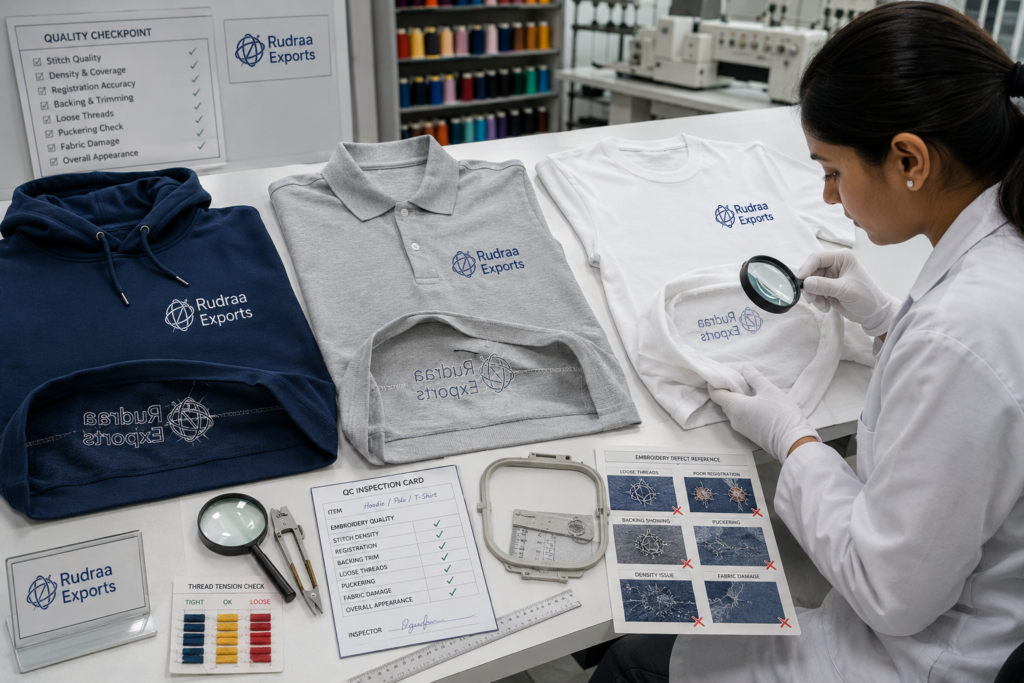
Premium embroidery can transform a basic garment into a high-value branded product.
A clean embroidered chest logo, raised 3D puff design, detailed appliqué, textured chain stitch or premium back embroidery can make a T-shirt, hoodie, polo or sweatshirt feel more distinctive and expensive.
But embroidery quality is not determined only by how many stitches are used.
Premium embroidery depends on accurate digitising, suitable thread, correct backing, fabric stability, clean registration, consistent tension, precise placement and repeatable production.
Australian lifestyle, streetwear and athleisure brands often struggle to source premium embroidery locally at a workable price, especially for smaller production runs.
This is why more start-ups explore offshore manufacturing in India, particularly Tirupur.
At Rudraa Exports, we support Australian apparel brands with garment manufacturing and custom embroidery from Tirupur, including sampling, stitch-count planning, thread selection, fabric compatibility checks, private labels, quality inspection, export packing and shipment documentation.
Quick Answer
Australian apparel start-ups can source premium embroidered T-shirts, hoodies, polos, sweatshirts and activewear from Tirupur by treating embroidery as a controlled manufacturing process. Buyers should specify artwork dimensions, stitch count, thread colours, placement, embroidery technique, backing type, defect tolerances and AQL standards. For smaller runs, MOQ can often be reduced by using stock garments or fabrics, limiting thread colours and keeping embroidery placements consistent.
Planning a premium embroidered clothing range? Contact Rudraa Exports to request an embroidery development and sampling plan.
Why Premium Embroidery Requires More Than a Logo File
Embroidery should not be treated as a simple decoration added after garment production.
It affects:
- Fabric stability
- Garment appearance
- Reverse-side comfort
- Production time
- Unit price
- Wash durability
- Brand perception
- Quality consistency
The uploaded source explains that offshore embroidery succeeds when it is treated as a controlled manufacturing process rather than a basic logo add-on.
What Premium Embroidery Really Means
Premium embroidery means repeatable quality.
Premium Embroidery Characteristics
| Quality Area | Premium Result |
|---|---|
| Edge quality | Clean and sharp |
| Registration | Design elements align correctly |
| Thread tension | No loose loops or visible bobbin |
| Fabric surface | No puckering or tunnelling |
| Thread colour | Consistent across the full order |
| Trimming | No long loose threads |
| Reverse finish | Clean and comfortable |
| Placement | Consistent across garments |
| Wash result | Shape and colour remain stable |
| Repeat orders | Same appearance across production runs |
The uploaded source defines premium embroidery through clean edges, accurate registration, stable fabric, consistent thread colour, tidy reverse trimming and repeatability.
Why Tirupur Works for Embroidered Apparel
Tirupur is known for knitwear manufacturing and export-oriented garment production.
The cluster includes:
- Fabric sourcing
- Knitting
- Dyeing
- Garment cutting
- Sewing
- Embroidery
- Printing
- Finishing
- Quality inspection
- Export packing
This makes it easier to coordinate the base garment and embroidery within one manufacturing ecosystem.
The uploaded source highlights Tirupur’s knitwear scale, export readiness and ability to support small-batch embroidered apparel programs.
Products Suitable for Premium Embroidery
Embroidered Apparel Categories
| Product | Common Embroidery Placement |
|---|---|
| T-shirts | Left chest, sleeve, centre chest |
| Polo shirts | Chest, sleeve, back yoke |
| Hoodies | Chest, sleeve, hood, back |
| Sweatshirts | Chest, centre front, sleeve |
| Joggers | Thigh, pocket, lower leg |
| Caps | Front, side and back |
| Jackets | Chest, sleeve and back |
| School uniforms | Crest and student name |
| Corporate uniforms | Company logo and department |
| Activewear | Small chest or sleeve branding |
| Kidswear | Small motifs and appliqué |
| Streetwear | Large back or puff embroidery |
Premium Embroidery Techniques
Different embroidery methods create different visual effects.
Flat or Satin Embroidery
Flat embroidery is suitable for:
- Small chest logos
- Brand names
- Fine lettering
- Polo shirt logos
- Uniform crests
- Minimal streetwear branding
It creates a clean, polished surface when density, backing and fabric are correctly matched.
3D Puff Embroidery
3D puff uses foam beneath the stitches to create a raised design.
Best for:
- Bold letters
- Caps
- Hoodies
- Sweatshirts
- Streetwear logos
- Simple graphic forms
Thin lines and detailed artwork do not work well with puff embroidery.
Appliqué Embroidery
Appliqué combines fabric pieces with embroidered borders.
Best for:
- Varsity designs
- College-style lettering
- Large chest designs
- Heritage sportswear
- Premium sweatshirts
- Kidswear motifs
Chain-Stitch Embroidery
Chain stitch creates a textured and vintage appearance.
Best for:
- Heritage branding
- Western-style graphics
- Script logos
- Heavyweight garments
- Retro collections
The uploaded source discusses flat or satin embroidery, 3D puff, appliqué and chain stitch as useful premium embroidery techniques.
How Stitch Count Affects Embroidery Cost
Embroidery pricing is often influenced by stitch count.
A larger or denser design requires more machine time and thread.
Main Cost Drivers
| Cost Driver | Effect on Price |
|---|---|
| Stitch count | More stitches increase cost |
| Design size | Larger designs usually cost more |
| Thread colours | More colour changes increase machine time |
| Placement | Sleeves and difficult areas can cost more |
| Technique | Puff and appliqué require more setup |
| Backing | Premium stabilisers add cost |
| Quantity | Higher volumes reduce setup cost per unit |
| Digitising | Complex artwork costs more to prepare |
| Garment fabric | Stretch fabrics require more control |
Buyer Tip
Request embroidery pricing based on:
- Final stitch count
- Design dimensions
- Number of thread colours
- Placement
- Technique
- Setup or digitising fee
- Per-piece embroidery cost
Do not accept only “small logo” or “large logo” pricing.
Embroidery Digitising
Digitising converts artwork into a stitch file that an embroidery machine can read.
It controls:
- Stitch direction
- Stitch type
- Density
- Underlay
- Pull compensation
- Colour sequence
- Trim points
- Machine path
Poor digitising can create puckering, gaps, distorted letters and misaligned sections even when the embroidery machine is good.
Thread Selection
Polyester embroidery thread is commonly used because it offers:
- Good strength
- Colour consistency
- Wash durability
- Bright colours
- Resistance to abrasion
- Suitability for activewear and uniforms
Other thread options may include:
- Rayon
- Metallic thread
- Matte thread
- Recycled polyester thread
- Glow or speciality thread
Backing and Stabiliser
Backing helps hold the fabric stable during embroidery.
Common Backing Options
| Backing Type | Suitable For |
|---|---|
| Cut-away | Stretch fabrics, jersey and activewear |
| Tear-away | Stable woven fabrics |
| Wash-away | Delicate or open designs |
| Foam | 3D puff embroidery |
| Topping film | Fleece, towels and textured surfaces |
Buyer Tip
For premium garments, check the reverse side.
Backing should be trimmed cleanly and should not create sharp or scratchy edges.
Embroidery on Different Fabrics
The same design may behave differently on different fabrics.
Fabric Compatibility Guide
| Fabric | Main Risk |
|---|---|
| Cotton jersey | Stretch and puckering |
| Piqué | Texture can hide fine detail |
| Fleece | Stitches can sink into fabric |
| French terry | Loop texture affects stability |
| Poly-spandex | Stretch distortion |
| Heavy sweatshirt fleece | Thick layers affect needle penetration |
| Woven cotton | More stable but can show needle damage |
| Nylon | Heat and tension sensitivity |
This is why the production sample must be embroidered on the actual bulk fabric.
Sampling Process for Premium Embroidery
A sample should predict the bulk order.
Recommended Sampling Sequence
| Stage | What to Approve |
|---|---|
| Artwork review | Shape, detail and text size |
| Digitised file | Stitch count and sequence |
| Test sew-out | Early embroidery result |
| Thread colour approval | Closest match to requested colour |
| PP embroidered sample | Final design on actual garment |
| Wash test | Stability after laundering |
| Size-set review | Placement consistency across sizes |
The uploaded source recommends approving a digitised file proof, thread colours, a PP embroidered sample on the actual garment fabric, and size-set consistency before bulk production.
Common Embroidery Defects
Quality Defect Guide
| Defect | Common Cause |
|---|---|
| Puckering | Excess density or incorrect backing |
| Poor registration | Digitising or hooping issue |
| Loose loops | Incorrect thread tension |
| Visible bobbin thread | Tension imbalance |
| Needle holes | Wrong needle or machine speed |
| Uneven lettering | Poor digitising |
| Thread breaks | Needle, tension or thread issue |
| Design distortion | Stretch fabric not stabilised |
| Colour inconsistency | Different thread lots |
| Rough reverse side | Poor trimming or backing choice |
The uploaded source identifies registration problems, puckering, thread tension imbalance and fabric damage as common defects buyers should check.
AQL for Embroidered Garments
AQL means Acceptable Quality Limit.
It helps define how a production batch will be inspected.
Common Planning Direction
| Defect Type | Example AQL Direction |
|---|---|
| Major defects | AQL 2.5 |
| Minor defects | AQL 4.0 |
Major embroidery defects may include:
- Wrong logo
- Incorrect placement
- Severe puckering
- Missing embroidery section
- Major registration error
- Wrong thread colour
Minor defects may include:
- Small loose thread
- Minor trimming issue
- Slight placement variation within tolerance
The uploaded source recommends using defined AQL language so embroidery quality requirements become measurable and contractual.
Low MOQ Premium Embroidery
Low MOQ is possible when the program is organised correctly.
What Helps Lower MOQ
- Stock fabric
- Stock garment colours
- One garment body
- Standard embroidery placements
- Three to five thread colours
- Simple logo shapes
- Shared labels across styles
- Repeat-order forecast
- Combined size run
- One shipment
The uploaded source notes that some Tirupur suppliers may support custom orders around 20–50 units when fabric and trims are straightforward, although exact MOQ depends on the production program.
How to Negotiate Embroidery MOQ
Better Negotiation Approach
Instead of saying:
“I need only 30 pieces. Can you reduce MOQ?”
Say:
“We can use your stock fleece, one colour, three embroidery thread colours, one chest placement and standard packaging. What is the lowest workable MOQ?”
This helps the factory reduce:
- Fabric waste
- Thread changes
- Machine setup
- Sampling effort
- Packing complexity
Embroidery Cost Planning
Premium embroidery cost depends on:
- Digitising fee
- Stitch count
- Thread colours
- Placement
- Technique
- Quantity
- Backing
- Garment construction
Costing Checklist
| Cost Line | Ask Supplier to Separate |
|---|---|
| Base garment | T-shirt, hoodie or polo cost |
| Digitising | One-time setup |
| Embroidery | Per-piece cost |
| Puff foam | If used |
| Appliqué fabric | If used |
| Special thread | Metallic, matte or recycled |
| Sampling | Sew-out and PP sample |
| Labels | Woven and care labels |
| Packing | Bag, tag and carton |
| Inspection | AQL or third-party QC |
The uploaded source recommends comparing embroidery quotes using stitch count, thread colour count, placement, backing and separate setup fees.
Lead-Time Planning for Australia
A premium embroidered apparel order includes more than bulk stitching.
Production Timeline
| Stage | Indicative Planning Direction |
|---|---|
| Artwork and digitising | Several working days |
| Test sew-out | Depends on revisions |
| PP embroidered sample | Around 1–2 weeks where feasible |
| Bulk garment production | Depends on garment and quantity |
| Embroidery production | Added after garment panels or finished garment stage |
| Final QC | Before packing |
| Sea freight | Route and season dependent |
| Air freight | Faster but more expensive |
The uploaded source gives planning ranges of approximately 25–38 days for sea freight and 1–5 days for air freight on relevant India-to-Australia routes, subject to routing and season.
Embroidery Tech Pack Checklist
Your embroidery tech pack should include:
| Requirement | What to Provide |
|---|---|
| Artwork | Vector file where possible |
| Dimensions | Width and height in millimetres |
| Placement | Distance from seam or HPS |
| Technique | Satin, puff, appliqué or chain stitch |
| Stitch count | Target and tolerance |
| Thread colours | Pantone reference and approval requirement |
| Backing | Cut-away, tear-away or other |
| Fabric | Composition and GSM |
| Quality references | Pass and fail images |
| Tolerance | Placement and defect tolerance |
The uploaded source recommends including artwork dimensions, placement diagrams, stitch-count tolerance, thread colours, technique, backing and visual pass/fail references.
Quality-Control Checkpoints
1. Pre-Production Meeting
Confirm:
- Stitch count
- Thread colour list
- Backing
- Garment fabric
- Placement
- Machine setup assumptions
2. First-Production Check
Review the first 10–20 pieces for:
- Registration
- Puckering
- Colour
- Placement
- Reverse trimming
3. Final Inspection
Check:
- Quantity
- Embroidery consistency
- Measurement
- Garment quality
- Labels
- Packing
- AQL results
The uploaded source recommends a pre-production meeting, early inline photos or video and final AQL inspection to prevent bulk embroidery failures.
Why Rudraa Exports
Rudraa Exports supports custom embroidered apparel manufacturing from Tirupur, India.
Products Supported
- Embroidered T-shirts
- Embroidered polo shirts
- Embroidered hoodies
- Embroidered sweatshirts
- Embroidered joggers
- Embroidered caps
- School uniforms
- Corporate uniforms
- Sportswear
- Streetwear
- Private-label apparel
Embroidery Support
- Artwork review
- Digitising coordination
- Stitch-count planning
- Thread colour approval
- Puff embroidery
- Appliqué development
- Flat embroidery
- Placement approval
- PP samples
- Wash testing coordination
- AQL inspection support
- Export packing
Manufacturing Strengths
- Factory-direct Tirupur garment manufacturing
- MOQ discussions from around 300 pieces for suitable programs
- Stock fabric and colour planning
- Sampling and private-label support
- Export documentation for Australian buyers
- Multi-port shipping through Chennai, Tuticorin and Cochin
- Export support for Australia and global markets
Buyer Advantages
- Base garment and embroidery coordination
- Better control over stitch quality
- Better fabric-to-embroidery compatibility
- Fewer sourcing layers
- Low-MOQ discussions for suitable designs
- Repeat-order embroidery consistency
- Factory-direct communication
- Export-ready packing and documentation
Ready to develop premium embroidered apparel? Speak with Rudraa Exports to share your artwork, garment type, fabric, GSM, quantity, embroidery technique and delivery destination.
Premium Embroidery Sourcing Checklist
| # | Checklist Item |
|---|---|
| 1 | Confirm garment type |
| 2 | Confirm fabric and GSM |
| 3 | Provide vector artwork |
| 4 | Define embroidery dimensions |
| 5 | Define placement |
| 6 | Select embroidery technique |
| 7 | Confirm thread colours |
| 8 | Request stitch count |
| 9 | Confirm backing |
| 10 | Approve test sew-out |
| 11 | Approve PP sample |
| 12 | Check reverse-side comfort |
| 13 | Conduct wash test |
| 14 | Approve size-set placement |
| 15 | Define AQL |
| 16 | Review first production pieces |
| 17 | Confirm labels |
| 18 | Confirm packing |
| 19 | Complete final inspection |
| 20 | Keep approved sample for repeats |
FAQ: Premium Embroidery Manufacturing in India
1. Is India good for premium embroidery manufacturing?
Yes. India, particularly Tirupur, offers garment manufacturing, embroidery capability, export support and flexible production options for premium embroidered apparel.
2. What garments can be embroidered?
T-shirts, polo shirts, hoodies, sweatshirts, joggers, caps, uniforms, jackets, activewear and streetwear can all support embroidery when the fabric and stabiliser are suitable.
3. What is the MOQ for custom embroidery?
MOQ depends on garment fabric, thread colours, embroidery size, technique and trims. Suitable programs may begin around 50 pieces, while very simple stock-based programs may sometimes support lower quantities.
4. What is 3D puff embroidery?
3D puff embroidery uses foam under satin stitches to create a raised design. It works best for bold, simple artwork.
5. What causes embroidery puckering?
Puckering can be caused by excessive stitch density, incorrect backing, poor hooping or unsuitable machine tension.
6. How is embroidery pricing calculated?
Embroidery cost is commonly influenced by stitch count, design size, colour changes, placement, quantity, technique, backing and digitising.
7. Should embroidery be sampled on the actual fabric?
Yes. Embroidery should be approved on the same fabric, GSM and colour planned for bulk production.
8. What thread is best for activewear embroidery?
Polyester embroidery thread is commonly used because of its durability, colour retention and resistance to repeated washing.
9. What is AQL for embroidered apparel?
AQL is a sampling method used to determine whether the production batch meets agreed defect limits. AQL 2.5 for major defects and 4.0 for minor defects is a common starting direction.
10. Can Rudraa support puff and appliqué embroidery?
Yes. Rudraa can discuss flat embroidery, puff embroidery, appliqué, embroidered crests and private-label branding depending on artwork and production requirements.
11. How can I keep embroidery MOQ low?
Use stock garments or fabrics, limit thread colours, keep one placement, simplify the design and provide a repeat-order forecast.
12. What should I send Rudraa for an embroidery quote?
Send the garment type, artwork file, embroidery dimensions, placement, technique, thread colours, quantity, fabric, GSM, labels, packing and delivery location.
Conclusion
Premium embroidery is not created by stitch count alone.
It requires the right combination of digitising, thread, fabric, backing, tension, placement, sampling and quality inspection.
Australian start-ups can source premium embroidered clothing from Tirupur without committing to luxury-level MOQs when the design and production plan are kept practical.
The safest approach is to approve a PP embroidered sample on the actual fabric, define measurable specifications, review early production pieces and inspect the final order using agreed defect standards.
Rudraa Exports helps Australian lifestyle, streetwear, athleisure, schoolwear and corporate buyers develop embroidered apparel with factory-direct garment production, embroidery coordination, sampling, QC, private labels and export support.
Visit rudraaexports.com or contact our team directly to share your embroidered clothing requirement — and receive a custom development and production plan from Rudraa Exports.
Related reading
3 Factory Practices You Must Verify Before Placing a Heavyweight Knitwear Order
Cut-and-Sew vs Blank Customisation: Which Model Fits Your Australian Streetwear Brand?
What Printing Techniques Are Best for Custom T-Shirts in 2026? Complete Buyer’s Guide
Why Your Garment Sample Does Not Fit Like the Reference: Pattern Grading Mistakes Explained