
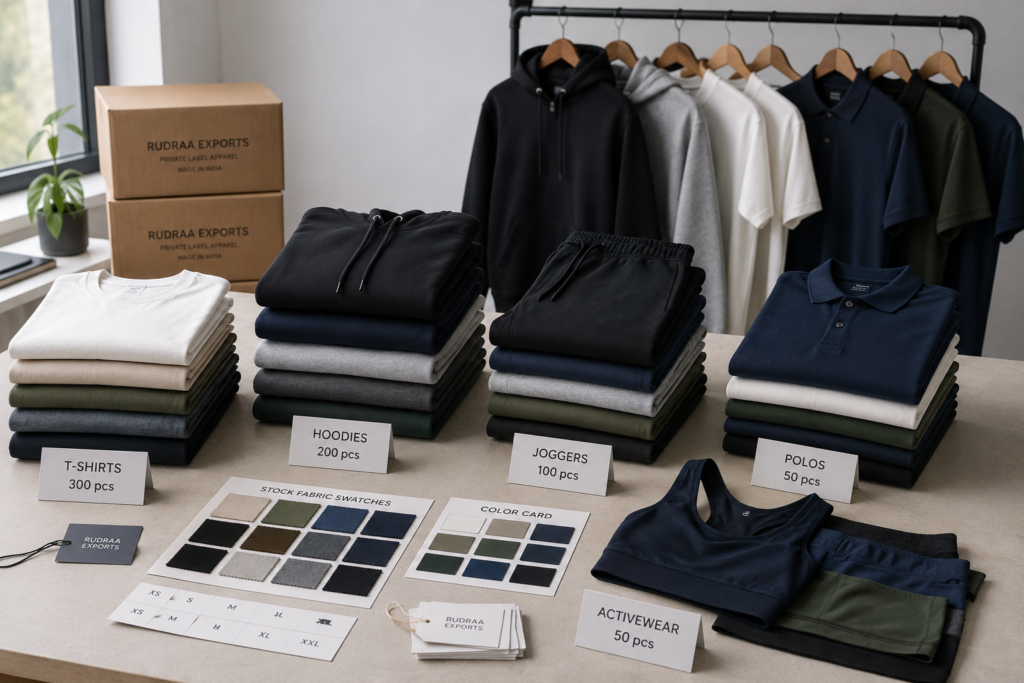
Launching a clothing brand in Australia starts with a difficult production decision:
How many units should you manufacture?
This is where MOQ matters.
MOQ means Minimum Order Quantity. It is the smallest number of garments a factory is willing to produce for one style, colour, fabric, or order.
For established brands, a high MOQ may be manageable.
For a startup, it can create serious cash-flow pressure.
A founder may only need 100 or 200 pieces to test demand, but some factories may ask for 500, 1,000 or more. Once freight, GST, customs clearance, labels, packaging, storage and fulfilment are added, the first order can become a large financial commitment.
This is why Australian startup brands need more than a low number.
They need a low-MOQ manufacturing strategy.
At Rudraa Exports, we help Australian startup brands source small-batch clothing from Tirupur, India, with factory-direct production, stock-fabric planning, MOQ discussions, sampling, private labels, quality inspection, export packing and repeat-order support.
Quick Answer
Australian startup clothing brands can reduce MOQ by choosing stock fabrics, limiting colourways, simplifying trims, using one base pattern across multiple designs, consolidating labels and sharing a repeat-order plan with the factory. T-shirts and knit basics generally offer the easiest low-MOQ starting point, while hoodies, joggers and custom-dyed products may require higher quantities. Rudraa Exports can discuss suitable programs beginning around 300 pieces per style where fabric, colour, trims and production conditions allow.
Planning your first clothing drop? Contact Rudraa Exports to request a low-MOQ production plan.
Why MOQ Is Your First Real Production Decision
MOQ affects almost every part of your first clothing launch.
It determines:
- How much cash you need
- How much inventory you hold
- How many colours you can offer
- How wide your size range can be
- Which fabrics are available
- Your unit price
- Your freight cost
- Your dead-stock risk
- Your reorder strategy
The uploaded source explains that MOQ shapes a startup’s first production run because it affects fabric purchasing, machine setup, labour planning, trim sourcing and total cash exposure.
What MOQ Means in Clothing Manufacturing
MOQ is the minimum quantity a manufacturer will produce under a specific set of conditions.
It may be quoted:
- Per order
- Per style
- Per colour
- Per fabric
- Per print
- Per size run
Important Buyer Question
Do not ask only:
“What is your MOQ?”
Ask:
- What is the MOQ per style?
- What is the MOQ per colour?
- What is the MOQ if I use stock fabric?
- What is the MOQ if I need custom dyeing?
- What is the MOQ for custom labels and packaging?
A factory that says “300 pieces MOQ” may mean 300 pieces per colour.
Three colours could therefore become 900 pieces.
The uploaded source highlights that MOQ may apply per style, colour or size run, and warns buyers to clarify this in writing.
Why Clothing Factories Have MOQs
Factories do not create MOQs only to make buyers order more.
MOQs are connected to production economics.
Main MOQ Drivers
| MOQ Driver | Why It Increases Minimums |
|---|---|
| Fabric roll minimum | Mills may require a full roll or batch |
| Custom dyeing | Dye houses have minimum dye-lot quantities |
| Custom GSM | Special fabric development needs volume |
| Pattern setup | Pattern and grading require development time |
| Machine setup | Production lines need setup and changeover |
| Custom trims | Labels, zippers and badges have supplier MOQs |
| Printing | Screens and setup costs need to be spread |
| Embroidery | Digitisation and machine setup add cost |
| Packaging | Custom bags and boxes have separate minimums |
| Factory capacity | Busy lines prioritise larger orders |
The uploaded source explains that fabric minimums, dyeing, complexity, trims, embellishments and factory capacity are major factors that increase MOQ.
What Increases MOQ
MOQ normally increases when buyers request:
- Custom-dyed fabric
- Special GSM
- Organic or recycled certification
- Multiple colours
- Multiple patterns
- Complex pockets
- Custom zippers
- Branded drawcord tips
- Custom woven labels
- Premium boxes
- Low-volume embroidery
- Multiple wash finishes
What Helps Reduce MOQ
MOQ can often be reduced by simplifying the first order.
Low-MOQ Strategies
| Strategy | Why It Helps |
|---|---|
| Use stock fabric | Avoids mill minimums |
| Use stock colours | Avoids custom dyeing |
| Start with one hero product | Reduces setup complexity |
| Limit colourways | Consolidates fabric volume |
| Use one body pattern | Reduces pattern changes |
| Standardise labels | Reduces trim minimums |
| Use simple packaging | Avoids packaging MOQ |
| Share repeat forecast | Shows future volume potential |
| Accept setup charges | Helps cover small-run development |
| Use factory-recommended inputs | Fits existing production flow |
Typical Low MOQ by Product Type
MOQ varies by factory, product and fabric.
The ranges below are practical planning directions rather than fixed promises.
| Product | Suitable Startup MOQ Direction | What Changes It |
|---|---|---|
| Basic T-shirt | Around 50–300 pieces for suitable programs | Fabric, colour and print |
| Polo shirt | Around 100–300 pieces | Pique fabric, collar and embroidery |
| Sweatshirt | Around 100–300 pieces | Fleece GSM and colour |
| Hoodie | Around 100–500 pieces for suitable simplified runs | Fleece, trims, zipper and print |
| Joggers | Around 100–300 pieces | Pockets, rib and fabric |
| Leggings | Around 150–300 pieces | Stretch fabric and colour |
| Kidswear | Around 100–300 pieces | Size curve and safety requirements |
| Uniforms | Around 300 pieces per style / colour | Embroidery and repeat volume |
The uploaded source explains that knit basics generally offer the best starting point for low-MOQ programs, while hoodies and more complex products often face greater MOQ pressure.
Why T-Shirts Are Good for a First Drop
T-shirts are often the simplest product for startup manufacturing.
They usually have:
- Fewer pattern pieces
- Standard fabrics
- Simple stitching
- Easier grading
- Lower trim complexity
- Easier print customisation
- Better stock-colour availability
First-Drop Example
A startup could begin with:
- One T-shirt body
- Two colours
- One fabric
- One label package
- Two graphic variations
- Limited size range
This gives the brand product variety without creating several completely different production setups.
Why Hoodies Usually Need More Planning
Hoodies use more fabric and require more operations.
They may include:
- Fleece or French terry
- Rib cuffs
- Rib hem
- Hood lining
- Drawcords
- Eyelets
- Kangaroo pocket
- Zipper
- Embroidery
- Multiple print positions
To reduce hoodie MOQ, begin with:
- One fabric
- One colour
- One trim set
- One body shape
- Simple branding
- Standard packaging
How to Negotiate Lower MOQ with Indian Factories
Low-MOQ negotiation works best when the buyer helps reduce factory risk.
1. Use Stock Fabrics and Colours
Ask the factory which fabrics it already runs regularly.
Common options may include:
- Black cotton jersey
- White cotton jersey
- Grey mélange
- Navy pique
- Standard fleece
- Standard French terry
Using existing materials can reduce fabric minimums and lead time.
2. Consolidate Styles
Instead of developing three different T-shirt bodies, use one base pattern with different prints.
This reduces:
- Pattern work
- Sampling
- Fabric variation
- Sewing setup
- Grading changes
3. Offer a Phased Order Plan
Example:
- First order: 200 pieces
- Repeat order: 500 pieces if sales targets are met
- Third order: larger seasonal program
A documented repeat plan helps the factory see long-term value.
4. Pay Clear Setup Charges
For a small order, the factory may charge separately for:
- Pattern development
- Sampling
- Grading
- Embroidery digitisation
- Print screens
- Label development
Paying reasonable setup costs can help reduce the production MOQ.
5. Standardise Trims
Use the same:
- Neck label
- Size label
- Care label
- Hangtag
- Packaging bag
across multiple styles.
6. Present a Professional Brief
Factories are more likely to discuss flexible MOQs with organised buyers.
Send:
- Tech pack
- Product reference
- Fabric requirement
- GSM
- Colour list
- Size range
- Quantity matrix
- Branding details
- Target delivery date
The uploaded source recommends negotiating by solving the factory’s risks through stock fabrics, consolidated trims, phased commitments, clear setup costs and organised buyer documentation.
MOQ Per Style vs MOQ Per Colour
This distinction can completely change your order.
Example
Factory MOQ:
300 pieces per colour
Your colour plan:
- Black: 300
- White: 300
- Navy: 300
Total order:
900 pieces
Better Startup Plan
Ask whether the factory can accept:
- Black: 150
- White: 100
- Navy: 50
Total: 300 pieces across the style
This may only be possible if the factory can use stock colours and combine production efficiently.
How to Control Cash Exposure
Before requesting quotes, set a maximum landed-cost budget per style.
Example
Maximum landed budget:
AUD 6,000 per SKU
Target landed cost:
AUD 20 per hoodie
Maximum quantity:
300 hoodies
This helps you avoid accepting an MOQ that is not financially safe.
The uploaded source recommends deciding the maximum cash exposure per style and working backwards to the target MOQ and FOB price.
FOB Price vs Landed Cost
A low MOQ usually means a higher unit price.
But this may still be financially safer than over-ordering.
FOB May Include
- Fabric
- Cutting
- Stitching
- Trims
- Basic labels
- Basic packing
- Export carton
- Factory margin
Landed Cost May Include
- FOB
- International freight
- Insurance
- Duty if applicable
- GST
- Customs brokerage
- Port charges
- Local delivery
- Inspection
- Bank fees
- FX spread
- Storage and fulfilment
The uploaded source explains that founders should compare suppliers on the same Incoterm and focus on predictable landed cost rather than the lowest FOB quote.
Simple Startup Cost Example
Assume:
- 300 T-shirts
- FOB price: USD 6
- FOB goods value: USD 1,800
You must still add:
- Freight
- Insurance
- Customs clearance
- GST
- Local delivery
- Sampling
- Labels and packaging
- Bank fees
This is why founders should avoid pricing retail products from FOB alone.
Ask Every Supplier for These Details
RFQ Checklist
| Detail | Why You Need It |
|---|---|
| MOQ per style | Total production minimum |
| MOQ per colour | Prevents surprise volume |
| FOB price | Factory export price |
| Incoterm | Allows supplier comparison |
| Packed CBM | Needed for sea freight |
| Gross weight | Needed for freight quotes |
| Carton count | Helps logistics planning |
| Fabric composition | Quality and customs |
| GSM | Product performance |
| HS code suggestion | Broker classification support |
| Sample charges | Development budgeting |
| Label costs | Avoid hidden extras |
| Packaging costs | Full product costing |
| Testing costs | Compliance budgeting |
Red Flags in Low-MOQ Manufacturing
A low MOQ is not always a good deal.
Warning Signs
| Red Flag | Possible Risk |
|---|---|
| “Any MOQ is possible” | Substitution or hidden charges |
| No GSM confirmation | Fabric may be lower quality |
| No composition details | Product may not match quote |
| Extremely low FOB | Missing trims, QC or packing |
| No factory proof | Supplier may be a trader |
| No sample process | Bulk quality risk |
| Full upfront payment | Commercial risk |
| No written specifications | Dispute risk |
| No inspection process | Defects found after delivery |
| No landed-cost inputs | Margin surprise |
The uploaded source warns that vague specifications, unusually low prices, unlimited MOQ promises, unclear factory identity, weak compliance proof and upfront payment pressure are common red flags.
Quality Control for Small-Batch Orders
Small orders still need quality control.
Essential QC Checks
- Fabric GSM
- Fibre composition
- Shrinkage
- Colourfastness
- Stitching quality
- Measurements
- Print placement
- Embroidery placement
- Label accuracy
- Size ratio
- Packing accuracy
Sampling Path
| Sample Stage | Purpose |
|---|---|
| Proto sample | Construction and overall shape |
| Fit sample | Measurements and fit |
| Size set | Grading across sizes |
| PP sample | Final bulk approval |
The uploaded source recommends pre-production sample approval, simple QC plans, measurement tolerances, inline photos and carton-marking checks for first orders.
Low-MOQ Readiness Checklist
| # | Checklist Item |
|---|---|
| 1 | Define maximum cash exposure |
| 2 | Define target MOQ per style |
| 3 | Define target MOQ per colour |
| 4 | Select stock or custom fabric |
| 5 | Confirm fabric composition |
| 6 | Confirm GSM |
| 7 | Limit colour count |
| 8 | Simplify trims |
| 9 | Prepare tech pack |
| 10 | Confirm FOB Incoterm |
| 11 | Request packed CBM |
| 12 | Request gross weight |
| 13 | Confirm sample pathway |
| 14 | Approve size set |
| 15 | Approve PP sample |
| 16 | Confirm QC checkpoints |
| 17 | Request itemised proforma invoice |
| 18 | Calculate landed cost |
| 19 | Share repeat-order forecast |
| 20 | Start simple and scale winners |
Why Rudraa Exports
Rudraa Exports helps startup clothing brands source small-batch and private-label garments from Tirupur, India.
Products Supported
- T-shirts
- Polo shirts
- Hoodies
- Sweatshirts
- Joggers
- Leggings
- Activewear
- Kidswear
- Babywear
- Uniforms
- Nightwear
- Corporate apparel
- Private-label knitwear
Startup Support
- Product brief review
- Tech pack guidance
- Fabric and GSM guidance
- Stock-fabric recommendations
- MOQ planning
- Sample development
- Fit and size set coordination
- Print and embroidery support
- Private labels
- Packaging support
- AQL 2.5 inspection support
- Export packing and documentation
- Repeat-order planning
Manufacturing Strengths
- Factory-direct Tirupur knitwear manufacturing
- MOQ discussions from around 300 pieces per style for suitable programs
- 72,000+ units per month stated production capacity
- Sampling and small-batch development support
- Multi-port shipping through Chennai, Tuticorin and Cochin
- Export support for Australia and global buyers
Buyer Advantages
- Lower initial inventory exposure
- Factory-direct communication
- Fewer middle layers
- Better control over fabric and GSM
- Better small-batch planning
- Easier test-to-repeat roadmap
- Export-ready documentation
- Up to 40% cost-saving positioning compared with indirect sourcing models, depending on specs and order structure
Ready to launch a small clothing collection? Speak with Rudraa Exports to share your product, target MOQ, colours, fabric, budget and Australia delivery location.
FAQ: Low MOQ Clothing Manufacturing
1. What is MOQ in clothing manufacturing?
MOQ is the minimum number of garments a factory will manufacture for a style, colour, fabric or order.
2. What is a good MOQ for a startup clothing brand?
A suitable startup MOQ depends on the product and fabric. Basic knitwear may be possible from around 50–300 pieces for suitable programs, while complex hoodies or custom fabrics may require more.
3. Can I order 50 pieces from a clothing manufacturer?
Some factories may accept around 50 pieces for selected products, stock fabrics and simplified programs. Custom colours, special trims or complex construction can increase the minimum.
4. Is MOQ per style or per colour?
It can be either. Always ask the factory to confirm MOQ per style and MOQ per colour separately.
5. How can I reduce clothing MOQ?
Use stock fabric, reduce colours, standardise trims, simplify construction, consolidate styles and share a repeat-order forecast.
6. Are low-MOQ garments more expensive?
Usually, yes. Fixed costs such as setup, sampling, pattern development and administration are divided across fewer pieces.
7. Should a startup begin with T-shirts or hoodies?
T-shirts are generally easier for a first low-MOQ launch. Hoodies require more fabric, trims and sewing operations.
8. What is the difference between FOB and landed cost?
FOB is the factory-side export price. Landed cost includes freight, insurance, duty, GST, clearance, local delivery and other import costs.
9. What documents should I send for a quote?
Send your tech pack or reference images, fabric, GSM, quantity, colours, size range, branding, packaging and delivery requirement.
10. What are low-MOQ supplier red flags?
Red flags include vague fabric details, unrealistic prices, unlimited MOQ promises, no sample process, unclear factory ownership and pressure for full upfront payment.
11. Can Rudraa Exports support Australian startup brands?
Yes. Rudraa can discuss suitable startup programs with stock fabrics, simplified trims, sample development, low-MOQ planning and repeat-order support.
12. What should I send Rudraa for a low-MOQ quote?
Send product type, target quantity, fabric, GSM, colour count, size range, print or embroidery details, packaging, budget and Australia delivery location.
Conclusion
Low-MOQ clothing manufacturing allows Australian startup brands to test demand without committing too much cash to inventory.
But the best result does not come from forcing the factory to accept an unrealistic quantity.
It comes from designing a production plan that works for both the brand and the manufacturer.
Use stock fabrics. Limit colours. Simplify trims. Start with one hero product. Approve samples properly. Calculate landed cost. Share your repeat-order plan.
Rudraa Exports helps Australian startup brands source small-batch clothing from Tirupur with factory-direct production, fabric guidance, MOQ planning, sampling, private labels, QC and export support.
Visit rudraaexports.com or contact our team directly to share your startup clothing idea — and receive a low-MOQ production plan from Rudraa Exports.
Related reading
How to Launch Your Clothing Brand with Small-Batch Production: 50–200 Unit Guide
How to Start a Clothing Brand in Australia: The Correct Order and Realistic Timeline
What GSM Means in T-Shirts: Complete Fabric Weight Guide for Buyers
What Actually Drives Repeat Customers for Early-Stage Clothing Brands