
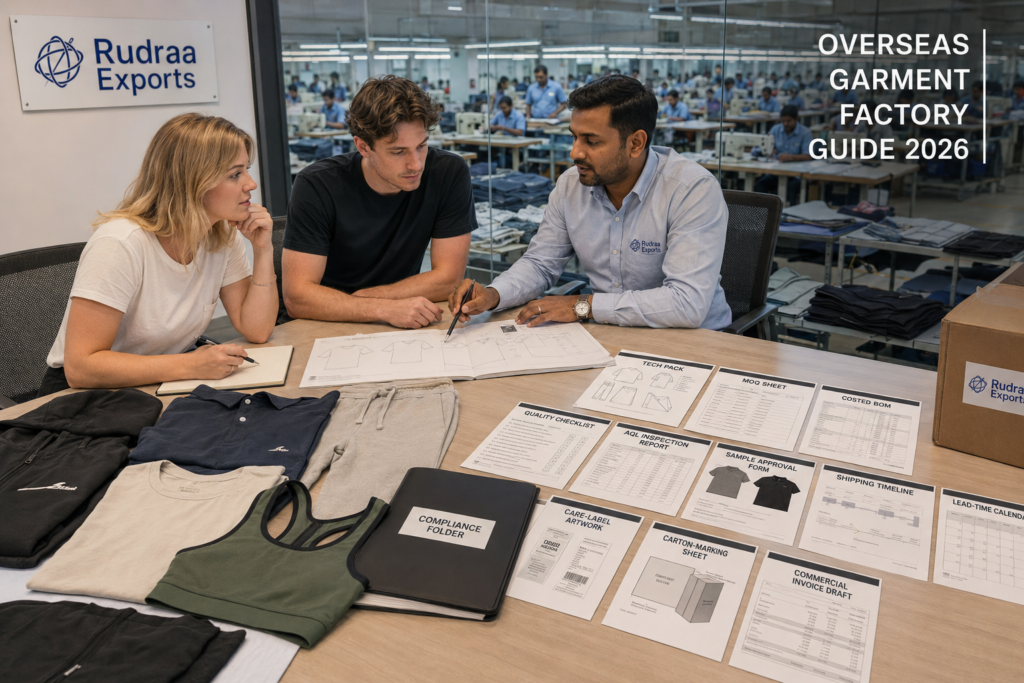
Ordering from an overseas garment factory can help Australian brands reduce costs, access better manufacturing capacity, and scale product ranges faster.
But it also comes with real risks.
Most first-time Australian fashion brands worry about the same five things:
- Quality
- Communication
- Shipping delays
- High MOQs
- Ethical compliance
These concerns are valid.
A delayed shipment can miss your launch window. A poor-quality batch can damage your brand reputation. A high MOQ can lock too much cash into unsold stock. Weak communication can turn small sample issues into bulk production mistakes.
This is why overseas garment sourcing must be handled with a clear process.
At Rudraa Exports, we help Australian brands source factory-direct knitwear and apparel from Tirupur, India, with sampling support, MOQ planning, English-speaking merchandising, weekly production visibility, AQL inspection, compliance support, export packing, and documentation coordination.
Quick Answer
Before ordering from an overseas garment factory, Australian brands should check the factory’s quality control system, communication process, MOQ by style and colour, lead time, shipping plan, ethical compliance documents, inspection process, and ability to scale repeat orders. A factory-direct model can reduce risk because brands communicate closer to the production floor, receive clearer updates, and get better visibility over sampling, bulk production, QC, packing, and shipment readiness.
Planning your first overseas garment order? Contact Rudraa Exports to request a factory-direct sourcing and production plan for Australia.
Why Overseas Garment Sourcing Feels Risky
For Australian brands, offshore sourcing often feels uncertain because the factory is far away.
You cannot easily visit production every week. You may be working across time zones. Freight can be unpredictable. Supplier claims can be hard to verify.
The uploaded source highlights that first-time Australian labels commonly worry about quality, communication, shipping delays, high MOQs, and ethical compliance when ordering offshore.
The 5 Biggest Concerns Before Ordering Overseas
| Concern | What Can Go Wrong |
|---|---|
| Quality | Bulk does not match sample |
| Communication | Delayed answers and unclear updates |
| Shipping | Launch delays due to freight or port issues |
| MOQ | Too much cash tied in inventory |
| Ethical compliance | Audit or labour concerns damage trust |
These risks can be controlled with proper supplier vetting, sample gates, inspection planning, and clear documentation.
Agent vs Factory-Direct Sourcing
Australian brands usually source in two ways:
- Through an agent, trader, or sourcing company
- Directly from a garment factory
Both can work, but the risk profile is different.
Comparison Table
| Area | Agent / Trader | Factory-Direct |
|---|---|---|
| Communication | One point of contact, but filtered | Direct technical answers |
| Cost visibility | Often bundled | Clearer cost discussion |
| QC visibility | May be outsourced | Factory can control inline checks |
| MOQ | May aggregate orders | Can plan test-to-repeat roadmap |
| Compliance | Depends on supplier network | Factory can share direct evidence |
| Production updates | May be delayed | Easier weekly visibility |
| Best for | Buyers needing coordination help | Brands needing control and scale |
The uploaded source explains that neither model is automatically right, but brands should compare sourcing routes based on quality risk, communication, shipping, MOQ, and ethical compliance.
Why Factory-Direct Can Reduce Risk
A factory-direct model gives Australian brands better visibility.
Factory-Direct Advantages
- Fewer middle layers
- Faster technical answers
- Better sample feedback
- Clearer production planning
- Direct QC coordination
- Better visibility over delays
- More transparent MOQ discussion
- Easier repeat-order planning
- Stronger traceability
A factory-direct partner does not remove all risk, but it makes the risk easier to see and manage.
Concern 1: What If the Quality Is Bad?
Quality is the biggest fear for many brands.
A sample can look good, but bulk production may still fail if the process is not controlled.
Common Quality Problems
| Problem | Possible Cause |
|---|---|
| Bulk does not match sample | PP sample not properly approved |
| Measurements vary | No tolerance or inline check |
| Stitching defects | Weak sewing QC |
| Shade mismatch | Lab dip or dye lot issue |
| Shrinkage | Fabric not tested before cutting |
| Pilling | Wrong fabric or finish |
| Print cracking | Weak print testing |
| Wrong labels | Packing and labelling control issue |
The uploaded source notes that quality verification should include tech packs, measurement tolerances, PP samples, lab dips, inline checks, and final inspection.
How to Reduce Quality Risk
Before bulk production, confirm:
- Tech pack is complete
- Fabric is approved
- Lab dip is approved
- PP sample is approved
- Measurement tolerance is clear
- QC checkpoints are agreed
- AQL standard is defined
- Final inspection report is required
Buyer Tip
Do not start bulk production without written PP sample approval.
Concern 2: What If Communication Breaks Down?
Communication problems create production mistakes.
For Australian brands, time zone differences can slow down approvals and corrections.
Communication Risks
| Risk | Result |
|---|---|
| Slow replies | Sampling delays |
| Vague answers | Wrong assumptions |
| No update rhythm | Buyer loses visibility |
| No escalation contact | Problems stay unresolved |
| Technical details filtered | Sample corrections are misunderstood |
How to Improve Communication
Set expectations before sampling.
Ask:
- Who is my day-to-day merchandiser?
- Can they communicate clearly in English?
- How often will I receive updates?
- Do you send photos or video updates?
- What is the response time?
- Who handles urgent issues?
- How are sample comments tracked?
The uploaded source explains that factory-direct communication with English-speaking merchandisers and weekly production visibility can reduce “distance anxiety” for Australian brands.
Concern 3: What If Shipping Delays Ruin the Launch?
Even when production is on time, freight can delay delivery.
Australian brands should never plan launch dates with zero buffer.
Shipping Delay Causes
| Delay Cause | What Happens |
|---|---|
| Late production finish | Missed vessel cut-off |
| Packing delay | Goods not ready for pickup |
| Missing documents | Customs delay |
| Port congestion | Transit time increases |
| Peak season | Freight space becomes tight |
| Weather disruption | Vessel schedule changes |
The uploaded source explains that ocean freight and port congestion can add extra days or weeks to timelines, so Australian brands should build delay buffers into the critical path.
How to Reduce Shipping Risk
Plan:
- Production completion date
- QC inspection date
- Packing date
- Freight booking date
- Vessel cut-off
- Estimated arrival date
- Customs clearance time
- Warehouse delivery date
- Launch buffer
Buyer Tip
For fixed launch dates, consider split shipment:
- Small quantity by air for launch
- Remaining quantity by sea to control cost
Concern 4: What If MOQ Forces Over-Ordering?
MOQ means Minimum Order Quantity.
High MOQs can hurt cash flow for new Australian brands.
MOQ Risks
| MOQ Problem | Risk |
|---|---|
| Too many units | Cash tied in inventory |
| Too many colours | Fabric MOQ increases |
| Too wide size range | Stock imbalance |
| Custom fabric | Higher minimum required |
| Custom trims | Extra MOQ |
| Large first order | Higher dead stock risk |
The uploaded source explains that brands should ask MOQ by style, colour, fabric, and size instead of accepting one general MOQ number.
How to Manage MOQ
Start with:
- One hero product
- One or two colours
- Core size range
- Stock fabric where possible
- Simple labels
- Standard packaging
- Test order before repeat
Better MOQ Question
Ask the factory:
“What is the MOQ by style, colour, fabric, size range, label package, and packaging requirement?”
This gives a clearer answer than asking only “What is your MOQ?”
Concern 5: What If the Supply Chain Is Not Ethical?
Ethical compliance matters for Australian brands.
Customers, retailers, and partners increasingly expect transparency.
Ethical Risks
| Risk | Why It Matters |
|---|---|
| Undisclosed subcontracting | You do not know where goods are made |
| No audit evidence | Labour standards unclear |
| Weak wage policies | Social compliance risk |
| Poor working conditions | Reputation risk |
| No grievance process | Worker concerns may be hidden |
| No traceability | Sustainability claims are weak |
The uploaded source explains that ethical compliance is no longer only a big-brand concern, and brands should request audit evidence, subcontractor disclosure, and compliance clauses.
What to Request
Ask for:
- Factory profile
- Audit summaries if available
- SEDEX / SMETA / SA8000-type alignment where applicable
- Labour policy
- Working hour policy
- Subcontractor disclosure
- Corrective action process
- Traceability information
10-Question Overseas Factory Vetting Checklist
Use this before placing a sample order.
| # | Question |
|---|---|
| 1 | What is your QC plan and AQL standard? |
| 2 | Can you share recent inspection report formats? |
| 3 | Who is my day-to-day contact? |
| 4 | What is your sample approval process? |
| 5 | What is your production lead time by style type? |
| 6 | How do you handle delays and escalation? |
| 7 | What is MOQ by style, colour, fabric and size? |
| 8 | Can you support test order to repeat order scaling? |
| 9 | Can you share audit or compliance evidence? |
| 10 | Can you provide traceability for fabric, trims and subcontracting? |
The uploaded source provides a 10-question vetting checklist built around quality, communication, shipping delays, MOQs, and ethical compliance.
First Overseas Order Roadmap for Australian Brands
Step 1: Define Non-Negotiables
Before contacting factories, define:
- Product category
- Fabric
- GSM
- Fit
- Measurement tolerance
- Target MOQ
- Target landed cost
- Launch date
- Quality standard
- Ethical requirement
Step 2: Request Proof
Ask the factory to share:
- Factory profile
- Product capability
- Sample timeline
- QC process
- AQL standard
- Inspection format
- Compliance documents
- Export experience
- Production update process
Step 3: Sampling with Gates
Use clear approval gates.
| Sample Stage | Approval Focus |
|---|---|
| Proto sample | Shape and construction |
| Fit sample | Measurement and comfort |
| Size set | Grading across sizes |
| Lab dip | Colour approval |
| Print strike-off | Print quality |
| PP sample | Final bulk approval |
Step 4: Controlled First Bulk Order
Do not start with too many styles.
A safer first order may include:
- One hero SKU
- One fabric
- One or two colours
- Core size range
- Clear label package
- Defined QC checkpoints
- Inspection before shipment
Step 5: Protect the Launch Calendar
Plan with buffers.
| Timeline Area | Add Buffer For |
|---|---|
| Sampling | Revisions |
| Fabric | Lab dip delays |
| Bulk production | QC corrections |
| Packing | Label and carton checks |
| Freight | Port or vessel delay |
| Customs | Documentation review |
| Warehouse | Delivery scheduling |
Step 6: Scale with Repeat Orders
After the first order:
- Review defect rate
- Review fit feedback
- Review shrinkage
- Review customer returns
- Review delivery timeline
- Improve specs
- Add colours slowly
- Increase quantity gradually
The uploaded source recommends treating the first bulk order as a controlled experiment, then scaling after quality, communication, MOQ, and delivery systems are proven.
Why Rudraa Exports
Rudraa Exports supports Australian brands with factory-direct garment manufacturing from Tirupur, India.
Product Categories Supported
- T-shirts
- Polo shirts
- Hoodies
- Sweatshirts
- Joggers
- Leggings
- Kidswear
- Babywear
- Nightwear
- Uniforms
- Corporate apparel
- Activewear
- Private-label knitwear
Buyer Support
- Tech pack review
- Fabric and GSM guidance
- Sampling support
- Pattern and fit review
- Lab dip coordination
- Print and embroidery approval
- Label and packaging support
- English-speaking merchandising
- Weekly production visibility
- AQL 2.5 inspection standards
- Export packing and documentation support
- Shipment coordination for Australia
Manufacturing Strengths
- Factory-direct Tirupur knitwear manufacturing
- 72,000+ units per month production capacity
- MOQ discussions starting from around 300 pieces for suitable programs
- 500+ workers / professionals
- Multi-port shipping through Chennai, Tuticorin, and Cochin
- Export support for Australia, USA, UK, Europe, Middle East, and global buyers
Buyer Advantages
- Fewer middle layers
- Clearer communication
- Better production visibility
- Better control over fabric, trims, QC and packing
- Test-order to repeat-order planning
- Factory-direct pricing without trading-company markups
- Up to 40% cost-saving positioning compared with indirect sourcing models
- Export-ready production support for Australian labels
Ready to plan your first overseas garment order? Speak with Rudraa Exports to share your tech pack, MOQ, product category, launch date, fabric, GSM, and Australian delivery requirement.
Overseas Garment Factory Checklist for Australian Brands
| # | Checklist Item |
|---|---|
| 1 | Define product category |
| 2 | Prepare tech pack or reference sample |
| 3 | Confirm target MOQ |
| 4 | Confirm target landed cost |
| 5 | Confirm fabric and GSM |
| 6 | Ask MOQ by style and colour |
| 7 | Ask for sampling timeline |
| 8 | Ask for production lead time |
| 9 | Confirm merchandiser contact |
| 10 | Confirm update frequency |
| 11 | Confirm QC checkpoints |
| 12 | Confirm AQL standard |
| 13 | Request inspection report format |
| 14 | Confirm compliance documents |
| 15 | Confirm subcontracting policy |
| 16 | Confirm export packing plan |
| 17 | Confirm shipping buffer |
| 18 | Approve PP sample |
| 19 | Inspect first bulk order |
| 20 | Scale only after first order is stable |
FAQ: Ordering from an Overseas Garment Factory
1. Is overseas garment manufacturing good for Australian brands?
Yes. Overseas manufacturing can help Australian brands access better capacity, product variety, fabric options, and cost efficiency. But brands must manage quality, communication, MOQ, shipping, and compliance carefully.
2. What is the biggest risk when ordering garments overseas?
The biggest risks are poor quality, unclear communication, shipping delays, high MOQs, and weak compliance documentation.
3. Should I use an agent or work factory-direct?
Use an agent if you need full sourcing coordination and cannot manage factory communication. Work factory-direct if you want better cost visibility, direct technical communication, stronger production control, and repeat-order planning.
4. How do I avoid poor quality from an overseas factory?
Use a clear tech pack, approve samples properly, define measurement tolerances, approve lab dips, agree AQL inspection, and inspect the first bulk order before shipment.
5. What is AQL in garment inspection?
AQL means Acceptable Quality Limit. It is a sampling method used to decide whether a bulk order passes or fails inspection.
6. How can I avoid shipping delays?
Build a shipping buffer, book freight early, confirm packing deadlines, prepare export documents correctly, and consider split shipment for fixed launch dates.
7. How can I reduce MOQ risk?
Start with fewer styles, fewer colours, stock fabric, simple trims, and a test-order to repeat-order plan.
8. What should I ask about ethical compliance?
Ask for audit evidence, compliance policies, subcontractor disclosure, working hour policy, wage policy, grievance process, and corrective action plan.
9. Can Rudraa Exports work with Australian start-up brands?
Yes. Rudraa can support suitable start-up programs with low-MOQ discussions, sampling, fabric guidance, private-label support, QC, export packing, and repeat-order planning.
10. What products can Rudraa Exports manufacture for Australian brands?
Rudraa supports T-shirts, polos, hoodies, sweatshirts, joggers, leggings, kidswear, babywear, nightwear, uniforms, corporate apparel, activewear, and private-label knitwear.
11. What should I send to Rudraa Exports for a quote?
Send your tech pack, reference photos, fabric requirement, GSM, quantity, size range, colours, print or embroidery details, labels, packaging, launch date, and Australian delivery location.
12. How should I plan my first overseas order?
Start with one hero product, approve samples properly, keep MOQ controlled, inspect before shipment, build shipping buffers, and scale only after the first order performs well.
Conclusion
Ordering from an overseas garment factory can be a strong growth move for Australian brands, but only when the process is controlled.
The five biggest risks are quality, communication, shipping delays, high MOQs, and ethical compliance.
Each risk can be reduced with the right systems: clear tech packs, sample approval gates, AQL inspection, weekly production updates, realistic shipping buffers, MOQ planning, and verified compliance documentation.
For Australian brands sourcing knitwear and apparel from India, Rudraa Exports provides a factory-direct pathway from Tirupur with sampling support, English-speaking merchandising, production visibility, QC, packing, and export documentation.
Visit rudraaexports.com or contact our team directly to share your product idea, tech pack, MOQ, timeline, and Australian delivery requirement — and receive a practical overseas garment sourcing plan from Rudraa Exports.
Related reading
How to Verify a Brand-New Overseas Garment Manufacturer Before Paying a Deposit
How to Find Reliable OEM Clothing Manufacturers: A Buyer’s Vetting Guide
India vs Bangladesh vs Vietnam Garment Sourcing 2026: Which Country Should Apparel Brands Choose?