
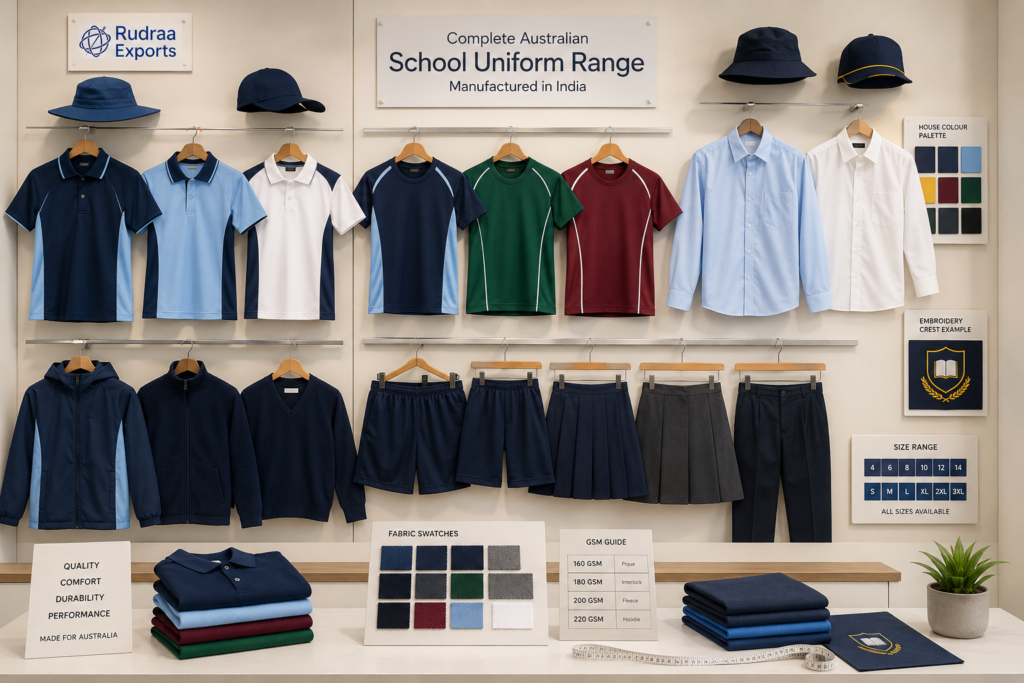
School uniform sourcing is not only about price.
Australian schools need uniforms that are affordable, durable, comfortable, safe, size-consistent, easy to reorder, and compliant with Australian labelling and product expectations.
Parents want value. Schools want reliable supply. Procurement teams want fewer complaints, fewer size exchanges, and fewer delays before term starts.
This is why many Australian schools and uniform retailers are looking at India as a sourcing destination.
India has strong apparel manufacturing capacity, especially in knitwear hubs like Tirupur. For school uniforms, this means access to polo shirts, sports uniforms, fleece hoodies, jumpers, formal shirts, skirts, trousers, shorts, hats, caps, house-colour uniforms, and private-label institutional apparel.
At Rudraa Exports, we help Australian schools, schoolwear retailers, distributors, and uniform procurement teams source school uniforms from India with factory-direct production, MOQ planning, fabric guidance, embroidery, labelling, AQL inspection, export documentation, and shipment support.
Quick Answer
Australian schools can source school uniforms from India by defining each style as a controlled SKU with fabric, GSM, colour, size curve, embroidery, labels, care instructions, testing requirements, and inspection checkpoints. Key compliance areas include care labelling, country-of-origin accuracy, chemical safety expectations such as OEKO-TEX where required, UPF testing for sun-protection claims, AQL inspection, shrinkage testing, colourfastness testing, and Australian-aligned sizing. Rudraa Exports supports school uniform sourcing from Tirupur with factory-direct production and export-ready documentation.
Planning to source school uniforms from India? Contact Rudraa Exports to request a school uniform sourcing plan for Australia.
Why Australian Schools Source Uniforms Offshore
Australian schools are under pressure to keep uniforms affordable while maintaining consistent quality and supply.
Uniform programs must handle:
- New student enrolments
- Term starts
- Sports events
- House colour launches
- Mid-year replenishment
- Size exchanges
- Damaged garment replacements
- Seasonal demand spikes
The uploaded source explains that Australian schools are interested in offshore uniform manufacturing because of cost control, supply reliability, bulk capacity, and export documentation support.
Why India Works for School Uniform Manufacturing
India offers strong value for institutional buyers because it has:
- Bulk apparel capacity
- Skilled stitching workforce
- Fabric sourcing options
- Knitwear and woven garment capability
- Embroidery and branding support
- Export documentation experience
- Competitive factory-direct pricing
- Repeat production systems
The uploaded source highlights India’s value proposition for school uniforms through cost savings, scalable capacity, repeatability, and improving trade settings between India and Australia.
Why Tirupur Is Useful for School Uniforms
Tirupur is especially strong for school uniform products that use knit fabrics and everyday apparel construction.
Tirupur Strengths
| Tirupur Strength | Benefit for Australian Schools |
|---|---|
| Knitwear manufacturing | Strong for polo shirts, sports tops and fleece |
| Fabric sourcing | Cotton pique, polyester, fleece, jersey and blends |
| Embroidery | School crests, house logos and names |
| Printing | Sports uniforms and house designs |
| Bulk production | Better for annual uniform programs |
| Export experience | Supports Australia shipments |
| Repeatability | Useful for term-wise and yearly reorders |
School Uniform Products Rudraa Exports Can Manufacture
Core School Uniform SKUs
| Product | Common Requirement |
|---|---|
| Polo shirts | 180–220 GSM cotton pique or blends |
| Sports T-shirts | Polyester or performance knit |
| Sports shorts | Polyester or durable sports fabric |
| Formal shirts | Woven easy-care fabric |
| Blouses | Woven or blended fabric |
| Trousers | Durable woven fabric |
| Shorts | Reinforced schoolwear construction |
| Skirts | School-approved fit and length |
| Fleece hoodies | 280–320 GSM brushed fleece |
| Jumpers | Warm, durable and washable |
| House T-shirts | Colour consistency and print / embroidery |
| Hats / caps | Sun-protection claim testing if required |
| Kindergarten uniforms | Soft fabric and child-friendly trims |
| Staff uniforms | Polo shirts, shirts and jackets |
The uploaded source lists common Australian school uniform products including polo shirts, sports uniforms, formal shirts, woven shorts, trousers, skirts, fleece hoodies, jumpers, hats, and caps.
School Uniform Fabric and GSM Guide
Fabric choice affects comfort, durability, wash performance, and price.
Common Fabric Options
| Product | Fabric Direction | Indicative GSM |
|---|---|---|
| School polo shirt | Cotton pique / cotton-rich pique | 180–220 GSM |
| Sports top | Polyester performance knit | 140–180 GSM |
| Sports shorts | Polyester sports fabric | 120–180 GSM |
| Formal shirt | Woven cotton / poly-cotton | Depends on construction |
| Skirt | Woven schoolwear fabric | Medium to heavy |
| Trousers | Durable woven fabric | Medium to heavy |
| Hoodie / jumper | Brushed fleece | 280–320 GSM |
| House T-shirt | Cotton jersey or polyester | 160–180 GSM |
| Hat / cap | Woven cotton / poly-cotton | Product-specific |
The uploaded source recommends 180–220 GSM cotton pique for school polos and 280–320 GSM fleece for hoodies or jumpers.
MOQ for School Uniform Manufacturing in India
MOQ depends on style, colour, fabric, size curve, embroidery, labels, trims and packing requirements.
Typical MOQ Planning
| Program Type | Indicative MOQ Direction |
|---|---|
| Proto / sample development | Low quantity |
| Pilot school order | Lower trial MOQ where feasible |
| Standard school uniform style | Often 300 pcs per style / colour |
| Annual bulk program | Higher quantities by size curve |
| Repeat order | Better planning and pricing possible |
The uploaded source says typical factory MOQs for institutional school uniform programs are often 300 pieces per style or colour, with some suppliers offering lower trial MOQs for sampling or pilot runs.
MOQ Buyer Tip
Ask MOQ by:
- Style
- Colour
- Fabric
- Size curve
- Embroidery
- Label package
- Annual repeat volume
This gives a clearer answer than asking only “What is your MOQ?”
Customisation Options for Australian Schools
School uniforms require controlled customisation.
Common Customisation Options
| Customisation | Use Case |
|---|---|
| Embroidered school crest | Polo shirts, jumpers, hoodies |
| House colour matching | Sports uniforms and house shirts |
| Pantone matching | School-approved colour consistency |
| Woven labels | School name and size |
| Printed labels | Care and fibre content |
| Heat-transfer logos | Sportswear and performance garments |
| Contrast collars | Polo shirts |
| Rib cuffs | Jumpers and hoodies |
| Extended sizing | Inclusivity and fit coverage |
| Barcode / SKU labels | Uniform shop inventory |
The uploaded source explains that customisation should be treated as controlled specifications, including embroidery, Pantone matching, woven or printed labels, and extended sizing.
Safety and Compliance for Australian School Uniforms
School uniform sourcing needs documentation.
Offshore sourcing does not reduce compliance responsibility.
It makes documentation more important.
Compliance Areas to Check
| Area | What to Confirm |
|---|---|
| Care labelling | Durable care label with correct washing instructions |
| Fibre content | Accurate fabric composition |
| Country of origin | Truthful origin statement |
| Chemical safety | OEKO-TEX or buyer-required chemical standard |
| UPF claims | Test reports if sun-protection claim is made |
| Flammability | Check only if product falls under relevant category |
| Shrinkage | Test after wash |
| Colourfastness | Wash and rub performance |
| Size consistency | Size set and grading control |
| AQL inspection | Final quality acceptance |
Care Labelling for Australia
Care labelling is important for school uniforms because garments are washed frequently.
Labels should be legible, durable and securely attached.
Care Label Should Include
- Washing instruction
- Drying instruction
- Ironing instruction
- Bleaching instruction
- Dry cleaning instruction if needed
- Fibre content where required by buyer
- Size
- Country of origin if included on same label
The uploaded source explains that care labelling for clothing and textiles is mandatory in Australia under the Consumer Goods Care Labelling Information Standard 2023, referencing AS/NZS 1957:1998.
OEKO-TEX for School Uniforms
OEKO-TEX Standard 100 is not always a legal requirement, but many institutional buyers use it as a chemical safety benchmark.
For school uniforms, it can help reassure parents and procurement teams.
When OEKO-TEX Is Useful
| Product | Why It Helps |
|---|---|
| Polo shirts | Daily skin contact |
| Sports uniforms | Sweat and repeated wash |
| Kindergarten uniforms | Younger child skin contact |
| Fleece jumpers | Long wear duration |
| Hats | Skin and sweat contact |
The uploaded source states that OEKO-TEX Standard 100 is often used by institutional buyers as a chemical risk management baseline, even though it is not an Australian legal requirement.
Country of Origin and Australian Consumer Law
Country-of-origin claims must be truthful.
If the uniform is made in India, the label, carton, documents and product listing should not create confusion.
Buyer Checklist
- Label says correct country of origin
- Invoice and packing list match origin claim
- Product listing does not mislead
- School communication matches actual sourcing
- Carton labels match shipment records
The uploaded source explains that origin claims and labels must not mislead under Australian Consumer Law expectations.
UPF 50+ Claims for School Uniforms
Australian schools often care about sun safety.
But UPF claims should only be made when tested.
Products That May Need UPF Testing
| Product | UPF Relevance |
|---|---|
| Hats | Very important |
| Caps | Important if sun-protection claim is made |
| Sports polos | Relevant if marketed as sun protective |
| Rash-style sports tops | Relevant |
| Outdoor event shirts | Relevant |
The uploaded source explains that if a school markets hats, polos, or sports items as sun-protective, UPF claims should be substantiated to AS/NZS 4399:2017.
Buyer Tip
Do not print “UPF 50+” unless test reports support the claim.
Flammability: What Schools Should Know
Standard school uniforms such as polos, trousers, skirts and jumpers are usually not treated like children’s nightwear.
However, flammability rules may matter if the school introduces special products such as sleepwear, camp pyjamas, or limited daywear-style products.
The uploaded source explains that AS/NZS 1249 applies to children’s nightwear and limited daywear categories, and that standard school uniforms are usually not classed as children’s nightwear.
Quality Control for School Uniforms
Uniforms must survive repeated washing and daily use.
QC Checks
| QC Area | What to Check |
|---|---|
| Fabric GSM | Matches approved spec |
| Colour matching | School colours stay consistent |
| Shrinkage | Size remains stable after wash |
| Colourfastness | No fading or bleeding |
| Seam strength | Stress points hold |
| Embroidery quality | Crest is clean and durable |
| Label accuracy | Size, care and origin correct |
| Measurement tolerance | Sizes match approved chart |
| Packing accuracy | Correct size and colour per carton |
| AQL inspection | Final random inspection before shipment |
The uploaded source recommends using AQL 2.5 sampling for final inspection and lab tests such as colourfastness and dimensional stability to reduce complaints and returns.
Sizing for Australian Students
Sizing errors create returns, exchanges and parent frustration.
Size Control Process
| Step | What to Do |
|---|---|
| 1 | Use Australian-aligned garment measurement charts |
| 2 | Approve physical size set samples |
| 3 | Lock grading rules |
| 4 | Confirm label size codes |
| 5 | Check measurements during production |
| 6 | Match carton labels to size and style |
| 7 | Review return feedback before repeat order |
The uploaded source explains that schools should use Australian-aligned size charts, pre-production size sets, clear labels, carton markings and locked grading rules to reduce returns.
Lead Time for School Uniform Orders
School uniform sourcing must be planned around the academic calendar.
Typical Timeline
| Stage | Indicative Timeline |
|---|---|
| Tech pack / spec review | 1 week |
| Sampling | 2–3 weeks |
| Fit and size approval | 1–2 weeks |
| Lab testing | Depends on test scope |
| Bulk production | 5–7 weeks |
| Sea freight India to Australia | Around 20–25 days |
| Buffer | Recommended for customs, delivery and school launch |
The uploaded source gives a practical timeline of 2–3 weeks for sampling, 5–7 weeks for bulk production, and around 20–25 days for India to Australia sea freight.
Buyer Tip
Plan 3–4 months ahead for school uniform programs.
This helps protect term-start delivery dates.
Indicative FOB Pricing for School Uniforms
Pricing depends on GSM, fabric, trims, embroidery, quantity, testing and packing.
Indicative FOB Benchmarks
| Product | Indicative FOB Range |
|---|---|
| School polos | USD 3–5 |
| Polyester sports shorts | USD 2.5–4 |
| Fleece hoodies / jumpers | USD 6–10 |
The uploaded source gives indicative FOB ranges for polos, sports shorts and fleece hoodies or jumpers used in institutional sourcing discussions.
How to Source School Uniforms from India
Step 1: Define the Uniform Range
Start with the required styles:
- Polo shirt
- Sports top
- Sports shorts
- Formal shirt
- Skirt
- Trouser
- Hoodie
- Jumper
- Hat or cap
Step 2: Lock Specifications
Confirm:
- Fabric
- GSM
- Colour
- Size range
- Embroidery
- Labels
- Packing
- Compliance requirement
Step 3: Approve Samples
Approve:
- Proto sample
- Fit sample
- Size set
- Lab dip
- Embroidery sample
- PP sample
Step 4: Confirm Testing
Test:
- Shrinkage
- Colourfastness
- Dimensional stability
- UPF if claimed
- Chemical safety if required
Step 5: Inspect Before Shipment
Use AQL inspection and packing checks before dispatch.
Why Rudraa Exports
Rudraa Exports supports Australian school uniform buyers with factory-direct production from Tirupur, India.
School Uniform Products Supported
- Polo shirts
- Sports T-shirts
- Sports shorts
- Formal shirts
- Blouses
- Trousers
- Shorts
- Skirts
- Hoodies
- Jumpers
- House T-shirts
- Hats and caps
- Staff uniforms
- Kindergarten uniforms
- Private-label schoolwear
Buyer Support
- Tech pack review
- Fabric and GSM guidance
- Size set coordination
- Embroidery approval
- Pantone colour matching support
- Care label support
- Country-of-origin label support
- OEKO-TEX fabric discussion where needed
- UPF testing coordination where claimed
- AQL 2.5 inspection support
- Export packing and documentation
- Shipment support to Australia
Manufacturing Strengths
- Factory-direct Tirupur knitwear manufacturing
- 72,000+ units per month production capacity
- MOQ discussions starting from around 300 pieces for suitable programs
- Bulk production support for institutional programs
- Multi-port shipping through Chennai, Tuticorin and Cochin
- Export support for Australia, USA, UK, Europe, Middle East and global buyers
Buyer Advantages
- Factory-direct pricing without trading-company markups
- Up to 40% cost-saving positioning compared with indirect sourcing models
- Better control over fabric, GSM, colour and embroidery
- Better repeat-order planning
- Stronger sizing control
- Export-ready documentation support
- Suitable for schoolwear retailers, distributors and school procurement teams
Ready to source school uniforms from India for Australia? Speak with Rudraa Exports to share your uniform range, MOQ, colours, embroidery, labels, size chart and target delivery date.
School Uniform Sourcing Checklist for Australian Schools
| # | Checklist Item |
|---|---|
| 1 | Define uniform range |
| 2 | Confirm school colours |
| 3 | Confirm fabric and GSM |
| 4 | Confirm MOQ by style and colour |
| 5 | Prepare size chart |
| 6 | Approve size set |
| 7 | Approve lab dips |
| 8 | Approve embroidery sample |
| 9 | Approve care label |
| 10 | Confirm country-of-origin label |
| 11 | Confirm OEKO-TEX requirement if needed |
| 12 | Confirm UPF testing if claimed |
| 13 | Confirm shrinkage testing |
| 14 | Confirm colourfastness testing |
| 15 | Agree AQL level |
| 16 | Confirm packing method |
| 17 | Confirm carton labels |
| 18 | Plan shipment timeline |
| 19 | Inspect before shipment |
| 20 | Review repeat-order feedback |
FAQ: School Uniform Suppliers in India for Australian Schools
1. Can Australian schools source uniforms from India?
Yes. Australian schools, schoolwear retailers and uniform distributors can source school uniforms from India when specifications, testing, labelling, sizing and documentation are managed properly.
2. What school uniforms can Rudraa Exports manufacture?
Rudraa can support polo shirts, sports T-shirts, sports shorts, formal shirts, blouses, trousers, skirts, hoodies, jumpers, house T-shirts, hats, caps and staff uniforms.
3. What is the MOQ for school uniforms in India?
MOQ depends on style, colour, fabric, size curve, embroidery and labels. Institutional programs commonly use 300 pieces per style or colour, with lower trial options possible for suitable programs.
4. What GSM is best for school polo shirts?
School polo shirts commonly use 180–220 GSM cotton pique or cotton-rich pique depending on durability, comfort and budget.
5. What GSM is best for school hoodies?
School hoodies and jumpers often use 280–320 GSM brushed fleece, depending on warmth, structure and pilling-control requirements.
6. Is care labelling required for Australian school uniforms?
Yes. Care labelling for clothing and textiles is mandatory in Australia, and labels should be durable, legible and attached properly.
7. Is OEKO-TEX required for school uniforms?
OEKO-TEX is not always legally required, but it is often used by schools and institutional buyers as a chemical safety benchmark.
8. Can I claim UPF 50+ on school uniforms?
Only if the product has been tested and supports the claim. UPF claims should be backed by appropriate test reports.
9. What quality tests are important for school uniforms?
Important tests include shrinkage, colourfastness, dimensional stability, pilling, seam strength, embroidery durability, and UPF testing if a sun-protection claim is made.
10. How long does school uniform production take in India?
A practical timeline includes 2–3 weeks for sampling, 5–7 weeks for bulk production, and around 20–25 days for sea freight to Australia, plus buffer time.
11. How can schools reduce sizing problems?
Use Australian-aligned garment measurement charts, approve size set samples, lock grading rules, and check measurements during production.
12. What should I send Rudraa Exports for a school uniform quote?
Send product list, fabric requirements, GSM, colours, school crest artwork, size chart, MOQ, label requirements, testing needs, delivery location and target deadline.
Conclusion
Australian schools need uniforms that are affordable, durable, compliant, comfortable, size-consistent and delivered on time.
India is a strong sourcing option when schools treat uniform procurement as a controlled program, not a casual purchase.
The safest approach is to define each style clearly, approve fabrics and size sets, confirm labels, test for shrinkage and colourfastness, inspect with AQL and plan delivery around the school calendar.
Rudraa Exports helps Australian schools, uniform retailers and distributors source school uniforms from Tirupur, India, with factory-direct production, MOQ planning, embroidery, labelling, QC, testing support, export packing and documentation.
Visit rudraaexports.com or contact our team directly to share your school uniform requirement — and receive a factory-direct school uniform sourcing plan from Rudraa Exports.
Related reading
School Uniform Manufacturers in Tirupur: Bulk Institutional Wear for Global Buyers
School Uniform Manufacturing Standards in India
Case study: School uniform procurement for a UAE school group
School Uniform Manufacturer in India for UK Schools: Safety Standards, MOQ and Compliance Guide