
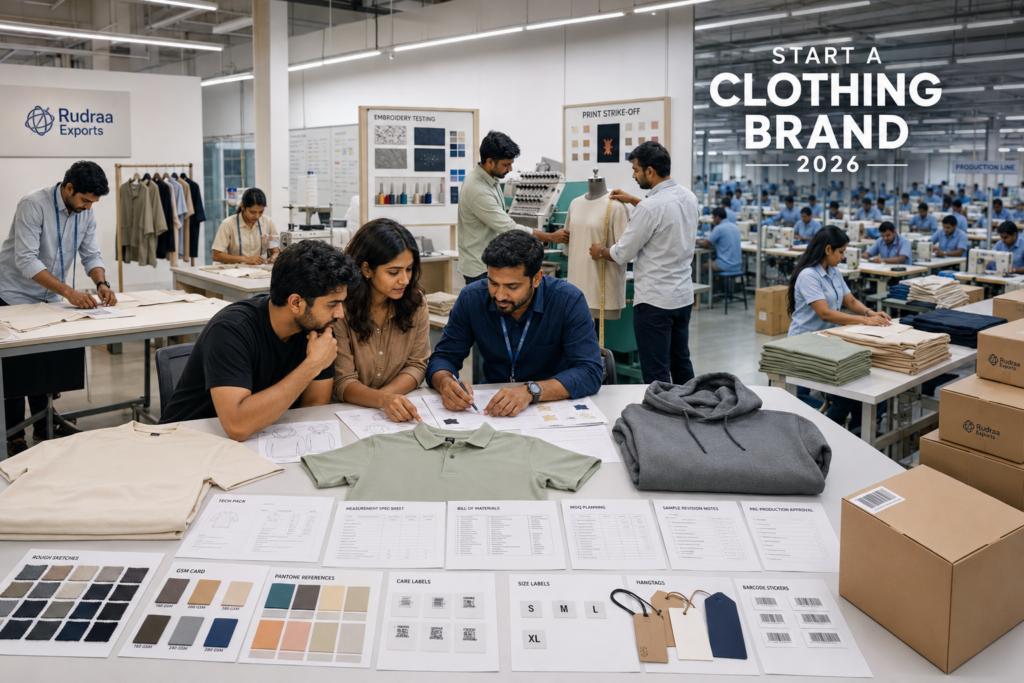
Starting a clothing brand in 2026 does not require fashion school, industry contacts, or a big office.
But it does require one important thing: understanding how clothing manufacturing actually works.
Many first-time founders start with a strong idea but get stuck when they hear terms like tech pack, MOQ, CMT, FOB, sampling, pre-production sample, AQL, size set, and production tolerance. These words can feel confusing at first, but they are simply part of the process that turns an idea into a real product.
The good news is that clothing manufacturing can be learned step by step.
This guide explains how to start a clothing brand with no experience, from validating your idea to designing your first product, preparing a tech pack, finding a manufacturer, handling samples, negotiating MOQs, placing your first order, checking quality, and preparing for launch.
At Rudraa Exports, we help new clothing brands, DTC founders, private-label buyers, and startup apparel businesses turn ideas into production-ready garments through factory-direct manufacturing in Tirupur, India.
Quick Answer
To start a clothing brand with no experience, begin with one clear product idea, validate demand with a waitlist or pre-order, create a simple design brief, build a tech pack, choose the right manufacturing model, find a factory that matches your product category, develop samples, confirm MOQ, approve a pre-production sample, run quality control, and prepare packaging before launch. Beginners should avoid launching too many products at once and should work with a factory-direct partner that can explain sampling, costing, production, and quality control clearly.
Planning your first clothing brand production? Contact Rudraa Exports to discuss your first product, MOQ, sampling plan, and manufacturing route.
Why Starting a Clothing Brand Feels Confusing
Most beginners do not fail because their idea is bad.
They fail because they skip the manufacturing basics.
Common beginner problems include:
- Starting with too many products
- Not validating demand
- Designing products that are hard to manufacture
- Not creating a tech pack
- Choosing the cheapest supplier
- Not understanding MOQ
- Approving samples too quickly
- Skipping quality control
- Forgetting packaging and labelling
- Not calculating landed cost
- Launching without production timelines
A clothing brand is not only about design. It is also about sourcing, production, quality, packaging, inventory, and delivery.
Step 1: Validate Your Clothing Brand Idea
Validation means checking whether people actually want your product before you spend heavily on manufacturing.
Do not start with 20 products.
Start with one strong product.
Good First Product Examples
| Brand Idea | Better First Product |
|---|---|
| Streetwear brand | Heavyweight oversized T-shirt |
| Activewear brand | Pocket leggings |
| Corporate apparel brand | Premium polo shirt |
| Kidswear brand | Soft cotton T-shirt set |
| Sustainable basics brand | Organic cotton T-shirt |
| Gymwear brand | Performance training T-shirt |
| Resortwear brand | Lightweight cotton co-ord |
Your first product should be simple enough to manufacture but strong enough to represent your brand.
How to Validate Demand
You can test demand using:
- Instagram content
- Landing page
- Waitlist
- Pre-order
- WhatsApp interest list
- Small paid ad test
- Polls and surveys
- Sample photos
- Founder story posts
- Pop-up or local testing
Simple Validation Goal
Before producing bulk, try to get:
- 100 email signups, or
- 20 pre-orders, or
- strong repeat interest from your target audience
If nobody shows interest before production, manufacturing will not solve the problem.
Step 2: Choose a Clear Niche
A clothing brand becomes easier to build when it is focused.
Do not say, “I want to make fashion clothes.”
Say something specific.
Better Brand Positioning Examples
| Weak Idea | Stronger Niche |
| I want to make T-shirts | Heavyweight oversized T-shirts for streetwear buyers |
| I want to make activewear | Pocket leggings for runners |
| I want to make kidswear | Soft cotton basics for toddlers |
| I want to make uniforms | Premium corporate polos for modern teams |
| I want to make sustainable clothing | Organic cotton everyday basics |
A clear niche helps you choose fabric, fit, price, supplier, packaging, and marketing.
Step 3: Design Your First Product
Beginners often over-design their first product.
They add too many details, trims, zippers, prints, panels, colours, and fabric combinations. This increases cost, sampling time, defect risk, and MOQ.
For the first product, keep the design simple and focus on one or two signature details.
Design Inputs You Need
| Input | What It Means |
| Rough sketch | Front and back idea |
| Reference product | Similar product for fit or fabric feel |
| Fabric idea | Cotton, fleece, jersey, interlock, pique, etc. |
| Fit direction | Oversized, regular, slim, relaxed |
| Branding placement | Print, embroidery, label, patch |
| Colour options | Start with 1–2 colours |
| Size range | Example: XS–XXL |
| Quality expectation | Budget, mid-market, premium |
Beginner Tip
Simple construction with better fabric often works better than complicated design with weak fabric.
For example, a clean 220 GSM oversized T-shirt with strong neck rib and good stitching may sell better than a complex design that is difficult to produce consistently.
Step 4: Understand Manufacturing Models
Before speaking to factories, understand the basic manufacturing models.
CMT
CMT means Cut, Make, Trim.
In this model, the factory mainly cuts and stitches the garment. The buyer may provide fabric, trims, patterns, and tech pack.
FOB / Full-Package Production
FOB or full-package production means the factory supports sourcing, sampling, development, production, finishing, packing, and export.
For beginners, FOB is often easier because one factory manages more of the process.
Blanks Decoration
This means you buy ready-made blank garments and add your print, embroidery, label, or branding.
This is useful for quick testing but gives less product uniqueness.
Private Label
Private label means the product is made for your brand with your label, packaging, and specifications.
Manufacturing Model Comparison
| Model | Best For | Beginner-Friendly? |
| CMT | Experienced buyers with fabric sourcing | Medium |
| FOB / Full-package | New brands and overseas buyers | High |
| Blanks decoration | Fast testing | High |
| Private label | Branded product launch | High |
| Fully custom cut-and-sew | Unique product development | Medium |
For first-time founders, a factory-direct FOB model is usually the most practical option.
Step 5: Build a Tech Pack
A tech pack is the blueprint of your garment.
It tells the factory exactly what to make.
Without a tech pack, the factory has to guess. When the factory guesses, mistakes happen.
What a Tech Pack Should Include
| Tech Pack Section | What to Add |
| Style name | Product name or code |
| Sketches | Front, back, and detail views |
| Fabric spec | GSM, composition, construction |
| Measurements | Chest, length, sleeve, shoulder, etc. |
| Tolerance | Allowed measurement variation |
| BOM | Fabric, thread, labels, trims, packing |
| Stitch details | Seam type, rib, hem, collar, pocket |
| Artwork | Print or embroidery file |
| Branding | Label, logo, placement |
| Colourways | Pantone or reference shade |
| Size range | XS–XXL etc. |
| Packaging | Polybag, carton, sticker, hangtag |
| QC points | Defects to avoid |
Why Tech Packs Matter
A tech pack helps:
- Reduce sampling mistakes
- Get accurate costing
- Improve factory communication
- Maintain measurement consistency
- Avoid arguments during production
- Support quality control
Beginner Rule
If it is not written in the tech pack, do not assume it will happen.
Step 6: Find the Right Manufacturer
The right manufacturer is not always the cheapest one.
The right manufacturer is the one that understands your product category and can produce consistent quality.
Manufacturer Vetting Checklist
| Question | Why It Matters |
| Do they make your product type? | Category fit is important |
| Do they support sampling? | Needed before bulk |
| Can they explain MOQ? | Shows transparency |
| Do they provide fabric options? | Helps beginners |
| Can they share past work? | Shows experience |
| Do they use QC reports? | Reduces risk |
| Can they support packaging? | Helps launch readiness |
| Do they communicate clearly? | Prevents mistakes |
| Are they factory-direct? | Reduces middlemen |
| Can they export? | Important for overseas buyers |
Red Flags
Avoid suppliers who:
- Give prices without product details
- Refuse samples
- Avoid measurement discussions
- Promise unrealistic timelines
- Cannot explain MOQ
- Do not provide clear payment terms
- Ignore quality control
- Change answers often
- Push only the cheapest fabric
- Cannot show relevant experience
A beginner needs a patient, process-driven manufacturer.
Step 7: Understand Sampling
Sampling is the process of developing the product before bulk production.
Do not expect the first sample to be perfect.
Sampling is how you improve the garment.
Common Sample Types
| Sample Type | Purpose |
| Proto sample | First physical version |
| Fit sample | Checks fit and measurements |
| Size set | Checks grading across sizes |
| Print strike-off | Checks print quality |
| Embroidery sample | Checks logo execution |
| Lab dip | Checks colour |
| Pre-production sample | Final sample before bulk |
| TOP sample | First output from production line |
Sampling Mistakes Beginners Make
- Approving only from photos
- Not checking measurements
- Changing too many things at once
- Not updating the tech pack
- Skipping size set
- Approving wrong fabric
- Ignoring wash shrinkage
- Forgetting print placement
- Not keeping approval records
Sampling Best Practice
After every sample round, write:
- What is approved
- What must change
- What measurement is wrong
- What fabric or trim changed
- What artwork changed
- Which version is final
Sampling should be controlled, not emotional.
Step 8: Understand and Negotiate MOQs
MOQ means Minimum Order Quantity.
Factories need MOQs because fabric, dyeing, cutting, stitching, trims, and production setup all require minimum efficiency.
MOQ Depends On
- Fabric type
- Colour
- GSM
- Dyeing
- Trims
- Print method
- Embroidery
- Size range
- Product complexity
- Production line setup
- Packaging requirements
How to Reduce MOQ Pressure
| Problem | Better Approach |
| Too many colours | Start with 1–2 colours |
| Too many styles | Start with one hero product |
| Custom fabric too early | Use available fabric options first |
| Too many trims | Keep trims simple |
| Complex packaging | Start with clean basic packaging |
| Wide size range | Start with core sizes |
| Low volume per colour | Consolidate demand |
Beginner Tip
Ask the factory what is driving the MOQ.
Sometimes the MOQ is not from stitching. It may come from fabric dyeing, trims, printing setup, or packing materials.
Step 9: Place Your First Production Order
Once your pre-production sample is approved, you can place your first bulk order.
Do not rush this step.
Before Placing the Order, Confirm:
- Final tech pack
- Final sample approval
- Final quantity
- Size ratio
- Colour ratio
- Fabric approval
- Trim approval
- Print / embroidery approval
- Packing instructions
- Delivery timeline
- Payment terms
- Incoterm
- Inspection plan
Important Purchase Order Details
Your PO should include:
- Buyer name
- Supplier name
- Style code
- Product description
- Colour
- Size ratio
- Quantity
- Unit price
- Total value
- Payment terms
- Delivery date
- Incoterm
- Packing requirement
- Quality requirement
- Approved sample reference
Beginner Rule
Do not allow bulk cutting before pre-production sample approval.
This one rule can prevent expensive mistakes.
Step 10: Perform Quality Control
Quality control ensures bulk production matches the approved sample and tech pack.
QC Should Check
| QC Area | What to Inspect |
| Fabric | GSM, shade, holes, shrinkage |
| Measurements | Chest, length, sleeve, shoulder |
| Stitching | Open seams, skipped stitches, puckering |
| Placement, cracking, colour | |
| Embroidery | Alignment, density, thread quality |
| Labels | Size, care, brand label |
| Packing | Folding, polybag, carton, barcode |
| Quantity | Size and colour count |
| Final appearance | Stains, loose threads, defects |
QC Stages
| Stage | Purpose |
| Pre-production check | Confirms fabric and trims |
| Inline inspection | Catches issues during production |
| Mid-line inspection | Checks consistency |
| Final inspection | Approves packed goods |
| Shipment check | Confirms cartons and documents |
AQL inspection is commonly used in apparel to define acceptable defect levels. Beginners should ask the manufacturer how quality is checked and whether measurement reports can be shared.
Step 11: Prepare Packaging and Labelling
Packaging is part of the customer experience.
Even a good garment can feel cheap if it arrives badly folded, poorly labelled, or packed without care.
Packaging Items
- Brand label
- Size label
- Care label
- Hangtag
- Polybag
- Barcode sticker
- Carton label
- Thank-you card
- Tissue paper
- Product insert
Label Information to Plan
- Brand name
- Size
- Fibre composition
- Care instructions
- Country of origin
- Batch or style code
- Barcode if needed
Beginner Tip
Create a packaging spec sheet like a mini tech pack.
It should show folding method, sticker placement, polybag size, carton quantity, and label placement.
Step 12: Prepare for Launch
Manufacturing is only one part of launch.
Before stock arrives, prepare:
- Product photos
- Size guide
- Website product page
- Pricing
- Shipping policy
- Return policy
- Inventory system
- Packaging
- Social media content
- Email launch list
- Customer support replies
Launch Checklist
| Area | What to Prepare |
| Product | Final approved garments |
| Website | Product page and size chart |
| Pricing | Retail price and margin |
| Inventory | SKU and size tracking |
| Photos | Front, back, details, model shots |
| Packaging | Labels, inserts, mailers |
| Marketing | Launch posts, reels, emails |
| Support | FAQs, returns, care instructions |
| Reorder plan | When to produce next batch |
A clothing brand is not finished when production ends. It becomes real when customers receive the product and want to buy again.
Common Mistakes First-Time Clothing Brand Founders Make
| Mistake | Better Approach |
| Starting with too many styles | Start with one hero product |
| Choosing supplier only by price | Choose by quality and communication |
| Skipping tech pack | Create a clear production blueprint |
| Approving sample too fast | Check fit, fabric, and measurements |
| Ignoring MOQ drivers | Ask what causes the MOQ |
| Not budgeting for packaging | Include it early |
| Skipping QC | Inspect before shipment |
| No launch plan | Build marketing before stock arrives |
| No reorder strategy | Track sell-through |
| Not calculating landed cost | Add freight, duty, and delivery |
Beginner Manufacturing Roadmap
| Stage | Goal |
| Week 1–2 | Validate niche and hero product |
| Week 2–4 | Prepare design brief and references |
| Week 4–6 | Build tech pack |
| Week 6–8 | Shortlist and vet manufacturers |
| Week 8–12 | Develop samples |
| Week 12–14 | Approve pre-production sample |
| Week 14–20 | Bulk production |
| Week 20–22 | Final inspection and packing |
| Week 22–26 | Shipping and launch preparation |
Timelines vary by product complexity, sampling rounds, fabric availability, and buyer response speed.
Why Rudraa Exports
Rudraa Exports supports first-time and growing clothing brands with factory-direct manufacturing from Tirupur, India.
Manufacturing Capabilities
- Factory-direct Tirupur knitwear manufacturing
- 72,000+ units per month production capacity
- T-shirts, polos, hoodies, sweatshirts, joggers, leggings, kidswear, babywear, uniforms, activewear, corporate apparel, and private-label basics
- MOQ discussions starting from around 300 pieces for suitable programs
- Sampling support for startup brands
- Bulk production planning for repeat programs
Founder Support
- Product feasibility review
- Fabric and GSM guidance
- Tech pack support
- Sampling workflow
- MOQ planning
- Costing support
- Packaging and labelling guidance
- AQL 2.5 inspection standards
- Export documentation support
- Factory-direct communication without trading-company confusion
Buyer Advantages
- Factory-direct pricing without middlemen
- Up to 40% cost-saving positioning compared with indirect sourcing models
- Clearer production accountability
- Support for first samples and bulk orders
- English-language communication for overseas founders
- Export support for USA, UK, Europe, Australia, Middle East, and global buyers
- Multi-port shipping through Chennai, Tuticorin, and Cochin
Ready to start your clothing brand with the right manufacturing process? Speak with Rudraa Exports to share your first product idea, MOQ target, fabric preference, and launch timeline.
First Clothing Brand Checklist
| # | Checklist Item |
| 1 | Choose one clear niche |
| 2 | Validate one hero product |
| 3 | Define target customer |
| 4 | Create design references |
| 5 | Choose fabric direction |
| 6 | Prepare rough sketches |
| 7 | Build tech pack |
| 8 | Decide CMT, FOB, blanks, or private label |
| 9 | Shortlist suitable manufacturers |
| 10 | Request samples |
| 11 | Check measurements and fit |
| 12 | Approve pre-production sample |
| 13 | Confirm MOQ and price |
| 14 | Place purchase order |
| 15 | Run quality control |
| 16 | Confirm packaging and labels |
| 17 | Prepare product page and size guide |
| 18 | Plan launch content |
| 19 | Track customer feedback |
| 20 | Plan reorder based on sales |
FAQ: How to Start a Clothing Brand with No Experience
1. Can I start a clothing brand with no experience?
Yes. You can start a clothing brand with no experience if you begin with one clear product, validate demand, prepare a tech pack, work with the right manufacturer, and follow a structured sampling and quality control process.
2. What is the first step to starting a clothing brand?
The first step is validation. Before manufacturing, confirm that people are interested in your product idea through waitlists, pre-orders, surveys, content, or small test campaigns.
3. What is the best first product for a clothing brand?
The best first product is simple, focused, and easy to manufacture consistently. T-shirts, polos, hoodies, sweatshirts, kidswear basics, and activewear basics are common starting points.
4. Do I need a tech pack?
Yes. A tech pack is highly recommended because it tells the factory exactly what to make. It reduces confusion, sampling mistakes, costing errors, and production disputes.
5. What is MOQ?
MOQ means Minimum Order Quantity. It is the smallest quantity a factory can produce profitably based on fabric, colour, trims, production setup, and order complexity.
6. What is the difference between CMT and FOB?
CMT means the factory mainly cuts and stitches using materials provided by the buyer. FOB or full-package production means the factory supports sourcing, development, production, packing, and export.
7. Should beginners choose FOB or CMT?
Beginners usually find FOB easier because one manufacturer manages more of the sourcing and production process. CMT is better for experienced buyers who already control fabric and trims.
8. How many samples are needed before bulk production?
Most brands need at least a proto sample, fit sample, and pre-production sample. More complex products may also need size sets, lab dips, print strike-offs, and TOP samples.
9. How do I avoid quality problems?
Use a clear tech pack, approve samples properly, define measurement tolerances, inspect during production, and run final inspection before shipment.
10. Can Rudraa Exports help new clothing brands?
Yes. Rudraa supports startup clothing brands with factory-direct manufacturing, fabric guidance, tech pack support, sampling, MOQ planning, production, QC, packaging, and export documentation.
11. How much money do I need to start?
The amount depends on product type, MOQ, fabric, sampling, packaging, photos, marketing, and shipping. Start with one product to reduce risk and control budget.
12. What is the safest way to start?
The safest way is to validate demand, start with one hero product, keep design simple, use a proper tech pack, approve samples carefully, and produce a controlled first batch.
Conclusion
Starting a clothing brand with no experience is possible when you follow the right manufacturing process.
Do not start with too many products. Do not choose a supplier only because they are cheap. Do not skip tech packs, sampling, quality control, or packaging planning.
Start with one clear product. Validate demand. Build a tech pack. Choose the right manufacturing model. Develop samples. Understand MOQ. Approve pre-production carefully. Inspect quality. Prepare packaging. Launch with confidence.
For first-time founders, the right factory-direct partner can make the journey much easier. Rudraa Exports helps new clothing brands move from idea to sample to bulk production with clearer communication, better sourcing support, and export-ready manufacturing from Tirupur, India.
Visit rudraaexports.com or contact our team directly to share your clothing brand idea, first product, target MOQ, and launch timeline — and receive a beginner-friendly manufacturing plan from Rudraa Exports.
Related reading
How to Launch Your Clothing Brand with Small-Batch Production: 50–200 Unit Guide
How to Start a Clothing Brand in Australia: The Correct Order and Realistic Timeline