
When buyers ask “What does it cost to produce custom T-shirts?”, the honest answer in 2026 is: it depends on a stack of variables that shift with fabric markets, decoration choices, order volume, compliance requirements, and shipping lanes.
A “₹150 per piece” quote from one factory and “₹280 per piece” from another for the “same” T-shirt isn’t a mistake — it reflects radically different fabric grades, printing methods, compliance levels, and volume tiers. Without understanding what’s actually inside that number, brand founders, sourcing managers, and import buyers waste budget on the wrong tradeoffs.
This 2026 complete cost breakdown shows you exactly where every rupee in a custom T-shirt goes — fabric, trims, cutting, sewing, printing, finishing, packing, overhead, logistics, and duties. You’ll see real ranges by volume tier, three illustrative scenarios (200 / 1,000 / 10,000 pieces), and a copy-paste costing checklist to compare supplier quotes apples-to-apples.
At the end, you’ll see how Rudraa Exports — a factory-direct Tirupur, India manufacturer — delivers transparent line-by-line costing that helps international buyers save up to 40% versus trading-company sourcing.
Quick Answer: How Much Does It Cost to Produce a Custom T-Shirt in 2026?
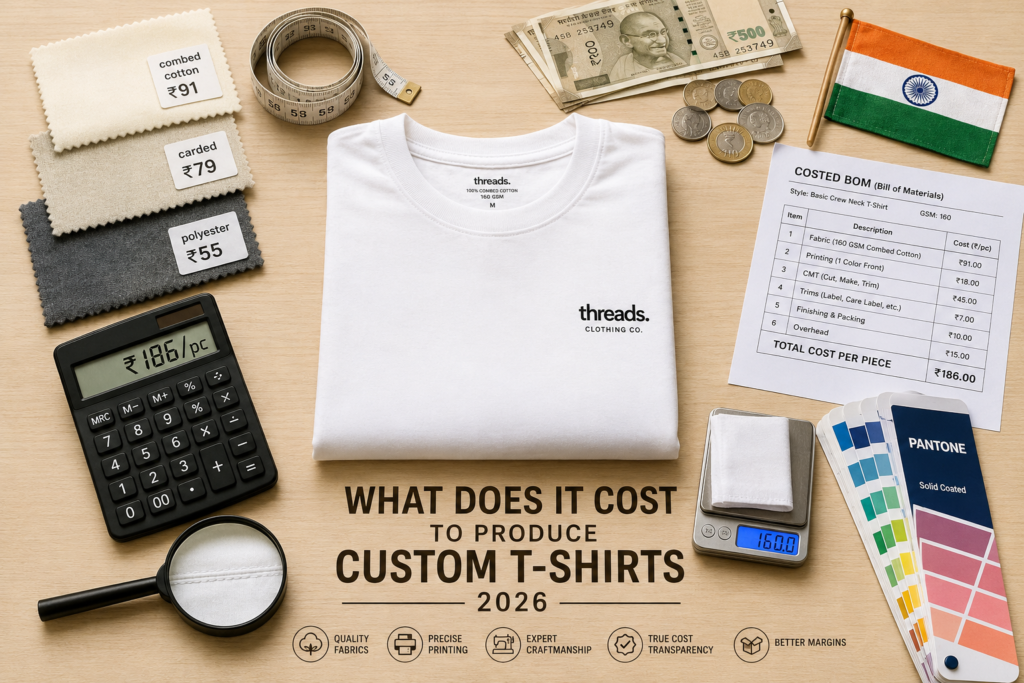
In 2026, a basic 160 GSM combed cotton custom T-shirt with a 1-color screen print costs approximately ₹166–₹275 ex-factory per piece in India, depending on order volume: ~₹221–₹275/pc at 200 pieces, ~₹186–₹230/pc at 1,000 pieces, and ~₹166–₹205/pc at 10,000 pieces. Fabric is typically the largest cost driver (~₹91/pc for combed cotton at ₹422/kg with ~217g consumption per shirt), followed by printing (₹15–₹25 screen / ₹80+ DTG), cut-make-trim, trims and packaging, and overhead. International buyers should add freight, customs duty, and inland delivery to calculate total landed cost. Factory-direct sourcing typically saves 25–40% versus agent or trading-company channels by eliminating intermediary markups.
Why “Average Cost” Is a Range, Not a Single Number
The practical definition of custom T-shirt cost is:
Per-unit cost = (materials + trims + cutting/sewing + printing/decoration + finishing/packing + overhead + logistics + duties/fees) ÷ total units
…adjusted for wastage, rejects, and payment terms.
In 2026, fabric is typically the largest cost driver, especially for cotton styles. Once you convert fabric price into “fabric cost per shirt,” differences become tangible:
- Combed cotton at ~₹422/kg × 0.217 kg = ~₹91 per piece
- Carded cotton: ~₹79 per piece
- Dry-fit polyester: ~₹55 per piece
That’s before adding printing, trims, labor, and freight.
Concrete example: Choosing combed cotton vs dry-fit polyester creates a ~₹36 per piece difference in base fabric cost alone — often larger than your entire print cost on large screen-print runs.
The practical approach: treat “average cost” as a range by volume tier. Build two scenarios:
- Basic cotton + 1-color print
- Premium fabric + multi-color or special finish
Then add shipping and duties based on destination.
The Complete Custom T-Shirt Cost Stack: 8 Components
Every custom T-shirt cost in 2026 breaks down into 8 components:
| Component | Typical Share of Cost |
|---|---|
| 1. Fabric & material | 40–55% |
| 2. Decoration (printing/embroidery) | 8–25% |
| 3. Cutting, sewing, finishing (CMT) | 15–25% |
| 4. Trims (labels, hangtags, polybags) | 3–8% |
| 5. Packaging & cartons | 2–5% |
| 6. Overhead & quality control | 5–10% |
| 7. Factory margin | 8–15% |
| 8. Logistics & duties (post-FOB) | Varies by destination |
Let’s break down each component with real 2026 benchmarks.
Component 1: Fabric and Material Cost (40–55% of Total)
Fabric is the foundation of your unit cost and the most common reason budgets miss the mark.
Fabric Consumption Math for Standard Export Tees
For a standard export tee at ~160 GSM:
- Marker consumption: ~205g per shirt
- After 6% allowance for shrinkage and cutting waste: ~217g per shirt
- Multiply by price per kg to get fabric cost per shirt
2026 Fabric Price Benchmarks (India)
| Fabric Type | Price Range (₹/kg) | Cost per Shirt (₹) |
|---|---|---|
| Combed cotton single jersey (26s/1) | 290–500 (avg ~422) | ~91 |
| Carded cotton jersey | 365–385 | ~79–84 |
| Organic cotton jersey (GOTS) | ~900 (ex-mill dyed) | ~195 |
| CVC 60/40 blend | ~510 | ~111 |
| Performance polyester (dry-fit) | 230–280 | ~50–61 |
| Recycled polyester (rPET, GRS) | 280–350 | ~61–76 |
Grey vs Finished Fabric: Where Quotes Hide Cost
Many “low” fabric quotes are based on grey (undyed) fabric, not finished. A typical cost build-up:
| Stage | Cost (₹/kg) |
|---|---|
| Yarn | ~320 |
| Knitting charge | ~22 |
| Grey fabric | ~343 |
| Finished dyed fabric (after processing) | ~425 |
Critical buyer rule: If you quote only grey rates, your “average cost” will be understated by 20–25%. Always confirm whether quotes are for finished dyed fabric or grey.
Fabric Cost Optimization Levers
✅ Choose carded vs combed cotton if softness premium isn’t critical (~₹12/pc saving)
✅ Use CVC blends for uniforms (better durability + lower shrinkage)
✅ Standardize on one fabric across the program for dye-lot continuity
✅ Lock GSM, yarn count, and finish specifications upfront in tech pack
Component 2: Trims, Labels, and Packaging (3–8% of Total)
Trims look minor per piece but scale with quantity and brand positioning.
Standard Trim Components for Export T-Shirts
- Main brand label (woven or printed)
- Size label
- Wash and care label (compliance-required)
- Hangtags and tag pins
- Polybags (plain or printed)
- Tissue paper and stickers
- Thread, neck tape, shoulder tape
- Elastane rib for neckline
- Master cartons for export
Cost Drivers for Trims
Branding upgrades (woven labels, embossed tags, printed polybags):
- Increase unit cost
- Require MOQs per component (e.g., labels in lots of 5,000+)
Compliance labeling (fiber content, country of origin, care symbols):
- Requires layout approvals
- Causes rework if materials change mid-program
Trim Cost Reality at Different Volumes
A startup ordering 200 pieces may pay disproportionately more per unit for labels and hangtags because the factory spreads sampling, artwork, and small-batch inefficiency across fewer pieces. At 10,000 pieces, trims become highly optimized.
Cost-saving priority for trim upgrades:
- Upgrade handfeel + fit first (fabric + pattern)
- Upgrade ONE brand element (woven main label is most visible)
- Keep packaging simple unless shipping direct-to-retail-shelf
Component 3: MOQ Tiers and the Fixed-Cost Dilution Effect
MOQs influence cost in two ways:
- Factory efficiency — line setup, pattern grading, marker planning, QC routines
- Supplier MOQs — fabric dye lots, label orders, carton minimums
Even when the fabric is the same, per-unit costs drop sharply as you move from 200 → 1,000 → 10,000 pieces because fixed and semi-fixed costs get diluted.
Indicative Ex-Factory Cost: 160 GSM Cotton Tee + 1-Color Screen Print (India/Tirupur)
| Order Volume | Fabric (combed) | Screen Print (1 color) | Cut/Sew + Finish + Pack | Total Ex-Factory (₹/pc) |
|---|---|---|---|---|
| 200 pcs | 91–95 | 20–30 | 110–150 | ₹221–₹275 |
| 1,000 pcs | 91–95 | 15–25 | 80–110 | ₹186–₹230 |
| 10,000 pcs | 91–95 | 15–20 | 60–90 | ₹166–₹205 |
Why This Matters for Your Business Decision
Screen print may only move ₹5–₹10 per piece between tiers, while CMT and overhead can drop dramatically because the line runs smoothly at scale.
Under 300 pieces per colorway? Reduce SKU complexity instead of negotiating fabric prices. Fewer colorways and fewer print placements save more than ₹2/pc fabric negotiations.
Component 4: Decoration Cost — Choose the Right Printing Method
Decoration is where many brands overspend relative to customer value. The best method depends on run size and artwork complexity.
Screen Printing (Best for Bulk, Simple Art)
- Per-piece cost: ₹15–₹25 in Tirupur (depending on complexity and volume)
- Setup fees: ~₹35 per color for screens/films
- Throughput: Automatic machines run ~550 impressions per hour
- Sweet spot: 500–50,000 pieces with 1–4 colors
DTG (Direct-to-Garment) Printing
- Per-piece cost: Often starts ~₹80 per piece, scaling by print area
- Area-based pricing: ~₹0.8/sq inch (white garments), ~₹0.9/sq inch (dark garments)
- Sweet spot: 1–500 pieces with high detail or many colors
HTV (Heat Transfer Vinyl) / DTF
- Per-piece cost: ₹15–₹25 in India
- Sweet spot: 25–500 pieces, names/numbers, personalization
Embroidery
- Stitch pricing: ₹1–₹3 per 1,000 stitches
- Digitizing fees: ₹300–₹850 per design (one-time)
- Sweet spot: 100–10,000 pieces for premium logos
Special Effects (Puff/Silicone/Reflective/Foil)
- Add-on cost: +₹15 (basic puff) to +₹75 (silicone) per piece
- Sweet spot: 300–20,000 pieces where effect drives sell-through
Decoration Cost Selection Guide (2026 India Benchmarks)
| Method | Best Order Size | Typical Unit Cost (₹) | What Drives Cost |
|---|---|---|---|
| Screen print | 500–50,000 | 15–25 | # colors, placements, underbase |
| DTG | 1–500 (sometimes 1,000) | 80+ | Print area, dark vs light |
| HTV/DTF | 25–500 | 15–25 | Size, weeding time |
| Embroidery | 100–10,000 | Depends on stitches | Stitch count + digitizing |
| Special effects | 300–20,000 | +15 to +75 | Special inks/films, curing |
Cost-saving rule for bulk orders: Simplify artwork. One placement + fewer colors can save more than switching factories.
Component 5: Labor and Overhead (15–25% of Total)
Buyers often assume labor cost alone determines country competitiveness. In reality, productivity, line balancing, defect rates, rework, compliance, and overhead decide your real “average cost.”
Tirupur’s Environmental Compliance Cost
Tirupur’s adoption of Zero Liquid Discharge (ZLD) systems required investments exceeding ₹1,000 crore, improving water recycling and compliance. ZLD wet processing:
- Raises processing costs versus non-compliant alternatives
- Reduces buyer risk
- Helps meet brand sustainability standards
Standard Overhead Components
- Sampling room costs, pattern making, grading
- QA/QC staff and inspection routines
- Compliance documentation and testing coordination
- Factory utilities and maintenance
- Financing costs and currency risk
- Insurance and certifications
Critical buyer rule: If your dye house must meet ZLD requirements, your finished fabric cost will sit closer to ~₹425/kg, not grey-level pricing. Under-quoting wet processing is a common reason “average cost” changes after sampling.
How to Compare Supplier Quotes Apples-to-Apples
Ask every supplier to clarify:
- Ex-mill fabric vs finished dyed fabric
- Ex-factory vs FOB vs CIF vs DDP
- Inclusion/exclusion of testing, packing, and rejection allowance
- Compliance level (ZLD, ETP, certifications)
Component 6: Logistics, Shipping, Duties, and Landed Cost
Many first-time importers budget ex-factory and forget the “tail” costs: inland freight, port handling, international shipping, insurance, customs clearance, and destination duties.
Regional Cotton Fabric FOB Comparison (Q2 2026, 160 GSM Cotton Knit)
| Country | FOB Price (US$/kg) |
|---|---|
| India | ~4.8 |
| Bangladesh | ~4.9 |
| China | ~4.7 |
| Vietnam | ~4.9 |
| Turkey | ~5.5 |
| Portugal | ~6.8 |
Small fabric differences can be overwhelmed by shipping and duty structures.
India FTA Advantages for Export Buyers in 2026
India’s FTA network reduces effective landed cost:
- India-UK FTA — Reduced duty for UK buyers
- India-UAE CEPA — Preferential rates for Middle East
- India-Australia ECTA — Lower tariffs for Australian importers
- India-EFTA TEPA — Coverage for Switzerland, Norway, Iceland, Liechtenstein
Building a Landed Cost Template
Separate your cost model into:
- FOB unit cost
- Ocean freight (per shipment + per unit)
- Customs duties and taxes (destination-specific)
- Customs broker/clearance fees
- Inland freight (last-mile)
Run sensitivity analysis: What happens if freight rises 20%? What if you switch from LCL to FCL? What if you ship through Tuticorin vs Chennai?
Component 7: Hidden Soft Costs That Surprise Brands
Soft costs are why two brands ordering the “same T-shirt” pay different totals.
Common Hidden Costs
- Sampling iterations: Each round adds time, courier cost, and sometimes sampling charges
- Lab testing: Colorfastness, shrinkage, azo dye, buyer-specific RSL standards
- Rejects and rework: A 2–5% defect allowance materially changes unit economics
- Payment terms impact: LC vs advance vs open account affects supplier pricing
- Timeline risk: Late delivery causes lost sales, markdowns, or chargebacks
Sustainability and Compliance Cost Impact
ZLD wet processing, GOTS chain-of-custody, OEKO-TEX certification, and SMETA audits all add real operational costs. But they reduce buyer risk, satisfy retailer compliance, and enable premium pricing.
Mini Case Study #1: Startup First Run (200 Pieces)
A streetwear startup orders 200 tees in combed cotton with a front print:
- Fabric: ~₹91/pc
- DTG printing (preserves artwork detail): ~₹80/pc
- CMT + finish + pack: ~₹130/pc
- Total ex-factory: ~₹301/pc
The per-unit cost looks high, but it avoids ordering 1,000 pieces just to make screen printing efficient. The startup saves cash and inventory risk — often more valuable than a lower ex-factory price.
For first runs: Optimize for learning speed and resale confidence, not just cheapest unit cost.
Component 8: Cost-Optimization Strategies for 2026
Once you understand the cost stack, optimization becomes systematic — not guesswork.
High-Impact Cost Levers
1. Fabric Engineering Choose the right yarn (carded vs combed), blend (CVC), and GSM. Fabric cost differences can be ₹30–₹90/pc depending on choice.
2. Decoration Simplification Move from DTG to screen printing as volume grows. Keep placements minimal. Avoid special effects unless they increase sell-through.
3. SKU Discipline Fewer colorways and fewer sizes per color reduce waste and improve line efficiency.
4. Vendor Consolidation One factory coordinating fabric, sewing, printing, and packing cuts handoffs, delays, and error rates.
5. Direct-Factory Sourcing Buying through agents or trading layers often adds 15–40% margin and reduces transparency. A direct factory relationship unlocks negotiation on real cost drivers.
Mini Case Study #2: Brand Scaling to 10,000 Pieces
A merch company standardizes to a 160 GSM combed cotton tee. At 10,000 pieces:
- Screen printing: ₹15–₹20/pc
- Fabric: ~₹91/pc
- CMT + overhead: ~₹60–₹90/pc
- Total ex-factory: ~₹166–₹205/pc
Savings come less from “cheaper fabric” and more from process stability — consistent markers, fewer shade issues, fewer stoppages, fewer packing errors.
Example Unit Economics Shift as a Brand Scales
| Scenario | Volume | Print Method | Ex-Factory (₹/pc) | What Improves |
|---|---|---|---|---|
| Launch drop | 200 | DTG (front) | 260–340 | Low inventory risk |
| Growth order | 1,000 | Screen (1–2 colors) | 190–240 | Better line efficiency |
| Scale | 10,000 | Screen (optimized) | 165–210 | Fixed costs diluted |
Complete Custom T-Shirt Costing Checklist for 2026
A. Product Spec (Locks Fabric and Labor Baseline)
✅ Style: men’s, unisex, women’s, fit (regular/oversized), sleeve length
✅ Fabric type: combed cotton, carded, organic, recycled, CVC, polyester
✅ GSM target (e.g., 160 GSM export standard)
✅ Color: melange/solid; number of colorways
✅ Consumption assumption: ~217g per tee including waste/shrink
✅ Confirm quote based on finished dyed fabric, not grey
B. Decoration and Customization
✅ Print method: screen, DTG, HTV/DTF, embroidery, sublimation
✅ Artwork: number of colors, print size (sq inches), placements
✅ Special effects: puff, silicone, reflective, foil (+₹15 to +₹75/pc)
✅ Setup fees: screen/film per color
✅ Strike-off and wash test approval cycle
C. Manufacturing and Quality
✅ Sampling rounds included
✅ QC standard and AQL level (typically 2.5 for major defects)
✅ Rejection allowance (%) and rework policy
✅ Compliance expectations (ZLD-aligned wet processing in Tirupur)
✅ Certifications required (ISO 9001, OEKO-TEX, GOTS, GRS)
D. Commercials and Logistics
✅ Incoterm: Ex-factory / FOB / CIF / DDP
✅ Lead time and production slot allocation
✅ Shipment split plan if needed
✅ Packing spec: units per carton, carton quality, labeling
✅ Landed cost model: freight + insurance + duties + clearance
✅ Compare suppliers using the same Incoterm
Frequently Asked Questions
What’s a realistic ex-factory price for a custom cotton T-shirt in India in 2026?
For a basic 160 GSM combed cotton tee with simple screen printing, plan within ₹166–₹275 per piece depending on volume tier (10,000 vs 200 pieces). Add ~25–40% for premium fabric, complex prints, or specialty finishes.
Is DTG or screen printing cheaper for custom T-shirts? DTG starts around ₹80 per piece and scales by print area — best for small runs (1–500 pieces) and complex art. Screen printing in Tirupur is ₹15–₹25 per piece at volume — best for bulk runs (500+ pieces) with simple 1–4 color designs.
How much does organic cotton increase custom T-shirt cost?
Organic cotton jersey (GOTS-certified) ranges around ₹900/kg ex-mill dyed versus ~₹422/kg for conventional combed cotton — meaning ~₹104+ additional fabric cost per shirt before any premium for documentation and chain-of-custody management.
Why do two Tirupur factory quotes differ for “the same” T-shirt?
Differences typically come from: (1) fabric assumptions — grey vs finished dyed; (2) compliance level — ZLD-aligned wet processing vs non-compliant; (3) print method assumptions — screen vs DTG; (4) what’s included — testing, packing, rejection allowance, and Incoterm.
How much does a custom T-shirt cost in US dollars in 2026?
Converting Indian pricing at ~₹83/USD: basic combed cotton tee with simple print at ex-factory ranges US$2.00–$3.30 per piece depending on volume. Add freight, duty, and last-mile to calculate full landed cost.
What’s the minimum order quantity for cost-efficient custom T-shirt production? 300 pieces per style is the practical efficiency threshold for screen-printed cotton tees in Tirupur. Below 500 pieces, fixed costs (setup, sampling, dye lots) inflate per-unit cost meaningfully. At 1,000+ pieces, costs stabilize. At 10,000+ pieces, you access optimal pricing.
How much should I budget for sampling before placing a bulk order?
Budget ₹3,000–₹15,000 total for a typical sampling cycle (3–5 rounds across proto, fit, size set, and pre-production samples). Costs vary by complexity, courier fees, and lab testing. Some factories absorb sampling cost into approved bulk orders.
What fabric weight is best for budget custom T-shirts?
140–160 GSM combed cotton or carded cotton offers the best balance of perceived quality and cost. Going below 140 GSM saves fabric but risks transparency issues. Going above 180 GSM raises both fabric and shipping costs without proportional value perception.
Can factory-direct sourcing really save 25–40% versus trading companies?
Yes. Trading companies typically add 15–25% margin plus 5–15% in indirect costs (longer communication chains, less specification control, fewer fabric options). Factory-direct sourcing eliminates these markups while providing transparency into actual fabric, processing, and printing costs.
What are typical payment terms for bulk custom T-shirt orders in 2026?
Standard terms: 30% advance with PO + 70% balance against shipping documents. For new buyers, expect 30/70 or LC at sight. After 2–3 successful shipments, negotiate 20/80 or extended terms. Letters of credit are common for orders above US$25,000.
What’s the freight cost from India to USA/Europe for T-shirts?
LCL shipping from India ranges US$80–$150 per CBM to US East Coast, US$70–$140 to EU ports in 2026. A typical 1,000-piece T-shirt order in 5–6 CBM costs US$400–$900 in ocean freight, plus customs clearance and inland delivery.
Are Indian custom T-shirts cheaper than China or Bangladesh in 2026?
FOB fabric pricing is closely clustered: India ~US$4.8/kg, China ~US$4.7/kg, Bangladesh ~US$4.9/kg. India’s advantages come from FTA networks (UK, UAE, Australia, EFTA), MOQ flexibility (50+ pieces vs China’s 500+), English communication, and faster onshore decision-making — not raw fabric cost.
Why Rudraa Exports Delivers Transparent Factory-Direct Custom T-Shirt Costing in 2026
Rudraa Exports operates as a factory-direct Tirupur, India manufacturer built for international buyers who demand cost transparency in 2026:
Cost transparency advantages:
- Line-by-line costed BOM showing fabric, CMT, decoration, trims, finishing
- Multi-tier pricing at 200 / 500 / 1,000 / 3,000 / 10,000+ pieces
- Up to 40% cost savings vs trading-company sourcing through factory-direct model
- Finished dyed fabric pricing (not grey rates that hide processing costs)
Production capabilities:
- 72,000+ units monthly capacity sized for serious programs
- Flexible MOQs starting from ~300 pieces per style
- ISO 9001:2015 certified quality management
- ZLD-aligned wet processing for compliance-focused buyers
- All major printing techniques — screen, DTG, DTF, embroidery, sublimation
- Multi-port shipping through Tuticorin, Chennai, and Cochin
International buyer advantages:
- FTA-eligible documentation for India’s UK, UAE, Australia, EFTA trade agreements
- Mature export documentation for EU, US, Middle East buyers
- English-language communication with named merchandiser accountability
- AQL 2.5 inspection standards with documented quality control
- Direct factory relationship eliminating agent and trader markups
Rudraa Exports is particularly well-suited for DTC fashion brands, private-label retailers, corporate uniform programs, and compliance-focused importers sourcing custom T-shirts in 2026.
Conclusion: Replace “Average Cost” with Transparent Line-by-Line Costing
The fastest way to reduce your custom T-shirt costs in 2026 is to remove guesswork and middle layers from your sourcing process. Working directly with a manufacturer like Rudraa Exports lets you see where every rupee actually goes — fabric, processing, printing, packing, and logistics — so you can optimize the real cost drivers rather than negotiating noise.
For a basic 160 GSM combed cotton T-shirt with screen printing, plan within ₹166–₹275 per piece depending on volume. Add fabric premiums, complex decorations, certifications, and freight to model true landed cost. Apply the 8-component checklist to compare supplier quotes apples-to-apples.
Ready to build a transparent costing plan for your next custom T-shirt program?
Visit rudraaexports.com to share your tech pack and target landed price — and request a costed BOM + best-method print recommendation for 200, 1,000, or 10,000+ pieces built for serious international buyers in 2026.
Related reading
Sourcing Cost Calculator 2026: Save Up to 40% on Garment Manufacturing
T-Shirt Quality Comparison Guide for Buyers
How to Choose the Right Fabric for Custom T-Shirts: Complete Bulk Buyer Guide 2026