
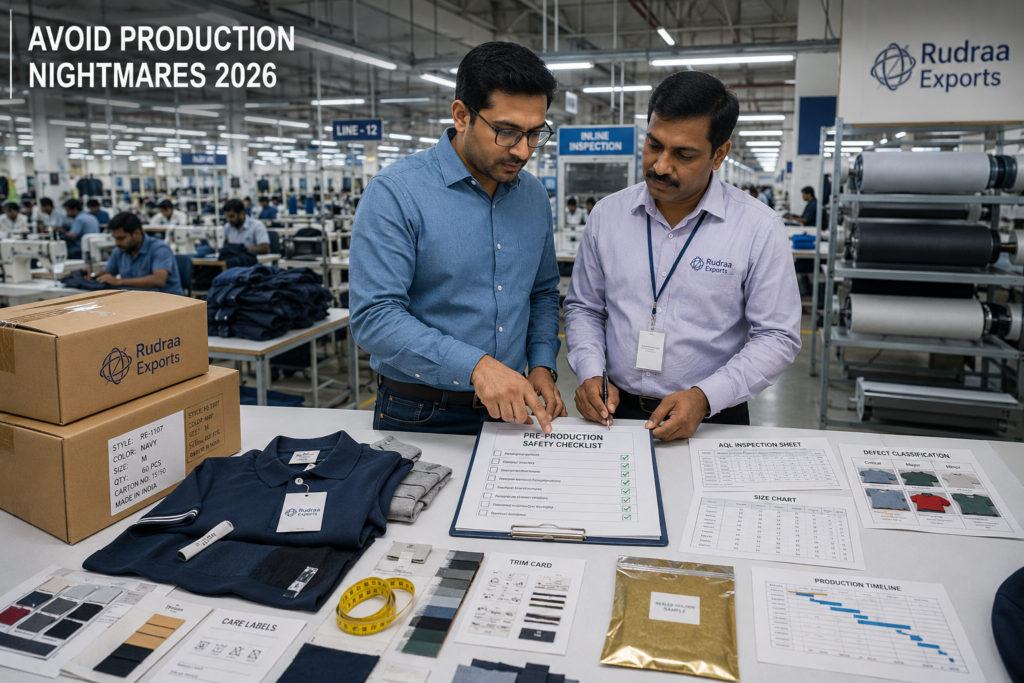
Starting your first apparel production run is exciting, but it can also feel risky. You may have strong designs, a clear brand idea, and customer demand, but one poor manufacturing decision can create wrong sizing, weak stitching, shade mismatch, late delivery, unusable inventory, and lost cash before your brand even launches properly.
The uploaded research explains why this fear is realistic. It notes that defect-rate datasets show textile and apparel failures are measurable and costly, and it highlights that poor quality can create rework, scrap, returns, delays, and margin loss. The main lesson is simple: production nightmares are rarely random. They usually come from unclear specs, weak sampling, poor material control, missing inspection gates, and bad communication.
At Rudraa Exports, we help startup and growing apparel brands reduce manufacturing risk through factory-direct communication, structured sampling, traceability, quality checkpoints, and AQL-based inspection planning.
Quick Answer
Startups can avoid apparel production nightmares by treating manufacturing as a controlled process, not a lucky guess. Before paying a deposit, founders should verify the factory, share a clear tech pack, approve fit and size-set samples, lock a sealed pre-production sample, define fabric lots and shade standards, use AQL inspection levels, schedule pre-production and inline checks, and maintain weekly production updates. A reliable manufacturer should explain how defects are prevented, measured, corrected, and documented before bulk production starts.
Planning your first apparel production run? Contact Rudraa Exports to review your tech pack, target MOQ, fabric, sampling plan, and delivery destination.
Why First Production Runs Go Wrong
Most production disasters do not start on the sewing line. They start before production begins.
Common causes include:
- Vague tech packs
- Missing measurement tolerances
- No approved size set
- Wrong fabric lot
- Weak shade control
- Unclear print or embroidery specs
- Poor sampling process
- No pre-production inspection
- No inline inspection
- No AQL standard
- No weekly production reporting
- Poor communication between buyer and factory
The uploaded guide makes a strong point: founders often think they are failing because of design or luck, but many first-drop failures are actually process failures.
A startup does not need to become a production expert overnight. But it does need a system.
Common Apparel Production Nightmares
| Production Nightmare | What It Looks Like | Root Cause |
|---|---|---|
| Poor stitching | Open seams, skipped stitches, loose threads | Weak machine setup or no inline QC |
| Size mismatch | Garments do not match size chart | No measurement method or tolerance |
| Shade variation | Same colour looks different across pieces | Poor dye lot control |
| Fabric surprise | Fabric feels different from approved sample | No fabric lot traceability |
| Print failure | Cracking, peeling, wrong placement | No strike-off or curing control |
| Embroidery issue | Puckering, unreadable logo | Wrong backing or stitch density |
| Late delivery | Launch date missed | Poor critical path planning |
| Packing errors | Wrong sizes or labels in cartons | No packing inspection |
| Surprise costs | Extra charges after deposit | Weak quotation and PO terms |
These issues are preventable when the buyer and factory agree on standards before production.
Nightmare 1: “Everything Is Sewn, But It Is Not Wearable”
This is one of the most painful outcomes. The factory finishes the order, but the garments have skipped stitches, open seams, loose threads, uneven stitching, or seam weakness.
The uploaded research identifies common garment defects such as skipped or broken stitches, open seams, uneven stitching, loose threads, and seam issues. These often come from poor machine settings, speed pressure, weak operator training, or insufficient inline inspection.
Prevention Checklist
✅ Define stitch type and seam construction
✅ Approve pre-production sample
✅ Use inline inspection
✅ Track defect trends
✅ Check seam strength where needed
✅ Define rework rules before production
Do not wait until final inspection to discover sewing defects. By then, rework is expensive and delivery risk is high.
Nightmare 2: Size Set Mismatch
Sizing mistakes destroy startup margins.
A T-shirt, hoodie, jogger, or kidswear item may look fine in one sample size but fail across other sizes. This happens when the factory interprets grading differently, measures incorrectly, or cuts without a verified size set.
Why Size Issues Happen
| Cause | Result |
|---|---|
| No tolerance table | Factory decides what is acceptable |
| No measurement method | Buyer and factory measure differently |
| No size set sample | Grading errors appear in bulk |
| No measurement audit | Drift continues through production |
| No AQL measurement plan | Defects discovered too late |
The uploaded source notes that measurement drift is one of the most expensive startup mistakes because it can make inventory unsellable or force discounting.
Before bulk cutting, approve a size set or at least key sizes. Never approve bulk based only on one sample.
Nightmare 3: Shade Variation and Fabric Surprises
Fabric problems can ruin a drop even when stitching is good.
Common fabric issues include:
- Shade variation
- Uneven dyeing
- Fabric flaws
- Pilling
- Wrong GSM
- Unexpected shrinkage
- Different handfeel from approved sample
The uploaded guide explains that shade variation and fabric surprises often come from insufficient fabric inspection and lack of lot control.
Fabric Control Checklist
✅ Confirm fabric composition
✅ Confirm GSM
✅ Approve fabric swatch
✅ Approve lab dip or shade band
✅ Record fabric lot numbers
✅ Check shrinkage where relevant
✅ Inspect fabric before cutting
✅ Keep approved sample as reference
If you cannot trace which fabric lot was used, you cannot fix the root cause when defects appear.
Nightmare 4: Timeline Blow-Ups
Delays are not only inconvenient. They can damage your launch.
If your production misses a launch, influencer campaign, retailer delivery, event, or seasonal window, the inventory may lose value even before it reaches customers.
Common Delay Causes
| Delay Cause | Prevention |
|---|---|
| Late fabric booking | Confirm material before sample approval |
| Repeated sampling | Share clear tech pack first |
| Late trim approval | Approve labels, zippers, buttons early |
| Rework after final inspection | Use inline inspection |
| Packing confusion | Approve packing spec before finishing |
| Shipping delay | Reverse-plan from delivery date |
The goal is not just fast production. The goal is predictable production.
Red Flags When Choosing a Manufacturer
Factories usually reveal risk before production begins. Founders just need to watch carefully.
Red Flag 1: “We Do Good Quality” Without Standards
If a factory cannot define quality, it cannot control quality.
Ask for:
- Defect classification
- AQL levels
- Measurement tolerance
- QC checklist
- Inspection stages
- Rework process
The uploaded guide warns that a factory refusing measurable standards like AQL is asking the buyer to accept unknown risk.
Red Flag 2: Sampling Is Treated Like a Formality
If the factory pushes directly from a proto sample to bulk, be careful.
A proper sampling ladder includes:
- Prototype sample
- Fit sample
- Size set sample
- Pre-production sample
- Sealed golden sample
- Top-of-production check
Skipping these steps increases the chance of discovering errors after hundreds or thousands of garments are already cut.
Red Flag 3: They Only Talk About Final Inspection
Final inspection is important, but it is too late to catch many structural issues cheaply.
A better factory uses:
- Pre-production inspection
- Inline inspection
- End-line checks
- Final random inspection
The uploaded research states that modern quality programs use multiple checkpoints instead of depending only on final inspection.
Red Flag 4: Poor Communication
Slow or unclear communication during sampling is a preview of bulk production.
Watch for:
- Contradictory updates
- No single point of contact
- Delayed sample feedback
- No written approval tracking
- No photos or measurement reports
- No production calendar
If you are guessing, the process is already weak.
Red Flag 5: No Traceability
Traceability is not only for sustainability. It is a practical problem-solving tool.
If shade, shrinkage, fabric, trim, or print issues appear, traceability helps isolate the problem instead of scrapping the full run.
Ask how the factory tracks:
- Fabric rolls
- Dye lots
- Trim lots
- Production batches
- Inspection records
- Packing cartons
How to Vet a Factory Before Paying a Deposit
Use a simple process before committing.
Step 1: Check Category Fit
Do not choose a factory only because it is cheap. Choose one that regularly makes your category.
| Product | Factory Capability Needed |
|---|---|
| T-shirts | Jersey knitting, cutting, stitching, print control |
| Hoodies | Heavy GSM handling, rib, fleece, shrinkage control |
| Kidswear | Safety, trims, chemical compliance |
| Sportswear | Performance fabric, sublimation, fit control |
| Polos | Collar, placket, embroidery, pique fabric |
| Streetwear | Oversized fit, heavyweight GSM, wash finish |
A factory that is strong in basic T-shirts may not be right for structured jackets or washed streetwear.
Step 2: Audit the Quality System
A sample can be made carefully by senior workers. Bulk production depends on systems.
Ask for:
- QC process flow
- Inspection checkpoints
- Defect categories
- Measurement audit format
- Corrective action process
- DHU tracking
- ISO 9001 certificate if available
The uploaded guide explains that ISO 9001:2015 focuses on process control, documentation, corrective actions, and continuous improvement. It also notes that ISO is not magic, but it is a useful signal of systematic quality management.
Step 3: Ask About DHU
DHU means Defects per Hundred Units.
Formula:
DHU = Total defects found / Total garments inspected × 100
The uploaded research gives an example: 35 defects found in 250 inspected garments equals DHU 14.
A factory that tracks DHU can identify where defects are happening. A factory that does not track defect data may rely on arguments and guesswork.
Step 4: Require a Pre-Production Inspection Plan
A Pre-Production Inspection checks readiness before bulk starts.
It should confirm:
- Fabric lot
- GSM
- Shade
- Trims
- Pattern
- Measurement method
- Production line setup
- Machine readiness
- Operator briefing
This is one of the best ways to catch problems before fabric is cut.
Step 5: Confirm Inline Inspection
Inline inspection catches defects while the production line is running.
It helps prevent:
- Repeated stitching defects
- Measurement drift
- Wrong seam construction
- Print placement errors
- Operator-specific mistakes
- Batch-level quality failure
If a factory says, “We check at the end,” that is not enough.
Step 6: Test Communication
Ask:
- Who is the single point of contact?
- How often will updates be shared?
- Will updates include photos?
- Will measurement reports be shared?
- Will QC reports be shared?
- How will approvals be documented?
- What happens if a defect trend appears?
A factory’s communication process is part of its production quality.
Sampling Ladder for Startups
Use this minimum sampling process.
| Sample Stage | Purpose |
|---|---|
| Prototype sample | Confirms design concept |
| Fit sample | Confirms fit and measurement method |
| Size set sample | Confirms grading across sizes |
| Pre-production sample | Final approval using actual materials |
| Sealed sample | Reference for bulk and disputes |
| TOP sample | First pieces from production line |
Do not skip the size set if fit matters. One good medium-size sample does not prove the full range is correct.
AQL Inspection for Apparel Startups
AQL means Acceptable Quality Limit. It is a sampling method used to decide whether a production lot passes or fails based on defect limits.
The uploaded guide explains that AQL helps turn subjective quality disputes into a measurable pass/fail system, and that many apparel programs reference levels such as AQL 2.5 for major defects and AQL 4.0 for minor defects, depending on product risk.
AQL Defect Classes
| Defect Type | Meaning | Example |
|---|---|---|
| Critical | Unsafe or unusable issue | Broken needle, harmful sharp object |
| Major | Customer likely rejects product | Open seam, wrong measurement, visible stain |
| Minor | Small issue but still not ideal | Loose thread, small finishing mark |
Agree on AQL levels before production. Do not negotiate quality standards after defects appear.
Inspection Stages That Protect Your Production Run
| Inspection Stage | Timing | Purpose |
|---|---|---|
| PPI | Before production | Confirms material and line readiness |
| Inline inspection | During production | Catches defects early |
| End-line inspection | After stitching/finishing | Checks finished garment quality |
| Final Random Inspection | 80–100% packed | Decides shipment acceptance |
| Packing inspection | Before dispatch | Confirms labels, cartons, size ratios |
The uploaded document recommends layered inspections instead of relying on one final check.
Cost of Weak QA vs Strong QA
A weak QA process feels cheaper at the start. It is more expensive later.
Weak QA Scenario
| Cost Area | Result |
|---|---|
| No proper size set | Measurement issues in bulk |
| No inline inspection | Defects repeated across production |
| No fabric lot control | Shade mismatch |
| No final inspection | Bad goods reach buyer |
| No packing check | Wrong sizes shipped |
| Final result | Discounts, returns, delay, remake |
Strong QA Scenario
| Control | Benefit |
|---|---|
| Tech pack approval | Clear spec |
| Fit and size set | Better sizing |
| Golden sample | Clear reference |
| PPI | Material readiness |
| Inline QC | Early correction |
| AQL FRI | Shipment-level decision |
| Weekly reporting | Fewer surprises |
The uploaded research explains the broader Cost of Poor Quality concept, where poor quality can create meaningful revenue loss through rework, scrap, returns, and failure.
15-Point Pre-Production Safety Checklist
Use this before paying your deposit or approving bulk.
| # | Safety Check | Status |
|---|---|---|
| 1 | Final tech pack issued with one dated version | |
| 2 | Measurement method agreed | |
| 3 | Tolerance table included | |
| 4 | Defect definitions agreed | |
| 5 | Fit sample approved in writing | |
| 6 | Size set approved | |
| 7 | Sealed PPS approved | |
| 8 | TOP approval planned | |
| 9 | Fabric lot confirmed | |
| 10 | Shade band or colour standard approved | |
| 11 | Trims verified | |
| 12 | Fabric inspection plan set | |
| 13 | AQL levels defined | |
| 14 | PPI scheduled | |
| 15 | Inline and final inspection plan agreed |
This checklist is adapted from the uploaded pre-production safety framework.
Why Rudraa Exports
Rudraa Exports supports apparel startups and growing brands that want to avoid common production failures through factory-direct control, traceability, structured sampling, and quality checkpoints.
Manufacturing Capabilities
- Factory-direct Tirupur T-shirt and knitwear manufacturing
- 72,000+ units per month production capacity
- Support for T-shirts, polos, kidswear, sportswear, corporate apparel, uniforms, and private-label knitwear
- MOQs starting from around 300 pieces per style, depending on fabric, colour, logo method, and customization
- OEM/ODM support for fabric selection, sampling, fit, logo methods, labels, packing, and export documentation
Quality and Risk Control
- ISO 9001:2015 certified manufacturing approach
- AQL 2.5 inspection standards
- Structured sampling and golden sample process
- Support for buyer-defined measurements, tolerances, GSM, shade standards, and packaging rules
- Traceability support across fabric lots, production batches, inspection records, and packing lists
- Factory-direct communication without unnecessary agent layers
International Buyer Advantages
- Factory-direct pricing without trading-company markups
- Up to 40% cost-saving positioning compared with indirect sourcing models
- English-language communication for founders, sourcing teams, procurement teams, and brand owners
- Export support for EU, USA, Australia, and Middle East markets
- Multi-port shipping through Tuticorin VOC, Chennai, and Cochin
- FTA-eligible documentation support for relevant destination markets
Ready to make your first production run predictable? Speak with Rudraa Exports to review your tech pack, sampling ladder, AQL plan, MOQ, and delivery timeline.
FAQ: Avoiding Apparel Production Nightmares
1. What are the most common apparel production nightmares?
The most common issues are wrong measurements, stitching defects, shade variation, fabric flaws, print cracking, embroidery puckering, late delivery, packing mistakes, and unexpected costs.
2. Why do first production runs often fail?
First production runs fail because founders often approve incomplete specs, skip size sets, ignore fabric lot control, rely only on final inspection, or choose factories based only on price.
3. What is AQL in garment inspection?
AQL means Acceptable Quality Limit. It is a statistical sampling method used to decide whether a garment lot passes or fails based on allowed defect levels.
4. What AQL level should startups use?
Many apparel programs use AQL 2.5 for major defects and AQL 4.0 for minor defects, but the correct level depends on product type, risk, customer expectations, and buyer tolerance.
5. What is a pre-production sample?
A pre-production sample is the final approved sample made with actual materials, trims, construction, and branding before bulk starts. It should become the reference for production and inspection.
6. What is a golden sample?
A golden sample is a sealed approved sample used as the final standard for bulk production. It helps resolve disputes over fit, fabric, colour, stitching, and finishing.
7. What is DHU in garment manufacturing?
DHU means Defects per Hundred Units. It is calculated as total defects found divided by total garments inspected multiplied by 100. It helps factories track defect trends.
8. Should I use third-party inspection for my first order?
Yes, especially for first orders or high-risk programs. A third-party inspection gives independent verification before shipment and helps protect your cash and launch timeline.
9. How do I know if a factory is risky?
A factory is risky if it avoids measurable quality standards, skips sampling steps, refuses AQL planning, communicates poorly, cannot explain defect prevention, or has no traceability system.
10. Is ISO 9001 enough to guarantee quality?
No. ISO 9001 supports quality management systems, but buyers still need approved samples, inspection plans, AQL standards, and clear communication.
11. How can I prevent shade variation?
Approve lab dips or shade bands, confirm fabric lots, inspect fabric before cutting, and track dye lots through production. Keep an approved colour standard for repeat orders.
12. Why choose Rudraa Exports for startup apparel production?
Rudraa Exports is suitable for startups that need factory-direct communication, structured sampling, traceability, AQL inspection support, ISO-aligned quality systems, and export-ready production planning.
Conclusion
Apparel production nightmares are preventable when founders stop relying on hope and start using systems. The safest production path includes clear tech packs, approved fit and size-set samples, sealed pre-production samples, fabric lot control, AQL standards, pre-production inspection, inline checks, final random inspection, packing verification, and consistent communication.
Visit rudraaexports.com or contact our team directly to share your tech pack, target MOQ, fabric, delivery destination, and launch timeline — and receive a factory-direct production plan designed to reduce risk before bulk begins.
Related reading
How to Verify a Brand-New Overseas Garment Manufacturer Before Paying a Deposit
How to Reduce Garment Production Lead Times: 7 Proven Strategies for Apparel Buyers
End-to-End Quality Control in ISO-Certified Tirupur T-Shirt Exporters: Complete 2026 Guide