
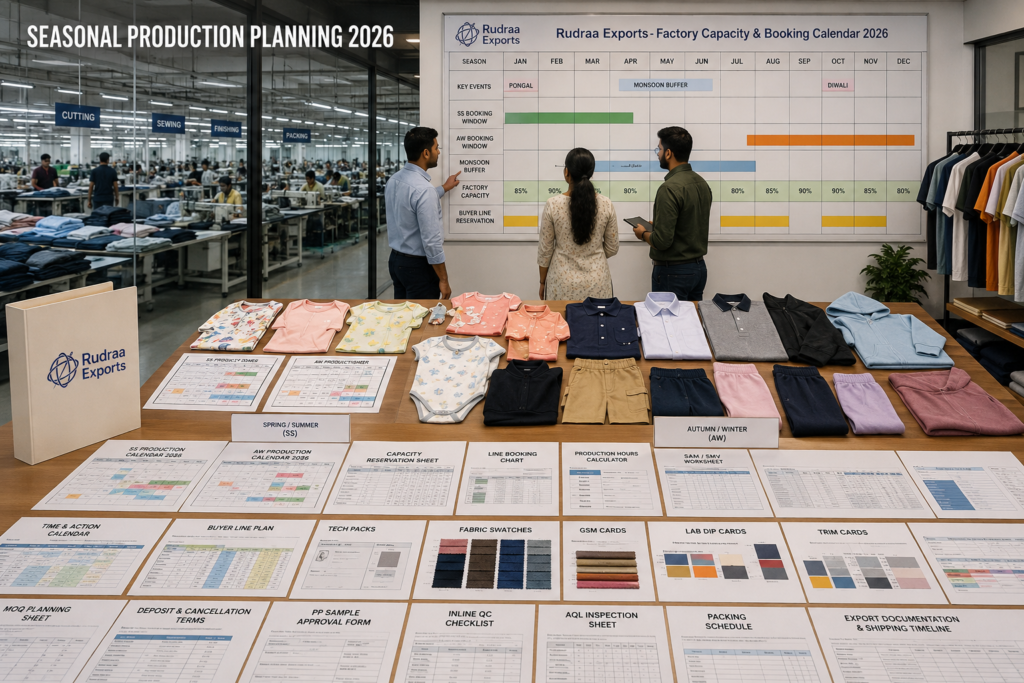
Scaling an apparel brand is not only about better designs or stronger marketing.
It is also about factory capacity.
Many brands manage the first drop successfully, but struggle with the second and third collections because they book production too late. By the time the tech pack is ready, the right fabric, dyeing slot, printing team, sewing line, and packing schedule may already be booked by other buyers.
This is where seasonal production planning becomes important.
For apparel brands sourcing from India, especially from Tirupur, production should be planned around buying seasons, factory calendars, Indian holidays, monsoon risks, fabric booking, sampling timelines, and export shipment windows.
At Rudraa Exports, we help global buyers plan T-shirts, polos, hoodies, sweatshirts, joggers, kidswear, babywear, uniforms, corporate apparel, and private-label knitwear production from Tirupur with capacity planning, sampling calendars, TNA milestones, QC checkpoints, and export dispatch support.
Quick Answer
Seasonal production planning helps apparel brands book factory capacity before peak season delays happen. Brands should forecast demand, convert expected units into production hours, reserve factory capacity for Spring/Summer and Autumn/Winter collections, approve fabrics and trims early, plan around Indian holidays such as Pongal and Diwali, add monsoon buffers, and use a TNA calendar to track sampling, production, QC, packing, and shipment. For India sourcing, capacity should be treated as something to reserve, not something to find at the last minute.
Planning SS or AW production from India? Contact Rudraa Exports to request a factory capacity and seasonal production planning review.
Why Seasonal Production Planning Matters
Apparel production is calendar-driven.
If your launch date is fixed, your factory booking date must be calculated backwards.
Many buyers make the mistake of confirming production only after everything is final. But by that point, the production calendar may already be full.
Seasonal Planning Helps You Control
- Sampling timeline
- Fabric booking
- Lab dip approval
- Trim sourcing
- Dyeing and finishing slots
- Printing and embroidery capacity
- Sewing line allocation
- QC schedule
- Packing schedule
- Export documents
- Sea or air shipment planning
A strong seasonal plan prevents last-minute rush costs, late deliveries, and missed launch windows.
The Real Problem: Spot Booking Production Too Late
Spot booking means placing a PO only when the full range is final.
This feels flexible, but it creates risk.
Spot Booking Risks
| Risk | What Happens |
|---|---|
| Factory lines already booked | Order waits in queue |
| Fabric not available | Sourcing starts late |
| Dyeing slot unavailable | Colour approval delays |
| Printing queue full | Decoration is delayed |
| Holiday shutdown ignored | Production days are lost |
| Monsoon buffer missing | Transit delays affect delivery |
| Rush freight needed | Landed cost increases |
| QC time compressed | Quality risk increases |
The uploaded source explains that scaling from the first drop to later collections often stalls because brands fail to book capacity early enough.
Direct Factory Capacity Reservation vs Agent vs Spot Booking
| Criteria | Direct Factory Capacity Reservation | Agent / Trader Model | Spot Booking |
|---|---|---|---|
| Peak-season slot security | Strong | Medium | Weak |
| Lead-time control | Strong | Medium | Weak |
| Cost transparency | Better | Lower visibility | Rush cost risk |
| Factory communication | Direct | Indirect | Late-stage pressure |
| Seasonal planning | Structured | Depends on agent | Usually reactive |
| QC planning | Built into calendar | Varies | Often compressed |
| SS/AW overlap control | Stronger | Medium | Weak |
| Best for | Growing brands and repeat programs | Buyers needing sourcing help | Small uncertain tests |
Buyer Tip
If your launch date is important, capacity reservation is safer than spot booking.
Typical India Apparel Lead Time
Lead time depends on product type, fabric, GSM, colour count, trims, sample approvals, production quantity, QC, packing, and shipping mode.
End-to-End Planning Window
For many India sourcing programs, buyers should plan with a broad window of 75–120 days door-to-door, depending on product complexity, approvals, shipment mode, and destination.
Typical Production Flow
| Stage | Planning Time |
|---|---|
| Design and tech pack finalisation | 1–2 weeks |
| Sampling and revisions | 2–6 weeks |
| Fabric and trim booking | 2–4 weeks |
| Lab dips and strike-offs | 1–3 weeks |
| Bulk production | 3–8 weeks |
| QC and packing | 1 week |
| Export documentation | 2–5 days |
| Sea freight and clearance | Depends on destination |
The uploaded source notes that India sourcing lead times are often planned around 75–120 days door-to-door, with extra buffers needed for monsoon and seasonal bottlenecks.
India Seasonal Calendar for Apparel Buyers
India’s production calendar is affected by export demand, festivals, holidays, weather, and shipping congestion.
Seasonal Calendar Overview
| Month | Factory / Sourcing Reality | Buyer Action |
|---|---|---|
| January | Pongal affects Tamil Nadu labour availability | Avoid critical starts during Pongal week |
| February–March | Spring/Summer production and dispatch cycles | Track QC and shipment readiness |
| April–June | AW planning and sampling window | Reserve AW capacity |
| June–September | Monsoon can affect logistics | Add transit buffer |
| July–August | AW production pressure rises | Freeze changes and monitor QC |
| October–November | Diwali impacts labour and logistics | Pre-book SS before Diwali |
| December | SS production ramp-up | Finalise PP approvals and shipment plan |
Key Indian Calendar Risks
Pongal
Pongal is important in Tamil Nadu, including Tirupur. It usually happens in mid-January and can affect labour availability due to travel and holidays.
Diwali
Diwali usually falls in October or November and may affect factory attendance, logistics, dispatches, and supplier response times.
Monsoon
The monsoon period can create logistics delays, especially when goods are moving between factory, port, and destination markets.
The uploaded source highlights Pongal, Diwali, and monsoon as important timing risks for apparel brands booking production in India.
SS and AW Production Planning
Most brands plan around two major seasons:
- Spring/Summer, or SS
- Autumn/Winter, or AW
SS Production Planning
For Spring/Summer drops, buyers should work backwards from retail launch date.
Example:
| Milestone | Timing |
|---|---|
| Retail launch | March |
| Warehouse arrival | February |
| Shipment from India | January |
| Production completion | December / January |
| PP approval | November |
| Fabric booking | October / November |
| Capacity reservation | Before Diwali |
AW Production Planning
For Autumn/Winter drops, buyers should reserve capacity earlier in the year.
Example:
| Milestone | Timing |
|---|---|
| Retail launch | September / October |
| Warehouse arrival | August |
| Shipment from India | July |
| Production completion | June / July |
| PP approval | May |
| Fabric booking | April / May |
| Capacity reservation | April–June |
Buyer Rule
Put two booking dates on your annual sourcing calendar:
- SS capacity reservation: October–November
- AW capacity reservation: April–June
Backward Planning Template
Start from your retail launch date and calculate backwards.
Backward Planning Steps
| Step | Planning Question |
|---|---|
| 1. Retail launch date | When must the product go live? |
| 2. Warehouse date | When must goods reach warehouse? |
| 3. Shipping time | How long will sea or air freight take? |
| 4. Ex-factory date | When must factory dispatch? |
| 5. Packing and QC | How many days needed? |
| 6. Sewing window | How long for bulk production? |
| 7. Fabric and trims | When must materials be ready? |
| 8. PP sample approval | When must final sample be approved? |
| 9. Capacity booking | When must the factory line be reserved? |
Simple Example
If your retail launch is March 15:
- Warehouse arrival may be needed by February 15
- Ex-factory may be needed by late January
- Bulk production may need to finish by mid-January
- PP sample should be approved by November
- Fabric and trims should be locked by October
- Capacity should be discussed before Diwali
How to Calculate Factory Capacity
Growing brands should not forecast only in units.
They should also forecast in production hours.
Capacity Calculation Example
Assume:
- 6 styles
- 300 units per style
- Total units: 7,200
- 8% buffer: 576 units
- Total planned units: 7,776
- Average sewing time: 14 minutes per unit
Calculation
7,776 units × 14 minutes = 108,864 minutes
108,864 minutes ÷ 60 = 1,814 production hours
Add 10–15% risk buffer.
Planning capacity needed: around 2,000+ production hours.
The uploaded source explains how brands can translate demand into factory hours using style count, units, SAM/SMV, and buffer assumptions.
Why Capacity Hours Matter
Factory capacity is not only about pieces.
A simple T-shirt and a hoodie do not consume the same line time.
Approximate Sewing Time Logic
| Product | Capacity Impact |
|---|---|
| Basic T-shirt | Lower |
| Polo shirt | Medium |
| Hoodie | Higher |
| Jogger | Medium to high |
| Kids set | Higher due to multiple pieces |
| Uniform set | Higher due to size and logo complexity |
If you book only by pieces, you may underestimate production load.
How to Reserve Factory Capacity
Capacity reservation means agreeing with the factory on production time before the final PO rush.
Capacity Reservation May Include
- Style family
- Approximate quantity
- Production month
- Sewing line allocation
- Fabric booking window
- PP sample deadline
- Deposit terms
- Cancellation policy
- Change-control rules
- QC checkpoints
- Shipment window
Capacity Reservation Questions
Ask the factory:
- Which production weeks can you reserve?
- What quantity or production hours can be held?
- What deposit is required?
- What happens if quantity changes?
- What happens if PP approval is delayed?
- What is the cancellation window?
- Can unused capacity move to next season?
- When must fabric and trims be final?
- Which styles are best suited for reserved capacity?
- How will progress be tracked?
Commercial Terms for Capacity Booking
Capacity booking needs clear terms.
Common Terms to Discuss
| Term | Meaning |
|---|---|
| Reservation deposit | Amount paid to hold production capacity |
| Credit against invoice | Deposit adjusted against final order |
| Cancellation window | Deadline for changing or cancelling |
| Use-it-or-lose-it | Unused capacity may expire |
| Change control | New changes may shift production slot |
| PP approval deadline | Final sample approval date |
| Material lock date | Date fabric and trims must be approved |
| Delay responsibility | Who owns delay caused by late approval |
Buyer Tip
Do not treat capacity reservation casually.
A factory is protecting labour, lines, and production planning. If you reserve capacity and do not use it, both buyer and factory lose time.
What to Reserve: SS and AW Capacity Buckets
A practical system is to reserve capacity in buckets.
Example Capacity Buckets
| Bucket | Purpose |
|---|---|
| SS bulk production | Spring/Summer production window |
| AW bulk production | Autumn/Winter production window |
| Development lane | Sampling and PP approvals |
| Reorder lane | Fast repeat production |
| Rush lane | Critical urgent styles |
This prevents one season from consuming all capacity and delaying the next season.
5-Step Seasonal Capacity Planning Process
Step 1: Build a Seasonal Line Plan
List:
- Style names
- Product categories
- Fabric
- GSM
- Colour count
- Size range
- Expected units
- Target launch date
- Target warehouse date
Step 2: Forecast Units and Buffer
Use historical sales, wholesale demand, website performance, buyer commitments, or campaign forecasts.
Add a buffer for:
- Size imbalance
- Reorders
- Defects
- Marketing demand
- Bestseller risk
Step 3: Convert Units into Capacity Hours
Estimate SAM/SMV or ask the factory to calculate.
This tells you whether the factory line capacity is realistic.
Step 4: Reserve Factory Slots
Discuss:
- Sewing line
- Sampling lane
- Dyeing window
- Printing / embroidery slots
- QC and packing calendar
Step 5: Track with TNA Calendar
Use one Time & Action calendar to track every milestone from sample to dispatch.
Direct Factory vs Agent for Seasonal Planning
A direct-factory relationship can make seasonal planning easier.
Comparison
| Area | Direct Factory | Agent / Trader |
|---|---|---|
| Capacity visibility | Clearer | Indirect |
| Line planning | Direct discussion | Depends on agent |
| Cost transparency | Better | Markup may be hidden |
| TNA control | Stronger | Slower feedback loop |
| Change control | Easier | More layers |
| QC planning | More direct | Depends on agent |
| SS/AW calendar | Easier to align | May be fragmented |
| Accountability | One partner | Responsibility can shift |
For growing brands, direct communication with the factory reduces uncertainty.
How Rudraa Exports Helps with Seasonal Planning
Rudraa Exports supports apparel buyers with structured seasonal planning from Tirupur.
Seasonal Planning Support
- SS and AW production planning
- Capacity reservation discussions
- Style feasibility review
- Fabric and GSM guidance
- MOQ planning
- Sampling calendar
- Lab dip approval tracking
- Trim approval tracking
- TNA calendar planning
- Inline QC checkpoints
- Export packing and documentation schedule
Product Categories Supported
- T-shirts
- Polo shirts
- Sweatshirts
- Hoodies
- Joggers
- Leggings
- Kidswear
- Babywear
- School uniforms
- Corporate apparel
- Activewear
- Private-label knitwear
Why Rudraa Exports
Rudraa Exports helps global buyers manufacture knitwear from Tirupur with factory-direct production planning and export support.
Manufacturing Strengths
- Factory-direct Tirupur knitwear manufacturing
- 72,000+ units per month production capacity
- MOQ discussions starting from around 300 pieces for suitable programs
- AQL 2.5 inspection standards
- Sampling support for new and growing brands
- Export support for USA, UK, Europe, Australia, Middle East, and global buyers
- Multi-port shipping through Chennai, Tuticorin, and Cochin
Buyer Advantages
- Better visibility into production capacity
- Fewer communication layers
- Clearer SS and AW planning
- Factory-direct pricing without trading-company markups
- Up to 40% cost-saving positioning compared with indirect sourcing models
- Better control over fabric, trims, QC, and packing
- Support for repeat programs and seasonal scaling
Ready to book seasonal production capacity in India? Speak with Rudraa Exports to share your line plan, target launch date, expected units, and product categories.
Seasonal Production Planning Checklist
| # | Checklist Item |
|---|---|
| 1 | Define retail launch date |
| 2 | Define warehouse arrival date |
| 3 | Define ex-factory date |
| 4 | List all styles |
| 5 | Confirm fabric and GSM |
| 6 | Confirm colour count |
| 7 | Confirm size range |
| 8 | Forecast units |
| 9 | Add buffer percentage |
| 10 | Estimate SAM / SMV |
| 11 | Convert units to production hours |
| 12 | Reserve capacity bucket |
| 13 | Confirm deposit terms |
| 14 | Confirm cancellation window |
| 15 | Approve tech pack |
| 16 | Approve fabric and trims |
| 17 | Approve PP sample |
| 18 | Track TNA calendar |
| 19 | Plan QC and packing |
| 20 | Confirm logistics and dispatch |
FAQ: Seasonal Production Planning for Apparel Brands
1. What is seasonal production planning in apparel?
Seasonal production planning is the process of forecasting demand, booking factory capacity, approving materials, planning sampling, and scheduling production for seasonal collections such as SS and AW.
2. Why should apparel brands book factory capacity early?
Factories can fill production lines before peak season. Booking early protects production slots and helps avoid rush charges, delays, and missed launch dates.
3. When should I book Spring/Summer production in India?
For SS production, buyers should usually start capacity discussions before major late-year bottlenecks such as Diwali and confirm key approvals early enough for production and export shipment.
4. When should I book Autumn/Winter production in India?
For AW production, buyers should usually begin planning and capacity discussions during April–June, especially for new fabrics, heavier GSM products, and complex trims.
5. What is a TNA calendar?
A TNA calendar is a Time & Action calendar that lists every milestone, owner, due date, and approval deadline from sampling to shipment.
6. How do I calculate factory capacity?
Estimate units by style, add a buffer, multiply by sewing minutes per unit, convert to hours, and add a risk buffer. This gives a clearer view of capacity needed.
7. What is capacity reservation?
Capacity reservation means agreeing with the factory to hold production time, sewing lines, or capacity hours for your planned order or season.
8. Do small brands need capacity reservation?
Small brands may not need full seasonal reservation, but if they have fixed launch dates or repeat programs, even a small capacity hold can reduce risk.
9. What holidays affect garment production in India?
Pongal can affect Tamil Nadu and Tirupur in January. Diwali can affect production and logistics in October or November. Monsoon can affect logistics during June–September.
10. Can Rudraa Exports help plan SS and AW production?
Yes. Rudraa can help buyers plan SS and AW production calendars, sampling timelines, capacity discussions, TNA milestones, QC checkpoints, packing, and export dispatch.
11. What products can Rudraa Exports manufacture for seasonal collections?
Rudraa manufactures T-shirts, polos, sweatshirts, hoodies, joggers, leggings, kidswear, babywear, school uniforms, corporate apparel, activewear, and private-label knitwear.
12. What should I send to request a capacity plan?
Send your line plan, product categories, expected units, style count, colour count, size range, fabric details, launch dates, destination market, and any tech packs available.
Conclusion
Seasonal production planning is what separates reactive sourcing from scalable apparel manufacturing.
If you wait until the range is fully final before booking capacity, you may already be late. Fabric, dyeing, printing, embroidery, sewing lines, QC teams, packing schedules, and export slots all need planning.
For apparel brands sourcing from India, the safest method is to work backwards from the launch date, build a seasonal calendar, calculate production hours, reserve capacity, approve materials early, and track everything through a TNA calendar.
Tirupur gives knitwear buyers an advantage because the ecosystem supports fabric sourcing, dyeing, printing, embroidery, stitching, finishing, packing, and export documentation within one manufacturing cluster.
Rudraa Exports helps brands plan seasonal knitwear production from Tirupur with factory-direct coordination, capacity planning, MOQ guidance, sampling support, QC, and export shipment readiness.
Visit rudraaexports.com or contact our team directly to share your SS or AW line plan, expected units, product categories, target launch dates, and destination market — and receive a seasonal capacity planning proposal from Rudraa Exports.
Related reading
How to Reduce Garment Production Lead Times: 7 Proven Strategies for Apparel Buyers
How to Build a Consistent Production System for Your Growing Australian Clothing Brand
Sourcing Cost Calculator 2026: Save Up to 40% on Garment Manufacturing