
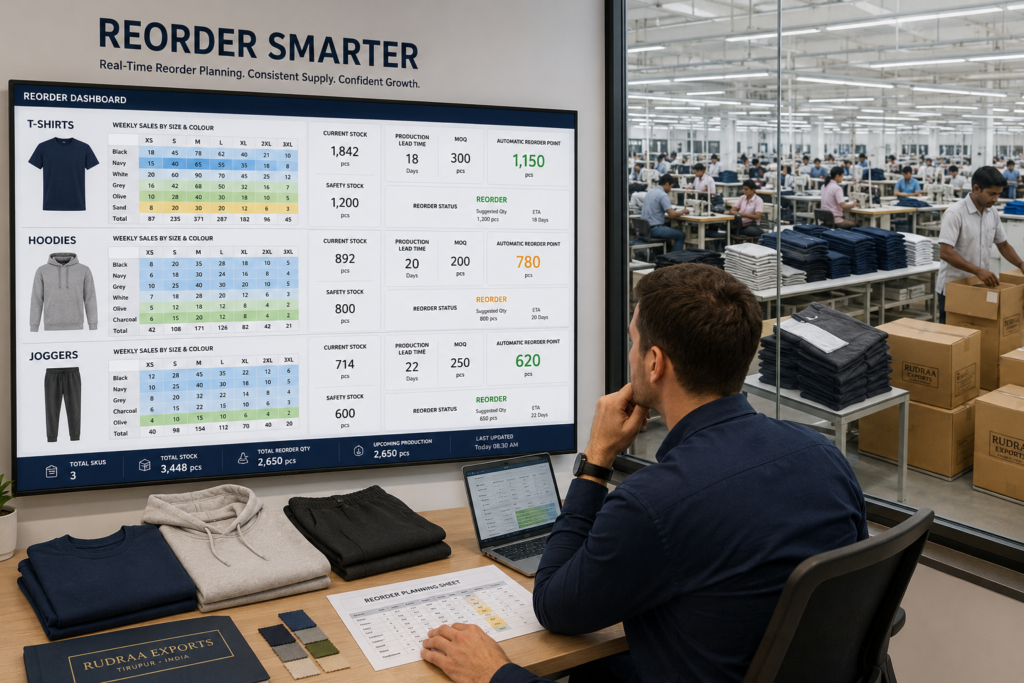
Your first few clothing drops may be managed through spreadsheets, WhatsApp messages, sample photos and daily follow-ups.
That can work while the business is small.
But once sales increase and reorders become regular, production problems become more expensive.
A repeat order may arrive late. The second batch may fit differently. The fabric colour may be close but not identical. A print position may shift. A factory may substitute a trim without clear approval.
At this stage, growth is no longer only a design challenge.
It becomes an operations challenge.
A consistent clothing production system gives your brand a repeatable method for moving every style from approved sample to finished stock.
It controls:
- Product specifications
- Production timelines
- Reorder decisions
- Sample approvals
- Material changes
- Quality inspections
- Export documentation
- Delivery planning
At Rudraa Exports, we help Australian brands build repeatable production workflows with factory-direct communication, tech-pack control, sample approvals, material traceability, AQL inspections, export packing and reorder planning from Tirupur, India.
Quick Answer
A consistent clothing production system needs one shared production calendar, clear reorder points, locked tech-pack versions, written sample approvals, change-control records and staged quality inspections. Every milestone should have an owner, due date and definition of completion. Reorders should use the same approved patterns, materials, colours and quality standards to prevent fit and quality drift.
Ready to turn irregular production into a repeatable system? Contact Rudraa Exports to discuss your product range, reorder volumes and production timeline.
What Is a Clothing Production System?
A clothing production system is a set of repeatable steps, documents, responsibilities and quality gates that move a garment from development to delivery.
A Complete Production System Covers
| Production Area | What It Controls |
|---|---|
| Product specification | Fabric, GSM, construction and trims |
| Sampling | Fit, colour, print and final approval |
| Calendar | Deadlines and dependencies |
| Reordering | When and how much to produce |
| Communication | Who approves each decision |
| Change control | What changed and why |
| Quality control | Inspection stages and defect limits |
| Shipping | Packing, documents and delivery |
| Recordkeeping | Approved standards for future repeats |
The uploaded source explains that a production system should create repeatable steps, documents, decisions and quality gates from approved sample to delivered stock.
Why Production Becomes Harder as a Brand Grows
Small brands can solve issues manually.
A founder may:
- Measure garments personally
- Check every sample
- Chase factory updates daily
- Fix minor defects locally
- Upgrade to air freight after delays
- Answer customer complaints directly
But this approach does not scale.
As volume grows, inconsistency creates:
- Higher rework costs
- More returns
- Missed launches
- Stockouts
- Rush freight
- Discounted inventory
- Customer complaints
- Lower trust in repeat products
The uploaded source highlights ambiguity, variability and volatility as three major problems that damage growing apparel brands.
Step 1: Calculate the Hidden Cost of Inconsistency
Before changing your workflow, analyse the last two or three production cycles.
Look for failures in four categories.
Time Failures
- Sampling completed late
- Fabric ordered late
- Bulk production started late
- Inspection delayed
- Ex-factory date missed
- Goods delivered after launch
Specification Failures
- Fabric GSM changed
- Colour differed from approved lab dip
- Measurements drifted
- Trim was substituted
- Print placement changed
- Label information was incorrect
Quality Failures
- Open seams
- Pilling
- Print cracking
- Embroidery puckering
- Twisted side seams
- Weak elastic
- Shrinkage
- Colour bleeding
Communication Failures
- Verbal approvals with no record
- Different tech-pack versions
- Unclear responsibility
- Late responses
- Changes made without approval
- Missing production updates
The uploaded source recommends creating a failure map across recent production cycles and assigning a financial value to each issue.
Cost of Inconsistency Table
| Problem | Direct Cost | Hidden Cost |
|---|---|---|
| Late production | Rush freight | Lost launch revenue |
| Size inconsistency | Returns | Customer frustration |
| Colour mismatch | Remake or discount | Brand inconsistency |
| Defective stitching | Repair or rejection | Poor reviews |
| Wrong labels | Relabelling | Compliance risk |
| Missing stock | Lost sales | Lower repeat purchase |
| Communication delays | Staff time | Founder distraction |
Action
Add the following costs to each failure:
- Rework
- Replacement
- Refunds
- Discounts
- Air freight
- Customer service time
- Lost sales
- Storage
- Inspection
- Marketing disruption
This will show which production problems deserve immediate attention.
Step 2: Build a Production Calendar
A production calendar is the central schedule for every style.
It should begin with the date the stock must be available in your Australian warehouse.
Then work backwards.
Recommended Production Calendar
| Stage | Key Output |
|---|---|
| Australian warehouse delivery | Stock available for sale |
| Customs and local transport | Goods cleared and delivered |
| International shipping | Sea or air shipment |
| Pre-shipment inspection | Order approved for dispatch |
| Packing completion | Cartons and documents ready |
| Bulk production completion | Finished goods ready |
| Inline inspection | Early defects corrected |
| Production start | Cutting begins |
| Material booking | Fabric and trims confirmed |
| PP sample approval | Final production standard locked |
| Size-set approval | Grading confirmed |
| Fit-sample approval | Measurements and construction confirmed |
| Lab dip / strike-off approval | Colour and artwork approved |
| Tech-pack release | Final production instructions issued |
The uploaded source recommends working backwards from the Australian warehouse date and including approvals, material booking, production, inspection, shipment and delivery.
Every Milestone Needs Three Things
Each production milestone should include:
- Owner – who is responsible
- Due date – when it must be completed
- Definition of done – what qualifies as approved
Example
| Milestone | Owner | Definition of Done |
|---|---|---|
| Lab dip approval | Brand | Physical colour approved in writing |
| PP sample | Brand + factory | Fit, fabric, labels and construction approved |
| Production start | Factory | Approved materials available and cutting authorised |
| Inline inspection | Factory QC | Measurements and workmanship within tolerance |
| Shipment release | Buyer | AQL inspection passed and documents approved |
Step 3: Add Realistic Time Buffers
A calendar without buffer time is only an optimistic plan.
Production can be delayed by:
- Sample revisions
- Colour rejection
- Fabric availability
- Printing corrections
- Embroidery corrections
- Peak-season capacity
- Failed inspections
- Port congestion
- Customs checks
- Domestic transport
The uploaded source explains that approvals and materials are frequent bottlenecks and recommends placing buffers around approval and shipping stages.
Practical Buffer Rules
| Production Area | Suggested Buffer Direction |
|---|---|
| Sample approval | Allow time for one revision |
| Lab dip approval | Allow for rejection and resubmission |
| Fabric booking | Add supplier lead-time buffer |
| Bulk production | Include peak-season capacity risk |
| Final inspection | Leave time for corrective action |
| Shipping | Add schedule and customs flexibility |
| Warehouse delivery | Do not plan launch on arrival day |
Important Rule
Do not set your customer launch date equal to your expected shipment arrival date.
Create an internal delivery deadline earlier than the public launch.
Step 4: Create a Reorder Workflow
Many clothing brands reorder only after stock is nearly sold out.
By then, it may already be too late.
A reorder workflow decides:
- When to reorder
- How much to reorder
- Which sizes to prioritise
- Which materials to reserve
- Which production slot to secure
Reorder Point Formula
Reorder Point = Average Weekly Sales × Total Lead Time in Weeks + Safety Stock
Example
Average weekly sales: 40 units
Total production and delivery lead time: 12 weeks
Safety stock: 120 units
Reorder Point = 40 × 12 + 120 = 600 units
When available stock approaches 600 units, the next production order should be considered.
Information Needed for Reorder Planning
| Data | Why It Matters |
|---|---|
| Weekly sales | Shows normal demand |
| Size-level sales | Prevents size stockouts |
| Colour-level sales | Identifies winning colours |
| Total lead time | Determines reorder timing |
| MOQ | Affects order quantity |
| Safety stock | Protects against delays |
| Current stock | Shows available inventory |
| Open purchase orders | Prevents duplicate buying |
The uploaded source recommends combining average sales, total lead time and safety stock to create a consistent reorder trigger.
Separate Launch Demand from Normal Demand
A product launch often creates a temporary sales spike.
Do not use only the launch-week sales rate for long-term reordering.
Track:
- Launch-week demand
- First-month demand
- Normal weekly demand
- Seasonal demand
- Promotion-related demand
This improves inventory decisions and reduces over-ordering.
Step 5: Make MOQ Part of the Reorder System
MOQ should be considered before inventory reaches the reorder point.
If your manufacturer requires 300 pieces per colour, waiting too long can leave only two choices:
- Accept a stockout
- Pay more for an urgent micro-run
MOQ Planning Table
| Product | MOQ Factor |
|---|---|
| T-shirts | Fabric and colour minimums |
| Hoodies | Fleece, rib and trim minimums |
| Activewear | Performance-fabric dye lots |
| Polo shirts | Collar and cuff minimums |
| Printed apparel | Screen and artwork setup |
| Embroidered apparel | Digitising and stitch setup |
Better Reorder Planning
For each core style, keep a one-page reorder sheet containing:
- Style code
- Approved supplier
- Approved fabric
- Approved colour
- MOQ
- Lead time
- Safety stock
- Reorder point
- Last order quantity
- Next production window
Step 6: Build Scale-Ready Tech Packs
Consistent production begins with consistent instructions.
A tech pack should be the factory’s primary source of truth.
A Scale-Ready Tech Pack Should Include
| Tech-Pack Section | Required Information |
|---|---|
| Style identity | Style code, name, season and version |
| Bill of materials | Fabric, trims, labels and packaging |
| Fabric specification | Composition, GSM, finish and colour |
| Construction | Stitch type, seam allowance and reinforcement |
| Measurements | Size chart and tolerance |
| Artwork | Print or embroidery dimensions and placement |
| Colour | Pantone or approved physical standard |
| Labels | Brand, size, care and origin information |
| Packaging | Folding, bagging, barcode and cartons |
| Quality | AQL level, tests and defect standards |
The uploaded source identifies tech packs as the core tool for reducing offshore production misinterpretation.
Use Version Control
Every tech pack should have a version number.
Example:
- V1 – Initial development
- V2 – Fit corrections
- V3 – Fabric change
- V4 – Final PP-approved version
Only one version should be approved for production.
Production Rule
Do not begin bulk production until the PP sample and final tech-pack version are approved in writing.
Step 7: Create an Approval Log
An approval log records every development decision.
Approval Log Example
| Item | Submitted | Result | Approval Date |
|---|---|---|---|
| Fabric swatch | 5 July | Approved | 7 July |
| Lab dip – Navy | 8 July | Rejected | — |
| Lab dip – Navy 2 | 12 July | Approved | 14 July |
| Fit sample | 16 July | Comments issued | — |
| Fit sample 2 | 22 July | Approved | 24 July |
| PP sample | 30 July | Approved | 1 August |
An approval log prevents confusion about which sample, colour or specification was accepted.
Step 8: Create a Change Log
Small changes can affect cost, quality and lead time.
Every change should be documented.
Change Log Example
| Change | Reason | Cost Impact | Time Impact | Approved By |
|---|---|---|---|---|
| Increase GSM from 280 to 320 | Improve premium feel | +USD 1.20 | +7 days | Brand |
| Change zipper supplier | Quality concern | +USD 0.30 | None | Brand |
| Move embroidery 10 mm | Fit issue | None | +2 days | Designer |
| Change carton size | Freight optimisation | Saving | None | Operations |
The uploaded source recommends using approval logs and change logs to prevent unauthorised or forgotten production changes.
Step 9: Install Staged Quality Control
Quality control should not happen only when the order is finished.
By then, defects may already affect the entire production run.
Recommended Quality-Control Gates
1. Incoming Material Inspection
Check:
- Fabric composition
- GSM
- Roll defects
- Shade variation
- Shrinkage
- Colourfastness
- Trim quantity
- Label accuracy
2. Pre-Production Meeting
Confirm:
- Final tech-pack version
- Approved sample
- Fabric lot
- Colour standard
- Measurements
- Print or embroidery placement
- Packing method
- Production timeline
3. Inline Inspection
Check early and mid-production garments for:
- Measurements
- Stitching
- Seam quality
- Print placement
- Embroidery quality
- Labels
- Shade consistency
4. Final AQL Inspection
Check:
- Finished quantity
- Workmanship
- Measurements
- Packaging
- Barcodes
- Carton marks
- Product function
- Defect limits
The uploaded source recommends incoming material checks, PP sign-off, inline inspection and final AQL sampling rather than relying only on end-line inspection.
Step 10: Use AQL to Make Quality Measurable
AQL means Acceptable Quality Limit.
It uses statistical sampling to determine whether a shipment meets the agreed defect threshold.
Common Defect Categories
| Defect Type | Example |
|---|---|
| Critical | Safety issue, wrong product or prohibited component |
| Major | Open seam, wrong measurement, print damage |
| Minor | Small loose thread or slight cosmetic issue |
Example Defect Definitions
Major Defects
- Skipped stitches longer than 2 cm
- Measurement outside agreed tolerance
- Incorrect colour
- Wrong print or embroidery placement
- Broken zipper
- Open seam
- Missing label
Minor Defects
- Small loose thread
- Minor temporary mark
- Slightly uneven stitching within acceptable function
- Small packing presentation issue
The uploaded source recommends defining defects in clear language so the factory and inspector use the same interpretation.
Step 11: Control Reorder Consistency
A reorder should not be treated like a completely new product.
Use the previous approved production as the standard.
Reorder Reference Pack
Keep:
- Approved PP sample
- Final tech pack
- Approved measurement chart
- Approved fabric swatch
- Approved lab dip
- Approved print or embroidery sample
- Previous inspection report
- Previous packing details
- Previous defect feedback
Reorder Verification Checklist
| Reorder Area | What to Confirm |
|---|---|
| Fabric supplier | Same source or approved alternative |
| GSM | Same target and tolerance |
| Dye lot | Matched to approved standard |
| Pattern | Same approved version |
| Grading | Same size rules |
| Trims | Same specification |
| Artwork | Same file and placement |
| Labels | Same approved content |
| Packing | Same method |
| QC | Same or improved standard |
Step 12: Use One Reliable Manufacturing Partner Where Practical
Working with several factories can appear to reduce sourcing risk.
But for a growing brand without a large internal production team, it may increase inconsistency.
Different factories may use:
- Different pattern blocks
- Different measurement methods
- Different colour tolerances
- Different stitching standards
- Different approval processes
- Different communication styles
Benefits of One Core Manufacturing Partner
- Consistent patterns
- Stable grading
- Repeat fabric knowledge
- Faster reorders
- Clear communication
- Centralised traceability
- Easier quality improvement
- Fewer process variations
The uploaded source explains that one reliable manufacturing partner can reduce production variability, especially when the buyer’s internal systems are still developing.
When Multiple Factories Make Sense
Multiple factories may be useful when:
- Product categories are very different
- Capacity risk is high
- Volumes are large
- Different countries serve different markets
- The brand has a mature production team
- Specifications and QC systems are highly standardised
The key is not the number of factories.
It is whether every factory follows the same production system.
How Rudraa Exports Supports Consistent Production
Rudraa Exports supports Australian clothing brands with factory-direct manufacturing and repeat-order coordination from Tirupur, India.
Production-System Support
- Product brief review
- Tech-pack review
- Version-controlled specifications
- Fabric and GSM confirmation
- Sample development
- Lab dip coordination
- Fit-sample approval
- Size-set coordination
- PP sample approval
- Production calendar planning
- Inline QC updates
- AQL 2.5 inspection support
- Carton and SKU traceability
- Export documents
- Repeat-order planning
Products Supported
- T-shirts
- Polo shirts
- Hoodies
- Sweatshirts
- Joggers
- Activewear
- Kidswear
- Babywear
- Nightwear
- School uniforms
- Corporate apparel
- Private-label knitwear
Benefits for Growing Brands
- Factory-direct communication
- Fewer approval layers
- Better fit consistency
- Better colour control
- Better reorder visibility
- Stronger quality records
- Easier issue escalation
- Repeatable production workflows
- Export-ready packing and documentation
Ready to build a consistent manufacturing workflow? Speak with Rudraa Exports and share your product range, reorder volume, tech packs and Australian delivery timeline.
Clothing Production System Checklist
| # | Checklist Item |
|---|---|
| 1 | Review the last three production cycles |
| 2 | Calculate the cost of failures |
| 3 | Set warehouse delivery date |
| 4 | Build the production calendar backwards |
| 5 | Add approval and shipping buffers |
| 6 | Assign an owner to each milestone |
| 7 | Define completion criteria |
| 8 | Calculate reorder points |
| 9 | Add safety stock |
| 10 | Record MOQ by style and colour |
| 11 | Lock approved materials |
| 12 | Create final tech-pack version |
| 13 | Maintain approval log |
| 14 | Maintain change log |
| 15 | Approve PP sample |
| 16 | Conduct incoming-material QC |
| 17 | Conduct inline inspection |
| 18 | Complete final AQL inspection |
| 19 | Keep reorder reference samples |
| 20 | Review performance after every shipment |
FAQ: Building a Consistent Clothing Production System
1. What is a clothing production system?
It is a repeatable workflow covering product specifications, samples, approvals, production dates, quality inspections, shipping and reorders.
2. Why do repeat clothing orders look different?
Repeat orders may differ because of fabric-lot changes, pattern revisions, different operators, trim substitutions, poor version control or unclear approvals.
3. What is the most important production document?
The tech pack is the main manufacturing reference, but it should be supported by approved samples, approval logs, change logs and inspection records.
4. What is a PP sample?
A pre-production sample is the final garment approved before bulk production. It should represent the correct fabric, fit, trims, labels, artwork and construction.
5. How early should I reorder?
Reorder when available stock reaches the average demand during total lead time plus the required safety stock.
6. What is safety stock?
Safety stock is additional inventory kept to protect the business from unexpected sales increases or production and shipping delays.
7. Do small orders need AQL inspection?
Yes. AQL or another clearly defined inspection method helps keep quality decisions objective even for smaller production runs.
8. What causes production delays?
Common causes include late approvals, unavailable fabric, colour rejection, sample revisions, factory capacity, failed inspections and shipping disruptions.
9. How do I prevent unauthorised factory changes?
Use a locked tech-pack version, written approvals and a formal change log. No substitution should happen without buyer approval.
10. Is it better to use one clothing manufacturer?
One reliable manufacturer can improve consistency and communication, especially for related knitwear products. Multiple factories can work when systems are mature and specifications are standardised.
11. How does Rudraa Exports support repeat orders?
Rudraa can support approved specifications, fabric confirmation, sampling, production planning, inline QC, AQL inspection, export packing and reorder coordination.
12. What should I send Rudraa Exports?
Send your tech pack, approved sample details, current sales volumes, MOQ, reorder needs, target delivery date and destination in Australia.
Conclusion
A growing clothing brand cannot depend on memory, informal messages or last-minute follow-ups.
Consistent production needs a system.
Build a calendar. Add realistic buffers. Calculate reorder points. Lock tech-pack versions. Record every approval and change. Inspect quality at multiple production stages. Keep approved reference samples for every reorder.
The goal is not to create unnecessary administration.
It is to make every production run predictable.
Rudraa Exports helps Australian brands build repeatable garment production workflows through factory-direct communication, sample control, material traceability, AQL inspection, export documentation and reorder planning.
Visit rudraaexports.com or contact the Rudraa Exports team to discuss a consistent production system for your growing clothing brand.
Related reading
How to Reduce Garment Production Lead Times: 7 Proven Strategies for Apparel Buyers
Seasonal Production Planning for Apparel Brands: How to Book Factory Capacity in India
How to Get Samples from a Garment Manufacturer in India: Step-by-Step Buyer Guide
Why Your Garment Sample Does Not Fit Like the Reference: Pattern Grading Mistakes Explained