
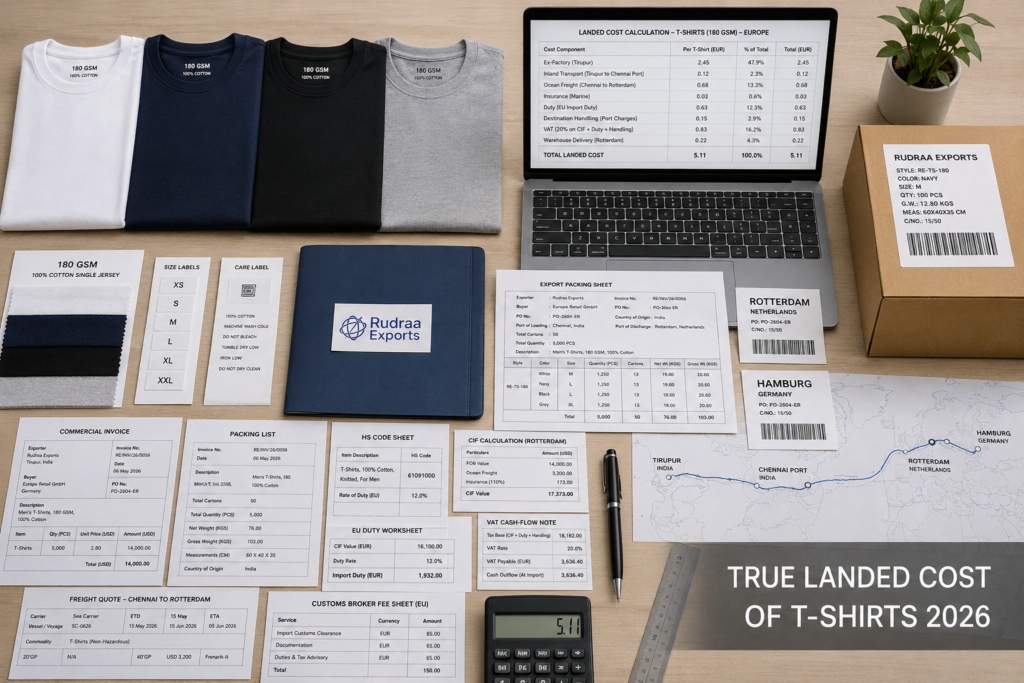
When European brands source T-shirts from Tirupur, the supplier’s ex-factory price is only the starting point.
A factory may quote €2.00 per T-shirt. But that does not mean your true cost is €2.00.
By the time the goods reach your warehouse in Europe, you may also pay for export handling, inland trucking, ocean freight, insurance, port charges, customs clearance, EU import duty, VAT cash flow, destination handling, and last-mile delivery.
That complete number is called landed cost.
For European fashion brands, DTC founders, corporate apparel buyers, and private-label companies, landed cost is the only number that should guide sourcing decisions. If you compare suppliers only by ex-factory price, you may choose the wrong supplier, wrong Incoterm, or wrong shipment structure.
At Rudraa Exports, we help European buyers understand the full cost of sourcing T-shirts from Tirupur, India, including factory price, export documentation, shipping options, customs assumptions, and landed-cost planning.
Quick Answer
The true landed cost of sourcing T-shirts from India includes the ex-factory garment price, export handling in India, inland movement to port, ocean freight, cargo insurance, EU customs duty, customs broker fees, destination handling, VAT cash-flow impact, and final delivery to the buyer’s warehouse. For European buyers importing from Tirupur to Rotterdam or Hamburg, landed cost can vary significantly depending on order volume, Incoterm, LCL vs FCL shipping, freight rates, duty classification, and VAT setup.
Planning to source T-shirts from Tirupur to Europe? Contact Rudraa Exports to request a landed-cost breakdown for your exact GSM, quantity, destination, and shipping mode.
What Landed Cost Really Means
Landed cost is the total cost to get sellable goods into your warehouse.
It is not only the factory price.
Landed Cost Includes
| Cost Area | What It Covers |
|---|---|
| Ex-factory price | Fabric, CMT, trims, basic packing |
| India inland transport | Tirupur to port or CFS |
| Export documentation | Invoice, packing list, shipping bill support |
| Port / CFS handling | Origin-side logistics handling |
| Ocean freight | LCL or FCL freight to Europe |
| Insurance | Cargo protection |
| Customs value | Value used for import duty calculation |
| EU import duty | Duty based on HS code and customs value |
| Customs broker | Clearance and document handling |
| Destination handling | Port, terminal, release, deconsolidation charges |
| Import VAT | Cash-flow impact if payable upfront |
| Last-mile delivery | Port to warehouse |
| Overlooked costs | Inspection, sampling, bank charges, FX spread |
The uploaded source highlights that ex-factory pricing does not include export documents, port handling, ocean freight, destination charges, duty, import VAT, and final delivery.
Why European Buyers Should Not Compare Only Ex-Factory Price
A low ex-factory price can look attractive, but it may hide expensive logistics or documentation gaps.
Example
Supplier A quotes €1.95 per T-shirt but gives unclear freight and export costs.
Supplier B quotes €2.10 per T-shirt but gives a transparent landed-cost structure.
Supplier B may still be safer because the buyer can see the real cost before placing the PO.
Common Surprises
- LCL minimum charges
- Port handling fees
- Destination handling fees
- Duty charged on freight-inclusive customs value
- Import VAT cash-flow impact
- Courier and sampling costs
- Bank charges and FX spread
- Freight surcharges
- Customs broker fees
- Demurrage or detention risk
A good sourcing decision needs the full picture.
Step 1: Start With the Factory-Gate Price
The factory-gate or ex-factory price is the base product cost.
For a Tirupur T-shirt, it usually includes:
- Fabric
- Cutting
- Stitching
- Finishing
- Basic trims
- Labels
- Packing
- Export carton packing
But every quote must be checked.
Ex-Factory Quote Checklist
| Item | Confirm With Supplier |
| Fabric GSM | 160, 180, 200, 220 GSM etc. |
| Fabric type | Combed cotton, carded cotton, organic cotton, blends |
| Dyeing | Included or separate |
| Printing | Screen print, DTG, heat transfer, embroidery |
| Labels | Main label, size label, care label |
| Packing | Polybag, carton, barcode, size sticker |
| Testing | Included or extra |
| MOQ | Per style, colour, and size |
| Incoterm | EXW, FOB, CIF, DDP |
| Port | Chennai, Tuticorin, Cochin |
Never compare two quotes unless the specification is the same.
Step 2: Add India Export-Side Costs
After production, the goods must move from Tirupur to the export port or container freight station.
Common origin-side costs include:
- Tirupur to Chennai / Tuticorin trucking
- Export documentation support
- Customs export handling
- CFS handling
- Forwarder service charges
- Port handling
- Container loading coordination
For smaller shipments, these costs can feel high because they are spread across fewer units.
Example
A €350 export handling cost spread across 1,000 pieces equals €0.35 per T-shirt.
The same type of cost spread across 5,000 pieces may be much lower per unit.
This is why volume matters in landed-cost planning.
Step 3: Choose LCL or FCL Shipping
Shipping mode has a big impact on landed cost.
LCL vs FCL
| Shipping Mode | Meaning | Best For |
| LCL | Less than container load | Small shipments |
| FCL | Full container load | Larger shipments |
| Air freight | Fast but expensive | Urgent top-ups |
| Split shipment | Part air, part sea | Launch deadlines |
LCL: Less Than Container Load
LCL is useful for small orders, but it often includes minimum charges, deconsolidation fees, and destination handling add-ons.
LCL may look cheap per cubic meter, but final charges can surprise buyers.
FCL: Full Container Load
FCL gives more control and usually fewer handling risks. It can be useful even when the shipment does not fully fill the container, especially when buyers want cleaner documentation, lower damage risk, and better control.
Step 4: Understand Ocean Freight Volatility
Ocean freight is not fixed.
It changes based on:
- Peak season
- Port congestion
- Carrier capacity
- Route disruption
- Fuel charges
- Emergency surcharges
- Container availability
- Demand from Asia to Europe
The uploaded source notes that South Asia to North Europe ocean freight rates in Q2 2026 were reported around $4,000–$5,500 per 40-foot container in market references, with upward pressure and carrier surcharges also affecting planning.
European buyers should treat freight as a variable line, not a fixed assumption.
Step 5: Calculate Customs Value Correctly
EU customs duty is not always applied only to the ex-factory value.
Customs value is usually closer to the CIF value.
CIF Means
Cost + Insurance + Freight
So duty may be calculated on:
- Goods value
- Freight to EU border
- Insurance
- Certain additions depending on Incoterm and customs rules
This is why a lower freight rate can reduce not only logistics cost, but also duty base.
Step 6: Add EU Import Duty
For many cotton knit T-shirts under HS 6109, EU third-country duty is commonly planned around 12%, depending on classification and current tariff rules.
Buyers must confirm final HS code and duty with their customs broker.
Common HS Code Areas
| Product | Possible HS Area |
| Cotton T-shirts | HS 6109 |
| Sweatshirts / pullovers | HS 6110 |
| Polo shirts | HS 6105 / 6106 depending on gender and construction |
| Kidswear | Depends on garment type |
| Synthetic blends | Different classification possible |
Classification matters. A wrong HS code can create duty errors, delays, or customs risk.
Step 7: Add Destination Charges in Europe
Once the shipment arrives in Rotterdam or Hamburg, destination charges may apply.
These can include:
- Terminal handling
- Container release fees
- Deconsolidation charges for LCL
- Port documentation fees
- Customs broker fees
- Local administrative fees
- Delivery appointment charges
- Warehouse receiving charges
These charges are often missed in early costing.
Example
A €250 destination handling charge on 1,000 pieces adds €0.25 per T-shirt.
A €350 destination charge on 5,000 pieces adds only €0.07 per T-shirt.
This is another reason larger shipments usually produce better landed cost.
Step 8: Understand Import VAT Cash Flow
Import VAT is different from customs duty.
For VAT-registered businesses, import VAT may often be recoverable, but it still affects cash flow if paid upfront.
VAT Examples
| Country | Standard VAT Rate |
| Netherlands | 21% |
| Germany | 19% |
| France | 20% |
| UK | 20% |
The uploaded source explains that many brands show landed cost excluding recoverable VAT for margin analysis, but include VAT for cash requirement planning.
That is the right approach.
Margin View vs Cash View
| View | Include VAT? | Why |
| Margin landed cost | Usually exclude recoverable VAT | Shows product economics |
| Cash planning | Include VAT if payable upfront | Shows working capital need |
For importers using Rotterdam, VAT deferment options may improve working capital if properly set up.
Step 9: Add Last-Mile Delivery
The shipment still needs to move from port to warehouse.
Last-mile costs depend on:
- Port
- Warehouse location
- Carton or pallet loading
- Delivery appointment
- Devanning
- LCL pickup
- 3PL requirements
- Local trucking rates
A buyer shipping to a Netherlands 3PL may choose Rotterdam, while a buyer shipping to a German warehouse may choose Hamburg or Rotterdam depending on freight, VAT setup, and inland trucking.
Step 10: Add Overlooked Costs
Some costs do not appear in the first supplier quote but still affect profitability.
Common Overlooked Costs
| Cost | Why It Matters |
| Pre-shipment inspection | Important for new suppliers |
| Sampling rounds | Adds courier and development cost |
| Lab dips | Needed for colour approval |
| Print strike-offs | Needed for logo or artwork approval |
| Testing | Shrinkage, colourfastness, RSL, OEKO-TEX |
| Bank charges | TT, LC, intermediary bank fees |
| FX spread | Currency conversion difference |
| Demurrage | Delays after container arrival |
| Detention | Late container return |
| Rework | Quality correction cost |
| Claims | Post-delivery defect risk |
A landed-cost sheet should include a risk reserve for these items.
Worked Example: 1,000 vs 5,000 T-Shirts
Below is a simplified landed-cost model for T-shirts shipped from Tirupur to Rotterdam or Hamburg.
These are planning numbers only. Actual costs depend on fabric, GSM, Incoterm, freight week, duty classification, warehouse location, and customs handling.
Assumptions
| Item | 1,000 pcs | 5,000 pcs |
| Ex-factory price | €2.20 / pc | €1.95 / pc |
| Shipping mode | LCL | FCL planning case |
| EU duty assumption | 12% | 12% |
| VAT shown separately | Yes | Yes |
Landed Cost Comparison
| Cost Line | 1,000 pcs Total | 1,000 pcs / pc | 5,000 pcs Total | 5,000 pcs / pc |
| Ex-factory goods value | €2,200 | €2.20 | €9,750 | €1.95 |
| India export handling + inland | €350 | €0.35 | €600 | €0.12 |
| Ocean freight | €304 | €0.30 | €2,210 | €0.44 |
| Cargo insurance | €7 | €0.01 | €29 | €0.01 |
| Customs value | €2,861 | €2.86 | €12,589 | €2.52 |
| EU duty at 12% | €343 | €0.34 | €1,511 | €0.30 |
| Customs broker + documents | €120 | €0.12 | €120 | €0.02 |
| Destination handling | €250 | €0.25 | €350 | €0.07 |
| Last-mile delivery | €180 | €0.18 | €450 | €0.09 |
| Landed cost excluding VAT | €3,734 | €3.73 | €15,370 | €3.07 |
| Import VAT cash-flow estimate | €672 | €0.67 | €2,947 | €0.59 |
| Cash out including VAT | €4,406 | €4.41 | €18,317 | €3.66 |
What This Shows
The landed cost excluding VAT falls from about €3.73 per piece at 1,000 pieces to about €3.07 per piece at 5,000 pieces.
That is a major improvement.
The biggest savings come from spreading fixed charges across more units, such as:
- Export handling
- Brokerage
- Destination handling
- Delivery setup
- Documentation fees
This is why volume planning is important in apparel sourcing.
Why MOQ and Shipment Size Affect Landed Cost
A small order may feel safer, but it often carries a higher landed cost per unit.
Small Order Advantages
- Lower inventory risk
- Easier testing
- Less cash locked in stock
- Useful for new brand validation
Small Order Disadvantages
- Higher logistics cost per unit
- Higher destination charges per unit
- Higher inspection cost per unit
- Less factory efficiency
- Lower price negotiation power
Larger Order Advantages
- Lower ex-factory price
- Better freight efficiency
- Lower fixed charges per unit
- Better supplier planning
- Stronger margin
Larger Order Disadvantages
- More inventory risk
- Higher total cash requirement
- Longer planning cycle
- More stock exposure
A smart buyer uses smaller quantities for testing and larger quantities for proven SKUs.
Break-Even Retail Price Formula
Once you know landed cost, you can calculate the minimum retail price needed to hit your target margin.
Formula
Retail price excluding VAT = landed cost excluding VAT ÷ (1 – target gross margin)
Example
If landed cost excluding VAT is €3.07 and your target gross margin is 65%:
€3.07 ÷ (1 – 0.65) = €8.77
So the brand needs at least €8.77 ex-VAT retail to hit 65% gross margin.
If selling in the Netherlands with 21% VAT:
€8.77 × 1.21 = €10.61 consumer price
This formula helps merchandising and procurement work together.
Incoterms: Why They Matter
Incoterms decide who is responsible for cost and risk at each stage.
Common Incoterms for Apparel Buyers
| Incoterm | What It Means |
| EXW | Buyer handles almost everything from factory |
| FOB | Supplier delivers goods to port/export point |
| CIF | Supplier includes cost, insurance, and freight to destination port |
| DAP | Supplier delivers to named destination, duty unpaid |
| DDP | Supplier delivers duty paid |
Best Practice
Ask for both FOB Chennai and CIF Rotterdam/Hamburg pricing.
This helps you separate:
- Product cost
- India export cost
- Freight cost
- Europe-side import cost
For most experienced buyers, FOB gives better freight control. For smaller buyers, CIF can feel simpler but must be checked carefully.
Landed-Cost Checklist for European Buyers
Use this before approving a PO.
| # | Checklist Item |
| 1 | Confirm product spec, GSM, fabric, trims, and packing |
| 2 | Confirm HS code with customs broker |
| 3 | Confirm Incoterm and named place |
| 4 | Separate ex-factory price from export and freight costs |
| 5 | Add Tirupur-to-port inland cost |
| 6 | Add export documentation and handling |
| 7 | Compare LCL vs FCL |
| 8 | Add freight surcharge buffer |
| 9 | Add cargo insurance |
| 10 | Calculate customs value |
| 11 | Apply EU duty rate |
| 12 | Add broker and clearance fees |
| 13 | Add destination handling |
| 14 | Add last-mile delivery |
| 15 | Show VAT separately for cash-flow planning |
| 16 | Add inspection cost |
| 17 | Add sampling and courier cost |
| 18 | Add bank and FX spread reserve |
| 19 | Add demurrage/detention risk reserve |
| 20 | Compare landed cost at 1k, 3k, 5k, and 10k quantities |
Why Rudraa Exports
Rudraa Exports helps European buyers source T-shirts and knitwear from Tirupur with clearer landed-cost planning.
Manufacturing Capabilities
- Factory-direct Tirupur knitwear manufacturing
- 72,000+ units per month production capacity
- T-shirts, polos, sweatshirts, hoodies, joggers, kidswear, babywear, uniforms, corporate apparel, and private-label basics
- MOQ discussions starting from around 300 pieces for suitable programs
- Sampling support for European buyers
- Bulk production planning for repeat programs
Landed-Cost Support
- Ex-factory price clarity
- FOB Chennai / Tuticorin / Cochin discussion
- CIF Rotterdam / Hamburg planning support
- Export documentation support
- Packing list and carton data support
- Freight option comparison
- HS code cooperation with buyer/customs broker
- AQL inspection support
- Shipment planning for LCL and FCL
Buyer Advantages
- Factory-direct pricing without trading-company markups
- Up to 40% cost-saving positioning compared with indirect sourcing models
- Transparent cost breakdowns
- Better planning for small and bulk orders
- Export support for Germany, Netherlands, France, Belgium, Denmark, Sweden, Norway, Finland, Italy, Spain, and wider EU markets
- Multi-port shipping through Chennai, Tuticorin, and Cochin
Ready to understand your real landed cost? Speak with Rudraa Exports to request a T-shirt landed-cost estimate for your exact GSM, quantity, destination port, and Incoterm.
FAQ: Landed Cost of Sourcing T-Shirts from India
1. What is landed cost in garment sourcing?
Landed cost is the total cost to get finished garments from the supplier to your warehouse, including product cost, freight, duty, customs fees, destination handling, VAT cash flow, and delivery.
2. Is ex-factory price the same as landed cost?
No. Ex-factory price usually covers the product at the factory level. Landed cost includes export, shipping, import, and warehouse delivery costs.
3. What is the EU duty on cotton T-shirts from India?
For many cotton knit T-shirts under HS 6109, European buyers commonly plan around 12% third-country duty, but final classification must be confirmed with a customs broker.
4. Should I ship T-shirts by LCL or FCL?
LCL is useful for smaller shipments, while FCL can give better control and fewer handling risks for larger orders. The best option depends on volume, timing, cost, and damage risk.
5. Why does landed cost fall when quantity increases?
Fixed costs such as export handling, brokerage, destination charges, and delivery are spread across more units, reducing cost per piece.
6. Should import VAT be included in landed cost?
For margin analysis, recoverable VAT is often shown separately. For cash-flow planning, VAT should be included if it must be paid upfront.
7. What is the best Incoterm for importing T-shirts from India?
FOB is often preferred by experienced buyers because it gives more freight control. CIF may be easier for smaller buyers but should be checked carefully for hidden costs.
8. What hidden costs should I watch for?
Watch for LCL minimums, destination handling, document fees, freight surcharges, demurrage, detention, inspection costs, sampling costs, bank fees, and FX spread.
9. Is Rotterdam or Hamburg better for importing from India?
Both can work. Rotterdam may offer VAT cash-flow advantages for some importers, while Hamburg may be better for German warehouse networks. The best port depends on your 3PL and customs setup.
10. Can Rudraa Exports help calculate landed cost?
Yes. Rudraa can help buyers compare ex-factory, FOB, CIF, LCL, FCL, destination port, and shipment-size scenarios for T-shirts and knitwear.
11. What order size gives better landed cost?
Larger orders usually reduce landed cost per unit, but they require more cash and stronger demand planning. Buyers should compare 1k, 3k, 5k, and 10k scenarios.
12. What is the safest way to start?
Start with a small controlled order to validate quality, then move proven SKUs into larger shipment sizes for better landed cost efficiency.
Conclusion
The true cost of sourcing T-shirts from India is not the ex-factory price. It is the full landed cost.
European buyers must include factory price, export handling, inland movement, ocean freight, insurance, duty, broker fees, destination handling, VAT cash flow, last-mile delivery, inspection, sampling, bank charges, and risk reserves.
Once all costs are visible, sourcing decisions become clearer. You can compare India against other origins fairly, choose the right Incoterm, select LCL or FCL wisely, and price your garments with confidence.
For T-shirts and knitwear, Tirupur remains one of India’s strongest sourcing hubs. With a transparent factory-direct partner, European brands can reduce uncertainty, avoid hidden costs, and build better landed-cost control from the first PO.
Visit rudraaexports.com or contact our team directly to share your T-shirt spec, GSM, quantity, destination port, and Incoterm — and receive a factory-direct landed-cost breakdown from Rudraa Exports.
Related reading
How to Import T-Shirts from Tirupur, India to Europe in 2026
Sourcing Cost Calculator 2026: Save Up to 40% on Garment Manufacturing