
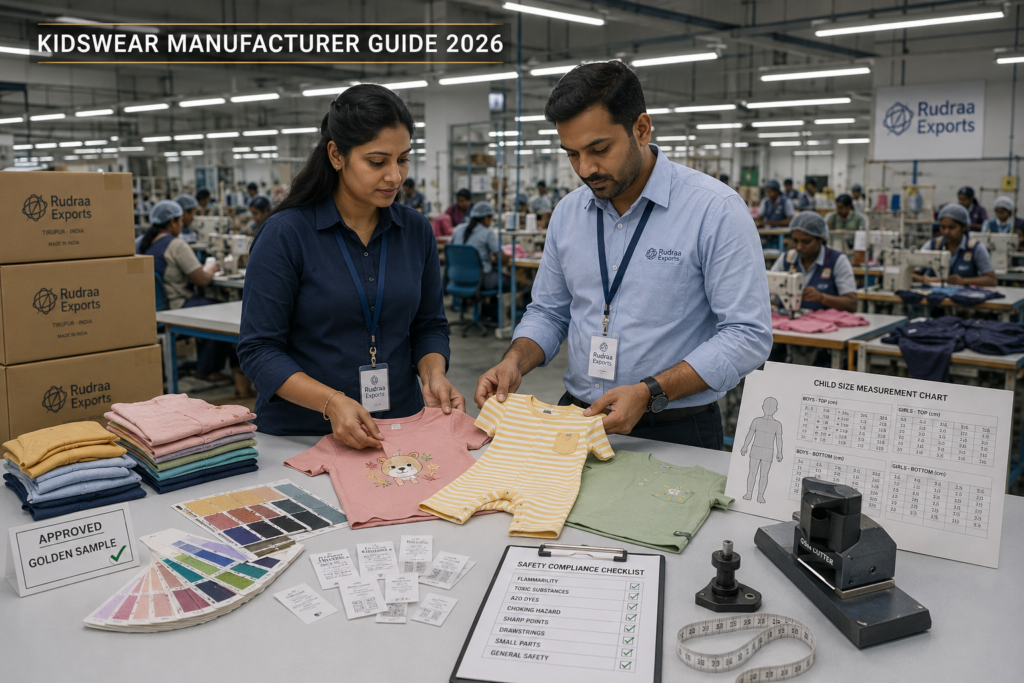
Finding the right kids clothing manufacturer in 2026 is not the same as finding a normal apparel supplier. Children’s clothing carries higher responsibility because the product is worn by infants, toddlers, and young children. That means safety, chemical compliance, flammability rules, labeling, traceability, testing, and documentation matter as much as fabric quality, MOQ, price, and lead time.
A new kidswear brand cannot afford to choose a factory only because it offers the lowest price. That is reckless. If the manufacturer cannot manage restricted substances, sleepwear flammability requirements, traceable materials, consistent sampling, and quality control, your brand can face failed tests, rejected shipments, customer complaints, retailer blocks, or even recalls.
At Rudraa Exports, we support buyers who need factory-direct Tirupur knitwear manufacturing with structured sampling, small-batch support, documentation discipline, and quality-focused production planning. This guide rewrites the uploaded kidswear manufacturer research into a practical 2026 framework for new children’s clothing brands that need the right manufacturing partner, not just a cheap supplier.
Quick Answer
New kids clothing brands should choose a manufacturer by checking product safety readiness, small-batch MOQ flexibility, sampling discipline, quality systems, testing support, certification scope, communication speed, and documentation control. For children’s apparel, buyers must define target markets first because U.S. CPSIA rules, children’s sleepwear flammability standards, EU GPSR expectations, REACH chemical restrictions, and Australia nightwear rules can affect fabric, trims, labels, and test requirements. The safest approach is to shortlist startup-friendly factories, send a detailed tech pack, verify certificates, approve samples carefully, and build a compliance-ready production file before bulk manufacturing.
Starting a kidswear line and need a factory-direct quote? Contact Rudraa Exports to share your product type, age range, fabric GSM, MOQ target, and destination market.
Why Kidswear Manufacturing Needs a Different Sourcing Process
Many first-time founders think children’s clothing is simple because the garments are small. That is wrong.
Kidswear can be more complicated than adult clothing because it involves safety-sensitive users, stricter chemical limits, flammability concerns, trims that may create hazards, comfort requirements, shrinkage control, and country-specific labeling rules. A baby romper, toddler pajama set, kids T-shirt, leggings set, or fleece sweatshirt may all require different testing and documentation depending on where it is sold.
The uploaded research makes a clear point: choosing a children’s clothing manufacturer is a safety, compliance, and brand-trust decision, not only a cost and capacity decision. It also notes that markets such as the U.S., EU, and Australia have specific safety and documentation expectations that brands must consider before production.
If you ignore these requirements in the beginning, you will pay for them later through delayed sampling, failed testing, relabeling, rejected inventory, or reputational damage.
The 5-Step Framework for Choosing a Kids Clothing Manufacturer
New brands should use a simple but strict framework.
| Step | What to Do | Why It Matters |
|---|---|---|
| 1 | Clarify product and compliance needs | Prevents unsafe design choices and wrong supplier quotes |
| 2 | Shortlist low-MOQ certified factories | Helps startups avoid oversized supplier systems |
| 3 | Vet sampling and QC systems | Predicts bulk production reliability |
| 4 | Ask high-signal questions | Reveals whether the factory understands kidswear risk |
| 5 | Build long-term improvement systems | Reduces defects and compliance gaps season by season |
This is not overkill. For kidswear, this is basic responsibility.
Tip 1: Clarify Your Product and Compliance Needs First
Before contacting any manufacturer, define exactly what you are making and where you will sell it.
A factory cannot quote properly if you do not know the age group, fabric, GSM, trims, print method, market, labeling needs, and required tests. Worse, the factory may quote a low price based on incomplete assumptions, then increase the cost later when compliance requirements appear.
Product Compliance Snapshot
| Product Type | Key Risk Area | Buyer Action |
|---|---|---|
| Baby rompers | Chemical safety, snaps, labeling, softness | Confirm fabric, trims, test needs, and label rules |
| Kids T-shirts | Print safety, shrinkage, colorfastness | Check dyes, inks, GSM, wash testing |
| Toddler pajamas | Flammability, fit, labeling | Treat sleepwear rules as a design constraint |
| Kids leggings | Stretch recovery, seams, chemical controls | Test fabric recovery, pilling, and colorfastness |
| Fleece sweatshirts | Brushing, shrinkage, lint, print durability | Test wash performance and material safety |
The uploaded document highlights that U.S. CPSIA limits, children’s sleepwear flammability rules, EU GPSR, REACH updates, and Australia’s children’s nightwear requirements can all affect kidswear sourcing.
What to Put in Your First Factory Brief
Your first factory brief should include:
✅ Target age range: infant, toddler, child, or youth
✅ Product category: T-shirts, rompers, leggings, sleepwear, sets
✅ Fabric type: cotton jersey, interlock, rib, fleece, terry
✅ GSM target
✅ Print or embroidery requirements
✅ Trim details: snaps, elastics, drawcords, labels
✅ Market: USA, EU, Australia, Middle East, or domestic
✅ Label requirements
✅ Testing requirements
✅ MOQ target
✅ Sampling deadline
✅ Bulk target date
If your brief is vague, your quotation will be unreliable. That is not the factory’s fault. It is poor buyer preparation.
Tip 2: Shortlist Factories That Support Small MOQs and Real Certification Workflows
For new kidswear brands, the biggest factory is usually not the best factory.
Large factories may have strong systems, but they may not prioritize small runs, multiple colorways, or founder-led sampling. New brands often need lower MOQs, sampling patience, clearer communication, and practical guidance.
The uploaded research states that Tirupur knitwear suppliers can commonly support startup-friendly MOQs in the range of around 300 pieces per style, depending on fabric, color, trims, and complexity. It also notes that sampling can often be around 7–10 days when specifications are clear.
That makes Tirupur a practical sourcing location for cotton knit kidswear such as T-shirts, rompers, leggings, and simple sets.
Low MOQ Does Not Mean Unlimited Flexibility
This is where many founders misunderstand manufacturing.
A factory may say “MOQ 300 pieces,” but that does not mean you can produce 50 pieces across 10 colors, 6 sizes, 3 fabric types, and custom trims at a low price.
MOQ is affected by:
| MOQ Driver | Why It Matters |
|---|---|
| Fabric dye lot | Custom colors usually require minimum dyeing quantity |
| Rib fabric | Neck/cuff rib may have separate minimums |
| Print setup | Screen printing has setup cost per color/artwork |
| Trims | Snaps, labels, elastics, and buttons may have vendor MOQs |
| Size range | Too many sizes increase cutting and production complexity |
| Packaging | Custom polybags, tags, and barcodes add minimums |
So ask for MOQ by component, not just MOQ per style.
A serious manufacturer will explain these limits instead of blindly saying yes to everything.
Tip 3: Vet Quality Systems and Sampling Processes
Kidswear quality failures are not only about loose threads. They can become safety and compliance failures.
A factory that changes fabric without approval, uses a different print supplier, loses material traceability, or skips proper inspection can put your brand at risk.
Sampling Stages for Kidswear
| Sample Stage | Purpose |
|---|---|
| Proto sample | Checks basic design feasibility |
| Fit sample | Confirms measurements and comfort |
| Size set sample | Checks grading across sizes |
| Pre-production sample | Final approval using actual fabric, trims, print, and labels |
| TOP sample | First output from bulk production |
The uploaded research recommends treating sampling as a process audit. That is correct. The way a factory handles sampling tells you how it will handle bulk. If the factory cannot explain sample steps clearly, bulk production will likely become chaotic.
Kidswear QC Gates
Use a simple three-gate system:
| QC Gate | What to Check |
|---|---|
| Pre-production | Final fabric, trims, measurements, labels, test plan |
| Inline inspection | Stitching, measurement, print, shade, defect trends |
| Final inspection | AQL, packing, labels, carton count, document pack |
For kidswear, also check restricted substance documentation, flammability requirements where applicable, and material traceability. A good sample is not enough if the factory cannot repeat it safely in bulk.
Tip 4: Ask the Right Questions Before You Trust the Factory
Bad factories often give confident answers. Good buyers ask questions that expose whether the supplier actually understands kidswear.
High-Signal Questions to Ask
| Question | What a Good Answer Should Include |
|---|---|
| How do you manage restricted substances for kidswear? | RSL, supplier declarations, test reports, material controls |
| Which lab do you use for testing? | Recognized lab names and style/lot-specific reports |
| Can you support CPSIA / REACH / market-specific requirements? | Specific documentation process, not vague “yes” |
| How do you handle sleepwear flammability? | Awareness of design, fabric, fit, and testing implications |
| What is your sampling process? | Proto, fit, PP, size set, TOP stages |
| What happens if bulk defects appear? | CAPA, root cause, rework, prevention |
| Can you provide recent QC formats? | Inspection forms, defect logs, measurement reports |
| Can you disclose subcontractors? | Clear list for dyeing, printing, embroidery, washing |
The uploaded guide warns that vague QC statements, inconsistent lab reports, slow communication, unclear MOQ logic, and overpromised lead times are serious red flags.
Be strict here. If a factory resists basic documentation before production, it will not magically become transparent after receiving your deposit.
Tip 5: Build a Long-Term Manufacturing Partnership
The best kidswear brands do not treat manufacturing as a one-time transaction. They build a repeatable system.
Start with a pilot order. Use it to test fit, wash performance, print durability, label placement, packing, and supplier communication.
Pilot Run Framework
| Pilot Element | Recommended Approach |
|---|---|
| Quantity | Start small but meaningful |
| Styles | Limit complexity |
| Colors | Keep color count controlled |
| Sizes | Use core size range first |
| Testing | Run wash, shrinkage, colorfastness, and safety checks |
| Feedback | Record defects and improvements |
| Repeat plan | Create Season 1 improvements from pilot data |
The uploaded research recommends a “Season 0 to Season 1” improvement plan, defect tracking, CAPA loops, and standardized documentation folders. That is exactly how small brands grow without repeating the same mistakes.
Kidswear Manufacturer Evaluation Scorecard
Use this before choosing a factory.
| Evaluation Area | Score 1–5 | What to Check |
|---|---|---|
| Kidswear experience | Similar products and age categories | |
| MOQ realism | MOQ by style, color, fabric, trim | |
| Sampling process | Clear stages and timelines | |
| Quality system | QC gates, AQL, defect tracking | |
| Testing support | Lab reports, test plan, documentation | |
| Compliance knowledge | CPSIA, REACH, GPSR, sleepwear rules where relevant | |
| Certifications | ISO, OEKO-TEX, GOTS, WRAP, BSCI, SMETA | |
| Traceability | Fabric lot, trim source, test report matching | |
| Communication | Response speed and clarity | |
| Export readiness | Labels, documents, shipment support |
Any supplier scoring poorly on testing, documentation, or communication should not be used for kidswear, even if the price is attractive.
Red Flags New Kidswear Brands Must Avoid
| Red Flag | Why It Is Dangerous |
|---|---|
| “No need for testing” | Shows poor safety awareness |
| Lab reports do not match your product | Traceability failure |
| No clear MOQ by component | Hidden costs later |
| No PP sample process | Bulk may drift from approved sample |
| No written QC checkpoints | Defects discovered too late |
| Overpromised lead time | Production delay risk |
| Refuses certificate sharing | Compliance risk |
| No subcontractor disclosure | Hidden production risk |
| Poor communication during sampling | Worse during bulk |
| Says yes to everything | Usually means they do not understand constraints |
The worst supplier is not always the one who says “no.” Sometimes the worst supplier is the one who says “yes” to everything without explaining risk.
What Certifications Should Kidswear Brands Look For?
Certifications depend on product category and target market.
| Certification / Standard | Why It Matters |
|---|---|
| ISO 9001 | Quality management system |
| OEKO-TEX STANDARD 100 | Harmful substance control for textile products |
| GOTS | Organic textile processing and chain-of-custody |
| GRS | Recycled material claims and chain-of-custody |
| BSCI | Social compliance benchmarking |
| SMETA | Ethical trade audit |
| WRAP | Responsible apparel production |
| SA8000 | Social accountability |
Certifications are useful, but only when the scope matches your order. A certificate for a fabric mill does not automatically cover the finished garment. A GOTS claim without transaction certificates is weak. OEKO-TEX must cover the relevant components.
What Tests Should Kidswear Brands Request?
Testing depends on market and product. But common tests include:
| Test | Why It Matters |
|---|---|
| Fiber composition | Confirms material claim |
| GSM | Confirms fabric weight |
| Shrinkage | Prevents fit complaints after wash |
| Colorfastness | Prevents fading and bleeding |
| Pilling | Checks long-term surface quality |
| Print durability | Checks cracking and peeling |
| Seam strength | Checks construction durability |
| Restricted substances | Helps meet chemical safety expectations |
| Flammability | Critical for sleepwear and applicable categories |
| Pull / attachment safety | Important for trims like snaps and buttons |
For kidswear, do not treat testing as optional. If your category or destination market requires it, build it into the quote, PO, and timeline.
Why Tirupur Works for New Kidswear Brands
Tirupur is a strong sourcing location for knitwear because it has a mature ecosystem for cotton jersey, rib, interlock, leggings, T-shirts, rompers, nightwear, and casual sets. The region has factories, fabric suppliers, dyeing units, printing vendors, finishing teams, packing support, and export documentation experience.
For new brands, the advantage is practical: you can often find manufacturers that understand small-batch knitwear while still having export capability.
Tirupur Advantage for Kidswear
| Advantage | Buyer Benefit |
|---|---|
| Knitwear specialization | Better fit for T-shirts, rompers, leggings, sets |
| Lower MOQ options | Useful for first drops |
| Faster sampling potential | Helps early-stage development |
| Fabric sourcing ecosystem | Easier fabric and GSM matching |
| Export experience | Better documentation support |
| Factory-direct options | Less communication loss |
But do not romanticize the cluster. Tirupur has good factories and weak factories. Your job is to separate them through documentation, sampling, and inspection discipline.
Why Rudraa Exports
Rudraa Exports is positioned for buyers who want factory-direct knitwear manufacturing from Tirupur with practical support for startup and growth-stage brands.
Manufacturing Capabilities
- Factory-direct Tirupur knitwear and T-shirt manufacturing
- 72,000+ units per month production capacity
- Kids T-shirts, rompers, leggings, sets, uniforms, and casual knitwear support depending on product requirements
- MOQs starting from around 300 pieces per style, depending on fabric, color, and customization
- Fabric sourcing, sampling, cutting, stitching, finishing, packing, and export documentation support
Quality and Compliance
- ISO 9001:2015 certified manufacturing approach
- AQL 2.5 inspection standards
- Support for buyer-defined quality checkpoints and test requirements
- Certification-aligned sourcing support for OEKO-TEX, GOTS, GRS, BSCI, SMETA, WRAP, and related buyer standards where applicable
- Practical QC workflow from sampling to bulk inspection
International Buyer Advantages
- Factory-direct pricing without trading-company markups
- Up to 40% cost-saving positioning compared with indirect sourcing models
- English-language communication for global buyers
- Export support for EU, USA, Australia, and Middle East buyers
- Multi-port shipping through Tuticorin VOC, Chennai, and Cochin
- FTA-eligible documentation support for relevant destination markets
Ready to discuss your children’s clothing line with a Tirupur factory team? Speak with Rudraa Exports for a structured sampling, MOQ, quality, and export discussion based on your product category and market.
FAQ: Kids Clothing Manufacturer Guide
1. How do I find the right kids clothing manufacturer?
Start by defining your product category, age range, destination market, fabric, GSM, trims, and testing requirements. Then shortlist factories that have kidswear experience, low-MOQ capability, sampling discipline, QC systems, and compliance documentation.
2. What is a reasonable MOQ for a new kidswear brand?
For knitwear in Tirupur, startup-friendly MOQs may commonly fall around 300 pieces per style, depending on fabric, color, trims, and print method. Always ask for MOQ by component, not only by style.
3. What certifications should a kids clothing manufacturer have?
Useful certifications may include ISO 9001, OEKO-TEX STANDARD 100, GOTS, GRS, BSCI, SMETA, WRAP, and SA8000, depending on your product and market. Always verify certificate scope, expiry, site address, and product relevance.
4. Is OEKO-TEX important for children’s clothing?
Yes, OEKO-TEX can be useful because it focuses on harmful substances in textile products. But buyers must confirm whether the certificate covers the actual fabric, trims, prints, labels, and components used in their order.
5. What tests are important for kidswear?
Important tests may include restricted substances, fiber composition, GSM, shrinkage, colorfastness, pilling, seam strength, print durability, flammability where applicable, and attachment safety for trims such as snaps or buttons.
6. How long does kidswear sampling take?
The uploaded research notes that Tirupur knitwear sampling is often around 7–10 days as a standard timeline when specifications are clear, with faster timelines sometimes possible depending on complexity and factory queue.
7. Why is sleepwear more sensitive than regular kids clothing?
Children’s sleepwear can trigger flammability requirements in some markets. Buyers should treat flammability as a design requirement from the start, not as a final-stage testing surprise.
8. What should I include in a kidswear tech pack?
Include sketches, measurements, tolerances, fabric composition, GSM, color references, print details, trims, labels, packaging, safety requirements, testing needs, and destination market rules.
9. Should I start with a pilot order?
Yes. A pilot order helps validate fit, fabric, shrinkage, print durability, packing, communication, and documentation before scaling. It is smarter than placing a large first order with an untested supplier.
10. What are the biggest red flags in kidswear manufacturing?
Red flags include vague testing answers, inconsistent lab reports, no traceability, no PP sample process, unclear MOQs, slow communication, refusal to share documents, and lack of subcontractor disclosure.
11. Can Tirupur manufacturers support small kidswear brands?
Yes, many Tirupur knitwear manufacturers can support small and mid-sized brands, especially for cotton knit categories such as T-shirts, rompers, leggings, and sets. But buyers must still verify capability and compliance.
12. Why choose Rudraa Exports for kidswear manufacturing?
Rudraa Exports is suitable for buyers who want factory-direct Tirupur knitwear manufacturing, startup-friendly MOQ discussions, structured sampling, QC checkpoints, export support, and communication without unnecessary trading-company layers.
Conclusion
Choosing a kids clothing manufacturer in 2026 requires more discipline than sourcing normal fashion basics. New brands must define product and compliance needs early, shortlist startup-friendly factories, verify certifications, inspect sampling systems, ask tough safety questions, and build long-term quality improvement processes. The right manufacturer will not simply say “yes.” The right manufacturer will help you understand MOQ limits, testing needs, material control, quality gates, and documentation requirements before bulk production starts.
If your range includes institutional or school wear, our overview of school uniform manufacturing standards in India explains the consistency, colourfastness, and sizing requirements that set uniform production apart.
Related guides: our complete guide to custom T-shirt manufacturing and the benefits of private-label manufacturing.
Visit rudraaexports.com or contact our team directly to share your kidswear product idea, target MOQ, fabric GSM, safety requirements, and destination market — and receive a factory-direct manufacturing quote built for serious children’s clothing brands in 2026.
Related reading
Women’s Clothing Manufacturer in India: Leggings, Nightwear and Casual Wear Sourcing Guide