
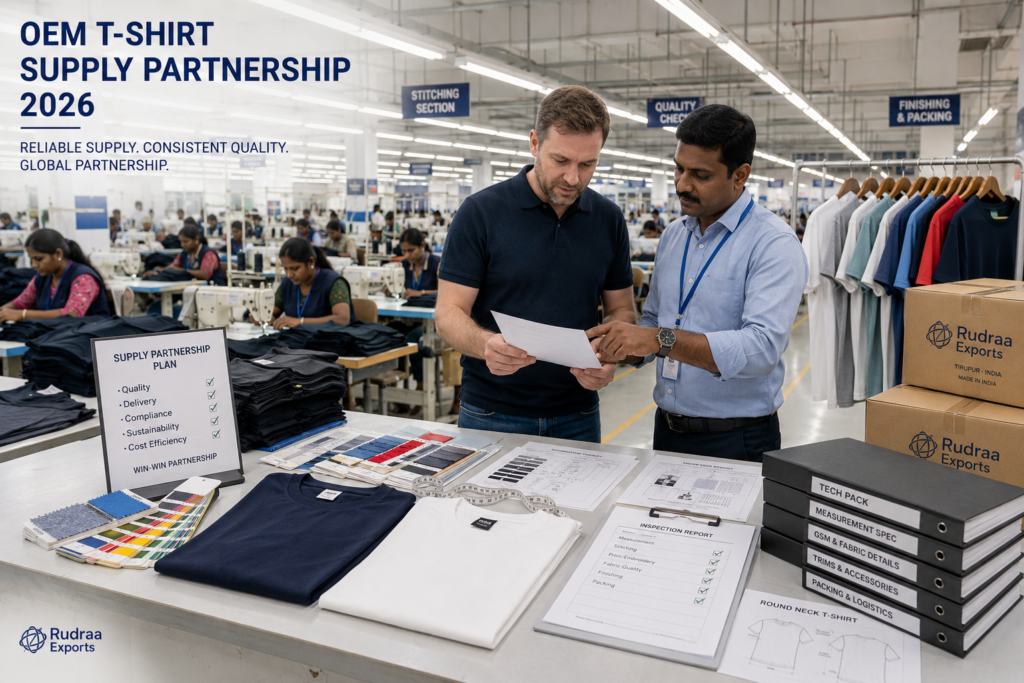
Starting a supply partnership with an OEM T-shirt manufacturer in 2026 is not just about finding a factory and asking for a price. That is how buyers end up with wrong GSM, late samples, unclear MOQs, weak contracts, failed inspections, and surprise shipping costs.
A proper T-shirt sourcing partnership needs a structured process: supplier shortlist, RFQ, quotation comparison, factory vetting, sampling, contracts, production approval, inspection, export documentation, and ongoing KPI tracking. If any step is skipped, the buyer carries the risk.
At Rudraa Exports, we support international buyers looking for factory-direct Tirupur T-shirt and knitwear manufacturing with clear RFQs, sampling support, quality control, export documentation, and long-term supply planning. This guide rewrites the uploaded supply partnership playbook into a practical 2026 buyer framework for starting an OEM men’s round-neck T-shirt manufacturing relationship.
Quick Answer
To start a T-shirt supply partnership in 2026, first create a clear product brief and timeline, then shortlist credible OEM manufacturers, send a structured RFQ, compare quotes, vet factory documents, confirm certifications, develop samples, sign a manufacturing agreement, approve a golden sample, run bulk production, inspect before shipment, and track supplier KPIs after delivery. A typical first-order timeline can take several weeks before bulk production, especially when sampling, testing, due diligence, and contract review are done properly.
Starting a new T-shirt sourcing program? Contact Rudraa Exports to share your tech pack, target quantity, fabric GSM, label requirements, and destination market.
First, Plan the Timeline Before Contacting Suppliers
Most buyers underestimate the time required to start a new T-shirt supply partnership. They assume the factory can quote today, sample tomorrow, and ship bulk in a few weeks. That is unrealistic unless the product is extremely standard and the buyer already has approved specs.
A serious first-order timeline includes supplier search, RFQ, due diligence, sampling, contracts, purchase order, production, inspection, and shipping.
| Stage | Typical Timeline | Buyer Action |
|---|---|---|
| Supplier shortlist and first contact | 1–2 weeks | Identify credible OEM factories |
| RFQ and quote comparison | 1–2 weeks | Compare price, MOQ, lead time, terms |
| Due diligence | 2–6 weeks | Check documents, certifications, references |
| Sampling | 3–8+ weeks | Proto, fit, PP, size set, TOP samples |
| Contract and PO | 1–3 weeks | Finalize agreement and purchase order |
| Bulk production | 20–45 days | Depends on fabric, quantity, print, approval speed |
| Final inspection and shipping prep | 1–2 weeks | FRI, packing, documents |
| Transit | Air 3–10 days, sea 20–45+ days | Depends on destination |
The uploaded document correctly warns that buyers should plan cost checkpoints too: sampling fees, courier charges, lab testing, production deposit, inspection fees, freight, insurance, and duties.
If you rush this process, you are not moving fast. You are creating expensive mistakes.
Step 1: Shortlist Credible OEM T-Shirt Manufacturers
The first step is not searching “cheap T-shirt supplier India” and messaging random vendors. That is low-quality sourcing.
Use higher-signal channels:
| Channel | Why It Helps |
|---|---|
| Industry directories | Useful for finding export-oriented manufacturers |
| Trade fairs | Better for meeting verified exporters directly |
| B2B supplier portals | Good for discovery, but still requires due diligence |
| Referrals | Useful when from trusted buyers |
| Factory websites | Shows positioning, certifications, products, and export readiness |
The uploaded source mentions industry directories, AEPC/ITPO trade networks, and supplier listings as discovery channels, while also making it clear that due diligence is still required. That is the correct approach.
What to Look for in a Shortlist
✅ Factory-direct manufacturer, not only a trader
✅ Experience with men’s round-neck T-shirts or similar knitwear
✅ Export market experience
✅ Clear production capacity
✅ Ability to share references or previous shipment evidence
✅ Certification and compliance documentation
✅ Sampling capability
✅ Transparent quotation format
✅ Responsive communication
✅ Willingness to explain process and limitations
Do not shortlist a supplier just because they reply fast. Fast replies mean nothing if the factory cannot prove capability.
Step 2: Send a Structured RFQ
A weak RFQ gets a weak quote. If you send “Need 1,000 cotton T-shirts, best price,” you deserve the messy pricing you receive.
A proper RFQ should include product, fabric, construction, print, size, quantity, quality, packaging, commercial terms, and expected timeline.
OEM T-Shirt RFQ Checklist
| RFQ Field | Details to Include |
|---|---|
| Product type | Men’s round-neck / crew neck T-shirt |
| Fabric | 100% cotton, CVC, polyester blend, organic cotton, etc. |
| GSM | Example: 160, 180, 200, 220 GSM |
| Knit type | Single jersey, pique, interlock, rib |
| Yarn | Combed, compact, ring-spun, carded |
| Construction | Neck rib, shoulder tape, stitch type, seam allowance |
| Color | Pantone references, number of colorways |
| Screen print, DTF, DTG, embroidery, placement size | |
| Sizes | S–XXL or custom size range |
| Measurements | POM chart with tolerance |
| Quantity | Total units and per color/size breakup |
| Quality | AQL level, defect classification, required tests |
| Packaging | Polybag, hangtag, barcode, carton marking |
| Commercial | FOB/CIF/DDP, payment terms, lead time |
| Destination | Country and port/warehouse location |
The uploaded document clearly states that an effective RFQ should include detailed specs such as fabric GSM, yarn composition, size range, colorways, print/embellishment, target volumes, and target prices, ideally with a tech pack.
Step 3: Compare Quotations Properly
Most buyers compare only the unit price. That is lazy and dangerous.
A quotation should include:
- Unit price
- Incoterm
- MOQ
- Sampling cost
- Sample lead time
- Bulk lead time
- Payment terms
- Packing details
- Testing cost
- Compliance document cost
- Freight assumptions if quoted CIF/DDP
- Price validity period
Quote Comparison Table
| Quote Element | Supplier A | Supplier B | Supplier C |
|---|---|---|---|
| Unit price | |||
| Incoterm | |||
| MOQ per style | |||
| MOQ per color | |||
| Sample cost | |||
| Sample lead time | |||
| Bulk lead time | |||
| Fabric included | |||
| Printing included | |||
| Labels included | |||
| Testing included | |||
| Packing included | |||
| Payment terms |
A lower unit price can become more expensive if labels, testing, packaging, inspection, or freight are excluded. So compare total landed cost, not only FOB.
Step 4: Vet the Factory Before Sampling Too Deep
Do not spend weeks on sampling with a factory you have not vetted. That wastes time.
Factory vetting should include documents and reality checks.
Core Documents to Request
| Document | Why It Matters |
|---|---|
| Legal entity name and address | Confirms who you are contracting with |
| GST / IEC / export registration | Confirms business legitimacy |
| Factory profile | Shows product range, capacity, team, machinery |
| Production capacity details | Helps verify order feasibility |
| Certification copies | Supports compliance screening |
| QC flow | Shows quality process |
| Recent inspection report | Shows actual quality documentation |
| Audit report summary | Shows compliance readiness |
| Subcontractor list | Reveals hidden risk |
The uploaded document highlights the need to verify legal entity, factory address, GST/IEC/export registration, ownership, own factory versus trader status, subcontracting policy, capacity calculation, and evidence for claimed capacity.
A supplier saying “72,000 pieces per month” should be able to explain line layout, shift pattern, machinery, historical shipment records, and current order load. If they cannot explain capacity, the number is just marketing.
Step 5: Verify Quality Management
“Export quality” is not a standard. It is a vague phrase suppliers use when they do not want to define measurable quality criteria.
A proper OEM T-shirt supplier should have a written QC system covering fabric inspection, inline inspection, end-line inspection, final inspection, measurement checks, defect classification, and corrective actions.
Quality Checks Buyers Should Ask For
| Quality Area | What to Verify |
|---|---|
| Fabric inspection | Holes, stains, GSM, shade, width |
| Inline inspection | Stitching defects during production |
| End-line inspection | Defects after sewing |
| Measurement check | POM versus tolerance |
| Print inspection | Placement, cracking, color, wash durability |
| Packing inspection | Labels, barcodes, carton count |
| Final random inspection | AQL-based shipment decision |
The uploaded document specifically notes inline and end-line inspection, AQL approach, fabric/garment testing, pilling, and colorfastness as important areas.
If a factory cannot share the last 3–6 months of internal QC reports or a recent final inspection format, that is a warning sign.
Step 6: Verify Certifications and Compliance
Certifications are useful only if they are valid, in scope, and relevant to your order.
For T-shirt sourcing, common certification and compliance references include:
| Standard / Audit | Why It Matters |
|---|---|
| ISO 9001:2015 | Quality management system |
| SA8000 | Social accountability and labor practices |
| SMETA | Ethical trade audit framework |
| WRAP | Responsible apparel production |
| GOTS | Organic textile chain-of-custody |
| OEKO-TEX | Product chemical safety |
| BSCI | Social compliance benchmarking |
Buyers should verify:
✅ Certificate number
✅ Legal entity name
✅ Factory address
✅ Expiry date
✅ Scope
✅ Product/process coverage
✅ Certifying body
✅ Latest audit summary
✅ Corrective action plan status
The uploaded source makes the same point: verify certifying body, scope, specific site/address, product category, processes, latest audit report summary, and CAP.
Do not trust certification logos pasted on a presentation. Ask for documents.
Step 7: Negotiate Commercial Terms
After RFQ and vetting, negotiate commercial terms.
The key terms include MOQ, pricing, Incoterm, lead time, payment method, sample cost, inspection responsibility, testing cost, and chargeback remedies.
Commercial Terms to Negotiate
| Term | What to Clarify |
|---|---|
| MOQ | Per style, color, and size ratio |
| Price | FOB/CIF/DDP, inclusions and exclusions |
| Lead time | From PP approval and deposit, not from discussion date |
| Payment | Advance, balance trigger, LC, escrow, TT |
| Sampling | Cost, timeline, revision rounds |
| Packaging | Included or extra |
| Testing | Buyer-paid or supplier-paid |
| Inspection | Who pays if inspection fails |
| Defects | Rework, discount, rejection, replacement |
| Late delivery | Penalty or air-freight responsibility |
The uploaded document recommends negotiating MOQ at multiple levels and asking for a trial order at slightly higher unit cost if the buyer is smaller. This is practical.
Step 8: Draft and Sign the Right Contracts
A proforma invoice is not enough. It usually does not protect quality, IP, delivery, inspection, subcontracting, or post-delivery claims.
A professional supply partnership needs:
- Master Manufacturing or Supply Agreement
- NDA and IP clauses
- Quality Agreement or QC Manual
- Purchase Order for each production run
Contract Clauses Buyers Should Include
| Clause | Purpose |
|---|---|
| Scope and specifications | Locks tech pack, BOM, measurements, packaging |
| Quality standard | Defines AQL, tests, tolerances, defect types |
| Testing and compliance | Defines required lab tests and documents |
| Inspection rights | Allows IPC, DUPRO, FRI, third-party inspection |
| Remedies | Rework, discount, rejection, replacement |
| Warranty / claims window | Protects against latent defects |
| IP ownership | Protects logos, artwork, labels, patterns |
| Subcontracting control | Prevents hidden production risk |
| Ethical compliance | Links supplier to labor and safety expectations |
| Dispute resolution | Defines escalation and legal path |
The uploaded document is blunt on this point: relying only on proforma invoices is a common pitfall because they rarely include enforceable quality remedies and IP protections.
That is correct. A proforma invoice confirms a sale; it does not build a supply partnership.
Step 9: Develop Samples and Create a Golden Reference
Sampling is where the product becomes real. Do not rush it.
Common sample stages include:
| Sample Type | Purpose |
|---|---|
| Prototype sample | Checks feasibility |
| Fit sample | Checks measurement and silhouette |
| Pre-production sample | Final fabric, trims, labels, print |
| Size set sample | Checks grading across sizes |
| TOP sample | Checks first bulk output |
The uploaded source recommends keeping a sealed and signed PP sample as the “golden sample.” This is essential because it becomes the reference point for inspections and disputes.
Without a golden sample, arguments become subjective:
- Buyer says shade is wrong.
- Factory says shade is acceptable.
- Buyer says fit changed.
- Factory says it is within normal range.
A sealed sample prevents this.
Step 10: Control Changes During Production
Spec drift is a real problem in apparel production.
Suppliers may substitute fabric, trims, rib, labels, thread, print method, or packaging if something is unavailable or delayed. Sometimes this is done without bad intent, but it can still damage the buyer’s product.
Use written change control.
✅ No fabric substitution without approval
✅ No trim substitution without approval
✅ No shade change without approval
✅ No print placement change without approval
✅ No packaging change without approval
✅ No subcontracting without approval
Every change request should include cost impact, time impact, and buyer approval.
Step 11: Run Pre-Shipment Inspections
Do not rely only on final product photos from the factory. Photos are not inspection.
A proper inspection program may include:
| Inspection Stage | Timing | Purpose |
|---|---|---|
| IPC | Early production | Catch setup issues |
| DUPRO | During production | Catch defects before full production finishes |
| FRI | Final random inspection | Decide shipment acceptance |
The uploaded document warns that skipping IPC/DUPRO and relying only on final inspection creates late discovery, expensive rework, and shipment delays. That is exactly right.
Final inspection should verify quantity, assortment, carton counts, measurements, visual defects, shade consistency, print alignment, labels, carton marking, packaging, and AQL acceptance.
Step 12: Manage Export Logistics and Documents
Before shipment, confirm who is responsible for freight and documents.
Common export documents include:
- Commercial invoice
- Packing list
- Bill of Lading or Air Waybill
- Certificate of Origin
- Inspection report
- Test reports
- Compliance declarations
- Insurance certificate if applicable
- Buyer-specific customs or retailer documents
The uploaded source recommends asking for draft documents 48–72 hours before shipment to catch errors in HS codes, consignee details, carton counts, and other shipment information. This is a smart habit.
Document mistakes can delay customs clearance even when the goods are ready.
Step 13: Build a Country-by-Country Compliance Matrix
A T-shirt going to the USA, EU, Australia, and the Middle East may need different labeling and compliance documents.
| Market | Planning Requirements |
|---|---|
| EU / EEA | Fiber composition, country of origin, care labeling, REACH/RSL expectations |
| USA | Fiber content label, country of origin, care label, flammability considerations |
| Australia | Fiber content, care labeling, supplier declarations |
| Middle East | Arabic/English labeling may be needed depending on destination |
| Global retail | Test reports, inspection reports, supplier declarations, audit documents |
The uploaded guide correctly says that market-specific rules should be validated against official regulator guidance. That is important because labeling and import rules can change.
Step 14: Set Weekly Communication and KPIs
Once bulk production begins, do not wait silently until shipment week.
A good supplier should provide weekly updates on:
- Fabric status
- Cutting quantity
- Sewing output
- Inline defects
- Finishing status
- Packing status
- Inspection readiness
- Document readiness
- Shipment schedule
Use a KPI scorecard after each order.
| KPI Area | Metric |
|---|---|
| Quality | First-time inspection pass rate |
| Quality | Defects per hundred units |
| Delivery | On-time ex-factory rate |
| Delivery | Lead-time adherence |
| Cost | Price stability versus quotation |
| Compliance | Certificate validity and CAP closure |
| Communication | Response speed and issue transparency |
This turns sourcing from a one-time purchase into a professional supplier relationship.
Common Pitfalls Buyers Must Avoid
| Pitfall | Consequence | Fix |
|---|---|---|
| Incomplete RFQ | Wrong pricing | Use detailed tech pack and specs |
| No sample stages | Bulk quality drift | Follow proto, fit, PP, size set, TOP |
| No certificate verification | False compliance comfort | Verify scope, site, expiry, audit outcomes |
| No AQL definition | Shipment disputes | Define AQL and defect classification |
| Only final inspection | Late defect discovery | Add IPC and DUPRO |
| Unclear Incoterms | Hidden landed cost | Compare FOB and CIF clearly |
| No contract | Weak legal protection | Use supply agreement and QC annex |
| No golden sample | Subjective disputes | Seal and sign PP sample |
| No change control | Spec drift | Require written approvals |
| No KPI tracking | Repeated problems | Score suppliers after every order |
Why Rudraa Exports
Rudraa Exports is suitable for buyers who want a structured OEM T-shirt supply partnership from Tirupur instead of one-off transactional sourcing.
Manufacturing Capabilities
- Factory-direct Tirupur T-shirt and knitwear manufacturing
- 72,000+ units per month production capacity
- MOQs starting from around 300 pieces per style, depending on product and customization
- Custom men’s round-neck T-shirts, polos, uniforms, activewear, sportswear, and private-label knitwear
- Fabric sourcing, sampling, cutting, stitching, finishing, packing, and export documentation support
Quality and Compliance
- ISO 9001:2015 certified manufacturing approach
- AQL 2.5 inspection standards
- Support for buyer-aligned inspection plans and documentation
- Capability to support compliance-aligned sourcing requirements such as OEKO-TEX, GOTS, GRS, BSCI, SMETA, WRAP, and related buyer standards where applicable
- Practical process control from RFQ to sampling, production, inspection, and shipping
International Buyer Advantages
- Factory-direct pricing without trading-company markups
- Up to 40% cost-saving positioning compared with indirect sourcing models
- English-language communication for global buyers
- Export support for EU, US, Australia, and Middle East markets
- Multi-port shipping support through Tuticorin VOC, Chennai, and Cochin
- FTA-eligible documentation support for relevant markets
Ready to build a proper OEM T-shirt supply partnership? Speak with Rudraa Exports for a structured RFQ, sampling, production, and export quotation based on your tech pack and destination market.
FAQ: Starting a T-Shirt Supply Partnership
1. How do I start working with an OEM T-shirt manufacturer?
Start with a clear product brief, tech pack, quantity plan, and target market. Then shortlist manufacturers, send RFQs, compare quotations, verify documents, develop samples, sign contracts, and approve a golden sample before bulk production.
2. What should I include in a T-shirt RFQ?
Include product type, fabric composition, GSM, yarn type, colorways, print method, size range, measurement chart, quantity, packaging, quality requirements, Incoterms, payment terms, and destination market. A vague RFQ produces unreliable pricing.
3. How long does it take to start a first T-shirt order?
A first order can take several weeks before bulk production because supplier vetting, quote comparison, sampling, testing, contract review, and PO approval take time. Bulk production for knit T-shirts may take around 20–45 days after approvals, depending on complexity.
4. What documents should I request from a T-shirt factory?
Ask for the factory profile, legal registration, GST/IEC details, export registration, certification copies, QC flow, recent inspection reports, audit summaries, capacity details, and subcontractor disclosure.
5. What is a golden sample?
A golden sample is the final approved pre-production sample, sealed and signed by buyer and supplier. It becomes the reference for bulk production, inspections, and dispute resolution.
6. Is a proforma invoice enough to start production?
No. A proforma invoice is not enough for serious sourcing. Buyers should use a manufacturing agreement, NDA/IP clauses, quality agreement, and purchase order with clear specs, inspection rules, remedies, and delivery terms.
7. What inspections should I use for T-shirt production?
Use initial production check, during production inspection, and final random inspection where possible. For smaller orders, at minimum use a final inspection based on AQL and clear defect classifications.
8. How do I avoid quality problems in bulk production?
Use a detailed tech pack, approved samples, written tolerances, AQL standards, inline checks, final inspection, and written change control. Never allow fabric, trim, or print changes without approval.
9. What payment terms are common for OEM T-shirt orders?
Common terms include wire transfer deposit and balance after inspection or against shipping documents. Larger buyers may use letters of credit, while mature supplier relationships may move toward open account terms.
10. Why is supplier due diligence important?
Due diligence confirms whether the factory is real, capable, compliant, and suitable for your order. It reduces the risk of fake capacity claims, poor quality systems, hidden subcontracting, and weak documentation.
11. Can small brands work with Tirupur T-shirt manufacturers?
Yes, but they need clear specs and realistic expectations. Some factories support smaller MOQs at higher unit costs, especially if there is a written plan to scale future orders.
12. Why choose Rudraa Exports for OEM T-shirt manufacturing?
Rudraa Exports is suitable for buyers who want factory-direct Tirupur manufacturing, structured RFQ support, sampling, quality control, export documentation, and communication without unnecessary trading-company layers.
Conclusion
Starting a T-shirt supply partnership in 2026 requires structure. A serious buyer should not jump from WhatsApp enquiry to purchase order without RFQ discipline, supplier vetting, sample control, contract protection, inspection planning, and export documentation checks. The safest path is simple: define the product clearly, verify the factory, approve samples properly, lock contract terms, inspect before shipment, and track supplier performance after delivery.
Before committing to a partner, it helps to understand exactly how an order is run. Our design-to-delivery manufacturing process walks through each stage from consultation to shipment.
Related guides: the typical manufacturer payment terms and how Rudraa Exports compares to other suppliers.
Visit rudraaexports.com or contact our team directly to share your tech pack, target MOQ, fabric GSM, label requirements, and destination market — and build a factory-direct OEM T-shirt supply partnership for 2026.