
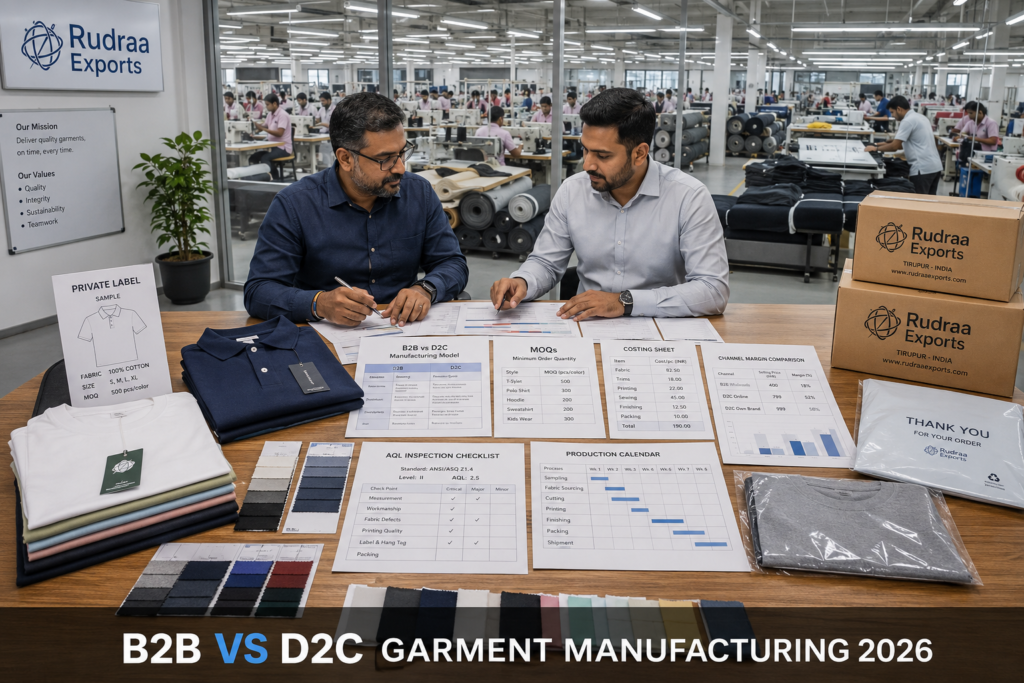
Choosing between B2B and D2C garment manufacturing in 2026 is not just a branding decision. It is an operational strategy decision. The model you choose affects MOQ, unit cost, working capital, inventory risk, fulfillment complexity, quality systems, compliance, and how fast you can scale.
B2B garment manufacturing is built around bulk orders, wholesale programs, uniforms, institutional buyers, export buyers, and repeat supply. D2C garment manufacturing is built around consumer-facing brands, smaller drops, direct customer relationships, online sales, and stronger brand control. Both models can work, but they demand different systems.
The uploaded research explains this clearly: sourcing and procurement leaders must decide whether they are optimizing for predictable volume through B2B manufacturing or end-customer control through D2C. For founders, the key question is whether they want margin potential first or operational survivability first.
At Rudraa Exports, we support both paths: factory-direct bulk production for B2B buyers and flexible OEM/ODM production support for D2C brands testing and scaling repeat drops.
Quick Answer
B2B garment manufacturing works better for buyers who need predictable volume, lower unit costs, compliance documentation, quality consistency, and repeat supply. D2C garment manufacturing works better for founders who have strong brand demand, community-led sales, tighter product storytelling, and the ability to manage CAC, fulfillment, returns, and inventory risk. In 2026, the safest model for many brands is hybrid: use D2C to test demand, then use B2B or wholesale-style manufacturing to scale proven SKUs with stronger production efficiency.
Planning a B2B bulk program or D2C apparel drop? Contact Rudraa Exports to share your product category, MOQ, fabric, target market, and launch timeline.
What Is B2B Garment Manufacturing?
B2B garment manufacturing means producing apparel for another business, not directly for the final consumer.
Common B2B buyers include:
- Wholesalers
- Corporate uniform buyers
- Retail chains
- Export buyers
- Sports clubs
- Schools and colleges
- Hospitality groups
- Healthcare uniforms
- Promotional merchandise companies
- Private-label brands
- Buying offices
- Institutional procurement teams
B2B manufacturing usually focuses on bulk production, repeatability, cost efficiency, documentation, compliance, delivery accuracy, and quality consistency.
What Is D2C Garment Manufacturing?
D2C means Direct-to-Consumer. In this model, the apparel brand sells directly to customers through its own website, marketplace store, social media, pop-ups, or community channels.
D2C brands usually focus on:
- Brand storytelling
- Smaller drops
- High perceived value
- Faster product testing
- Customer data ownership
- Community building
- Premium packaging
- Social media marketing
- Repeat customer retention
- Influencer-led demand
D2C can create better gross margin potential, but it also adds marketing, fulfillment, returns, inventory, customer service, and cash-flow pressure.
B2B vs D2C Garment Manufacturing: Comparison Table
| Criteria | B2B Garment Manufacturing | D2C Garment Manufacturing |
|---|---|---|
| Primary goal | Predictable volume and delivery | Brand control and customer ownership |
| Buyer type | Businesses, wholesalers, institutions | End consumers |
| Order size | Medium to large | Small to medium, unless scaled |
| MOQ | Usually higher | Usually lower or staged |
| Unit cost | Lower at scale | Higher in small drops |
| Margin structure | Lower margin, higher volume | Higher gross margin, higher operating cost |
| Marketing cost | Low | High |
| Fulfillment | Bulk cartons, pallets, export shipments | Individual pick-pack-ship |
| Inventory risk | Often shared or shifted to buyer | Owned by brand |
| Cash-flow issue | Receivables and payment terms | Inventory, CAC, and returns |
| Quality pressure | Compliance and audit driven | Customer review driven |
| Scalability | Strong with repeat programs | Strong only if CAC and inventory are controlled |
| Best for | Stable demand and repeat SKUs | Differentiated brands and niche communities |
The uploaded file notes that B2B manufacturing prioritizes capacity utilization, on-time delivery, and compliance, while D2C prioritizes demand creation, brand experience, and cash efficiency.
Cost Difference: FOB Cost Is Not the Full Story
Many founders compare only factory price. That is a mistake.
A T-shirt may cost a similar amount to manufacture whether it is sold B2B or D2C. But the operating model changes the real cost.
The uploaded research gives manufacturing cost benchmarks such as India tees around $2.70–$5.50 per unit depending on quality and order size, and Bangladesh large-order FOB tees around $2.50–$3.50 for 10,000+ units. But it also explains that D2C adds structural costs such as customer acquisition, fulfillment, returns, packaging, and inventory risk.
Cost Stack Comparison
| Cost Area | B2B | D2C |
|---|---|---|
| Manufacturing | Lower at scale | Higher for small batches |
| Sampling | Structured, often planned by season | Frequent due to drops |
| Packaging | Bulk or buyer-specific | Branded individual packaging |
| Marketing | Sales-led, lower per unit | Paid ads, influencers, content |
| Fulfillment | Bulk shipment | Per-order pick, pack, ship |
| Returns | Usually B2B claim-based | Consumer returns and exchanges |
| Customer support | Lower | Higher |
| Inventory holding | Lower if PO-backed | Higher if demand is uncertain |
So D2C may look more profitable at gross margin level but can become cash-negative if customer acquisition and fulfillment costs are not controlled.
Margin Difference: B2B Stability vs D2C Upside
B2B usually has lower margin percentage but higher predictability. D2C usually has higher gross margin potential but higher operating risk.
The uploaded research states that wholesale trading environments often operate around 25–35% margins, while D2C brands may target 60–70% gross margins, but must fund CAC, returns, and fulfillment.
Margin Reality Table
| Model | Margin Potential | Risk |
|---|---|---|
| B2B | Lower margin percentage | Payment terms and compliance risk |
| D2C | Higher gross margin percentage | CAC, returns, inventory, fulfillment |
| Hybrid | Balanced | Needs operational discipline |
A founder should not choose D2C only because the gross margin looks attractive. If paid acquisition is expensive and inventory sits too long, the business can struggle even with high gross margin.
Working Capital: DIO vs DSO
This is one of the biggest differences.
B2B and D2C create different cash-flow pain.
B2B Cash-Flow Pain: DSO
B2B buyers may pay on credit terms. That creates Days Sales Outstanding, or DSO. The uploaded research notes wholesale DSO can often sit around 45–60 days, with Net 60 becoming common in some cases.
This means you may produce, ship, invoice, and then wait to get paid.
D2C Cash-Flow Pain: DIO
D2C brands usually buy inventory before selling it. That creates Days Inventory Outstanding, or DIO. The uploaded research mentions D2C inventory guidance around 129 days DIO as a reference point.
This means your money can sit inside unsold stock for months.
Cash-Flow Comparison
| Model | Main Cash Risk | What It Means |
|---|---|---|
| B2B | DSO | Waiting for buyer payment |
| D2C | DIO | Cash stuck in inventory |
| Hybrid | Both | Must manage payment and inventory cycles |
B2B feels stable because demand is clearer. D2C feels flexible but can become fragile if inventory does not move.
Inventory Risk: Who Owns the Mistake?
In B2B, the buyer often commits through purchase orders, forecasts, or contracts. The manufacturer’s risk is execution: quality, timing, documentation, and compliance.
In D2C, the brand owns the demand risk. If the collection does not sell, the stock remains with the brand.
The uploaded research highlights that unsold stock can reach around 20–30% per season for many fashion businesses.
Inventory Risk Comparison
| Situation | B2B Impact | D2C Impact |
|---|---|---|
| Wrong colour selection | Buyer may still take PO if approved | Brand may be stuck with dead stock |
| Overproduction | Usually based on buyer PO | Direct brand owns excess |
| Poor demand forecast | Buyer problem | Brand problem |
| Size curve mistake | Claim or chargeback risk | Returns and exchange risk |
| Trend miss | Lower if SKU is institutional | High for fashion drops |
D2C rewards demand accuracy and punishes optimism.
Marketing and Fulfillment Complexity
B2B is mostly sales-led. D2C is demand-generation led.
A B2B manufacturer or brand builds relationships, attends trade shows, responds to RFQs, manages compliance packs, and delivers repeat orders. A D2C brand must build traffic, convert customers, manage ads, create content, handle customer service, ship individual orders, and process returns.
The uploaded research cites fashion/apparel CAC around $61–$66 per customer and fulfillment costs around $10–$17 per order.
D2C Cost Pressure
| D2C Cost | Why It Matters |
|---|---|
| CAC | Paid acquisition can destroy margin |
| Fulfillment | Every order needs picking, packing, and shipping |
| Returns | Apparel fit issues create cost |
| Customer support | Exchanges and complaints need handling |
| Packaging | Premium packaging adds cost |
| Inventory | Unsold stock locks cash |
If a brand sells a $35 T-shirt but pays high CAC and fulfillment, profit can disappear quickly.
Quality Control: Different Pressure, Same Importance
Both models need quality control, but the pressure comes from different sides.
B2B Quality Pressure
B2B buyers usually require:
- AQL inspection
- Compliance documents
- Sample approvals
- Lab tests where needed
- Size and measurement reports
- Packing accuracy
- On-time delivery
- Chargeback prevention
- Social audit readiness
D2C Quality Pressure
D2C customers may not ask for audit documents, but they react publicly.
Poor quality can lead to:
- Bad reviews
- Returns
- Instagram complaints
- Low repeat purchase
- Influencer backlash
- Customer service overload
- Brand trust loss
The uploaded guide notes that customer reviews amplify defects fast in D2C, while B2B quality is usually enforced through audits, AQL, documentation, and consistency.
Which Model Should You Choose?
Choose B2B Garment Manufacturing If:
- You have repeatable SKUs
- You sell to wholesalers, corporate buyers, or institutions
- You can handle compliance requirements
- You prioritize predictable volume
- You want lower unit costs at scale
- You can manage payment terms
- You need structured production planning
- You want stable supplier relationships
Choose D2C Garment Manufacturing If:
- You have a strong brand story
- You can create demand efficiently
- You have community-led growth
- You need small drops for testing
- You want customer data and brand control
- You can manage fulfillment and returns
- You can handle inventory risk
- You can keep CAC under control
Choose Hybrid If:
- You want to test through D2C and scale through B2B
- You have proven hero SKUs
- You want retail/wholesale plus online sales
- You need both small drops and bulk production
- You want to reduce channel dependence
- You can manage separate pricing and inventory systems
The uploaded research says hybrid strategies are increasingly common as brands rebalance channels.
B2B vs D2C Decision Matrix
| Your Situation | Recommended Model |
|---|---|
| You have confirmed bulk buyers | B2B |
| You are testing a new fashion concept | D2C |
| You have strong community demand | D2C |
| You need stable repeat orders | B2B |
| You have 2–5 proven hero SKUs | Hybrid |
| You cannot afford high CAC | B2B or organic-led D2C |
| You cannot handle large inventory | D2C low-MOQ test or B2B PO-backed production |
| You need compliance-heavy buyers | B2B |
| You want full customer relationship | D2C |
| You want predictable factory planning | B2B |
Mini Case: Indian D2C Athleisure Startup
A Bengaluru athleisure founder launches leggings and sports bras through Instagram. Manufacturing cost is manageable, but the brand struggles with CAC, fulfillment cost, and inventory spread across too many styles.
The uploaded research describes this classic D2C challenge: CAC benchmarks, fulfillment cost, and inventory exposure can hurt cash flow even when the product margin looks strong. The solution is to tighten the SKU base, focus on hero products, and work with a manufacturer that can support smaller repeat production without sacrificing QC.
Lesson
D2C works best when demand is proven and replenishment is disciplined.
Mini Case: European B2B Wholesaler
A European wholesaler supplies retailers and corporate buyers. The business succeeds when suppliers deliver repeatable quality, on-time shipments, and seasonal capacity. The risk is receivables timing, chargebacks, and documentation errors.
The uploaded research notes that wholesalers still represent a large share of industry sales flows and that B2B models often depend on repeatable quality, on-time shipments, and receivables management.
Lesson
B2B works best when production systems, compliance, and delivery are reliable.
Transition Plan: D2C to B2B or B2B to D2C
Brands do not need to stay locked into one model forever.
6-Step Transition Plan
| Step | Action |
|---|---|
| 1 | Choose 2–5 anchor SKUs |
| 2 | Rebuild costing by channel |
| 3 | Pilot production before scaling |
| 4 | Align QC and compliance documentation |
| 5 | Negotiate both capacity and flexibility |
| 6 | Review KPIs every 90 days |
The uploaded guide recommends a similar six-step transition plan, including anchor SKUs, channel costing, pilot orders, QC documentation, capacity planning, and a 90-day KPI loop.
KPIs to Track
| Model | KPI |
|---|---|
| B2B | OTIF, defect rate, chargebacks, DSO, repeat orders |
| D2C | CAC, return rate, inventory days, sell-through, repeat purchase |
| Hybrid | Channel margin, reorder speed, stock split, cash conversion |
Why Rudraa Exports
Rudraa Exports is positioned for both B2B buyers and D2C brands that need a manufacturing partner with bulk capacity, flexible production thinking, and structured quality controls.
Manufacturing Capabilities
- Factory-direct Tirupur T-shirt and knitwear manufacturing
- 72,000+ units per month production capacity
- Support for B2B bulk programs, corporate uniforms, private-label apparel, D2C drops, sportswear, kidswear, and repeat SKUs
- MOQs starting from around 300 pieces per style, depending on fabric, colour, logo method, and customization
- OEM/ODM support for fabric selection, sampling, fit, logo methods, labels, packing, and export documentation
Quality and Compliance
- ISO 9001:2015 certified manufacturing approach
- AQL 2.5 inspection standards
- Support for buyer-defined GSM, shrinkage limits, Pantone references, print/embroidery specs, and packing controls
- Certification-aligned sourcing support for OEKO-TEX, GOTS, GRS, WRAP, SMETA, BSCI, and related buyer standards where applicable
- Traceability support across fabric lots, production batches, samples, inspection records, and packing lists
International Buyer Advantages
- Factory-direct pricing without trading-company markups
- Up to 40% cost-saving positioning compared with indirect sourcing models
- English-language communication for founders, procurement teams, sourcing teams, and brand owners
- Export support for EU, USA, Australia, and Middle East markets
- Multi-port shipping through Tuticorin VOC, Chennai, and Cochin
- FTA-eligible documentation support for relevant destination markets
Ready to choose the right manufacturing model? Speak with Rudraa Exports to compare B2B, D2C, or hybrid production options based on your product, MOQ, margin target, and growth plan.
FAQ: B2B vs D2C Garment Manufacturing
1. What is B2B garment manufacturing?
B2B garment manufacturing means producing apparel for businesses such as wholesalers, corporate buyers, retailers, institutions, private-label brands, and export buyers. It focuses on volume, consistency, compliance, and delivery.
2. What is D2C garment manufacturing?
D2C garment manufacturing means producing apparel for a brand that sells directly to consumers through its own website, social media, marketplaces, or community channels.
3. Which is better: B2B or D2C garment manufacturing?
Neither is always better. B2B is better for predictable volume and lower unit costs. D2C is better for brand control and customer ownership. Hybrid works well when a brand has proven SKUs and wants multiple channels.
4. Is D2C more profitable than B2B?
D2C can have higher gross margins, but it also has higher marketing, fulfillment, returns, and inventory costs. The uploaded research notes D2C gross margin targets around 60–70%, but these must cover CAC and fulfillment.
5. Is B2B safer than D2C?
B2B is often more predictable because demand is tied to purchase orders or repeat buyer relationships. But it still has risks such as payment terms, chargebacks, compliance failures, and delivery deadlines.
6. Why do D2C apparel brands struggle with cash flow?
D2C brands often buy inventory before selling it. Cash can remain locked in stock for months, especially when sell-through is slow or unsold inventory builds up.
7. What is the biggest risk in B2B garment manufacturing?
The biggest risks are delayed buyer payments, quality failures, compliance issues, late shipments, and chargebacks. Strong QC and documentation reduce these risks.
8. Can a brand use both B2B and D2C?
Yes. Many brands use D2C to test demand and B2B or wholesale to scale proven products. Hybrid models help reduce dependency on one channel.
9. What is the best model for a new apparel founder?
A new founder should start with D2C or low-MOQ testing if product-market fit is unproven. Once 2–5 hero SKUs are proven, the brand can explore B2B, wholesale, or hybrid scaling.
10. What manufacturing partner is best for hybrid brands?
Hybrid brands need a factory that can handle both smaller test drops and larger repeat production. The partner must support sampling, flexible planning, QC, documentation, and scale.
11. How does Rudraa Exports support B2B buyers?
Rudraa Exports supports B2B buyers through factory-direct bulk production, capacity planning, quality control, AQL inspection, export documentation, and repeat-program consistency.
12. How does Rudraa Exports support D2C brands?
Rudraa Exports supports D2C brands through flexible MOQ discussions, sampling, fabric selection, print and embroidery options, private-label support, packaging, and repeat-drop planning.
Conclusion
B2B and D2C garment manufacturing both work in 2026, but they solve different problems. B2B is better for volume, predictability, compliance, and repeat supply. D2C is better for brand control, product testing, storytelling, and direct customer relationships. The wrong choice creates cash-flow stress, inventory problems, or operational chaos. The right choice aligns manufacturing with your channel strategy, cash cycle, SKU plan, and growth model.
Visit rudraaexports.com or contact our team directly to share your apparel product idea, target MOQ, fabric, channel strategy, and destination market — and receive a factory-direct production plan built for B2B, D2C, or hybrid growth in 2026.
Related reading
OEM vs CMT vs Full-Package Apparel Manufacturing: Which Model Should Buyers Choose?
How to Start a Clothing Brand with No Experience: Complete Manufacturing Guide 2026