
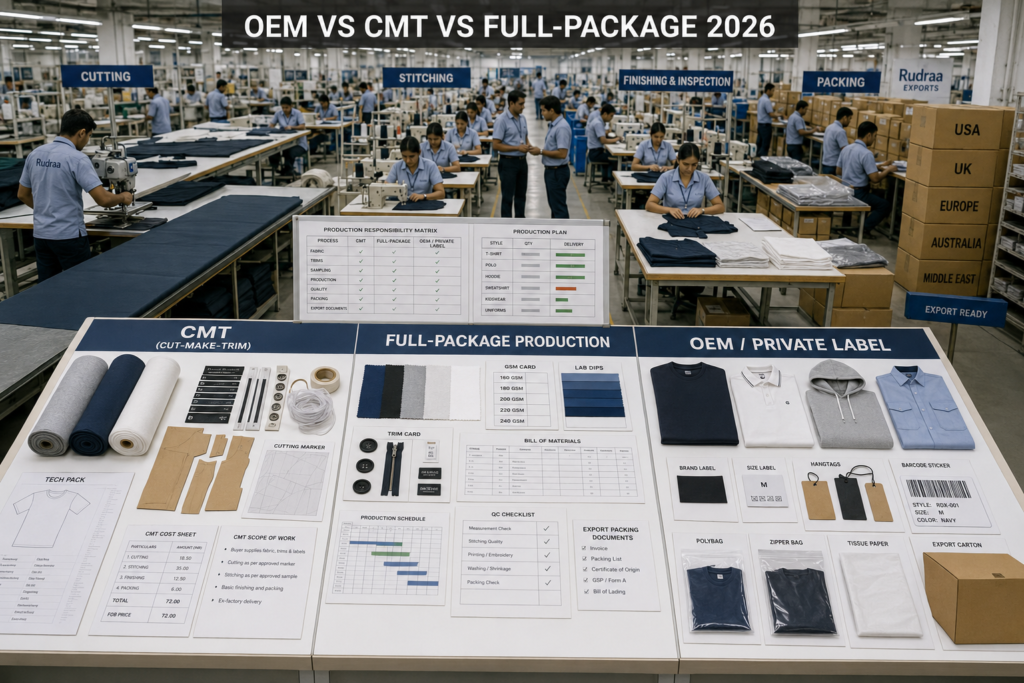
Most apparel sourcing problems do not happen because a factory cannot stitch garments.
They happen because the buyer and factory are not clear about the manufacturing model.
Before asking for a quote, buyers must understand one important question:
What exactly are you asking the manufacturer to do?
Are you asking the factory only to cut and stitch?
Are you asking the factory to source fabric and trims also?
Are you choosing an existing garment base and branding it under your label?
Are you expecting the factory to manage sampling, production, quality control, packing, and export documentation?
These are different models.
The three common apparel manufacturing models are:
- CMT — Cut, Make, Trim
- Full-Package Production — also called FPP
- OEM / Private Label Manufacturing
Each model has a different cost structure, responsibility level, lead time, risk, and control level.
At Rudraa Exports, we help global buyers choose the right manufacturing model for T-shirts, polos, hoodies, sweatshirts, joggers, leggings, kidswear, babywear, uniforms, corporate apparel, and private-label knitwear from Tirupur, India.
Quick Answer
CMT is best when the buyer already controls fabric, trims, patterns, and technical details, and only needs the factory to cut, stitch, and finish garments. Full-package production is best when the buyer wants the factory to handle fabric sourcing, trims, sampling, production, packing, and export support. OEM or private label is best when the buyer wants to use proven product styles, customise branding, and launch faster with less development work. Startups usually benefit from full-package production, while experienced buyers may use CMT or hybrid models to improve margin and control.
Planning to choose the right manufacturing model for your apparel order? Contact Rudraa Exports to request a CMT vs Full-Package vs OEM quote comparison.
Why Apparel Manufacturing Models Matter
Many buyers ask factories for prices without explaining the model.
This creates confusion.
One factory may quote only stitching cost. Another may include fabric, trims, labels, packing, testing, and export handling. A third may quote a private-label ready style.
These quotes cannot be compared directly.
Example
| Quote Type | What It May Include |
|---|---|
| CMT quote | Only cutting, sewing, trimming, and finishing |
| Full-package quote | Fabric, trims, sampling, production, packing, export support |
| OEM quote | Existing product base customised with buyer branding |
A low CMT quote may look cheaper, but if you add fabric, trims, inbound logistics, testing, and coordination, the total cost may become higher than a full-package quote.
The uploaded source explains that sourcing challenges often come from misaligned engagement models, not factory capability.
What Is CMT in Garment Manufacturing?
CMT means Cut, Make, Trim.
In this model, the buyer usually provides:
- Fabric
- Trims
- Labels
- Tech pack
- Patterns
- Artwork
- Measurement specs
- Packing instructions
The factory mainly handles:
- Cutting
- Sewing
- Trimming
- Finishing
- Basic quality checking
- Packing if agreed
CMT Is Best For
- Experienced brands
- Buyers with their own fabric suppliers
- Buyers with strong tech packs
- Buyers who control trims and labels
- Brands with technical teams
- Repeat styles with stable specs
- Special fabric programs
CMT Advantages
| Advantage | Why It Helps |
| More material control | Buyer chooses fabric and trims |
| Better cost visibility | Sewing cost can be separated |
| Useful for nominated suppliers | Buyer can use preferred mills |
| Good for repeat styles | Stable products become easier |
| Strong for technical buyers | More control over every input |
CMT Disadvantages
| Disadvantage | Risk |
| Buyer manages more work | More coordination needed |
| Fabric delay risk | Production can stop |
| Shade mismatch risk | Buyer must control lots |
| More supplier management | More emails and follow-up |
| Hidden logistics cost | Fabric and trims must reach factory |
| More technical responsibility | Buyer must know what to approve |
CMT can save money only if the buyer has the systems to manage it.
What Is Full-Package Apparel Production?
Full-package production means the factory manages more of the production process.
It is also called FPP, or Full-Package Production.
In this model, the factory may support:
- Fabric sourcing
- Trim sourcing
- Sampling
- Lab dips
- Print strike-offs
- Embroidery samples
- Pattern support
- Production planning
- Cutting and stitching
- Finishing
- Quality inspection
- Packing
- Export documentation support
- Freight coordination support where applicable
Full-Package Is Best For
- Startups
- DTC brands
- International buyers
- Private-label buyers
- Corporate apparel buyers
- Brands without fabric suppliers
- Buyers who want one accountable partner
- Buyers who want simpler production management
Full-Package Advantages
| Advantage | Why It Helps |
| One responsible partner | Less coordination for buyer |
| Easier for beginners | Factory guides sourcing and production |
| Faster decision-making | Fabric, trims, sampling, and production are coordinated |
| Better accountability | Factory owns more of the process |
| Cleaner project management | Fewer supplier handoffs |
| Export support | Better for overseas buyers |
Full-Package Disadvantages
| Disadvantage | Risk |
| Higher quoted price | Factory includes sourcing and coordination |
| Less direct material control | Buyer must approve factory-sourced options |
| Possible markup | Need transparent cost breakdown |
| Requires trust | Factory choices affect final product |
| Needs clear approvals | Buyer must approve fabric, trims, and samples |
Full-package production may look more expensive upfront, but it often reduces hidden coordination risk.
What Is OEM / Private Label Apparel Manufacturing?
OEM means Original Equipment Manufacturer.
In apparel, OEM often overlaps with private-label manufacturing.
This means the factory produces garments for your brand, often using existing product bases, proven patterns, standard fits, or ready styles that can be customised with your label, colours, trims, print, embroidery, or packaging.
OEM Is Best For
- Private-label brands
- Corporate apparel buyers
- Promotional apparel buyers
- Scaling brands
- Faster product launches
- Reorder programs
- Proven basic styles
- Brands that do not need fully custom patterns
OEM Advantages
| Advantage | Why It Helps |
| Faster launch | Existing patterns reduce development time |
| Lower development risk | Proven styles already work |
| Good for reorders | Repeatable production |
| Easier for corporate apparel | Standard products can be branded |
| Better for basics | T-shirts, polos, hoodies, uniforms |
| Good for scaling | Repeat programs become smoother |
OEM Disadvantages
| Disadvantage | Risk |
| Less uniqueness | Other brands may use similar base styles |
| Limited customisation | Not every detail can be changed |
| Fit may be standard | Not fully proprietary |
| Branding must be clear | Labels, trims, and packaging matter more |
OEM is a strong model when speed, repeatability, and branded execution matter more than full custom development.
CMT vs Full-Package vs OEM: Comparison Table
| Criteria | CMT | Full-Package | OEM / Private Label |
| Buyer provides fabric | Yes | Usually no | Usually no |
| Buyer provides trims | Yes | Usually no | Sometimes |
| Factory sources inputs | No or limited | Yes | Yes, usually from existing options |
| Buyer control | Highest | Medium | Medium to low |
| Buyer workload | Highest | Medium to low | Low |
| Factory responsibility | Lower | Higher | Medium to high |
| Best for | Experienced buyers | Startups and scaling brands | Fast private-label programs |
| Cost visibility | High | Medium | Medium |
| Upfront quote | Lower | Higher | Depends on customisation |
| Hidden risk | High if buyer is not experienced | Lower | Lower for standard products |
| Development time | Medium to long | Medium | Faster if style exists |
| Best products | Custom programs | Full development programs | Basics, uniforms, repeat styles |
Which Model Is Cheapest?
CMT often looks cheapest because the factory is quoting only cutting, stitching, and finishing.
But CMT is not always the cheapest total model.
CMT Hidden Costs
- Fabric sourcing
- Trim sourcing
- Pattern making
- Inbound shipping to factory
- Fabric inspection
- Lab testing
- Shade control
- Shrinkage testing
- Supplier coordination
- Extra handling
- Delays from missing materials
Full-Package Hidden Savings
Full-package may reduce:
- Coordination time
- Fabric sourcing mistakes
- Trim delays
- Supplier confusion
- Production stoppage
- Development errors
- Responsibility gaps
Buyer Rule
Compare total cost, not only stitching cost.
A CMT price is not the same as a full-package FOB price.
Which Model Gives the Most Control?
CMT gives the most control because the buyer chooses and manages most materials.
But control also means responsibility.
Control Comparison
| Control Area | Best Model |
| Fabric choice | CMT |
| Trim choice | CMT |
| Cost breakdown | CMT |
| Full process management | Full-Package |
| Fast launch | OEM |
| Custom fit development | CMT / Full-Package |
| Branded basics | OEM |
| Beginner simplicity | Full-Package |
| Repeat uniform programs | OEM / Full-Package |
If your team has fabric knowledge, CMT can work well. If not, full-package is safer.
Which Model Is Best for Startups?
For most startup clothing brands, full-package production is usually the safest model.
Startups often do not have:
- Fabric suppliers
- Trim suppliers
- Pattern makers
- Production managers
- Quality control teams
- Logistics support
- Export documentation knowledge
Full-package production gives the buyer one main partner who can guide the process.
Startup Recommendation
| Startup Situation | Recommended Model |
| No manufacturing experience | Full-Package |
| Need fast branded basics | OEM |
| Have strong technical designer | CMT or Full-Package |
| Testing T-shirts or polos | OEM / Full-Package |
| Building premium custom style | Full-Package |
| Already own fabric | CMT |
The uploaded source recommends full-package as a safer default for startups because one partner manages sourcing and production orchestration.
Which Model Is Best for Scaling Brands?
Scaling brands may use more than one model.
For example:
- Use OEM for repeat basics
- Use Full-Package for seasonal styles
- Use CMT for special fabric programs
Scaling Brand Strategy
| Product Type | Best Model |
| Core T-shirt repeat | OEM or CMT |
| Seasonal hoodie | Full-Package |
| Corporate polo | OEM / Full-Package |
| Custom fabric capsule | CMT |
| New product development | Full-Package |
| Large repeat program | CMT or OEM |
As the brand grows, it can move some styles from full-package to CMT if the internal sourcing team becomes stronger.
Which Model Is Best for Corporate Apparel?
Corporate apparel buyers usually need consistency, repeatability, and easy reordering.
OEM and full-package are often best.
Corporate Apparel Examples
| Product | Best Model |
| Corporate T-shirts | OEM / Full-Package |
| Polo shirts | OEM / Full-Package |
| Uniform hoodies | OEM / Full-Package |
| Event T-shirts | OEM |
| Staff uniforms | Full-Package |
| Safety-related garments | Full-Package with compliance checks |
Corporate buyers usually want branded execution, predictable quality, and simple reorder handling. They may not want to manage fabric and trims separately.
Responsibility Matrix: The Most Important Tool
Before approving any quote, create a responsibility matrix.
This shows who owns each task.
Responsibility Matrix Example
| Task | CMT | Full-Package | OEM |
| Fabric sourcing | Buyer | Factory | Factory |
| Trim sourcing | Buyer | Factory | Factory |
| Pattern | Buyer / factory | Factory / buyer approval | Factory base pattern |
| Tech pack | Buyer | Buyer / factory support | Buyer specs / factory template |
| Lab dips | Buyer / supplier | Factory | Factory if colour custom |
| Sampling | Factory | Factory | Factory |
| Fabric testing | Buyer | Factory / buyer approval | Factory / buyer approval |
| Production | Factory | Factory | Factory |
| QC | Buyer / factory | Factory / buyer | Factory / buyer |
| Packing | Buyer spec | Factory | Factory |
| Export docs | Buyer / factory | Factory support | Factory support |
If something is not assigned, it will become a problem later.
How to Request Quotes Correctly
Do not send one vague RFQ.
Ask for quotes based on the model you need.
CMT Quote Request
Ask:
“Please quote CMT only. Buyer will provide fabric, trims, labels, tech pack, and patterns. Factory to quote cutting, stitching, finishing, packing labour, thread if included, and inspection.”
Full-Package Quote Request
Ask:
“Please quote full-package FOB. Factory to source fabric, trims, labels, sampling, production, finishing, quality inspection, export packing, and documentation support.”
OEM Quote Request
Ask:
“Please share OEM/private-label options for this product type. We want to customise with brand label, colour, print/embroidery, packaging, and size range.”
Quote Comparison Checklist
| Item | Confirm |
| Manufacturing model | CMT / Full-Package / OEM |
| Incoterm | EXW / FOB / CIF / DDP |
| Fabric included? | Yes / No |
| Trims included? | Yes / No |
| Labels included? | Yes / No |
| Packaging included? | Yes / No |
| Sampling included? | Yes / No |
| Testing included? | Yes / No |
| Inspection included? | Yes / No |
| Export documents included? | Yes / No |
| Courier included? | Yes / No |
How to Negotiate CMT Pricing
CMT pricing depends on time, complexity, and factory efficiency.
Factories often calculate using:
- SAM / SMV
- Operation breakdown
- Line efficiency
- Labour cost
- Overhead
- Finishing time
- Packing time
CMT Negotiation Questions
Ask the factory:
- What operations are included?
- Is thread included?
- Is cutting included?
- Is finishing included?
- Is pressing included?
- Is polybag packing included?
- Is carton packing included?
- What SAM or time estimate did you use?
- What quantity did you assume?
- What happens if fabric arrives late?
Do not negotiate only by saying “reduce price.” Understand the cost basis.
How to Negotiate Full-Package Pricing
Full-package pricing should be broken into major components.
Ask for Cost Breakdown
| Cost Component | Ask For |
| Fabric | Per kg / metre / garment |
| Trims | Labels, buttons, zips, cords |
| Printing | Per placement |
| Embroidery | Per stitch count / placement |
| Washing | If applicable |
| CM | Cutting and stitching |
| Packing | Polybag, hangtag, carton |
| Testing | Lab testing or inspection |
| Export handling | Documentation and packing support |
This helps you compare suppliers fairly.
How to Use a Hybrid Model
Many brands do not use only one model.
They use a hybrid approach.
Hybrid Examples
| Situation | Model |
| Buyer provides special fabric, factory handles stitching | CMT |
| Factory sources fabric, buyer provides trims | Hybrid |
| Factory provides base style, buyer adds branding | OEM |
| Factory handles full seasonal development | Full-Package |
| Buyer moves repeat style to CMT after first season | Full-Package to CMT |
Hybrid models work well when both buyer and factory clearly define responsibilities.
Common Mistakes Buyers Make
| Mistake | Result |
| Comparing CMT quote with full-package quote | Wrong cost decision |
| Assuming factory sources everything | Delays and disputes |
| Assuming CMT includes fabric | Misunderstanding |
| Not defining Incoterm | Freight confusion |
| Not confirming sample cost | Surprise invoice |
| Not assigning fabric responsibility | Production delay |
| Not checking trims inclusion | Missing labels or accessories |
| Not defining QC responsibility | Quality disputes |
| Not confirming export docs | Shipment delay |
| Choosing cheapest quote only | Hidden cost later |
Why Rudraa Exports
Rudraa Exports supports global buyers with flexible apparel manufacturing models from Tirupur, India.
Supported Models
- CMT garment manufacturing
- Full-package apparel production
- OEM / private-label knitwear manufacturing
- Hybrid production models
Manufacturing Capabilities
- Factory-direct Tirupur knitwear manufacturing
- 72,000+ units per month production capacity
- T-shirts, polos, sweatshirts, hoodies, joggers, leggings, kidswear, babywear, uniforms, activewear, corporate apparel, and private-label knitwear
- MOQ discussions starting from around 300 pieces for suitable programs
- Sampling support for startup and scaling brands
- Bulk production planning for repeat programs
Buyer Support
- Model selection guidance
- CMT vs Full-Package quote comparison
- OEM product development support
- Fabric and GSM guidance
- Tech pack review
- Sampling and PP approval support
- AQL 2.5 inspection standards
- Export packing and documentation support
- Multi-port shipping through Chennai, Tuticorin, and Cochin
Buyer Advantages
- Factory-direct pricing without trading-company markups
- Up to 40% cost-saving positioning compared with indirect sourcing models
- Better transparency on responsibility and cost
- Export support for USA, UK, Europe, Australia, Middle East, and global buyers
- Clearer communication from sampling to shipment
Ready to choose the right apparel manufacturing model? Speak with Rudraa Exports to request CMT, Full-Package, OEM, or hybrid quote options for your product.
Buyer Checklist: Choosing OEM vs CMT vs Full-Package
| # | Checklist Item |
| 1 | Define your product category |
| 2 | Confirm whether you own fabric sourcing |
| 3 | Confirm whether you own trim sourcing |
| 4 | Check if your tech pack is complete |
| 5 | Decide how much control you need |
| 6 | Decide how much work your team can manage |
| 7 | Choose CMT, Full-Package, OEM, or hybrid |
| 8 | Ask for quote based on one clear model |
| 9 | Confirm what is included and excluded |
| 10 | Build a responsibility matrix |
| 11 | Confirm sample cost and lead time |
| 12 | Confirm MOQ |
| 13 | Confirm Incoterm |
| 14 | Confirm QC responsibility |
| 15 | Confirm export documentation support |
| 16 | Compare total cost, not only unit quote |
| 17 | Run sample approval before bulk |
| 18 | Use PP sample as golden reference |
| 19 | Track changes in writing |
| 20 | Review model again after scaling |
FAQ: OEM vs CMT vs Full-Package Apparel Manufacturing
1. What is CMT in apparel manufacturing?
CMT means Cut, Make, Trim. The buyer usually provides fabric, trims, labels, patterns, and tech pack, while the factory cuts, stitches, finishes, and packs the garment.
2. What is full-package apparel production?
Full-package production means the factory supports more of the process, including sourcing fabric and trims, sampling, production, finishing, quality control, packing, and export support.
3. What is OEM clothing manufacturing?
OEM clothing manufacturing means the factory produces garments for your brand, often using proven styles, base patterns, or private-label options that can be customised with your branding.
4. Is CMT cheaper than full-package?
CMT may look cheaper because it usually covers only cutting and stitching. But total cost can increase if the buyer must manage fabric, trims, testing, logistics, and delays.
5. Which model is best for startups?
Full-package production is usually best for startups because the factory manages more of the sourcing and production process.
6. Which model is best for experienced brands?
Experienced brands may use CMT if they already manage fabric, trims, patterns, testing, and production coordination.
7. Which model is best for corporate apparel?
OEM or full-package production is usually best for corporate apparel because buyers need repeatable products, branding, packing, and easy reordering.
8. Can one factory offer all three models?
Yes. Many manufacturers can offer CMT, full-package, OEM, and hybrid production depending on the buyer’s requirements.
9. What is the biggest mistake when comparing quotes?
The biggest mistake is comparing a CMT quote with a full-package quote without checking what is included.
10. What should I ask before approving a quote?
Ask what is included, what is excluded, who sources fabric, who sources trims, who pays for samples, who handles QC, what Incoterm applies, and who manages export documentation.
11. Can Rudraa Exports support CMT and full-package production?
Yes. Rudraa supports CMT, full-package, OEM, and hybrid apparel manufacturing models from Tirupur, India.
12. Which model gives the most control?
CMT gives the most material control, but it also gives the buyer more responsibility. Full-package gives less direct control but more operational simplicity.
Conclusion
CMT, full-package, and OEM are not just factory terms. They are different sourcing strategies.
CMT gives the buyer more control but also more responsibility. Full-package gives the buyer a simpler, more accountable production process. OEM helps buyers launch faster using proven styles and private-label execution.
The right model depends on your team, product, budget, timeline, technical ability, and sourcing experience.
If you are a startup or international buyer, full-package production is often the safest starting point. If you are an experienced buyer with fabric and trim control, CMT can improve margin. If you need branded basics, corporate apparel, or repeatable private-label products, OEM can be the fastest path.
The most important step is clarity. Before requesting a quote, define the manufacturing model, responsibilities, Incoterm, sample process, QC plan, and export scope.
Visit rudraaexports.com or contact our team directly to share your product type, tech pack, MOQ, destination market, and preferred manufacturing model — and receive a factory-direct CMT, Full-Package, OEM, or hybrid production plan from Rudraa Exports.
Related reading
OEM vs ODM Garment Manufacturing: A Decision Framework for Apparel Brands Sourcing from India
How to Find Reliable OEM Clothing Manufacturers: A Buyer’s Vetting Guide
B2B vs D2C Garment Manufacturing in 2026: Which Model Works Better?