
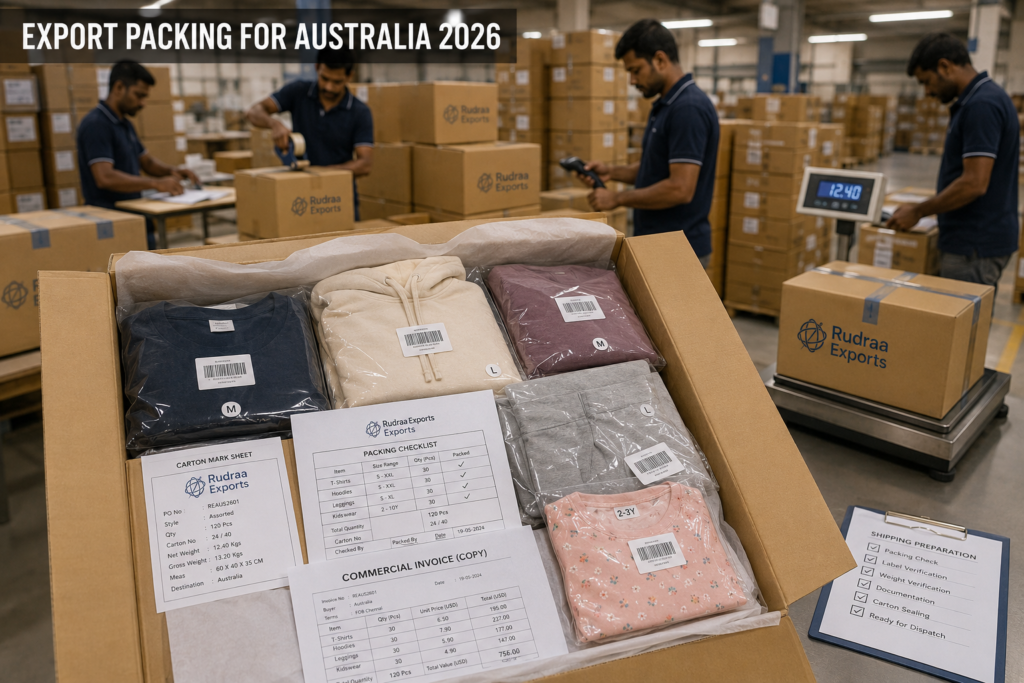
Importing garments from India to Australia can be simple when the documents are correct.
But it can become expensive when customs, duty, GST, labelling, packing declarations, biosecurity, or origin proof are handled late.
For Australian fashion brands, importing apparel is not only a freight task. It is a compliance workflow.
Before shipment, buyers must confirm the HS code, commercial invoice, packing list, country of origin, care labels, ECTA eligibility, GST impact, packing materials, and broker-ready documents.
A small error in fibre content, tariff classification, invoice description, packing declaration, or origin claim can delay customs clearance, increase landed cost, or create relabelling work after arrival.
At Rudraa Exports, we help Australian buyers source and import garments from Tirupur, India, with factory-direct production, compliant labelling support, export packing, commercial invoices, packing lists, HS code coordination, origin documentation support, and pre-shipment document readiness.
Quick Answer
To import garments from India to Australia, buyers should confirm the correct HS code, check ECTA preferential duty eligibility, prepare a commercial invoice and packing list, approve care and country-of-origin labels, arrange a packing declaration, share shipment documents with a customs broker, budget for GST, and ensure packaging meets biosecurity requirements. A factory like Rudraa Exports can support Australian buyers by preparing export documents, label approvals, carton packing details, origin documentation, and broker-ready shipment files.
Planning to import garments from India to Australia? Contact Rudraa Exports to request an Australia-ready garment export documentation plan.
Why Import Compliance Matters
A garment order is not complete when production finishes.
It must clear customs.
Australian import clearance depends on documents, product description, tariff classification, valuation, country of origin, packing details, and biosecurity compliance.
The uploaded source explains that importing apparel into Australia should be treated as a compliance project, not only a freight task, because ABF and DAFF can check classification, valuation, origin claims, packaging, and biosecurity declarations.
Key Authorities Involved
| Authority | Role |
|---|---|
| ABF | Australian Border Force handles customs, import declarations, classification and border controls |
| DAFF | Department of Agriculture, Fisheries and Forestry manages biosecurity requirements |
| ATO | Australian Taxation Office handles GST and Deferred GST Scheme matters |
| Customs broker | Lodges import declarations and supports clearance |
| Exporter | Provides invoice, packing list, origin and packing documents |
What Australian Buyers Must Prepare
Before importing garments from India, buyers should prepare a clean document and compliance pack.
Core Import Requirements
| Requirement | Why It Matters |
|---|---|
| HS code | Determines duty and classification |
| Commercial invoice | Supports customs value |
| Packing list | Confirms carton, weight, SKU and quantity details |
| ECTA origin proof | Supports preferential duty claim if eligible |
| GST calculation | Affects landed cost and cash flow |
| Care label | Required for retail-ready apparel |
| Country of origin label | Must match origin evidence |
| Packing declaration | Helps DAFF assess packaging and biosecurity risk |
| Bill of lading / airway bill | Transport document |
| Import declaration | Usually lodged by broker through ABF systems |
The uploaded source highlights HS classification, ECTA preferential claims, GST, import declaration, care labelling, country-of-origin labelling, biosecurity, and community-protection screening as the main control points.
Step-by-Step: Import Garments from India to Australia
Step 1: Confirm Product Details
Before documents are prepared, confirm:
- Product type
- Fibre content
- Knit or woven construction
- Gender or age category
- Quantity
- FOB value
- Packing method
- Country of origin
- Destination port or airport
These details affect classification, labels, invoice descriptions, and customs clearance.
Step 2: Confirm HS Code
HS code classification depends on garment type, fabric, fibre content, knit or woven construction, and end use.
Common Garment HS Areas
| Product | Common HS Heading Area |
|---|---|
| T-shirts | 6109 |
| Activewear / tracksuits | 6112 |
| Sweaters / sweatshirts | 6110 |
| Women’s woven garments | 6204 |
| Men’s woven garments | 6203 |
| Baby garments | 6111 or 6209 depending on construction |
| Hosiery / socks | 6115 |
Buyer Tip
Do not guess HS code only from product name.
A cotton knitted T-shirt and a woven shirt are classified differently.
Step 3: Check ECTA Duty Eligibility
ECTA means Australia–India Economic Cooperation and Trade Agreement.
Eligible Indian goods may receive preferential duty treatment if rules of origin are met and documents are correct.
ECTA Requirements to Check
| Requirement | What to Confirm |
|---|---|
| Product eligibility | Check tariff line treatment |
| Rules of origin | Product must meet origin rules |
| Origin document | Certificate of Origin or origin declaration where applicable |
| Supporting evidence | Fabric, processing and production records |
| Consistency | Invoice, packing list and origin details must match |
The uploaded source explains that ECTA can create duty-saving opportunities for eligible garments, but preference depends on rules of origin being met and evidenced correctly.
Step 4: Prepare Commercial Invoice
The commercial invoice must match the goods.
Commercial Invoice Should Include
| Field | Details |
|---|---|
| Exporter | Rudraa Exports / supplier details |
| Buyer | Australian importer details |
| Invoice number | Unique invoice reference |
| Date | Invoice date |
| Product description | Clear garment description |
| Fibre content | Example: 100% cotton |
| HS code | Broker-reviewed classification |
| Quantity | Pieces by style |
| Unit price | FOB or agreed Incoterm |
| Total value | Shipment value |
| Currency | AUD / USD / INR as agreed |
| Incoterm | FOB, CIF, FCA, etc. |
| Country of origin | India |
| Packing reference | Carton / packing list link |
Buyer Tip
Invoice description should not be vague.
Avoid descriptions like “garments” only. Use clear descriptions such as “men’s knitted cotton T-shirts” or “women’s polyester-spandex leggings.”
Step 5: Prepare Packing List
The packing list helps customs, freight forwarders, warehouses, and buyers identify what is inside the shipment.
Packing List Should Include
- Carton number
- Style number
- Product description
- Colour
- Size
- Quantity per carton
- Total cartons
- Net weight
- Gross weight
- Carton dimensions
- Total pieces
- Shipping marks
A good packing list reduces warehouse confusion and customs queries.
Step 6: Confirm Care Labels and Country-of-Origin Labels
Australian buyers should approve labels before bulk production.
Garment Labels to Confirm
| Label Type | What to Include |
|---|---|
| Care label | Washing, drying, ironing and care instructions |
| Fibre label | Accurate fabric composition |
| Size label | Size shown correctly |
| Country of origin | Made in India, where accurate |
| Brand label | Buyer’s brand label |
| Barcode label | Retail or warehouse requirement |
The uploaded source notes that care labelling and country-of-origin labelling should be approved and applied at source to avoid relabelling delays in Australia.
Step 7: Prepare Packing Declaration
DAFF may assess packaging and biosecurity risk.
A packing declaration confirms the type of packaging used and whether wood, straw, plant material, or other risk materials are present.
Packing Declaration Should Confirm
| Area | What to State |
|---|---|
| Packing material | Cartons, polybags, pallets if used |
| Wood packaging | Whether present or not |
| Straw / plant material | Whether present or not |
| Cleanliness | Goods and packaging free from contamination |
| Treatment certificate | If required for regulated materials |
| Container cleanliness | Where applicable |
The uploaded source explains that DAFF biosecurity requirements can delay or stop cargo if packaging declarations or treatment evidence are incomplete.
Step 8: Budget for Duty and GST
Australian import cost is not only FOB price.
Landed Cost Components
| Cost | What It Means |
|---|---|
| FOB value | Goods value from India |
| Freight | Sea or air freight cost |
| Insurance | If applicable |
| Duty | Depends on HS code and ECTA eligibility |
| GST | 10% on taxable importation value |
| Broker fee | Customs clearance service |
| Port / terminal charges | Depends on mode and port |
| Local delivery | From port to warehouse |
| Inspection / treatment | If customs or biosecurity selects shipment |
The uploaded source explains that GST is 10% and that duty depends on tariff classification and whether ECTA preference is accepted.
Simple GST and Duty Example
Assume:
- FOB garment value: AUD 20,000
- Freight and insurance: AUD 2,000
- CIF value: AUD 22,000
- General duty example: 5%
- Duty: AUD 1,100
- GST: 10% of taxable importation value
Simplified GST example:
AUD 22,000 + AUD 1,100 = AUD 23,100
10% GST = AUD 2,310
If ECTA preferential duty is accepted and duty becomes lower or nil, the landed cost can improve.
Buyer Tip
Use a customs broker to calculate duty and GST before placing the order.
Step 9: Send Pre-Alert Documents to Broker
Do not wait until goods arrive.
Send documents before the vessel or flight reaches Australia.
Broker Pre-Alert Pack
| Document | Purpose |
|---|---|
| Commercial invoice | Customs value and classification |
| Packing list | Carton and SKU details |
| Bill of lading / airway bill | Shipment reference |
| Packing declaration | Biosecurity support |
| Certificate of Origin | ECTA claim support if applicable |
| Origin evidence | Supports preferential claim |
| Product spec sheet | Helps classification |
| Freight invoice | Supports landed cost |
| Insurance document | If applicable |
The uploaded source recommends sending a pre-alert document pack to the broker before arrival so the import declaration can be prepared and risks can be reviewed early.
Step 10: Plan for ABF and DAFF Review
ABF or DAFF may ask questions or inspect the shipment.
Possible Queries
| Query Type | What They May Ask |
|---|---|
| Classification | Why this HS code? |
| Origin | How is India origin proven? |
| Valuation | Is invoice value accurate? |
| Packaging | What materials were used? |
| Biosecurity | Is treatment needed? |
| Community protection | Are there risk materials or supply-chain concerns? |
| Labelling | Are goods correctly labelled? |
A well-prepared document pack helps answer these quickly.
Importing Pathways: Which Model Fits You?
Model A: Direct Import from Indian Factory
You buy directly from the Indian factory, and your Australian business acts as importer of record.
Best for:
- Better cost transparency
- Better document control
- Repeat programs
- ECTA preference planning
- Source labelling control
- Factory-direct production visibility
Model B: Agent or Buying Office
An agent helps coordinate supplier, documents, and shipment.
Best for:
- Buyers who need handholding
- Multi-factory programs
- Complex sourcing networks
- Buyers without internal sourcing capacity
Model C: Delivered / Landed Supply
Supplier or local importer delivers goods domestically in Australia.
Best for:
- Buyers who want minimal import administration
- Buyers willing to accept less visibility
- Small brands avoiding broker handling
The uploaded source compares direct import, agent/buying office model, and delivered/landed supply, explaining that each model has different levels of control, cost visibility, and documentation responsibility.
When Importing from India to Australia Is a Good Fit
Importing garments from India is a strong option when you have:
- Clear product specs
- Stable product categories
- Repeat-order potential
- Proper tech packs
- Approved labels
- Broker support
- GST planning
- ECTA document planning
- Clean packing and biosecurity process
Strong-Fit Product Categories
| Product | Why It Works |
|---|---|
| T-shirts | Repeatable and easy to classify |
| Polo shirts | Good for corporate and retail |
| Hoodies | Strong knitwear category |
| Sweatshirts | Suitable for repeat programs |
| Joggers | Knit casualwear and athleisure |
| Leggings | Activewear and women’s basics |
| Kidswear | Needs safety and label control |
| Uniforms | Repeat orders and clear specs |
| Nightwear | Soft knitwear and loungewear |
| Activewear | Growing category with clear specs |
When to Pause or Restructure
Be careful if:
- Product details change after invoice draft
- Fibre content is unclear
- HS code is not broker-reviewed
- Origin proof is weak
- Packaging material is not documented
- Labels are not approved
- GST cash flow is not planned
- The supplier cannot provide clean documents
The uploaded source warns that importing from India may not be a good fit if product descriptions change late, origin evidence is weak, mixed-source materials lack traceability, or GST cash flow is not ready.
India to Australia Import Checklist
| # | Checklist Item |
|---|---|
| 1 | Confirm product description |
| 2 | Confirm fibre content |
| 3 | Confirm knit or woven construction |
| 4 | Confirm HS code with broker |
| 5 | Check ECTA eligibility |
| 6 | Prepare origin document |
| 7 | Prepare commercial invoice |
| 8 | Prepare packing list |
| 9 | Approve care label |
| 10 | Approve country-of-origin label |
| 11 | Prepare packing declaration |
| 12 | Confirm packaging material |
| 13 | Confirm freight mode |
| 14 | Confirm Incoterm |
| 15 | Budget duty |
| 16 | Budget GST |
| 17 | Send pre-alert to broker |
| 18 | Prepare DAFF documents if needed |
| 19 | Track arrival and clearance |
| 20 | Review landed cost after delivery |
How Rudraa Exports Supports Australia Import Documentation
Rudraa Exports supports Australian buyers with export documentation and shipment preparation from India.
Documentation Support
- Commercial invoice
- Packing list
- Carton details
- Shipping marks
- HS code coordination for broker review
- Certificate of Origin support where applicable
- ECTA origin document coordination
- Packing declaration support
- Bill of lading instruction support
- Export packing details
- Label approval support
- Traceability support
Production and Export Support
- Tech pack review
- Fabric and GSM guidance
- Sampling support
- Lab dip coordination
- PP sample approval
- AQL 2.5 inspection standards
- Export carton packing
- Multi-port shipping through Chennai, Tuticorin, and Cochin
- Export support for Australia, USA, UK, Europe, Middle East, and global buyers
Why Rudraa Exports
Rudraa Exports helps Australian fashion brands and importers manufacture and export garments from Tirupur, India, with a documentation-first workflow.
Product Categories Supported
- T-shirts
- Polo shirts
- Hoodies
- Sweatshirts
- Joggers
- Leggings
- Kidswear
- Babywear
- Nightwear
- Uniforms
- Corporate apparel
- Activewear
- Private-label knitwear
Buyer Advantages
- Factory-direct Tirupur knitwear manufacturing
- 72,000+ units per month production capacity
- MOQ discussions starting from around 300 pieces for suitable programs
- Export-ready packing and documentation
- Better coordination with Australian customs broker requirements
- Factory-applied care and country-of-origin labels
- ECTA origin support where eligible
- Clean invoice and packing list preparation
- Reduced risk of relabelling and clearance delays
- Factory-direct pricing without trading-company markups
- Up to 40% cost-saving positioning compared with indirect sourcing models
Ready to import garments from India to Australia? Speak with Rudraa Exports to share your tech pack, target MOQ, HS code if available, destination port, label requirements, and shipment timeline.
FAQ: Importing Garments from India to Australia
1. Can I import garments from India to Australia?
Yes. Australian businesses can import garments from India if commercial documents, customs declarations, labels, packing declarations, and biosecurity requirements are handled correctly.
2. Do I need a customs broker to import garments into Australia?
For commercial shipments, using a licensed customs broker is strongly recommended because classification, duty, GST, ECTA claims, and import declarations can be complex.
3. What documents are needed to import garments from India to Australia?
Common documents include commercial invoice, packing list, bill of lading or airway bill, packing declaration, Certificate of Origin if applicable, and any required treatment or biosecurity documents.
4. What is ECTA?
ECTA is the Australia–India Economic Cooperation and Trade Agreement. It may allow eligible Indian goods to receive preferential duty treatment if rules of origin are met.
5. Are garments from India duty-free under ECTA?
Not automatically. Duty depends on the exact HS code, tariff schedule, and whether the product meets ECTA rules of origin with proper documents.
6. Is GST payable when importing garments into Australia?
Yes. GST is generally 10% on the taxable importation value. Importers should plan GST cash flow before shipment.
7. What is an HS code?
An HS code is a customs classification code used to identify goods. It affects duty rate, statistics, and customs treatment.
8. What labels are needed for garments sold in Australia?
Garments usually need accurate fibre content, care instructions, size label, brand label, and country-of-origin information where applicable.
9. What is a packing declaration?
A packing declaration states what materials are used in packaging and whether wood, straw, plant material, or other biosecurity-risk materials are present.
10. Can DAFF inspect garment shipments?
Yes. DAFF may inspect shipments if packaging, contamination, treatment, or biosecurity risk is flagged.
11. Can Rudraa Exports help with Australia import documents?
Yes. Rudraa can support commercial invoices, packing lists, label approval, packing declarations, Certificate of Origin coordination, shipment details, and export-ready documentation.
12. What should I send Rudraa Exports before importing?
Send your product type, tech pack, quantity, fibre content, destination port, label requirements, packing requirements, buyer details, broker details if available, and target shipment date.
Conclusion
Importing garments from India to Australia is manageable when the process is planned correctly.
The biggest risks are not only freight delays. They are document mismatches, wrong HS codes, weak origin proof, missing packing declarations, unclear labels, GST surprises, and biosecurity holds.
Australian brands can reduce these risks by planning import compliance before shipment, not after goods are packed.
A clean import workflow should include broker-reviewed HS codes, ECTA origin checks, approved care labels, country-of-origin labels, commercial invoice, packing list, packing declaration, freight details, GST planning, and a pre-alert document pack.
Rudraa Exports helps Australian buyers manufacture and export garments from Tirupur, India, with a documentation-first approach covering production, labels, packing, QC, and export documents.
Visit rudraaexports.com or contact our team directly to share your garment import requirement, destination in Australia, label needs, MOQ, and shipment timeline — and receive an Australia-ready garment export plan from Rudraa Exports.
Related reading
How to Import Garments from India to Australia: Duties, GST and Customs Guide 2026
How to Forecast Garment Landed Costs from India to Australia